Hamlet, Ophelia – Part One, Edinburgh Festival Fringe

rsz_121

What would Hamlet have been like as a child? Ophelia? Were they close? Did they squabble or were they the best of friends? Shakespearian Lovers, a new female-led company from Italy, attempt to answer these questions in Hamlet, Ophelia – Part One. In this version Hamlet is played by a woman, bringing a quiet, feminine sensitivity to the role considered one of Shakespeare’s greatest. Despite performing in their second language, the two women have a sound connection with the contemporary English text that shows the two grow from playful children to adults at Gertrude’s wedding to her second husband. There are some major issues with staging and the ending needs work, but this gentle, little play stays true to Hamlet’s personality as reflected in Shakespeare’s text and has the strong foundations of a good script.

Of the two performers, the perky Ophelia is the stronger. She has a natural curiosity and handles the English script comfortably. Hamlet is much more reserved and often too quiet to easily hear, but she has an intellectual intensity that suits the character. Though Hamlet’s femininity is not disguised, masculine pronouns are used throughout – the relationship in this piece wouldn’t differ from one gender to the other, Ophelia is clearly female but Hamlet’s ambiguity interferes with any potential statement about his gender.

The script has a sensible progression through childhood and into adulthood. They play as equals but as they grow, the difference between the son of a king and the daughter of a minister informs their interactions. The affection they have for each other is genuine and heartwarming, though the circumstances life deals them requires formal restraint, even through teenage hormones. The ending needs development and resolution in order to emphasise why the it is where it is, and the reason why this story is being told needs clarification, but the characterisation is sound.

The staging is the primary issue with this production. The venue is too small to allow space to be clearly differentiated through either distance or lighting and there is no backstage. Private moments lose their intimacy and physical expression is restricted, particularly when they are playing, and Hamlet tries to express his grief for his father’s death.

This is some promising work from a new international company. Even though a native English speaker’s advice would be useful to sort out a few minor mispronunciations, the confidence and ability both actors display in performing in a foreign language is impressive. With additional work on the script and fully realised staging, this has potential to be a great two-hander.

Hamlet, Ophelia – Part One runs through 28th August.

The Play’s the Thing UK is committed to covering fringe and progressive theatre in London and beyond. It is run entirely voluntarily and needs regular support to ensure its survival. For more information and to help The Play’s the Thing UK provide coverage of the theatre that needs reviews the most, visit its patreon.

A Fool’s Paradise, Edinburgh Festival Fringe

rsz_shakespeare-in-ecn

“Americans can’t do Shakespeare,” joke the five women from A Fool’s Paradise.

The self-deprecating, all-female company of players from Baltimore boot that myth out of the theatre with relish. Having learnt 45 scenes, speeches and moments from Shakespeare’s cannon, they promise to perform 30 of them in 60 minutes or else one of the actors gets a pie in the face.

In this delightfully raucous hour, the audience chooses what the actors perform from a bingo card that adds play to their autonomy, and they’re encouraged to take photos as well. The performances are a mix of styles, from emotionally committed and realistic through to outrageous slapstick. Some stick to Shakespeare’s text, some eschew it all together. Some use audience volunteers, some use props. The range is reminiscent of variety, vaudeville and US-style improvisation shows, creating a wonderful mix of theatrical traditions. It’s part-game show and part-celebration of Shakespeare teetering on the edge of total chaos. The atmosphere becomes wonderfully Elizabethan, with the actor/audience and actor/character boundaries heavily blurred.

Kids get involved in order to fill their bingo cards and win sweets, adults are swept away by playful joy. The performers’ response rate is lightening fast and each of them plays about a dozen or so roles. It’s a fantastic display of improvisation, multi-rolling, ensemble and physical skill, and the company are warm and charismatic, sharing enthusiasm rather than alienating through an acrobatic display of Shakespeare knowledge. The material isn’t all from his most popular plays, either – they include histories and the late romances though not all of the scenes include context, which makes it a challenge for even the most Shakespeare-familiar to keep up.

It’s a shame they aren’t here for the whole festival as it promises to be different each night and the exuberance of the company is a delightful celebration of Shakespeare’s greatest moments.

A Fool’s Paradise runs through 12th August.

The Play’s the Thing UK is committed to covering fringe and progressive theatre in London and beyond. It is run entirely voluntarily and needs regular support to ensure its survival. For more information and to help The Play’s the Thing UK provide coverage of the theatre that needs reviews the most, visit its patreon.

“Just let the wind untie my perfumed hair…” or, Who Is Tahirih?, Edinburgh Festival Fringe

https://i0.wp.com/www.ridikulmagazin.hu/cuccok/storages/thumbnails/2014-06-06/153cc8eec7af4dc9e7fe3737d2192f41/680x0.jpg

A woman sings behind a gauzy white curtain. We cannot see her face, but in her soaring cries we hear her passion. This is Tahirih, born in what is now Iran in the early 1800’s (we don’t know her exact date of birth because authorities burned these documents after her execution). She is a poet, theologist and women’s rights activist, and she has enough followers that the country views her as a national threat to the patriarchal Islam that requires women to be veiled in public.

In the days leading up to her execution, Delia Olam plays people from Tahirih’s life, unfolding her biography, teachings and radical actions. These we see plainly, but Tahirih is always behind the curtain, playing and singing. As the revered and reviled woman is sculpted through the accounts of others whilst her face remains hidden, she becomes mythical and hugely powerful, a revolutionary who’s life is tragically cut short.

Olam’s script and performance meld into a fluid solo performance that is a fitting tribute to such a remarkable woman. Her physical and vocal distinction between the handful of characters she plays is detailed and precise. A servant, Tahirih’s father, an executioner, and a female follower are crafted in detail, and all visited by the audience who go to these people to discover more about this woman who is revolutionary, dangerous, or both. This is excellent clarification of the audience/character relationship in solo performance format – it makes sense with the play’s circumstances and embeds the audience in the action. There is none of the talking out into undefined space or invisible characters that alienates the audience and removes the character from reality, something that often occurs in solo performance. Across these characters in different places and with different relationships to Tahirih, there is still a clear, well-proportioned narrative arc building to an awful end.

The scenes themselves are well-crafted and provide a snapshot of the landscape of attitudes towards women in Iran at the time. They are simply staged and prettily enhanced with candlelight, their simple, calming beauty juxtaposes the inevitable prospect of her death. Transitions are a touch slow; some are smoothed with recorded music whereas others have silent gaps as Olam transforms in and out of Tahirih, who sings and plays between characters. The silences make for a choppy disruption, but this is a minor issue easily forgiven in view of the story’s excellent construction and execution.

To learn about such a remarkable woman through a strong show and performance feels as much of a privilege as it is an education. Olam has fantastic instinct for storytelling and character development, and this detailed show needs hardly any improvement. Do not miss it.

“Just let the wind untie my perfumed hair…” or, Who Is Tahirih? runs through 29th August.

The Play’s the Thing UK is committed to covering fringe and progressive theatre in London and beyond. It is run entirely voluntarily and needs regular support to ensure its survival. For more information and to help The Play’s the Thing UK provide coverage of the theatre that needs reviews the most, visit its patreon.

Feature/Review: Children & Shakespeare, Edinburgh Festival Fringe

https://i0.wp.com/unknownmagazine.co.uk/wp-content/uploads/2015/07/York-3-credit-Rob-Freeman-1-1024x683.jpg

Whilst there’s plenty of Shakespeare at the fringe, it doesn’t get much coverage. It’s understandable – the Bard doesn’t count as a potential Next Big Thing, and he’s favoured by student and international groups that usually have short runs and are deemed less worthy of critical attention. It’s obviously necessary to recalibrate expectations and vocabulary when evaluating children and young people’s performances, but directors and teachers can and should be held accountable for the quality of their own creative work and bringing out the best in their students or young cast. They do have the additional pressure of incorporating an educational element and ensuring that their work is suitable for the children and young people they are working with, but that specialism is no more or less different than any other in the performing arts.

To completely ignore young people’s work at the Fringe when sampling the Shakespeare on offer cuts out a large segment of the Shakespeare productions on offer, and considering that these are often international schools as well, the cultural differences can be considered when critiquing. Over one day at the fringe, I watched three distinctly different Shakespeare adaptations – a Scottish stage school including children approximately aged eight through sixteen that looks at Twelfth Night, an American university’s analysis of Shakespeare’s baddies and a Notts young people’s dance-theatre company’s deconstruction of Macbeth.

Admirable Fooling or What You Will by Little Shakespeare School’s Michelle van Rensburg had the most challenging remit in that it is a show suitable for performers over a big age range, but the show she invents is a nonsensical mess. When she sticks to her simplified script with sections of original text more the more able students, it is standard children’s fare – able to be followed, giving the kids a chance to show their skills and including everyone. The random sections from Titanic, though? Inexplicable. None of the children on that stage or in the audience would have even been alive when the film came out, so crowbarring in pop culture references that they wouldn’t understand is gratuitous and self-absorbed. There are also numerous off-text clowning sequences that are unconnected to the story, and a lengthy exposition setting up a storytelling premise that isn’t consistently followed through. The one, shining moment of kitschy, creative inspiration that epitomises fringe Shakespeare is the tiny blond girl who plays the letter Malvolio finds in the garden. She wears a bright yellow sack with felted letters on either side and enthusiastically delivers the text that Malvolio reads from the letter in Shakespeare’s original. She looks about eight years old, maybe nine, certainly no more than ten, and it is an adorable thing of wonder. There are some good actors who are confident and speak well, particularly the eldest girl who plays Olivia, but the show itself is a baffling construction with little through-line or sense.

Bad Shakespeare, by Oklahoma State University drama students, isn’t bad, but it’s just as much of a lecture as it is a performance. Showcasing their intensive summer Shakespeare studies, they work their way though Shakespeare’s development of his villains. The exposition that sets up their five act structure is too long, but the acts’ increasing complexity is a nice touch. Most of the ethnically diverse ensemble are good performers, and all bar one are women – great work towards increasing diversity from the programme director. They handle the language and verse with muscularity and confidence, though there is no evidence of work towards convincingly playing men. Their emotions tend to read more as upset rather than angry or vindictive, and their physicalities are distinctly feminine. The show’s director has chosen faux-period costume; some are in dresses and some in doublet and hose. Neutral, modern dress would suit much better, especially considering the large amount of instructing the audience with contemporary language and pop culture references. Bad Shakespeare is great for learning more about Shakespeare’s characters and some of the scholarship behind them in a relaxed, easy to follow format, but it’s more of a learning experience than a show. However, they wear their confidence and passion for Shakespeare on their sleeves, which is a wonderful thing to see.

Fortitude Dance Theatre’s Macbeth has potential to be the most promising of these three adaptations, and whilst it certainly has some great moments, there are also some misguided creative choices and interpretations, and an inconsistent application of style. The young company demonstrates competence in their dance and verse delivery, though as a whole, they struggle with achieving moments of emotional intensity and staging on a  thrust. The pace was great, but tone consistently conversational. Their opening sequence was a great capture of the 90’s club scene with text and contemporary dance obviously inspired by Frantic Assembly, but the dance element is absent until the discovery of Duncan’s body, about half way through this abrupt edit. There are missed opportunities to incorporate movement into Macbeth and Lady Macbeth’s scenes showing their fluctuating power struggle. This dynamic between characters later between Macbeth and the witches inspires some good tribal, threatening choreography. Macduff’s monologue on hearing of his wife and children’s deaths is a stunning blend of movement and text that the company could to stylistically inspire their future work. They could also do with a stronger director, or dramaturg familiar with Shakespeare pronunciation, to confirm any line interpretations – “Out, damn spot” is not referring to blemishes on her face.

It’s brilliant to see young artists finding their way through making work and discovering styles and forms that work for what they want to communicate in their Shakespeare interpretations. Even though they won’t be up to professional performance standard unless they are extraordinarily gifted, their teachers and directors should be strive for clarity. Though none of these three productions quite reached that point, they each had their merits and watching children and young people discover and explore the joy of performing is a marvelous thing.

The Play’s the Thing UK is committed to covering fringe and progressive theatre in London and beyond. It is run entirely voluntarily and needs regular support to ensure its survival. For more information and to help The Play’s the Thing UK provide coverage of the theatre that needs reviews the most, visit its patreon.


A Midsummer Night’s Dream in Gotham, Edinburgh Festival Fringe

https://i0.wp.com/www.gannett-cdn.com/-mm-/fc7f555cbf52fb26543e971d5e28e773dc747515/c%3D428-0-4784-3275%26amp%3Br%3Dx408%26amp%3Bc%3D540x405/local/-/media/2016/07/26/LAGroup/Shreveport/636051373770747955-SHR-caddo-magnet-01.JPG

The American High School Theatre Festival is wonderful. It gives school students from the US and Canada the opportunity to perform at the fringe as well as travel abroad, and is often the first chance participants have to travel outside their home country. Teacher-directors also have a platform for showcasing their skills in front of an international audience, so it’s sad that these student productions are often ignored by press. Shakespeare is regularly produced along with a fairly standard programme of musicals and plays for young people, though the bard gives directors more o to be flexible with the text. Whilst these show are far from the standard you’d expect from professionals, they are enthusiastically executed and sheer joy in performing is evident throughout.

A Midsummer Night’s Dream in Gotham by Caddo Parish Magnet High School in Louisiana is one of the festival’s offerings, and whilst it certainly has its issues, it has plenty of merits. A comic book world could certainly work for the action-driven, over-the-top fights and comedy, but director Patti Reeves only consistently applies it to the fairy world. She changes names and locations from Shakespeare’s original which is hard on the ear to begin with, but soon becomes less so. Adapting pronunciation so syllables fit Shakespeare’s verse would minimise this. The lovers remain unadapted – a lost opportunity for an added layer of humour and clashing with the gritty caped crusaders.

Reeves has innate instinct for physical comedy and a clear skill in developing that in her students. There are plenty of chuckles to be had in the mechanicals’ scenes that steal the show. The performances are hammy and over-the-top, but that’s the sort that works best for these characters who are rooted in Commedia stock characters and slapstick. She has some wonderfully confident pupils in her cast, with Echo Patriquin as Helena and Scott Martin as Flute/Thisby the most consistent examples.

Though most of the performances are typically pedestrian school fare and the concept has potential to be developed with further time and resources (something teachers generally lack), the dedication these young people show for Shakespeare is truly inspiring and a great trip down memory lane for anyone who found their love of theatre whilst at school.

A Midsummer Night’s Dream in Gotham runs through 10th August.

The Play’s the Thing UK is committed to covering fringe and progressive theatre in London and beyond. It is run entirely voluntarily and needs regular support to ensure its survival. For more information and to help The Play’s the Thing UK provide coverage of the theatre that needs reviews the most, visit its patreon.

These Books Are Made For Walking, Jackson’s Lane

https://farm8.staticflickr.com/7398/15871797584_e5b143b72f_b.jpg

Fabrice Dominici is a solitary librarian who takes great pleasure from the books he tenderly looks after. Gently stroking them, he flips to his favourite passages before giving them a sniff and balancing them on shelves made out of ladders. When a pile of books at the top comes to life, revealing a woman who has no intention of leaving and has a musician friend join her, the librarian tries everything to drive off these nonchalant interlopers. As his attempts continue to fail, this simple storyline of These Books Are Made for Walking starts to wander until it completely loses its way at an anti-climactic ending. Though visually dynamic and a nice premise for its aged 6+ target audience, the lack of distinct characterisation and a simple narrative arc is a disappointment to all ages.

Dominici’s nameless librarian draws on clowning to create a somewhat hapless but caring character who endears himself to the audience with his Wile E. Coyote determination. There are regular laughs, and his performance finds a lovely midpoint between over-exaggerated and underplayed. The other two performers lack personality, and it is never made clear what they want other than to hang out and make music on top of the rickety shelves. A love song gives away that they are a couple, but their relationship has no real bearing on the story.

Whilst the librarian’s attempts to get rid of his uninvited guests are entertaining and draw to a close before they become stale and repetitive, his sudden change of heart is inexplicable. He dashes around the stage with ropes and an audience volunteer to set up for the woman’s slack rope routine; after poking her musician friend in the bum with gardening sheers it simply doesn’t make sense. It’s a strange transition, but not as abrupt and unsatisfying as the show’s conclusion.

The set design, presumably by the three devising artists that also perform, is the highlight These Books Are Made for Walking. It’s instability naturally creates tension, though I would not want to be the person that had to risk assess the freestanding structure with performers clambering along the top. Books create a wonderful aesthetic, though watching them tumble to floor and then be trodden on cause several tiny heartbreaks. Christopher McGhee’s lighting works with the set well to create gentle shadows and focus points, though a moment of bright orange rays made the subjects hard to see as they were too close to the source to be lit evenly.

This second production from Bikes & Rabbits shows a promising use of narration in physical and visual theatre with additional elements of circus, but the spectacle’s temptation proves too much and is not properly integrated into the piece’s structure. It’s a lovely idea that doesn’t manage to follow through to a satisfying, clear conclusion.

These Books Are Made For Walking tours until 2 April at various venues.

The Play’s the Thing UK is committed to covering fringe and progressive theatre in London and beyond. It is run entirely voluntarily and needs regular support to ensure its survival. For more information and to help The Play’s the Thing UK provide coverage of the theatre that needs reviews the most, visit its patreon.

Shifter, Crick Crack Club at Soho Theatre

Going to a Crick Crack Club storytelling event is a bit like joining a private members’ club. This club doesn’t have strict entry criteria, nor is it cold and exclusive – quite the opposite. A welcoming spirit of community and the use of ritual enhance Jan Blake’s and TUUP’s four globe spanning stories. The first half of the two-hour, four-story Shifter has sturdier narratives, but the tales of trickery and metamorphosis interspersed with simple call and response create a magical, engrossing evening despite a few structural shortcomings.

We begin in Scotland, where young prince Raymond on a hunting trip meets a beautiful woman in the depths of the forest. He takes her home and the two soon marry. After many years and the births of their ten children who all have some sort of foreshadowing deformity, the prince makes a surprising discovery after spying on his wife whilst she bathes one evening. After a public reveal, the myth quickly relocates to a chateau in France, where inexplicable marks on a high window ledge are made clear. The prince is very much the victim of his bride’s deceit, but their love is also held up for admiration. Told by TUUP, this story is particularly male focused, demonising the female but also giving her power. It would be an interesting experiment to see what a woman storyteller could bring to this story. The climax and denouement are rushed, but the final line satisfies. TUUP has a relaxed, magnetic presence and his delivery of this warped love story is endowed with empathy and respect.

Blake now takes us to the Gulla Islands off the coast of America, one of the first settlements by African slaves. This is a another love story, again with a man who falls in love with a powerful, shape-shifting woman. Mary is less friendly than Raymond’s wife, and the threat to hew new husband John is tangible in Blake’s telling. This unnamed tale alludes to Rumpelstiltskin and Sleeping Beauty with the prominence of a spinning wheel and mysterious nighttime happenings. The strongest of the four stories in Shifter, its madness and imminent danger give this story a thrill, heightened by the various percussive instruments TUUP uses to accompany.

After the interval, two tribal, pre-Christian tales evoke the savannahs of Africa and the prestige that comes with being a successful hunter. The morals in these stories aren’t about the fear of powerful women in the Christian West; they more broadly apply to all humanity – don’t allow yourself to lose sight of your life goals, and practice rather than magic will bring you success. This half has a more epic sense of coverage, but the narrative arcs are less familiar to Western stories. They are more rounded, with a greater sense of the world outside of the characters; this makes them initially unsatisfying, but more universal.

TUUP and Blake both have natural warmth and charisma that draws in the audience like a hug. They are energetic but not ostentatious, simply relying on the rhythms and language of their stories. Much of the pleasure from Shifter comes from their presence, though hearing these stories grants a comfortable sense of inclusiveness despite some rocky moments in the stories themselves.

The Play’s the Thing UK is committed to covering fringe and progressive theatre in London and beyond. It is run entirely voluntarily and needs regular support to ensure its survival. For more information and to help The Play’s the Thing UK provide coverage of the theatre that needs reviews the most, visit its patreon.
The Long Road South, King’s Head Theatre

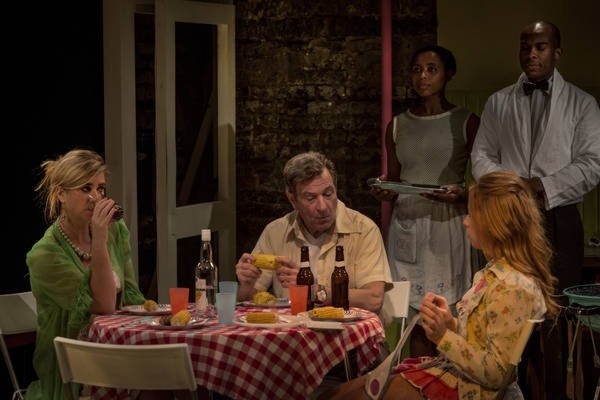
The Civil Rights movement in America was time of turbulence and violence but both black and white activists retaliated with their passion for equality. The issue divided individual families across generations, recreating the conflict on a microcosmic level. Paul Minx’s The Long Road South recreates this excruciating tension through close examination of the dysfunctional Price family in suburban Indiana.

Stay at home Carol Ann (Imogen Stubbs)is mother  to teenager Ivy (Lydea Perkins) and married to supermarket manager Jake (Michael Brandon). They are the only family in their neighbourhood able to afford “help”, black couple Grace (Krissi Bohn) and Andre (Cornelius Macarthy). On the surface, these characters are aspirational and progressive. That American Dream veneer doesn’t hold up for long, though. The characters’ gangrenous innards seep out, creating a kitchen sink drama with excellent moments, dramatic themes  and characterisation akin to Miller and Williams, but lacks the linguistic sophistication of these revolutionary writers and a few too many twists and turns for a one-act play.

The cast is generally strong, with Brandon outshining the rest when he eventually appears in Willy Loman-esque glory. Perkins has a grating vocal quality that, though appropriate to the lying, manipulative character, was nails on a blackboard after a few scenes. Bohn and Macarthy are good foils to each other with a lovely chemistry and sharp edges that sporadically pop out, adding to the dissonance. Stubbs is the tragic heroine, trapped in her house by alcoholism and the memory of an institutionalised child. This lot are a close-knit ensemble, an extended family with all the complexity of a real life one. Unfortunately, the accents spanned the country rather than uniting this family in a common place.

Director Sarah Berger skilfully uses the irregular playing space and space to enhance tension. Rarely touching or even close to each other, this shows the power of religious belief in these characters constantly aware of Satan’s temptations. Adrian Linford’s sunny back garden with its perfectly mowed grass and pastel BBQ juxtaposes the family’s chaos. Minx has an instinct for conflict, but the production’s subtlety comes from the performances rather than the dialogue. There’s no overt moralising or thickly laid Americanisms, just the characters’ genuine need to do what they think is right.

The Long Road South is a quite the good script by a writer with plenty of promise and a great cast. It’s a good reminder of a crucial period of American history, and that monumental change can wreak havoc on the closest of family units. The cast and the characters’ individual stories are certainly the best features here, but the other production elements aren’t far behind.

The Play’s the Thing UK is committed to covering fringe and progressive theatre in London and beyond. It is run entirely voluntarily and needs regular support to ensure its survival. For more information and to help The Play’s the Thing UK provide coverage of the theatre that needs reviews the most, visit its patreon.

Torn Apart (Dissolution), Theatre N16

rsz_1broken_heart_by_chain_saw

Love is one of the best things in the world, or the worst. It feels like floating, butterflies, warmth and fuzziness, or being trapped in a cage with no way out. Everyone wants to love and be loved, but when it backfires, the effects are devastating. For life, sometimes. Torn Apart (Dissolution) presents three interconnected relationships across generations and international borders. These people are broken at worst or dysfunctional at best, which makes for some good dramatic tension but the playwright BJ McNeill’s structure, style and storyline deteriorates towards the end. Some lovely set-piece scenes, a few good performances and a powerful set design help offset these issues, but new company No Offence Theatre need to continue developing their ideas in order to better showcase them.

The international company founded by two actors, Australian Hannah Kerin and Polish Natazja Somers is admirably diverse, and the play suits their strengths well. Complimented by Simon Donohue and Elliott Rogers, they form two couples that are related but never met. Rogers, at only twenty years old, possesses a presence and rich emotional range rare in a performer so young. He is excellent contrast to his carefree girlfriend Casey (Kerin) and the two fill the intimate Theatre N16 wonderfully. Somers and Donohue as Alina and an unnamed soldier have a more mature, world-weary energy that add another layer of contrast. Less developed are scenes with lesbian couple Holly (Katherine Eskenazi) and Erica (Monty Leigh), but they create a rare and commendable female-strong cast. The action flips between these three couples’ stories, revealing their connection at a good pace.

Szymon Ruszczewski’s set is simple but evocative. A bed with white linens sits in the middle of the stage, inside a white cube with threads creating walls the audience can see through – or thin bars, trapping the unhappy couples inside a generic, characterless bedroom. Ruszczewski has also designed the lighting, which is the most successful plot I’ve seen in this low-ceilinged theatre with several nooks and crannies that tend to cast stark shadows.

McNeill also directs. There’s a good use of diagonal lines so all sides can see, but some odd choices as well. Gratuitous female toplessness doesn’t add anything to the story. If the point is that the audience is witnessing private, intimate moments, why isn’t everyone naked when they’re having sex? He also doesn’t include a curtain call; this is incongruent with the naturalistic style of the piece that has a literal fourth wall. Several of the characters toy with the strings that make up the set walls, which makes their meaning jarringly ambiguous – are they walls, or are they bars, or are they just strings? Structurally, the last couple of scenes change style, and neither develops the plot. Ending with the last soldier/Alina scene would be abrupt, but a reinforcement of the horror that lurks in some relationships.

There is definite potential in this new company and their creatives, as well as scope to continue developing and refining their work. Their goal to create truly international work not limited by where their artists are from is a wonderful one that will garner them more attention with the overall increase in quality of their work.


The Play’s The Thing UK is an independent theatre criticism website maintained voluntarily. Whilst donations are never expected, they are hugely appreciated and will enable more time to be spent reviewing theatre productions of all sizes. Click here to make a donation with PayPal.

Hello Again, Hope Theatre

https://i0.wp.com/grumpygaycritic.co.uk/wp-content/uploads/2015/10/Hello-Again-1402b.jpg

Knickers, bras and other vintage undergarments (oh my!) dangle from the Hope Theatre ceiling in dim light, the discarded ghosts of sexual encounters long past. Arthur Schnitzler’s 1897 Reigen, or La Ronde as it is more commonly known from the French translation, is reinvented in musical form in Michael John LaChiusa’s early 1990s Hello Again. Not content with the original story, LaChiusa spreads Schnitzler’s shags, blowjobs and wanks over the 21st century, updates some of the characters, includes gay relationships and adds a nearly continuous score mostly of duets, with musical influences from a host of eras. The sex is seen rather than just talked about, but otherwise Schnitzler’s format is replicated. Five actors each takes two characters and accompanied by a solitary keyboard, create an intimately filthy but strangely moving chamber musical in one of London’s newest pub theatres.

Hello Again, though titillating, also looks at the desire for sexual satisfaction through entirely unromantic, desperate scenarios. In ten short scenes, we see an array of social classes, professions and sexualities get their jollies before they run out of time; there’s the married housewife in her affair with a student, the soldier and the nurse before he ships out and the gentleman and cabin boy on the sinking Titanic amongst others. One-off and long-running relationships are accompanied by a range of musical styles on a bare bones set, but the minimalism means nothing is held back and it’s practically in your lap if you’re in the front row. Though there’s plenty of bonking, little is seen – a bum here, cleavage there; the acts themselves are staged realistically rather than stylized or hinted at by director Tania Azevedo. In our porno-fied modern culture where hardcore images and video are a couple of clicks away, to show the grunting and thrusting act without the bits strikes an interesting balance between honesty and discretion. With the audience split over three sides, more diagonals could have been used in the staging to improve sightlines for everyone, but otherwise the small space with no backstage is used well.

LaChiusa keeps the scenes short, but this enhances the immediacy and primal nature of sex. There are some good numbers, but the hodge podge of styles prevents much in the way of recurring motifs. The settings and characters are clear and believable, though their brevity needs the characters to get to the point quickly. As we don’t really get to know these people before us, they become an everyman of their character type: they are us, and we could easily be them. The ensemble cast is consistently good, with newcomer Isabella Messarra and veteran Miles Western giving the most striking vocal performances. Messarra’s Nurse is a wonderful force that literally dominates the posh student she cares for, Western is the smug senator exploiting a beautiful but lonely film star.

This is an excellent and largely faithful adaption of Schnitzler’s play that doesn’t shy away from explicitly prurient moments all sexual human beings can relate to. LaChiusa’s characters speak to all of us, even if his music is less satisfying. Azevedo’s direction and multi-roll casting suits the piece, as the intimate venue fits this infrequently staged and rarely seen musical.


The Play’s The Thing UK is an independent theatre criticism website maintained voluntarily. Whilst donations are never expected, they are hugely appreciated and will enable more time to be spent reviewing theatre productions of all sizes. Click here to make a donation with PayPal.