The Master Builder, The Old Vic


Halvard Solness is afraid. He’s afraid of young people displacing him, and heights. But he is revered as the master builder of his town, a self-made man with luck on his side. The middle aged, unwell Halvard is surrounded by similarly unwell people: a wife who never recovered from past losses, a dying employee and a lovesick clerk. When a young woman he met ten years before arrives on his doorstep and disrupts his routine, the Everyman’s life goes into free fall. This dense, wordy production of Ibsen’s late work is a tightly coiled spring with exquisite design, but David Hare’s adaptation could use a good trim.

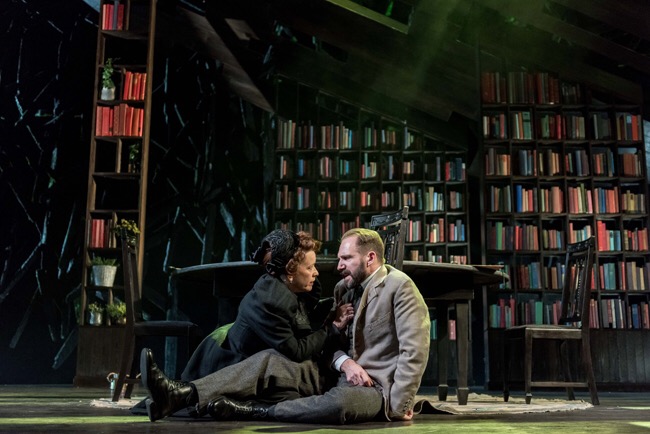
Luckily, Ralph Fiennes’ stage presence has been found some time between now and his Prospero at The Haymarket several years ago; Master Builder Halvard Solness flits around the edge of exploding for for nearly three hours and makes for captivating viewing. His tension isn’t alone, though. Linda Emond plays his wife Aline, a woman haunted by traumatic events in her past. Their cold, loveless marriage adds to the despair that hangs over the play. Even with bright spark Hilde Wangel (Sarah Snook), the foreboding and gloom still lurks on the edge of their existence.

Despite the grand performances, the set steals the show. Rob Howell’s design is grand and imposing, with symbolic elements that complement the play’s mood and tone. Curves and lines blend to create contemporary forms, but with a weight and scale that implies the architecture is not of this era. Hugh Vanstone’s lighting adds atmosphere and shadow, further emphasising plot points, but it could be used more often to create more visual variation. Though there are changes in both of the two intervals, the dominant elements remain until the climactic final moments; the sudden disintegration proves more surprising than the characters’ actions in the story itself.

Hare doesn’t skimp on language, but even though the two intervals prevent this production from feeling like its two hours and forty-five minutes, some of the scenes begin to lose momentum. Hare doesn’t attempt to make the language contemporary and maintains the script’s intellect, but neither is it hard to follow. There are just a lot of words, more than are actually needed. Snook uses her physicality most effectively, but the rest of the cast stick to the constraints of the text when extracting characterisation. Fiennes’ Halvard visibly relaxes in the presence of a younger woman, but outside of these infrequent moments, it’s all about the words.

Despite Matthew Warchus’ modern update of the Old Vic’s interior, this production of The Master Builder is firmly rooted in old fashioned realism. It’s a real treat for the senses with wonderful performances and a huge scope for interpretation – a most excellent production of a classic, despite its length.

The Play’s the Thing UK is committed to covering fringe and progressive theatre in London and beyond. It is run entirely voluntarily and needs regular support to ensure its survival. For more information and to help The Play’s the Thing UK provide coverage of the theatre that needs reviews the most, visit its patreon.
Kite, Soho Theatre

Grief doesn’t need words to communicate. Music and movement are much better mediums for the relentless, gut ripping echo that is losing someone you love. The Wrong Crowd’s latest work Kite depicts the simple, family friendly tale of Girl’s move to her grandmother’s home in the city after her mother’s death. Puppetry, movement and music completely replace words in this visual theatre piece that quietly charms in its simplicity.

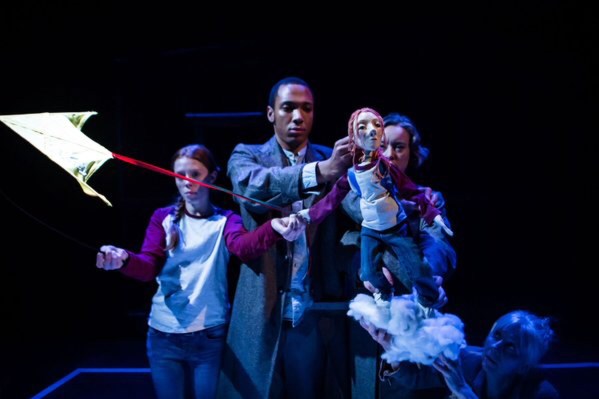
We first meet Girl (Charlotte Croft) poring through boxes labelled, “mum’s stuff” and reliving her memories through perfume, clothes and a photograph. In this sadly beautiful sequence, she rebuilds her mother out of these items, but her grandmother (Liz Crowther) eventually interrupts. Girl is often alone but for the constant wind the audience hears, personified by two strangers in grey trench coats, Linden Walcott-Burton and Nicola Blackwell. They are an ominous presence initially but once their purpose is made clear, they lose their threatening presence. These two also functionally serve as stagehands, moving and shifting the set and props in tightly choreographed neutrality that’s entrancing to watch. They never judge, just eternally observe and manipulate the world around them. 

Suddenly, a small, yellow kite interrupts Girl’s melancholy and refusal to eat at her grandmother’s house, and everything changes. The colour is a bright splash across the dark set and its constant movement takes on its own personality, like the wind that propels it. The quiet, calm atmosphere gains a refreshing energy as Girl bonds with the kite mid-air. Puppetry is introduced and adds additional charm, but could be incorporated more and earlier in the piece.

Though movement and sound are the primary features conveying mood and tone here, the choreography by Eddie Kay is simple. Polished, but simple – and it works. Dealing with grief is a repetitive process, making everyday routine even more meaningless. Girl has little expression until she finds the kite, drawing even more attention to the movement. The audience can see Grandmother’s exasperation in unembellished, repeated gestures. Crowther counters her with a warm, expressive face that betrays her love for girl; rare moments where she can focus on her own grief are some of the saddest in the show.

The design, like the choreography, is simple and effective. Director Rachel Canning takes charge of this element, integrating it well with the action. Domestic items seem mundane but are transformed into a skyline when Girl flies high above the city. A similar transformation happens to Grandmother’s umbrella with the addition of some rope lighting. 

The piece as a whole doesn’t have a huge “wow” factor, but that’s ok. It has a gentle warmth, plenty of pathos and feels like a soothing bath after a long day. Its quietness suits the very young and those prone to sensory overload, but the story of a young girl’s journey through grief resonates with all ages.

The Play’s the Thing UK is committed to covering fringe and progressive theatre in London and beyond. It is run entirely voluntarily and needs regular support to ensure its survival. For more information and to help The Play’s the Thing UK provide coverage of the theatre that needs reviews the most, visit its patreon.

Botallack O’Clock, Old Red Lion Theatre

Roger Hilton was an abstract artist working in Cornwall until his death in 1975. As alcoholism and ill health took hold, he confined himself to a basement bedroom and studio, prolifically churning out work in the middle of the night. Modelling Hilton’s experimental work, playwright Eddie Elks (of Mugs Arrows acclaim) has crafted an unconventional dialogue between an ageing, ill man finding late-night solace in his art, and his radio. Elks begins in naturalism, then surreal expressionism sets in like a lucid dream. The mind of an artist is an unusual, hard to pin down thing inventively captured and well performed in Botallack O’Clock, accompanied by the sadness of approaching death and the need to leave a legacy.

Ken McClymont’s set recreates Hilton’s studio/bedroom with excellent accuracy and detail, and a bit of theatre trickery further enhances the surrealism and absurdity. Photographic projections reinforce the authenticity of the set, complete with drying paintings strung around the periphery and paintbrushes everywhere. A 1960’s radio benignly sits centre stage next to a desk with paper and paints. With Dan Frost as an angular Roger folded on the corner of a mattress and the radio next to him, they become equals. The wardrobe on the back wall is also more than it appears, as are the walls themselves. Particularly bizarre but wonderful moments include the old man struggling to be reborn through the wall and Roger’s energetic bogey with a surprise visitor.

The power in this script is the juxtaposition of the profundity and truth in Roger’s dialogue with his radio, and the veering away from reality that happens soon after insomnia slowly wakes him. It surprises and disarms; Roger’s negotiation of this alteration is charming and confessional, provoking reflection on one’s own mortality. But it’s also deliciously funny and sweet, though begins to feel too long about fifteen minutes before the end.

Dan Frost is not an old man, but endows his physicality with the creaky weight of age. This is simply cast off, like his glasses, when he gleefully reflects on his art school days in Paris. Frost’s vocal rhythm is quick and short, forcing the audience to really listen to and process Elks’ script. Frost is complimented by the dulcet tones of George Haynes as the Radio. 

Botallack O’Clock is, in essence, a simple conversation between a man and his subconscious but Elks’ creativity and skill makes it seem like more than that.  There are some delightful surprises along the way and a range of styles are used to examine our intimate relationships with our work, our possessions and our inevitable deaths – a thoughtful, reflective piece is thinly veiled under the humour and Frost’s abrupt delivery. Though we empathise with Roger throughout, all of us are alone in our twilight years, and we are the sole leading players in our own narratives.

The Play’s the Thing UK is committed to covering fringe and progressive theatre in London and beyond. It is run entirely voluntarily and needs regular support to ensure its survival. For more information and to help The Play’s the Thing UK provide coverage of the theatre that needs reviews the most, visit its patreon.

Give Me Your Love, Battersea Arts Centre

I’ve grown up always having pet cats and it’s absolutely true that cats love being in cardboard boxes. I stumbled on a Buzzfeed or similar article recently that says cats seek out boxes or other encloses spaces when they’re stressed or in need of comfort. Humans have similar instincts, really. Think about the last time you were upset or stressed: did you want to hide under a duvet, make a pillow fort or crawl into a small, dark space? Or at least curl up into as small of a ball as you could? Observations and life experience indicate we’re pretty similar to our felines in that way. So it would make sense that someone suffering from grief or trauma might hide in a box and never come out.

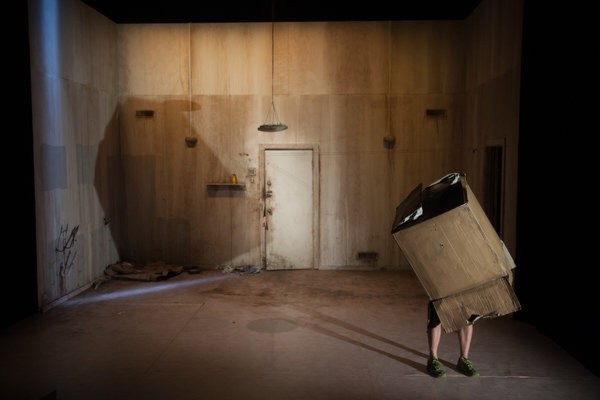
Zach (David Woods) does just that with feline stubbornness and rejection of direct human contact. An Iraq veteran suffering from Post-Traumatic Stress Disorder (PTSD) living with an unsympathetic wife (convincingly voiced offstage by Jon Haynes), we never see Zach’s face, or anyone else’s, in Give Me Your Love. This quiet, tiny show looks empty but brims with feeling in a sophisticated script, discusses cutting edge medical research without boring the audience and shares the horrors of PTSD that many of our vets are left to contend with, unsupported. A talking cardboard box and a patient drug dealer behind a chained door captivate for about an hour with flawless, sensitive performances and detailed dialogue that delicately balances humour and pathos.

Though it’s easy to focus on Woods as the central character, Haynes wonderfully supports and opposes him as wife Carol and friend/drug dealer Ieuan. Carol opposes Zach’s desire to explore MDMA’s potential to cure his PTSD, Ieuan, not unfamiliar with trauma himself, encourages Zach whilst displaying genuine, moving care for him. There’s a brotherly intimacy here that’s lovely to watch, and is perfectly captured by the pair of actors.

Jacob Williams’ set is super-realistic: there are no metaphors here, just the sparse filth that Zach lives in. The detail is in the tiniest things: the way masking tape curls at the edges, the holes in the box for Zach’s arms, the stains on the walls. The lack of people on stage calls for other means of  visual stimulation, and Williams’ work exceeds this tall order very well. Give Me Your Love is never boring, visually or otherwise.  Sound and light by March Cher-Gibard and Richard Vabre match the set’s naturalism, then toy with the audience’s perception of reality through abstract and expressionistic approaches. It’s a jarring transition, but manages to compliment Zach’s turmoil and experimental recovery instead of feeling stuck on and questions what is objective reality and what is in Zach’s head. 

The inclusion of using Ecstasy in PTSD therapy is fascinating research that doesn’t go too much in depth, but can feel extraneous to Zach’s struggle. It’s not about the recovery, but the day-to-day existence and paralysis that can result from action solders experience on the front line. The dialogue still flows, but the research informs the play rather than being the centre of it. This certainly isn’t a bad thing at all because the script could easily end up a lecture; the focus is very much on Zach’s mental and emotional health. The clever use of humour prevents it from becoming a drag, and exquisitely balances the brutality and debilitation of mental health conditions. This is a vital theatrical contribution to the mental health dialogue and de-stigmatisation, and one executed with delicate, detailed skill and a moving emotional journey. A fantastic watch.

The Play’s the Thing UK is committed to covering fringe and progressive theatre in London and beyond. It is run entirely voluntarily and needs regular support to ensure its survival. For more information and to help The Play’s the Thing UK provide coverage of the theatre that needs reviews the most, visit its patreon.

Jane Wenham: The Witch of Walkern

Banned at Ipswich School for Girls last year for ‘inappropriate language’, Rebecca Lenkiewicz’s new play, Jane Wenham: The Witch of Walkern is certainly not the profanity-ridden, immoral cesspool the school made it out to be. Quite the opposite, really. With a cast of characters who are  predominately female, this new play reads more like a GCSE English set text that’s a British version of The Crucible. This is a properly well-made play that fully embraces naturalism and touches on a host of issues: religious zealotry, lesbianism, rejection of The Other, Sisterhood, patriarchal domination of society, race, age and probably a handful of others. Consequently, there are numerous parallels we can make between this play set in the 1700s and modern day, though no singular one dominates. The production was competently performed, well-designed and overall, well done. That’s the problem, though. Jane Wenham: The Witch of Walkern doesn’t have anything wrong with it, but apart from a pair of breasts exposed during a torture scene, the play is, well, fine. It lacks the power and contemporary focus on a singular topic that The Crucible has, though it tells a good story and has some excellent moments.

Lighting designer Richard Howell’s work is the most innovative of the production elements. An ever-present but passive gallows takes on a startlingly different shape at the end of the first act, and nighttime woodland meetings are ringed in a glowing, inclusive circle. The set is minimalist but smart, drawing attention to James Button’s detailed costumes. A puppet is similarly detailed and lifelike, but Matt Hutchinson’s cockerel is underused. 

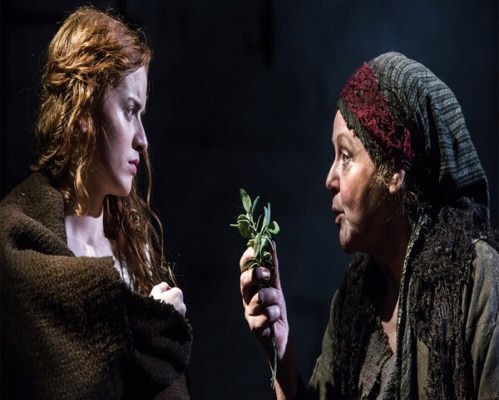
The performances are generally good, though the ensemble cast is evenly distributed so even the title role has an equal share of the stage time. This works well to create the feel of a small village with nosy neighbours relentlessly up in others’ business. Rachel Sanders shows great range by doubling as prolific breeder Bridget Hurst and pub landlady Widow Higgins; she has some wonderful intimacy with Andrew Macklin, a married Irish man with an infertile wife and desperate for children. Her hysteria is an excellent foil to Samuel Crane (Tim Dunlap), the new reverend dedicated to ridding the town of witches. Crane and the older Bishop Francis Hutchinson (a fantastic David Acton), who has learnt his lessons from historical witch hunts and sees the good in everyone, also have some sparky exchanges. The slightly old fashioned language interferes with character commitment at times, and some of the performances tend towards generalised due to a lack of development of the individual characters in favour of ensemble. 

Still, it’s not a bad play at all. It has a good story, some interesting history and stylistically harks back to American post-Stanislavskian plays from the 1920s – 1950s: Odets, Miller, Rice, and that lot. A clear metaphor would certainly enhance this show’s potency but it has some great elements that make it an enjoyable night at the theatre. Just not one that packs much of a punch.

Live from Television Centre

On Sunday night, theatre people ( and hopefully others) up and down the country tuned in to BBC Four to watch Battersea Arts Centre and Arts Council England take over the former Television Centre, now a building site for luxury flats. Over two hours, four theatre companies streamed their work for live audiences in the comfort of their homes, to push the boundaries of theatre’s adaptability to the popular small screen and to challenge typical TV programming. I watched in bed and with twitter open so I could keep half an eye on #livefromTVC; it was a gloriously anarchic experiment that I hope ushers in a new era for telly and theatre even though not every element worked as well as it could have – but that’s the point of experimentation.

Gecko’s The Time of Your Life celebrates life cycles in a circular swirling movement with a “Truman Show”-style storyline of meta-television. The close-up nature of telly supports the characters’ intimacy and expressiveness well, but the narrow framing reduced their normally expansive work to a much smaller scale. I didn’t mind the spinning camera work, but twitter buzzed with complaints of dizziness. It was rough and ready, with limbs often out of the frame and movements ahead of the action, but that supports the “liveness”. Their piece wasn’t the most accessible and most suitable to open the evening either; Richard DeDomenici’s Redux Project would have been a more appealing start to non-theatre goers.

The long running Redux Project is adapted for the evening with joyfully irreverent recreations of classic moments from BBC television history. DeDomenici has a friendly, laid-back persona thinly veiling biting political commentary just as sharp as “The Revolution Will Be Televised”, but less blatant and without personal attacks. The live artist aims, “to disrupt the cinema industry by making counterfeit sections of popular films”; he satisfies with powerful alternative perspectives that are funny on the surface, but pose bigger challenges to cinematic convention underneath.

Common Wealth’s No Guts, No Heart, No Glory is a verbatim piece sharing the experiences of young women from Bradford who are Muslim boxers. It’s a powerful piece challenging stereotypes and giving voice to a demographic often ignored at best or stigmatized at worst. This worked brilliantly on telly, capturing the intensity and passion of the characters despite some strange camera angles.

Backstage in Biscuit Land by Touretteshero (Jess Thom) becomes Broadcast from Biscuit Land, the wonderful show that’s inclusive, informative, and contains plenty of biscuits and cats. Thom has a noticeable form of Tourettes that manifests in physical and verbal tics used for comedic effect in her show, and a reminder that understanding for people with disabilities is still lacking. In a more surreal moment, Thom reminisces about a particularly funny tic about Keith Chegwin in a quiet theatre; cameras then reveal Cheggers there in the live studio audience.

The variety of the evening reminds audiences of the power of live performance and its relevance to everyone. I’m certain that anyone who watched would be able to find something appealing in the evening, and hopefully discovered a company or artist previously unknown to them. Even if it was mainly theatre makers and goers that watched, TV can still reach audiences that are otherwise unable to travel to an individual performance. At best, those who don’t consider themselves theatre people will have found pleasure in the event, and there’s hope that the powers that be discover there is room for dancing biscuits, physical theatre and political performance on our small screens as well as our big stages.


The Play’s The Thing UK is an independent theatre criticism website maintained voluntarily. Whilst donations are never expected, they are hugely appreciated and will enable more time to be spent reviewing theatre productions of all sizes. Click here to make a donation with PayPal.

Invisible Treasure, Ovalhouse Theatre

https://files.list.co.uk/images/i/invisible-treasure-lst184367.jpg

Invisible Treasure has no script and no actors. It’s not a play, but a playspace. For this hour long part-video game, part-puzzle, the audience/participants must work together to interpret the cryptic tasks that pop up on a small screen in the sterile room where they are deposited by theatre staff. The sensors, cameras and microphones that monitor the group at all times determine whether or not you progress to the next level or not, and the chance of failure is very real indeed. A giant white rabbit sinisterly lurks in the corner, its unblinking eyes the Big Brother that is unseen but all seeing. As the levels get harder, group dynamics become more pronounced. Emotions build and there’s potential for rebellion, made more exciting by each group’s unique composition. fanSHEN’s installation/event/environment’s use of interactive technology gives audiences a high degree of agency, but is still a powerful reminder that we are never truly free.

Hellicar & Lewis’ technical design is hugely impressive, or at least it is to a tech Luddite like myself. Others may find it less so but the unification and application are still incredibly inventive. The levels’ tasks require both problem solving and play that the group, on the whole, enjoyed even though some went on a bit too long. Those that aren’t keen on audience interaction or are introverted may find it challenging to engage, but as everyone is in the same position, it also might not feel so threatening. With clear leaders and followers quickly emerging, it’s possible to not contribute ideas but not joining in doesn’t feel like an option. It’s fascinating to watch others, and easy to let go and remember the childlike joy of playing without knowing where the game will lead.

When describing the experience with a friend afterwards, he boldly stated that it doesn’t sound like theatre. To be honest, I still haven’t decided if it is. But it is incredibly theatrical. With practitioners constantly trying to push the limits of immersive and interactive theatre, Invisible Treasure is certainly at the forefront and will create a personal experience and reaction for each person that attends. It’s tempting to go again and see what differs.

On completion of the levels, bonus rounds and free play sections the group is released into an analogue liminal space to process their thoughts and feedback on their experience. This relaxed environment provides an opportunity to decompress and discuss, but could, for some, lessen the impact of the experience by discovering how it works. Though this project is still in the early stages of its development, its certainly furthering the merging of theatre and gaming to empower audiences, and a wonderfully fun experience.


The Play’s The Thing UK is an independent theatre criticism website maintained voluntarily. Whilst donations are never expected, they are hugely appreciated and will enable more time to be spent reviewing theatre productions of all sizes. Click here to make a donation with PayPal.

Goodstock, Edinburgh Fringe

4619333323_702x449If you’re a woman with the BRCA1 gene, you have a 40% chance of developing ovarian cancer, and an 80% chance of developing breast cancer. Olivia Hirst is a playwright and actor. She has the BRCA1 gene and a family tree peppered with ancestors and family members who died from these cancers. Among those are her aunt, and her grandmother Elizabeth who survived a cancer diagnosis. Being a performing artist, Olivia wrote an autobiographical play about having BRCA1. Lost Watch’s Goodstock affectionately presents the major, real-life decisions she must make with humour, frankness and music.

An episodic structure frames the stories of numerous characters, with a particular focus on Olivia and her family. Illona Linthwaite plays her spunky and caring grandmother, Rianna Dearden plays Olivia’s parents, several doctors and Olivia’s aunt, as well as a host of musical instruments during scene transitions. Olivia plays herself. The cast of three clearly demonstrates great conviction in their story, endowing each character with charm and honesty. They often employ direct address, creating a relaxed, conversational environment. Olivia’s script cleverly utilizes levity, storytelling and meta-theatre to contrast quite a lot of science and grief, creating a well-balanced production. It could easily tend towards sentimentality, indulgence or preaching, but instead manages to be both informative and heartwarming.

One of Olivia’s decisions is what kind of preventative surgery to have. Medicine recommends breast removal by age 30, and the ovaries by age 35. Olivia is 26. She’s also recently single and faces the consequential decision of how to deal with becoming infertile. But, does she risk passing down this gene to her children if she can’t afford embryonic screening? It’s a lot for a 20-something to deal with, and her inner conflicts move the audience to tears.

There’s a lot packed into this gem of an hour-long play, but the only unclear aspect is what Hirst and the company want the audience to take away. It is a celebration of life, and raises awareness of what life is like for young women who know they have the BRCA1 gene, but this microcosmic biography doesn’t convey one particular message. Regardless of this, it is a wonderful piece of theatre with skilled performances and a distinctive writing style that is a vital contribution to this year’s Fringe.


The Play’s The Thing UK is an independent theatre criticism website maintained voluntarily. Whilst donations are never expected, they are hugely appreciated and will enable more time to be spent reviewing theatre productions of all sizes. Click here to make a donation with PalPal.

Jekyll & Hyde, everything theatre

“…The most immediately striking aspect of this production in the set. The floor and walls are covered in quotes and mathematical equations, floor to ceiling…The set is simple, but effective in evoking Dr Jekyll’s mental torture…

“Rory Fairbairn excellently plays the polite and reserved Dr Jekyll. He easily captures his professional motivation, his fear of Hyde and his love for his friends and family. Especially his relationship with his loving wife Penelope, played by Elizabeth Bryant, is very genuine, which makes her agony over Jekyll’s breakdown truly moving. Her relationship with her father is less credible…

“Wyatt Wendels plays Mr Hyde, Dr Jekyll’s evil alter-ego who is released through Jekyll’s academic research. Always present behind the huge golden frame, he is a constant reminder of the evil within us all. This character needs some refining, though…

“There are a few moments when the staging is effectively used to create suspense and give the audience a scare. Plenty of fog and low lighting add to the spooky atmosphere, but there are plenty of opportunities to make the production scarier that remain untapped, which is a shame particularly in the lead up to Halloween…

“…Some adjustments and development would certainly enhance the experience, but overall Jekyll and Hyde is a fun, creepy play perfectly suited to the chilly autumn nights.”

Read the entire review on everything theatre here.

Mother Courage & Her Children, everything theatre

“Royal Arsenal, a former WWI munitions factory, occupies a huge site bordering the Thames in Woolwich…Teatro Vivo and Greenwich & Lewisham Young People’s Theatre exploit this unique setting to stage an intimate production of Bertolt Brecht’s famous play

“When scene one begins, we meet Mother Courage and her three children who trundle over from the other side of the park with her cart. Mother Courage is played by the excellent Denise Orita, who gives her a more modern, bohemian interpretation with plenty of attitude. Tomi Ogbaro plays her son Eilif and Dane Stephens is her other son, Swiss Cheese…

“Mother Courage’s mute daughter Kattrin, despite being limited to non-speaking vocalisations, evokes the most pity…

“Brechtian staging conventions were adapted effectively by director Sophie Austin. Brecht’s trademark placards are replaced by the Narrator’s jarring interruptions by the loud hailer, providing vital context to a play whose action spans such a large time period.

“There are plenty of songs and the writing leaves us unable to empathise with the cast. Instead, we are disgusted by the world they inhabit and the lack of humanity in the characters themselves…”

Read the entire review on everything theatre here.