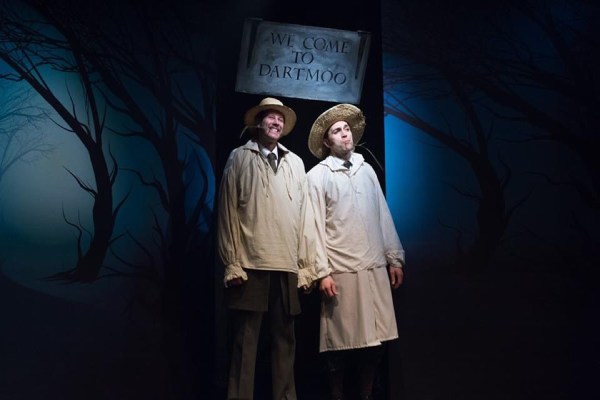
The Hound of the Baskervilles, Jack Studio Theatre

I’ve reviewed several Christmas shows this season and whilst I have nothing against pantomime,  coincidentally none are pantos. Some clearly betray an influence by the distinctly British style, which makes a lovely homage to the season but offer more choice to audiences. Jack Studio Theatre’s The Hound of the Baskervilles, adapted by Steven Canny and John Nicholson, is such a show. Performed by three actors who enthusiastically embrace physical comedy and metatheatre, this surprisingly faithful adaptation is spunky and fun with a few scares, but the performance quality occasionally fluctuates.

The cast directly introducing themselves to the audience and the inclusion of a health and safety disclaimer sets the tone for the evening – goofy, with a bit of danger. Karl Swinyard’s cartoonishly painted flats depicting a scary wood enhance the mood and add a cinematic influence, and there are regular metatheatrical interludes in the story. The script and style play with form and structure, though this is done with skill and panache – it’s never messy. Though there are plenty of laughs to be hand, the story is not a happy one. Kate Bannister’s production strikes a great balance between the dark and the light with plenty of physical comedy but doesn’t shy away from the scarier plot points.

Like panto, this production relies on stock characters for its comedy. Though this approach is often successful, some of the characters are too similar for this to be fully effective – Holmes, Watson and their client Henry Baskerville are all upper-class and urbane, often mirroring each other in comedic moments that can quickly feel repetitive. A trio of white men, though historically accurate, play all roles including the panto dame-esque Cecile. Though this is clearly an homage to melodrama and panto, in such a heightened, representational style there is no need for such casting when London theatre cries out for gender and race diversity on its stages.

The Jack Studio Theatre’s in-house shows are consistently high quality and innovative in form and style. This adaptation of a classic Sherlock Holmes story is a shining example of this, and the theatre’s commitment to new writing and reinterpretations of classics.

The Hound of the Baskervilles runs through 7 January.

The Play’s the Thing UK is committed to covering fringe and progressive theatre in London and beyond. It is run entirely voluntarily and needs regular support to ensure its survival. For more information and to help The Play’s the Thing UK provide coverage of the theatre that needs reviews the most, visit its patreon.

Stuck, Off Quay

By guest critic Rebecca Nice, @rebeccajsnice


In Stuck, four women alternate telling a story, reciting a monologue or presenting a speech. The work is loaded with satire that directly critiques the current political climate and societal struggles of sexism, patriarchy, immigration and oppression. Tamara Astor, Sophie Crawford, Lula Mebrahtuand Deli Segal are far from stuck; they are navigating a series of continual journeys. Although the themes cover many historical periods, the rich content of the text allows for critique and action from within. Dislocation and displacement are paramount but paralysis is not.


Contemporary and historical speeches from women form the structure of the work and director Andrew Brock, who runs the sound and lighting from behind a corner, appears at beginning and end in a Donald Trump mask. Speeches include those by Nancy Astor, the first female UK MPJosephine Baker, an American civil rights activist and suffragette, Emmeline Pankhurst. They are woven between stories from a backpacker, or a refugee, a girl saying goodbye to her Dad or woman jumping on a bus in a new and strange community. Impassioned monologues, emblazoned by the drama of each story, juxtapose the famous and the unheard in a series of gender-based scenes of oppression. Through this mixture of historical cannon and genre as content, Stuck finds the heroic in the everyday.


Trump’s cameo is unnecessary; the speeches themselves are powerful enough to relate to an audience with its own cultural makeup and political woes. The characterisation of each woman is, on occasion, excessive but draws on the emotive content and context of each speech. The almost minimalist style of the lighting and set sits at odds with the sometimes excessive dramatization. A simpler delivery would make for a more complex play. This would work well alongside the uncomplicated design of the work. One long strip light sits on the floor at the back and is raised and moved by the performers, an over-head projector forms an up-light in the foreground and a series of torches shone against metallic paper allow the minimal style and function to sit hand in hand. 


My name and place of birth is taken as I enter the space and written on a sheet of paper. A tribal goddess adorned with a paper head dress scatters these papers one by one, to be picked up and silently read, one after another. As bodies chase, place and abandon each spot for the next one, a choreography of churning worlds, flying papers, moving bodies and stillness introduces the running theme of journeys, displacement, home and belonging. The movement-based tableaus often strengthen the ensemble and the message: The quartet works back-to-back for example, supporting each other through balancing, moving up and down with torches in hand whilst one of them is talking. An abstracted world or set of bodies in space create a context for movement or frame the speaker as a chorus might and allude to a team of like-minded individuals who are fighting to be heard, the audience included.


The piece itself appears to be displaced at a stop off point along its long journey like that of the first speech of a traveller stuck in limbo, waiting for a visa. Tucked away on the eighth floor of a tower block in East India Dock, ‘Stuck’ is surrounded by a shiny, beautiful, soulless micro-city, abandoned for the night by the suited office workers and temporarily inhabited by four passionate women. The audience felt like they had travelled far into the middle of nowhere to find them, and this critique of the very world it inhabits feels transient and temporary which surrounds its message with a greater sense of zeal and urgency.


Stuck is now closed.


The Play’s the Thing UK is committed to covering fringe and progressive theatre in London and beyond. It is run entirely voluntarily and needs regular support to ensure its survival. For more information and to help The Play’s the Thing UK provide coverage of the theatre that needs reviews the most, visit its patreon.

Christmas, Theatre N16

Christmas. What a cunt.

No doubt many of us feel like this as some point in the run up to the holidays, but there are those that find this time of year particularly hard. Simon Stephens immortalises a ragtag collection of down-at-heel, working class Londoners in his early-career black comedy, Christmas. Both funny and tragic, the one act play is a fantastic anecdote to typically saccharine holiday theatre and a potent reminder that there are those of us with much less privilege than others. 

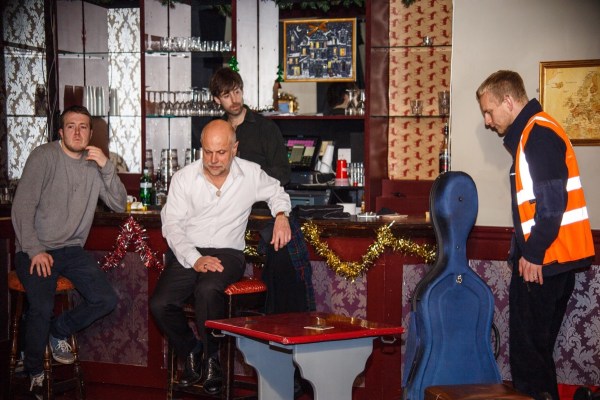
A week before the holiday, Billy, Seppo and Charlie prop up Michael’s east London boozer. None of them are having an easy time at the moment, nor are the other drinkers that pop in over the course of the evening. These are the East End’s waifs and strays, with no where else to go and no one else who understands them. They find kinship and conflict over their drinks, gradually confessing one secret after another as the empty glasses accumulate. Though the ending lacks any sort of resolution or certainty, the script is a good balance between comedy and provocative seriousness.

The performances are generally consistent, with Jack Bence as bricklayer Billy and Christopher Sherwood as cellist-turned-postie Charlie standing out with their nuance and intensity. Director Sarah Chapleo intuitively takes advantage of the theatre’s former use as a private bar and rearranges the audience to create a more intimate setting. She and her cast have a good instinct for the characters’ varying rhythms and are able to evoke plenty of empathy from the audience.

Though it’s great to see theatre with emotional range and depth framing working class issues, it’s a shame that the narratives here are all straight, white and male. This doesn’t invalidate the stories presented, but class diversity on stage isn’t enough anymore. But despite the unease of an all-white, all-male cast, Christmas still has plenty of impact.

With not everyone able to have a cosy, indulgent holiday season surrounded by warmth, food and loved ones, this play has an important place in Christmas theatre ecology. The production is a particularly strong one with good performances and staging in an intimate space, and has enough humour to counter the misery but still drive the message home. 

Christmas runs through 22 December.

The Play’s the Thing UK is committed to covering fringe and progressive theatre in London and beyond. It is run entirely voluntarily and needs regular support to ensure its survival. For more information and to help The Play’s the Thing UK provide coverage of the theatre that needs reviews the most, visit its patreon.
A Christmas Carol, Above the Arts

There are several versions of Dickens’ classic story on stage at the moment including two at the same venue, but I’m pretty sure that Flanagan Collective’s is the only one that involves a a two-course Christmas dinner. Traditional dinner theatre may be dreadfully out of fashion, and deservedly so – pun laden, thinly plotted murder mysteries performed by third rate actors in fading rural hotels are torturous affairs – but this A Christmas Carol is cleverly constructed, interactive and wonderfully fun.

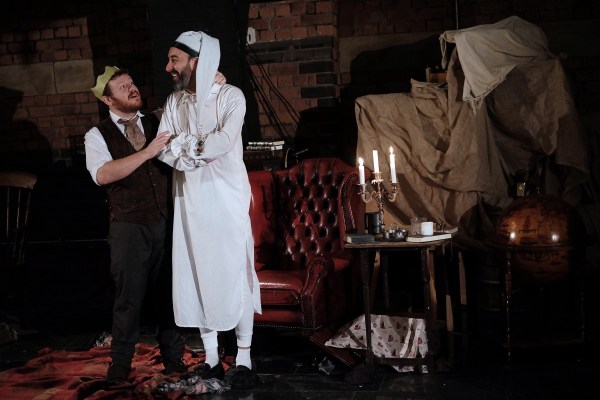
Upstairs at the Arts is transformed into Scrooge’s parlour, with a banquet table in the middle. There are some lovely details – the corner bar is bedecked with holly, a pub sign and frosted windows, walls are now book cases and a record of debts. Though the script diverges quite a long way from the book, the fundamental story is still there and the audience is fully included. There are some moments of excessive banter and waffling, and a few vague transitions, but this adaptation is generally clear and concise. The focus is much more on the show than the food – something that makes this very different from typical dinner theatre.

Marley and Scrooge are the only performers, with Marley guiding Scrooge on a narrative journey through his three ghosts rather than physically taking him to other worlds. A distinct change of tone leads Scrooge through the memories of his past that are described with a committed delivery of the imagery-laden text. The extended interval where the audience eats and plays games is the congenial, warm Ghost of Christmas Present, then concludes with the somber telling of Christmases yet to come if Scrooge doesn’t change his ways – which we all know he does. There are some naff devices that try to cover up the lack of other characters, like a torch following an invisible Bob Cratchett.

The performances are heightened, high energy and skilful. It is impossible to not be swept away with the joy and Christmas spirit that runs through this cautionary tale. There are Christmas carols and games, but the story is the crux of this event. Though some may view this production as common and frivolous, it has wide appeal and unites audiences rather than alienates with high art. And the food is delicious.

A Christmas Carol runs through 31 December. 

The Play’s the Thing UK is committed to covering fringe and progressive theatre in London and beyond. It is run entirely voluntarily and needs regular support to ensure its survival. For more information and to help The Play’s the Thing UK provide coverage of the theatre that needs reviews the most, visit its patreon.
Hedda Gabler, National Theatre

Hedda Gabler should be happy in the 1890’s world that Ibsen created for her. She has everything a woman wants: a successful new husband, servants in a huge new apartment and possibly a baby on the way. But she’s not happy with her lack of autonomy, and power others have over her and her body now that she is a wife. Railing against the patriarchy, she draws feminist audiences to her side despite her paradoxically strong helplessness. She is a quiet revolutionary, a martyr, a catalyst, and despite fighting against the society in which she lives, she is a product of it. In her being out of place, she fits. 

That’s a large portion of the problem with Ivo van Hove’s Hedda Gabler. He has forced her into a wealthy and minimalist present, and made her so unpleasant that she comes across as quite the nasty piece of work. Whilst her behaviour is understandable in the face of the horrendous misogyny she encounters, empathising with her – and anyone else – is difficult and the characters’ choices are often wholly implausible in present day. Some of van Hove’s choices are so uncomfortable that even though they try to challenge Hedda’s oppression, they imply masculine complicity or at the very least, indifference.

Patrick Marber’s script has been streamlined from Ibsen’s, though there is a scattering of jarring anachronisms. His update is largely believable and the characters’ economic privilege is a dominant theme. He stays close to Ibsen’s script, but too much so for it to be completely believable in the present day. Further divergence would certainly be a more interesting premise.

Ruth Wilson’s work is stunning, though – her performance is up there with Denise Gough’s in People, Places and Things. She successfully grapples with Hedda’s emotional changeability and displays a stunning range of aggression, vulnerability and volatility. Her reactions are totally unpredictable, matched in intensity by Rafe Spall as a totally abhorrent Brack. Chukwudi Iwuji’s Lovborg is also excellent, with an earthiness and emotional life that betrays his American training. Though it doesn’t add anything or detract from the performance, it is great to see a cast from around the world, with their native accents on show – a reflection of the range acting talent in the UK outside the white, British standard.

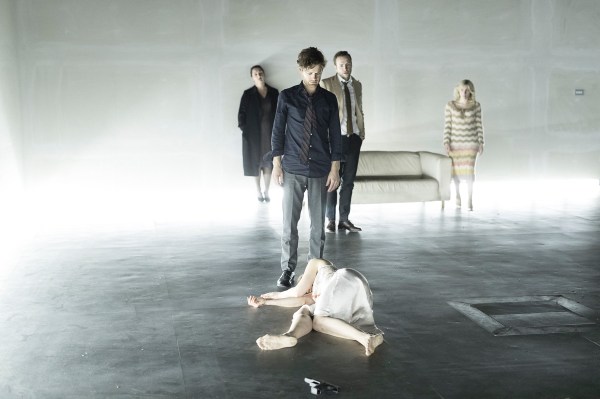
Van Hove’s expansive minimalism further develops a world where Hedda is out of place, but the sparsely furnished living room is so huge that no one seems to belong there. Though it forces distance between the characters, everyone is isolated and on show – not just Hedda in her ridiculously, barely-there slip of a dress. The aesthetic more closely resembles a modern art gallery than an upscale urban apartment, and the choice reeks of vanity rather than function. Even the plethora of brightly coloured flowers that are slowly crushed under foot (an obvious metaphor for Hedda herself) are more reminiscent of an art installation than a newlywed couple’s home.

Making mostly-silent maid Berte (Eva Magyar) ever present on the edge of the stage is also an evocative choice. Instead of supportive sisterhood, she is silhouetted and watchful, complicit with the men. Hedda’s pistols, mounted in a glass cupboard, are also a continuous threat – even though they are her’s, anyone can access them. They are not exclusively her’s, or a secret. 

By far, the most disturbing choice during Brack’s blackmail scene is the use of what appears to be an innocuous can of Coke, but its contents and their violent employment go beyond powerful, into the territory of offensive. The shock value this abusivemoment creates is entirely excessive, particularly when alluding to a woman’s inability to carry a pregnancy to term.

Though Hedda is a character that defies pinning down, van Hove’s attempts to crucify her on the wall of his exhibit is too much. The performances are certainly worth seeing, but the context they are placed in is an uncomfortable and totally inappropriate one to witness. The play itself does a fine job at advocating for feminism without the gratuitous choices in this production.

Hedda Gabler runs through 21 March.

Press tickets courtesy of Theatre Bloggers.

The Play’s the Thing UK is committed to covering fringe and progressive theatre in London and beyond. It is run entirely voluntarily and needs regular support to ensure its survival. For more information and to help The Play’s the Thing UK provide coverage of the theatre that needs reviews the most, visit its patreon.
The Tempest, Cockpit Theatre

Shakespeare’s original performances wouldn’t have had rehearsals or a director, and the actors never received full scripts – it was too expensive and time consuming to copy them out. Instead, they learnt their lines and cues from a script that was just that – their lines and cues. This cue script technique is now a huge challenge to actors who are used to weeks of rehearsal and analysis before their first performance, but it’s a fun exercise – for performers. Audiences used to nuance and polish in their Shakespeare will miss these elements, even though the seat of the pants approach inevitably brings unintended comedy. Clocking in at three hours long with a large cast, this is a worthy experiment and one that is helped along by a director, but the approach lends itself to a snail’s pace and underdeveloped characters.

The performance is often slow and flat despite a prompter’s help, as actors tend to focus on their lines rather than characterisation and responding to others. Some are better at it than the rest, making the pace inconsistent. Those that struggle aren’t better or worse actors no more than the ability to, say, play a musical instrument or juggle does – but regularly needing support with lines inhibits connection with the story. Scenes with more characters are more of a challenge what with snappier dialogue and more cues; unfortunately these are most effective when played at speed. Speeches and two-character scenes are more successful, with greater energy and emotional range – Prospero and Miranda’s first scene together is particularly lovely.

This Salon:collective production is worth commending for their experimentation and diversity. Four roles normally played by men are now women, with language adapted to match: King of Naples Alonso (Geraldine Brennan), Prospero (Lizzie Conrad Hughes) Francisco (Odera Ndujiuba) and Gonzalo (Angela Harvey). With powerful characters now female, this world of betrayal and magic is distinctly feminine, which completely alters the relationship dynamics between characters. A female Gonzalo’s support for a female Prospero in the face of forced exile by male Antonio (Dominic Kelly) reframes the event as sisterhood in the face of masculine oppression of women in power – an example of the impact gender reversal can have in Shakespeare’s texts. 

Some of the cast are particularly excellent. Dewi Hughes’ Trinculo is flamboyant and prissy; his attempts to tolerate Stephano and Caliban are utterly joyous. Alex Vendittelli’s camp Sebastian elicits belly laughs from bitchy looks and dry delivery, even when forgetting lines. Laurie Stevens’ Miranda’s innocence and joy is lovely, but she’s not all perfect – there’s a teenaged stroppiness she takes on around her mother. 

The company as a whole handles the space particularly well, and is largely confident enough to employ direct address to the audience. The design elements do little to add detail – the music and sound design it too repetitive. The costumes are rather generic, though at least the design is consistent and appropriate to the world of the play. Lighting could have been used to create more environmental contrast.

As the Salon:collective is a training body for actors, it’s understandable that their focus is on enabling their students to grow. The trouble is that this process doesn’t always make the most compelling of performances. This version of The Tempest, no doubt a brilliant challenge for the cast, is too long and often arduous for the audience.

The Tempest runs through 15 January.

The Play’s the Thing UK is committed to covering fringe and progressive theatre in London and beyond. It is run entirely voluntarily and needs regular support to ensure its survival. For more information and to help The Play’s the Thing UK provide coverage of the theatre that needs reviews the most, visit its patreon.

Santa’s Stocking, Lost Rivers Elephant

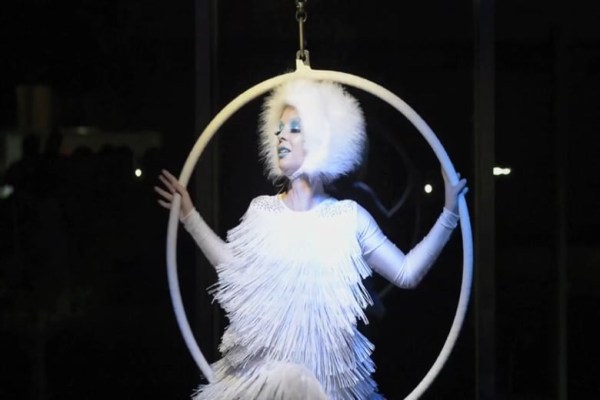
Amongst all the dispute about whether or not new venues should be opening, Lost Rivers Brewery, known for their Bermondsey Yard Cafe and other pop-up venues, have quietly expanded from beer into performance in their brand new temporary venue. Made out of shipping containers and a stretch tent on a pre-regeneration patch of land in the Elephant & Castle, Lost Rivers Elephant is unassumingly tucked behind the shopping centre and train station. It’s no mirrored spiegeltent or purple cow, but its rough-and-ready simplicity and grit approaches the edge of minimalist cool. Their debut show, the circus/cabaret Santa’s Stocking by Zero Central (creators of The Raunch), is a hit-and-miss collection of acts with a decidedly stronger second half. The show and venue are still very much finding their feet, but there is evident promise within some powerful moments (and excellent pints).

Hosted by X-Factor contestant Seann Miley Moore and Gingzilla, the two form a fabulously queer, gender binary-defying duo exuding pride and sex appeal. Their cheesy, punny banter wears on entirely too long but redeem themselves somewhat with well-sung Christmas and pop songs.

Of the Act I performers, Candy Cane Girl (Teresa Callan) is a smily, bendy hula hooper with moves that gradually increase in skill and complexity. She is accompanied by animated kaleidoscopic projections that add more adult flavour. She is the strongest in the first half, narrowly outdoing a Cyr wheel elf who tries and fails to flirt with the audience.

The second half mercifully has less of the hosts’ banal chat, more impressive circus and bolder sex. Hand balancer Michael Standon has an unusually impressive fluidity, Gingzilla’s Santa strip tease is akin to a opening a wonderfully unexpected gift on Christmas morning and Moore’s rendition of Hallelujah accompanied by ariel hoop artist Jo Foley is an exquisite finale in this intimate cabaret venue. 

Zero Central does well considering the space limitations in Lost Rivers Elephant, though cutting down the introduction, adding more punchy acts to the first half and taking out the interval would certainly improve the show. Shared lighting encourages guests to move around as needed, with food and drink easily accessible. With a bit of jazzing up, this intimate new venue could certainly become quite an exciting offer with a specialisation in small-scale circus and cabaret.

Santa’s Stocking runs through 22 December.

The Play’s the Thing UK is committed to covering fringe and progressive theatre in London and beyond. It is run entirely voluntarily and needs regular support to ensure its survival. For more information and to help The Play’s the Thing UK provide coverage of the theatre that needs reviews the most, visit its patreon.
Muted, The Bunker

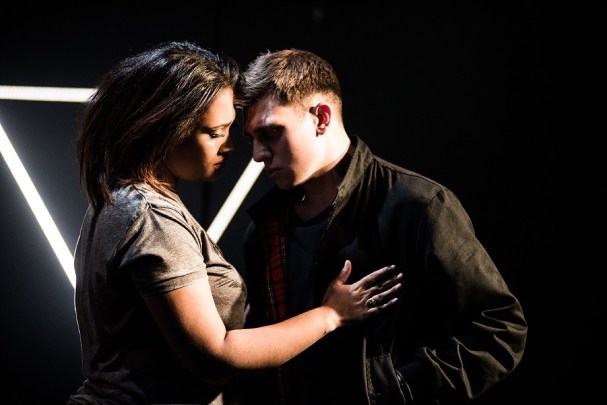
The Bunker’s debut season in the Menier’s disused carpark-turned-theatre has been nothing short of triumphant. Isley Lynn’s Skin A Cat and Philip Ridley’s Tonight With Donny Stixx, transfers from VAULT Festival and Edinburgh respectively, are rounded out with new British rock musical, Muted. The story of a promising, young musician who stops speaking after a string of highly traumatic experiences is surprisingly complex with some great numbers – but the script gets lost within itself. There are a few too many subplots and surprises that crowd out the main storyline and dilute the power of the message of hope and recovery.

Lauren (Tori Allen-Martin) and Jake (Jos Slovick) are a young, urban couple with loaded pasts and the urge to help their friend Michael, who’s shut himself away in his uncle’s Bethnal Green house and refuses to speak after his mum’s sudden death. As Lauren tries to coax him to speak to her by recounting good memories, Michael is tormented by darker times. His younger self and mum are sporadically made flesh by Edd Campbell Bird and Helen Hobson, though the majority of the action is in the present. Emotions and personal history get the better everyone, causing inevitable conflict and heartbreak.

The trouble is that Sarah Henley’s book packs in too much, and true transformation is minimal and slow. Hurt feelings and arguments abound, but little is achieved from them. There are some genuine surprises, but amongst the tangle of plot lines, they lose their impact. Allen-Martin and Tim Protty-Jones’ music is generally strong, though there’s a handful of overly trite lyrics. Some of the tunes are too short and come to abrupt ends, but others are absolutely cracking. 

Designer Sarah Beaton’s set is simple but a wonderful juxtaposition to the sticky web that entraps the characters. A swing hovers above a boxy platform containing a large island surrounded by water. All black and angular, the construction is a subtle metaphor that enhances symbolic but occasionally clunky choreography by Isla Jackson-Ritchie. 

Though the performances take a bit of time to gather speed and the script doesn’t quite manage to come together seamlessly, the story Muted tells is full of heart and potential. The passion and commitment in the work is clear, and the characters are real flesh and blood. It’s not a big, showy American musical, but one that is distinctly and quietly British. With more development and dramaturgical support, Muted will really shine.

Muted runs through 7 January.

The Play’s the Thing UK is committed to covering fringe and progressive theatre in London and beyond. It is run entirely voluntarily and needs regular support to ensure its survival. For more information and to help The Play’s the Thing UK provide coverage of the theatre that needs reviews the most, visit its patreon.
Benighted, Old Red Lion Theatre

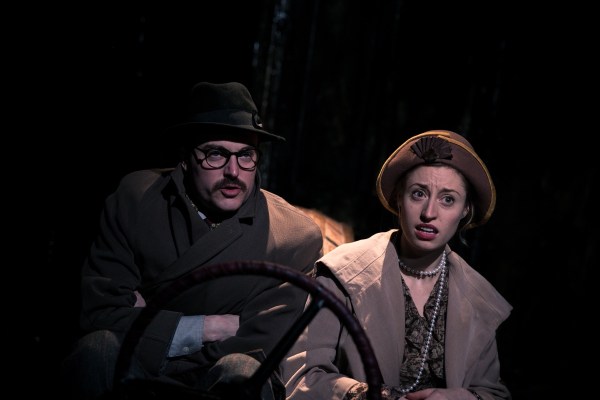
When repressed middle class couple Mr Phillip and Mrs Margaret Waverton and their friend Roger get lost in rural Wales in a horrific downpour, they head to the nearest house for shelter. With the roads flooded and cars in the 1920s not what they are today, they are well and truly stranded until the waters recede. But the creaking edifice and its ancient hosts, brother and sister Horace and Rebecca Femm, are not as welcoming as they hoped. The world premiere of this adaptation of JB Priestley’s early novel spanning a single terrifying night is a fun, jumpy thriller executed with polish and conviction.

The design is a particular highlight. Gregor Donnelly makes an immediate impression with his cubic fireplace, uneven floor and wall of floating chairs – we know we’re entering a world that is far from the way it should be. Though the set shows detail and thought, it doesn’t dominate the small stage and provides the actors with distinct levels and playing areas. David Gregor further enhances the tension and fear with his excellently layered sound design that’s akin to a cinematic score – something rarely heard in small-scale theatre but contributes so much to small budget shows.

The cast of six form a polished ensemble, with Matt Maltby as Roger and Jessica Bay as showgirl Gladys particularly standing out. They all attack their heightened characters with energy and commitment – a pleasure to watch. There is also some solid multi-rolling from Ross Forder and Michael Sadler, though director Stephen Whitson has Forder play a woman rather than casting another woman and attempting to even out the gender disparity. 

Duncan Gates’ script is well formed, creating suspense with good effect. Whitson captures its rhythms with intuition, though a singular, stylised fight scene is out of place. Some of the transitions are slightly clumsy, but these will easily speed up after a few more performances. The play’s anti-war, pro-veteran agenda is slow burning but satisfying when revealed and unfortunately, one that is still relevant despite the time period.

Other than a few minor issues, there is little that detracts from the deliciously classic film vibe of Benighted. It’s a great story that is well executed and a welcome break from saccharine holiday theatre.

Benighted runs through 7 January.

The Play’s the Thing UK is committed to covering fringe and progressive theatre in London and beyond. It is run entirely voluntarily and needs regular support to ensure its survival. For more information and to help The Play’s the Thing UK provide coverage of the theatre that needs reviews the most, visit its patreon.
Monorogue: Elf Off, Old Red Lion Theatre

https://i0.wp.com/northpoleexperience.com/wp-content/uploads/2014/09/slide-1.jpg

The Salon:Collective’s Monorogue is back again, this time with a Christmas edition. The monologue showcase is now in Santa’s workshop, where perky elf Gingersparkles is interviewing human candidates for a vacancy in the Lapland workshop. Seven lacklustre individuals who can’t otherwise find seasonal employment are created and performed by Salon:Collective actors in this spunky, lighthearted show where the audience gets to vote for the best performer/character. Distinctive characters and good performances are the trademark of this regular event, and the framework around the monologues makes for more palatable viewing.

The set is a simple construction of heaps of brightly wrapped presents, Christmas decorations and toys. It’s easy, cheap and hugely effective in the intimate blackbox theatre. Though perhaps unintended, it is also a lovely juxtaposition to some of the more down-at-heel characters.

The performances are generally good, though some of the characters tend towards stereotypical and miss opportunities for nuance. The standouts are Lucy Gallagher and Louise Devlin’s intense Scottish tomboy Mae, and Angela Harvey’s struggling mum of five Hayley. Rachel Stoneley’s confused but sweet stripper, Jade, is a great way to wrap up the candidates. Laurie Stevens is the adorable Gingersparkles, but she surprises with a ferocious climax that wraps up the evening well.

The scripts have a strong lean towards comedy, which suits the time of year, but some of them lack depth and choose to mock personality traits rather than empathise. Whilst there is nothing overtly offensive and the stereotypes created are identifiable and relatable, there is room for more variation.

Monorogue proves again that they offer an entertaining event that allows actors and playwrights to showcase their talents without taking the more common, in your face approach to self-marketing usually found in showcases. The theme sets the actor/writers a challenge and gives the audiences a needed framing device, and the performances are usually good.

Monorogue: Elf Off is now closed.

The Play’s the Thing UK is committed to covering fringe and progressive theatre in London and beyond. It is run entirely voluntarily and needs regular support to ensure its survival. For more information and to help The Play’s the Thing UK provide coverage of the theatre that needs reviews the most, visit its patreon.