
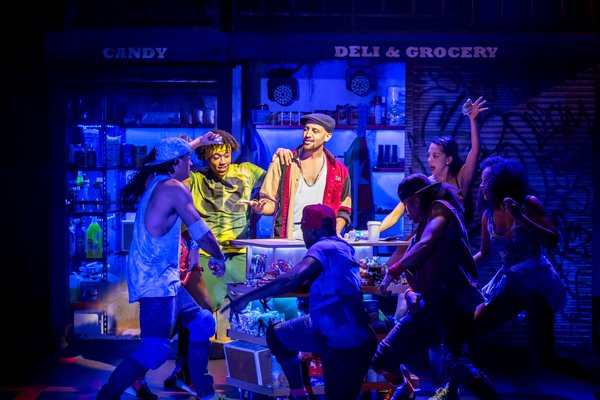
Way up in Manhattan, so far north that it’s nearly the Bronx, is Washington Heights. You take the A or the 1 train to 181 Street to find this primarily Hispanic neighbourhood that’s not on any tourist radar. In the Heights shows the day-to-day struggles and celebrations of a group of residents on one block far removed from downtown prosperity with a soundtrack of salsa, hip-hop and poppy musical theatre.
The songs are the most innovative aspect of this mostly-sung musical with a stellar cast, but the book is rather sparse and the large cast of characters means it’s a cracking ensemble performance with frustratingly little development for any one character. The book and lyrics rely on stereotypes of Latino immigrants in New York City, though it both fulfills and destroys them within the diverse array of characters. The story feels rather tenuously squeezed around the songs with the dialogue serving as a plot point connector; most, of the scenes aren’t substantial enough to stand on their own. But, going back to the music, the songs make up the bulk of this musical and create a fabulous atmosphere complimented by excellent design. The Latin and hip-hop tunes are the best and most original, resulting in a fun evening and a memorable soundtrack.
This production is the same one that received numerous accolades and award nominations last year at Southwark Playhouse, and deservedly so. The Kings Cross Theatre suits this show well, with a wide traverse stage and audiences on either side, creating intimacy and suiting Drew McOnie’s circular, street party choreography. There are still design relics from The Railway Children, but Takis’ urban set and Gabriella Slade’s bright, revealing costumes pull the focus onto this completely contrasting world. With the performances practically in the laps of the front rows, it’s hard not to get up and dance. Some people do during the curtain call.
It’s not all a party, though. Nina (Lily Frazer), the first of the neighbourhood to go to university, has dropped out after her first year. Her father Kevin (David Bedella) hates her boyfriend Benny (Joe Aaron Reid) and is furious about Nina’s deceitful behaviour. Corner shop (or “bodega” in NYC lingo) owner Usnavi (Sam Mackay) and salon owner Daniela (Victoria Hamilton-Barritt) are getting priced out due to rising rents. Others came here for a better life only to find themselves cleaning houses and pigeonholed by poverty. The joy in this show comes in the characters’ ability to party and find solace in each other in the face of adversity – a powerful message for modern times.
I wanted to know more about these characters, though. This is a “slice of life” show that tries to fit in a lot of big personalities and backstories in a short amount of time, so the main characters and their tales have little space to grow. The storyline feels rushed and the ending, though a happy resolution, is a bit too “musical theatre twee” for a world that’s poor and gritty, albeit one soaked with colour and excellent music. It’s still possible to be pulled into this little stretch of Washington Heights in the height of summer and to want to dance the night away to this extraordinary blend of Latino, rap and musical theatre.
The Play’s The Thing UK is an independent theatre criticism website maintained voluntarily. Whilst donations are never expected, they are hugely appreciated and will enable more time to be spent reviewing theatre productions of all sizes. Click here to make a donation with PayPal.
 Whilst visiting a Caribbean island about 100 years ago, Brutus Jones, an African American train driver, some how ends up emperor of the island’s native tribe. His reign is brutal, so Jones knows it will eventually end. Eugene O’Neill’s 1920 The Emperor Jones begins with Jones’ initially relaxed attempt at escape from the uprising citizens, and inevitable guilty descent into the madness of a Shakespearian villain. The script is entirely spoken by Jones, barring the first and last scenes, with his madness peppered with ghosts that won’t let him rest in the darkness of the island’s woods.
 Willem is 34. He moved from Amsterdam to New York City 12 years ago. After an inconveniently timed phone call from his mother on a cold New York morning, he goes home for his younger brother Pauli’s funeral. He is greeted by his father’s disappointment, his sister’s lectures and the disorientation of not knowing where “home” is anymore. Much has changed, yet so much has remained the same.
 Carol (Holly Joyce) moved to a village in Carcassonne to rebuild her life after a devastating divorce and her son had grown up. She is convinced that in a past life, she was a medieval troubadour called Guy in the time of the Cathars. Raymond (Danny Solomon) is an actor working in the second-rate tourist attraction that Carol stalks, and longs for a life in the more exciting London. With a poetic, reflective script by Nick Wood and direction by Natasha Wood, Consolation has riveting moments between these two damaged, conflicting characters as they travel on parallel journeys of self-discovery, but at two and a half hours with a lengthy, slow-burning beginning, the production could use a trim. The slow development and several sub-plots lend a real-life complexity to the story, though the last to be introduced has insufficient expositional time considering its importance to the play’s conclusion. Despite the script’s need for additional development, this is a moving character piece unsentimentally following two individuals as they come to terms with the insubstantiality of their dreams.
 The Play's The Thing UK