The Marvellous Adventures of Mary Seacole, Rosemary Branch Theatre

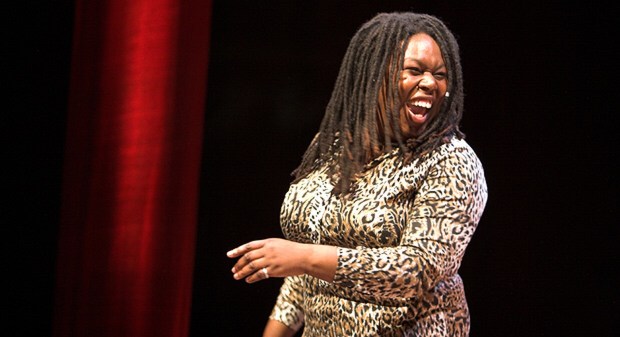
I had never heard of Mary Seacole until I began working in UK schools, several years after my arrival to the UK. What a woman!  No wonder her entrepreneurial, caring Victorian spirit is on the National Curriculum and she has been the subject of several plays, including Rosemary Branch co-artistic director Cleo Sylvestre’s one-woman show, The Marvellous Adventures of Mary Seacole. With a simple narrative structure, Sylvestre’s piece focuses on characterisation and biography. It is well performed, though some adjustments to the script and tech could make this an even better solo show.

We are never told who we are, but Seacole treats us like a society or club she has come to lecture about her life.  She speaks in the past tense shortly after her return from the Crimea; we hear her life story starting with her childhood in Jamaica, helping her mother run their Hotel, Blundell Hall and learnt about her “remedies” from foraging. Continuing onto her London, Central America and finally The Crimean War, Sylvestre endows her with a confident, charismatic warmth – no wonder she was so popular with soldiers and civilians alike. Her performance peaks when recalling her mother first teachings her about plants, and later memories of battlefields heaving with wounded soldiers – her “boys.” These are lovely moments to witness, but some of the more mundane content is delivered on autopilot.

Structurally, the script is a simple, linear narrative. This would be an excellent piece to tour to primary schools, as it’s easy to follow and has plenty of captivating anecdotes. The content is interesting enough to hold an adult audience’s attention for nearly an hour, but it would be a refreshing experiment to see this piece as episodic, with more lighting and sound than is presently used to highlight pivotal moments. This is not a new show, and solo performance has evolved since its inception. Sylvestre’s imagery-laden work would suit regularly used bigger projections, detailed soundscapes stronger lighting changes. Even though this is an important story, it is not an innovative production, but it certainly has the potential to be.

Cleo Sylvestre’s performance is the highlight of The Marvellous Adventures of Mary Seacole, but this long-running solo performance needs some revisiting to give it an extra burst of life worthy of such a vibrant character.

Running at The Rosemary Branch, 9-11 April.

The Play’s the Thing UK is committed to covering fringe and progressive theatre in London and beyond. It is run entirely voluntarily and needs regular support to ensure its survival. For more information and to help The Play’s the Thing UK provide coverage of the theatre that needs reviews the most, visit its patreon.

Gardens Speak, Battersea Arts Centre

5 Tania El Khoury _Gardens Speak_please credit James Allan for Fierce & Artsadmin

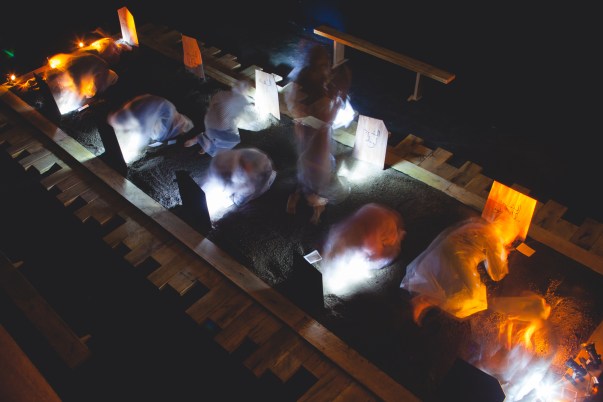
In Syria, Asad’s regime attacks the funeral services for rebel fighters. Rather than holding public burials, families bury dead martyrs in their gardens, usually with no tombstone. In tribute to these people, live artist Tania El Khoury has created an interactive sound installation with the stories of ten martyrs buried in gardens. An intimate audience of ten each hear the recorded monologue of an individual martyr who died fighting against Asad’s forces, but they have to experience some discomfort in the process. Gardens Speak lasts a mere 30 minutes but irrevocably alters the detached western view of Middle Eastern conflict, fostering empathy and despair for fellow man.

In a small room, we are asked to remove our shoes and socks, put our belongings to one side and don an over-sized raincoat. Once everyone is ready, the door is opened to a darkened room with ten tombstones lining the edge of a large wooden frame filled with soil. Each person is handed a postcard and a small torch. Following the instructions on the card, we each find the tombstone pictured. To hear the story of the person buried in that grave, we dig into the rich, peaty earth that scents the room. What with the competing sounds of other recordings, to hear properly we kneel or lie in the dirt.

The narration is a simple, unembellished tale of one man’s fight and fall at the hand of the tyrannical government. It’s neither overly graphic but neither does it hold back. The environment created by the set strongly influences the mood – there is a pronounced gravitas in the space. The whole effect doesn’t overwhelm, but imbeds itself internally, somewhere in the depths of the gut, along with the spirit of the young man who’s life spoke from the dirt I lie in.

We are lucky: the room is warm, and our clothes are protected from the soil. After the narrative of a man’s life, death and burial in his mother’s garden and a sound bath in Arabic singing, we can wash our feet (a reassuring ritual element that also adds to the aesthetic of the piece), collect our things and go home to our comfortable, little lives. Gardens Speak is both a little installation and one that encompasses the whole of humanity.

The Play’s the Thing UK is committed to covering fringe and progressive theatre in London and beyond. It is run entirely voluntarily and needs regular support to ensure its survival. For more information and to help The Play’s the Thing UK provide coverage of the theatre that needs reviews the most, visit its patreon.
Eggs, Vault Festival

rsz_eggs_florence_keith-roach_and_amarni_zardoe_courtesy_simon_annand_1

Women get the raw end of the deal no matter how young or old they are, how mainstream or alternative. Two late twenty-somethings, acquaintances through a mutual late friend but with completely opposite personalities, end up bonding over important issues but with dry humour and restrained emotion. Despite the content, Eggs avoids catering purely to women. The frank honesty is stereotypically blokey, covering topics such as masturbation, one-night stands and careers – issues that are obviously relevant to women, just not often spotlighted so directly – as well as fertility, marriage and the fear of aging. Structurally episodic and a bit clunky, Eggs is also bitingly funny and poignant, particularly for those of us in our 20s and 30s feeling like we don’t really fit into the world.

Playwright Florence Keith-Roach uses the versatile symbolism of eggs throughout, albeit obviously. Even the set and costume by Clementine Keith-Roach and Lily Ashley are all white and yellowy-orange. It’s an interesting catalyst for written material, and Keith-Roach riffs in numerous directions from that starting point. Fertility is an obvious path, but egg shaped vibrators less so. This makes the events in the story nicely unpredictable, but Keith-Roach does a great job tying up the issues into a satisfying end.

Keith-Roach and Amani Zardoe are girl 1 and girl 2. Girl 1 is a hippy artist fighting the status quo; Girl 2 loves her corporate job and can’t wait to marry and have children. Both performances are heighted and somewhat ‘Sex in the City’-esque, particularly at the beginning, where they feel like chick lit but on stage. Fortunately, both actors settle into more naturalistic performances after a couple of scenes. Unlike the terrible television series, these unnamed women develop depth and genuine conflict, even though they are not the most likeable of characters. Their insecurities and flaws are believably human, as are their prickly, awkward encounters that evolve into a genuine care for each other.

Eggs is heart-warming without being cheesy, and substantial but does not preach. It provides gentle solidarity to women who feel like their lives aren’t everything they’re supposed to be, and even though the earlier scenes feel disconnected from each other, the last third of the play really rings true. It’s a good piece of theatre for a second play and is a pointed reminder of the fact that no one really has their life together.

The Play’s the Thing UK is committed to covering fringe and progressive theatre in London and beyond. It is run entirely voluntarily and needs regular support to ensure its survival. For more information and to help The Play’s the Thing UK provide coverage of the theatre that needs reviews the most, visit its patreon.

What I Learned From Johnny Bevan, Soho Theatre; The Caucasian Chalk Circle, Jack Studio Theatre

Is revolution in the air? Or, are we all so broken and defeated by rising costs and a falling quality of life that all we can do is complain bitterly? Perhaps a bit of both? In any case, this is not the first time that I wonder if theatre is responding to the liberal sense of disaffection recently. Shortly before Christmas I questioned Dominic Cavendish’s assertion that theatre isn’t political enough, and my sentiment still stands, particularly after the coincidence of seeing two highly charged political pieces two nights in a row. Fringe theatre, like grassroots politics, is a place of community, a catalyst for change, and the foundations of revolt, as seen in Lazarus Theatre Company’s The Caucasian Chalk Circle and Luke Wright’s What I Learned From Johnny Bevan.

1997. The eve of the general election. Nick, who’s studying English Literature at a nameless uni stays up all night with his best mate, poet Johnny Bevan, to watch Tony Blair win. It’s the dawn of a new era and change is coming for the working class long oppressed by Thatcherite rule.  Fast forward fifteen years and Nick’s a journalist in London, but Johnny’s student aspirations didn’t come to fruition, and neither have Tony Blair’s. The story of these two lads’ friendship, written and performed by Luke Wright in a blaze of fiery spoken word, is an hour long tale of youthful vigour soured by the realities of adult life. Wright’s delivery and writing is fervent, topical and no moment is out of place in the trendy and on-point What I Learned From Johnny Bevan.

South of the river, an older revolution is taking place. In Soviet Russia, a group of peasants stages a play about a servant girl in Georgia raising the governor’s newborn baby that was abandoned during the family’s escape from a war zone. After a perilous journey, sacrifice for the sake of the infant, and a regime change, everything is put right again by a citizen judge. Lazarus Theatre Company, with its trademarks of a large cast and striking visuals, draws parallels between Brecht’s The Caucasian Chalk Circle and the despair of modern life – but “change is hope”. Energetic and in the round, the characters rally the audience to their side like they do in Wright’s monologue.

There’s optimism in both productions as well as despair, and an underlying current of discontent with the state of the UK’s current socio-political trajectory. Both display humanity’s capability for selflessness and selfishness, and the feeling that nothing has changed from Soviet ruled Eastern Europe, to Labour’s late-90’s victory, to present unviable economic conditions and Tory tyranny. We are undeniably flawed with a fickleness vulnerable to power and money, but as a society we are also deeply unhappy and feel that we lack the power to affect change. This sentiment now seems to be emerging in fringe theatre.

Though completely different in form and structure, both What I Learned From Johnny Bevan and The Caucasian Chalk Circle have plenty to say about the contemporary world from similar angles. What I Learned From Johnny Bevan is the better of the two productions, and  the more progressive. A solo performance delivered in spoken word accompanied by charcoal and watercolour landscape projections, most of the imagery in Wright’s language is precise and evocative. Brecht’s well-known play is linguistically stilted and stuffy in contrast, but it’s characters are just as colourful.

Performance poet Luke Wright is a singular tour de force and What I Learned From Johnny Bevan is politically charged and practically flawless. Lazarus Theatre’s performances vary, but of the ten-strong ensemble, no one was particularly strong or weak. Their choreography is well-rehearsed but director Ricky Dukes normally powerful movement sequences  lack impact in the round. The set components take up a lot of space and are used well occasionally, but otherwise clutter the stage with bright, industrial chaos. Neil McKeown’s sound design hints at atmosphere and mood, but is much too quiet to add the impact it could. It’s certainly not a bad production, but neither is it one of Lazarus’ stronger ones.

If theatre is a mirror held up to the world, then evidence is increasing that change is imminent. But what form will it take? Will the people rally as in The Caucasian Chalk Circle or will we either sell out or run away from it all like Nick or Johnny? Only time will tell.

The Play’s the Thing UK is committed to covering fringe and progressive theatre in London and beyond. It is run entirely voluntarily and needs regular support to ensure its survival. For more information and to help The Play’s the Thing UK provide coverage of the theatre that needs reviews the most, visit its patreon.
Mirrors, Rosemary Branch Theatre

rsz_tim_smyth-mirrors-siobhan_mcmillan_54

Photography © Tim Smyth

Maybe the witch in Snow White isn’t that bad. Or, maybe her badness is justified, like she had a traumatic childhood or suffers from a mental illness. Siobhan McMillan proposes just that: Shivvers realizes she’s past her prime and, with insecurity taking over rational thought, she decides to hunt down the young woman who dethroned her from her position as the fairest in the land. This quest takes shape as a solo performance told in the third person, like a fairytale. McMillan regularly interjects with contemporary references and using sarcastic humour to great advantage, makes a strong comment on women’s insecurity about aging.

The use of third person narration is one of the more interesting features of Mirrors; it distances McMillan from the audience and herself. Her physicality and energy cannot be denied as she embodies the characters she simultaneously describes. The audience is told her story but has plenty to watch, and a liberal use of sound and vocal effects create a dynamic aural landscape, even if a touch too loud at times.

The use of an occasional live feed adds another visual layer by which the audience scrutinises Shivvers, but a backlight interferes. The intention shows good instinct by director Jesse Raiment. The set isn’t particularly dyanmic with its black flats and mirrors, save for the ornate frame mounted on a table centre stage – a symbol of modern obsession with female appearance and its dominance in Shivver’s life.

This feminist solo show is an excellent display of performance storytelling and a witty comment on modern life as a woman. Not just about aging, it also looks at female competition, the need to be desired and the perils of dating. With the opportunity of a longer run, Mirrors could upgrade its tech and design to create a more polished production matching its content, creating a piece great for touring small to mid-scale venues.

The Play’s the Thing UK is committed to covering fringe and progressive theatre in London and beyond. It is run entirely voluntarily and needs regular support to ensure its survival. For more information and to help The Play’s the Thing UK provide coverage of the theatre that needs reviews the most, visit its patreon.

One Under, Vault Festival

rsz_img_6902[1]

Amy Fleming’s dad committed suicide when she was four years old. Fleming struggles with mood swings and wonders if she’s “mental,” like her dad. Luckily, she studied Molecular Medicine before becoming an actor so she understands how genetics dictates our characteristics. She also knows that talking about our problems and developing positive habits helps us overcome them. Combining her science and performance backgrounds, Fleming’s One Under is part conversational lecture, part interactive game. She relies on narration, humour and audience involvement to share her message, but the piece as a whole feels unfinished. It’s a nice idea, but it lacks theatricality and detail.

There’s no character, just Fleming and her generally cheerful honesty. She relaxes the audience straight away and easily facilitates discussion. After a frank introduction about her childhood and how genes are passed from parents to child; there’s some framing by her biography and a multi-round game/quiz with easily answerable mental health questions. These two elements aren’t solidly connected to each other, and the piece’s message isn’t spelled out until the very end. Structurally, it’s weak. By that point though, the message is less interesting that the journey we took to get there and the camaraderie that emerges en route.

This solo show isn’t very theatrical, but it’s lovely for its warm cuddliness and playful approach to form. Fleming is clearly passionate about helping people improve their quality of life and their mental health, which is a commendable mission. Her openness and her anti-performance make me feel uncomfortable writing any sort of negative judgement – it’s such a personal piece. But at an hour long, glossing over parts of her past with some audience debate over quiz questions about how to approach mental health issues at work, there’s a noticeable lack of depth.

The Play’s the Thing UK is committed to covering fringe and progressive theatre in London and beyond. It is run entirely voluntarily and needs regular support to ensure its survival. For more information and to help The Play’s the Thing UK provide coverage of the theatre that needs reviews the most, visit its patreon.

Dress Rehearsal, OSO Barnes

image
A performer’s life is far from glamorous, particularly for those managing to eke out some sort of living in the business. Corporate gigs, theatre-in-education, skin work and small-scale touring is better than working in a call centre or bar, but this work is exhausting and usually demoralising. I remember similar days in my past life as an actor, particularly that panto tour to schools and social clubs in South Wales. The schools were fine; teachers kept order. But the social clubs were all loud, drunk adults, and kids hyped up on e-numbers who thought hitting the actors was the most hilarious thing ever. With two shows a day, six days a week for a month and a half, I keenly feel the anguish of opera troupe The Overtones’ pub booking in AJ Evans’ Dress Rehearsal, even though those days are long behind me. Despite kinship with the characters’ aspirations and conflicts, and fantastic singing, the clunky script, poor performances, and undeveloped characters make this a missed opportunity to showcase opera within the structure of a play.

The concept reads well on paper and it could be a great way to make opera approachable as well as demystify life as a performer: flipping between the pub floor gig, the dressing room and reserved mezzo Steph’s past, we see trouble within The Overtones cast and career goals clashing with reality, and some cracking opera numbers. There’s certainly scope for situation comedy as well as character-driven dramatic conflict. However, Evans’ script hovers in the liminal space between these styles, creating something that manages to be both unfunny and quite flat with hackneyed dialogue. Subplots and the flashbacks are neglected and left incomplete, making them feel gratuitous to the main plot thread. The first half is slow and little happens other than exposition, but after the interval, both tension and pace picks up. The final moment even has genuine emotional connection between two characters, something that is pointedly absent in the script up to this point.

The singing is excellently emotive, however. There’s enough book (albeit a poorly written one) to make Dress Rehearsal a play with music, but there’s enough music to suitably break up the simplistic dialogue. Five of the eight actors are opera singers, one is a pianist who sings and two are “just” actors. The singers are certainly good at their primary craft, but lack in their acting ability. Director Paola Cuffolo focuses more on staging than coaching truthful performances from her cast. There is some stylisation that, as a conceptual break from realism, is under used and lacks punch.

If Dress Rehearsal was a single act composed mainly of the current second half, it would be a much stronger play. As it is, it wanders aimlessly for quite some time before finding its purpose and conviction. Fortunately, the songs are welcome respite in what feels like something that well precedes a dress rehearsal.

The Play’s the Thing UK is committed to covering fringe and progressive theatre in London and beyond. It is run entirely voluntarily and needs regular support to ensure its survival. For more information and to help The Play’s the Thing UK provide coverage of the theatre that needs reviews the most, visit its patreon.

Shifter, Crick Crack Club at Soho Theatre

Going to a Crick Crack Club storytelling event is a bit like joining a private members’ club. This club doesn’t have strict entry criteria, nor is it cold and exclusive – quite the opposite. A welcoming spirit of community and the use of ritual enhance Jan Blake’s and TUUP’s four globe spanning stories. The first half of the two-hour, four-story Shifter has sturdier narratives, but the tales of trickery and metamorphosis interspersed with simple call and response create a magical, engrossing evening despite a few structural shortcomings.

We begin in Scotland, where young prince Raymond on a hunting trip meets a beautiful woman in the depths of the forest. He takes her home and the two soon marry. After many years and the births of their ten children who all have some sort of foreshadowing deformity, the prince makes a surprising discovery after spying on his wife whilst she bathes one evening. After a public reveal, the myth quickly relocates to a chateau in France, where inexplicable marks on a high window ledge are made clear. The prince is very much the victim of his bride’s deceit, but their love is also held up for admiration. Told by TUUP, this story is particularly male focused, demonising the female but also giving her power. It would be an interesting experiment to see what a woman storyteller could bring to this story. The climax and denouement are rushed, but the final line satisfies. TUUP has a relaxed, magnetic presence and his delivery of this warped love story is endowed with empathy and respect.

Blake now takes us to the Gulla Islands off the coast of America, one of the first settlements by African slaves. This is a another love story, again with a man who falls in love with a powerful, shape-shifting woman. Mary is less friendly than Raymond’s wife, and the threat to hew new husband John is tangible in Blake’s telling. This unnamed tale alludes to Rumpelstiltskin and Sleeping Beauty with the prominence of a spinning wheel and mysterious nighttime happenings. The strongest of the four stories in Shifter, its madness and imminent danger give this story a thrill, heightened by the various percussive instruments TUUP uses to accompany.

After the interval, two tribal, pre-Christian tales evoke the savannahs of Africa and the prestige that comes with being a successful hunter. The morals in these stories aren’t about the fear of powerful women in the Christian West; they more broadly apply to all humanity – don’t allow yourself to lose sight of your life goals, and practice rather than magic will bring you success. This half has a more epic sense of coverage, but the narrative arcs are less familiar to Western stories. They are more rounded, with a greater sense of the world outside of the characters; this makes them initially unsatisfying, but more universal.

TUUP and Blake both have natural warmth and charisma that draws in the audience like a hug. They are energetic but not ostentatious, simply relying on the rhythms and language of their stories. Much of the pleasure from Shifter comes from their presence, though hearing these stories grants a comfortable sense of inclusiveness despite some rocky moments in the stories themselves.

The Play’s the Thing UK is committed to covering fringe and progressive theatre in London and beyond. It is run entirely voluntarily and needs regular support to ensure its survival. For more information and to help The Play’s the Thing UK provide coverage of the theatre that needs reviews the most, visit its patreon.

Hamlet, The Rose Bankside

The Rose, the tiny fringe theatre built on the remains of its Elizabethan original, is one of the most unique theatres in London. It has its issues, though. Rather than the hierarchy with an artistic director at the top, it is managed by a team of artistic associates, all volunteers. Due to the lack of  an individual’s clear programming vision, the productions here are hit and miss. Their current production of Hamlet, though it has a few moments of invention and effectiveness, largely misses the mark due to poor performances and a huge reduction in length, which hacks the dramatic arc and character journeys to bits.

Of the cast of seven, Luke Jasztal as Horatio is the only one with completely consistent characterisation and stage presence. As the confident, loyal friend and member of the court’s inner circle, he holds the plot together and picks up the energy in lagging scenes with warmth and charisma. Chris Clynes in the title role is more believable once Hamlet decides to feign madness. His ‘to be, or not to be’ is simple and honest, and he is full of energy whilst deeming Polonius a fishmonger. Clynes’ initial sullen sulk casts him as an overgrown, spoils teenager rather than a grieving young adult, but fortunately he gets over that quickly. The remaining cast tended towards either completely flat, monotone delivery or overwrought melodrama, with little light and shade between the two performance styles. The verse handling is also hugely inconsistent amongst this cast.

At nearly three hours if left intact, to reduce Shakespeare’s script to 90 minutes removes a lot of action. Though director Diana Vucane’s edit is linguistically seamless, major plot points are inevitably lost. The focus on Hamlet is maintained, but with so much of his dialogue cut, his character choices come across as unjustified. With The Rose’s 90-minute limit on productions, perhaps Hamlet isn’t the most suitable for this venue.

Some of Vucane’s choices were strong, whilst others questionable. Hamlet’s use of puppets in the players’ scene was inventive, but the impact of the scene was diminished with the murder reveal coming from Hamlet rather than strangers. Contemporary dress also worked in this casual, reduced version of the original but the number of costume changes was excessive and pointless. I stopped counting after Ophelia’s dresses numbered four, in as many different scenes. The rich sound design that stood in for the ghost and scene transitions was rich and spooky, but inexplicably gave way to vintage show tunes. (I’ll never know why “The Lonely Goatherd” made an appearance, or Judi Dench’s rendition of “Send in the Clowns” after the evocative introduction.) She utilises the rear of the The Rose rarely, but it is striking and powerful when she does. If she cast the play, she ought to look at her audition process in order to secure more consistent talent. No lighting designer or fight choreographer is credited, but both of these elements are well done and can count towards Vucane’s strengths as a director.

Though the abbreviated length works against the original play, with the performances given it largely goes in this production’s favour. Diana Vucane shows some promise as an emerging director, but her choices need more clarity in their justification. Luke Jasztal is a pleasure to watch, and Chris Clynes gets closer to his level eventually, but this Hamlet, like the Midsummer mechanicals, is tedious brief.

The Play’s the Thing UK is committed to covering fringe and progressive theatre in London and beyond. It is run entirely voluntarily and needs regular support to ensure its survival. For more information and to help The Play’s the Thing UK provide coverage of the theatre that needs reviews the most, visit its patreon.

Weald, Finborough Theatre

As picturesque as agrarian life may be with it’s rustic farmhouses, sweeping land and livestock, it is not an easy one for older and younger generations who just want to make a decent living. Faded and weather worn, Sam looks after his horses as he’s done his whole life; the younger Jim is all bouncy, boyish banter. The two clearly have much affection for each other in this emotive story of a tragic hero’s fall. But Daniel Foxsmith’s Weald, though full of poetry, passion and the ability to find the audience’s raw nerves, at just over an hour it sells itself short and lacks the sweat and earthiness of farm labour.

Sam (David Crellin) and Jim (Dan Parr) spend most of their time in a barn surrounded by riding tack and looking after horses. Though everything seems well, dramatic revelations are eventually confessed, bringing fiery conflict between the two. Crellin and Parr’s performances are exemplary, with emotional journeys that are the kind actors dream of. They both relish Foxsmith’s rich language and have a wonderfully watchable presence. Their character journeys feel rushed, though; this is wholly down to the script. It’s too short to justify Sam’s final, sudden deterioration that harks of Shakespeare’s Henry V should he have failed at Agincourt.

Bryony Shanahan’s direction taps into the poetic and powerful heart of the script that addresses coming to terms with personal failure, life choices and platonic male relationships that span decades. Her regular use of the audience space shows this is a story that won’t be contained. Though a masculine play, it’s still accessible to female audience members what with the themes that transcend gender. As a failed actor having to adapt to a new and totally unplanned for life, Sam’s struggles particularly resonate and left me feeling exposed and vulnerable, but the grit endemic to farming is glaringly absent. Linguistically heady, Weald lacks a visceral-ness. Even Sam’s final actions when faced with his own ruin are stylised, distancing the audience from the characters’ emotional life.

This is still a beautiful play with fine performances and painfully relevant to present day economic uncertainty, but it’s a sanitised version of real life. Though Sam and Jim mock the wealthy city family that bought the farm house, covering it in solar panels and driving a spotless Range Rover, their daily routine as depicted in the script bears more resemblance to the unseen city man with his shiny wellies than the true life of yard workers.

The Play’s the Thing UK is committed to covering fringe and progressive theatre in London and beyond. It is run entirely voluntarily and needs regular support to ensure its survival. For more information and to help The Play’s the Thing UK provide coverage of the theatre that needs reviews the most, visit its patreon.