Closer, Udderbelly at Southbank Centre

https://i0.wp.com/www.udderbelly.co.uk/images/made/images/uploads/closer_for_web_750_500_60_c1.jpg

Five performers gleefully throw themselves around the stage inside Southbank’s upside down purple cow. Displays of tumbling, trapeze and acrobatics abound, but what makes Australian company Circa’s show different from other circus isn’t their physical skill. Closer is full of unadulterated joy and celebration of human intimacy. Personality is on show as much as circus skills are, and Closer is a powerful reminder to share our emotions with those around us because it feels great to connect with others.

The ensemble of five begin with a sequence more akin to contemporary dance than circus. It suits the show’s pared back aesthetic of black costumes on a black stage that draws all focus onto their movement. Without the spectacle now common in modern circus, there are only bodies in space and their relationships with each other. It’s a refreshing change from the often vapid glitz and glam that draws attention away from the performers. Even the sections with equipment and props keep it simple: a white rope, plain wooden chairs, single coloured hoops. Every other sequence is acrobatic and balancing on each other, showcasing feats of strength and agility and how bodies can interact with each other. These numbers are by far more interesting than the solo displays of trapeze, hula hooping, hand balancing and rope work, though they are not without skill.

There is no narrative framework, and the simplicity is reminiscent of children at play. Emotions are clearly expressed facially, be they resentment, longing, or happiness. They’re a joy to watch, even if the plot they act out is a secret looked in their own minds as they hug, cuddle and throw themselves into each other’s arms. Obviously circus performers are often in contact with each other’s bodies, but the usual lack of expression doesn’t facilitate character relationships. Here, though there are no explicit characters, the ever-changing relationships between the performers are always clear.

The promised intimacy was plentiful between the performers, but less so with the audience. Udderbelly isn’t a small venue by any means, so even though the front row might feel a thrill from the performers being so close, the back row’s experience is more diluted. There is some audience participation but in this large, nearly full venue it still doesn’t stretch to the “intimacy” label.

Closer is not typical contemporary circus, and it’s all the better for it. Apart from the corporate sponsor’s logo emblazoned across the backdrop before the start, Circa’s work avoids the pitfalls of the form; instead it looks at the basics of human interaction through movement and circus. The performers’ bodies moving through space and stretching themselves to physical limits demonstrates what we do for the people we love without any sequins or glitter.

Closer runs through 12 June.

The Play’s the Thing UK is committed to covering fringe and progressive theatre in London and beyond. It is run entirely voluntarily and needs regular support to ensure its survival. For more information and to help The Play’s the Thing UK provide coverage of the theatre that needs reviews the most, visit its patreon.
Twelfth Night, Hope Theatre

rsz_web_size-93

Fringe Shakespeare can be terrible, brilliant and everything in between those two ends of the spectrum. The better productions are vivacious and effortlessly handle Shakespeare’s language whether or not they are updated to a more modern setting, edited heavily or otherwise adapted with a concept. Thick as Thieves’ Twelfth Night is one of these good ones. Four versatile actors play all the parts in this bouncy interpretation that incorporates onstage character changes, plenty of music and audience interaction, and some clever character interpretations. At two hours long with an interval, the text doesn’t feel butchered though the interval isn’t particularly needed. With few faults, this is one of the best Twelfth Nights of recent fringe Shakespeare productions.

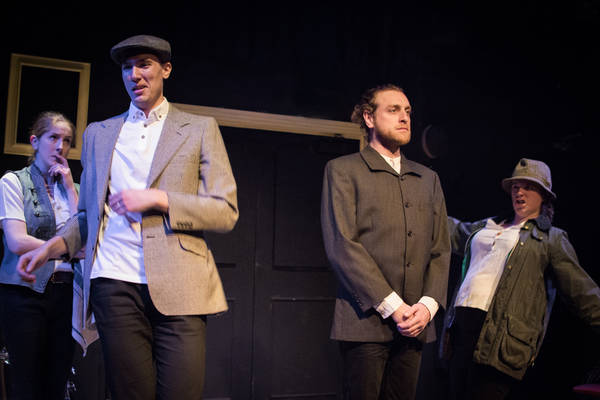
Company co-founder Nicky Diss, in an act of insightful  casting, plays Viola and Toby Belch. Her Viola is intense and boyish; her Belch is a gruff, posh older man. Diss’ presence and versatility are things of wonder, but she doesn’t outshine the rest of the cast. Her fellow co-founder Thomas Judd gives a Sir Andrew Aguecheek that is hapless and posh, a delightful interpretation that works very well; he doubles as a townie Orsino. Completing the quad are Oliver Lavery, particularly excelling as a hippy Feste and slimy Malvolio, and Madeliene MacMahon as a wonderfully frivolous Olivia. The four are all exceedingly good at creating clear, contrasting characters and have an energy that goes well beyond the walls of the tiny Hope Theatre.

There no set to speak of, which is fine for this play that changes location every scene. Costume pieces and musical instruments pepper the walls instead, giving easy access for changes. Hats, jackets and waistcoats over a uniform of black trousers and white shirts assist with character differentiation. It’s a simple but effective device to give visual variation and the lack of set reflects original practice. Occasional fiddly changes distract from the action on stage, but these moments are rare.

Some interesting alterations occur to facilitate the four actors, particularly the Sir Topas/Malvolio scene. Rather than Feste duping the prisoner, the lines are split between Sir Andrew, Toby and Maria. It’s believable enough despite vocal differences and makes no difference to the story.

Of the fringe Shakespeare that’s playing at the moment, the performances make this shoestring Twelfth Night a great one. Thick As Thieves are a talented, instinctual bunch certainly worth watching.

Twelfth Night runs through 30th April.

The Play’s the Thing UK is committed to covering fringe and progressive theatre in London and beyond. It is run entirely voluntarily and needs regular support to ensure its survival. For more information and to help The Play’s the Thing UK provide coverage of the theatre that needs reviews the most, visit its patreon.
Wendy Hoose, Soho Theatre

Laura is a single mum who just wants a shag. Jake is also a fan of no strings attached sex. When the two match on Tinder and he cabs it over to her east Glasgow neighbourhood, things start out swimmingly, if a bit awkward. When Jake discovers that Laura doesn’t have legs, his open minded intentions go out the window and both end up surprised by the evening’s evolution. A production that champions inclusive theatre, Birds of Paradise’s Wendy Hoose uses surtitles, audio description and signing as well as Johnny McKnight’s humour-laden script to remind us that different body types still very much want the same things and are just as lost as each other in both real and online worlds. McKnight’s sharp, witty dialogue and performances that evoke plenty of belly laughs make this an excellent, if a bit sentimental, example of integrated, inclusive theatre that goes below the surface of a body to discover what makes us modern human beings.

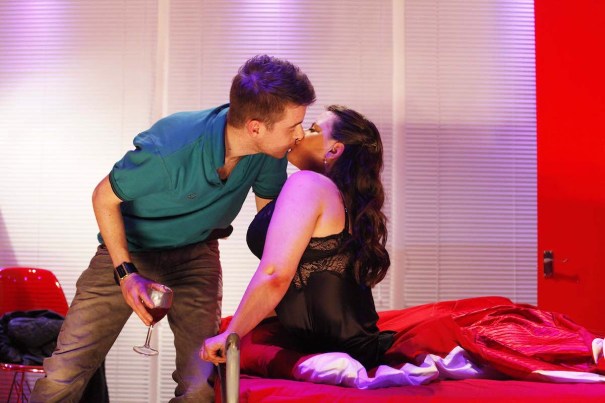
James Young is the nervous, self-conscious Jake desperately wanting to impress self-assured Laura (Amy Conachan). Personified by a bulging erection in colourful pants, he’s a great contrast to Laura’s black neglige and red satin bedding. Jake’s struggle to be PC when put off by the lack of thighs below her torso fantastically convinces, and is a pointed manifestation of a society that refuses to consider disabled people as sexual beings. Laura’s sarcastic, biting responses are excellently timed and show she’s no stranger to such treatment. Young and Conachan showcase their consistently great chemistry and presence through spiky tension and believable affection. 

Jake’s ensuing education due to a late taxi, whilst sweet and following a smooth progression, feels rushed and unrealistic, though. An hour isn’t long enough to change deep seated, unconscious prejudice and sexual attraction. This is a small issue dwarfed by plenty of other positives. What is most effective are the themes that extend beyond disability issues. Female objectification, societal standards of attractiveness and disparity between online and real life are just as prominent as Laura’s lack of legs and generate self-reflection on casual sex behaviour and what an individual finds sexy. The humour softens the initial impact of these topics, but they’re the lingering memories and provocations from the play.

Projection design and the audio describer’s snarky personality add additional levels of comedy, becoming semi-characters in their own right and breaking up this text-based script. McKnight’s banter and Conachan and Young’s work are the immediate appeal, but the weight behind the dialogue lasts well beyond Wendy Hoose’s curtain call. 

Wendy Hoose runs through 7 May.

The Play’s the Thing UK is committed to covering fringe and progressive theatre in London and beyond. It is run entirely voluntarily and needs regular support to ensure its survival. For more information and to help The Play’s the Thing UK provide coverage of the theatre that needs reviews the most, visit its patreon.

Gatsby, Union Theatre

Gatsby (c) Roy Tan (4)

Jay Gatsby’s distinctive yellow car is an iconic image in The Great Gatsby. Power, wealth and charisma emanate from its shimmering, custom paint job as it rolls between Long Island and Manhattan in the decadent 1920s. It’s eye catching and demands attention, like the enigmatic man who owns it. Adaptations of The Great Gatsby are plentiful, but good ones need the same characteristics as Gatsby’s car, along with a generous, heady mix of self-indulgence and extravaganza. Linnie Reedman and Joe Evans’ musical incarnation of F. Scott Fitzgerald’s iconic novel manages to avoid incorporating any these. Bland music, lazy performances and design and a book with numerous shortcomings makes Gatsby a stuttering, third-hand Ford Fiesta rather than a customized, purring Rolls Royce.

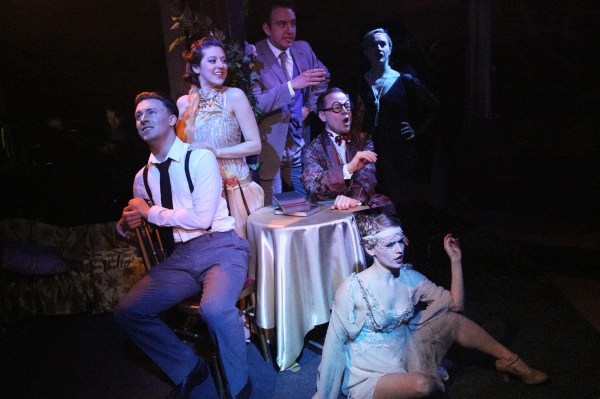
Reality TV celeb Ferne McCann makes her theatre debut in this production, bringing a lot of negative publicity with her as consequence. She’s also incredibly surprising – alone in a theatre-trained cast, she is the only one consistently able to be heard over the live actor-musos with her Amy Winehouse-influenced performance. Of the 13-strong cast, most are weak, some terribly so. They are either grotesquely overacted cartoons, or underplayed so much that their performances are flat. There’s no sense of danger or excitement, or EVERYTHING IS EXCITING ALL THE TIME FOR OVER TWO HOURS. It’s exhausting to take in. In either case, the characters are no more than stereotypes; this is more of an issue with Reedman’s book as it certainly doesn’t give the actors much depth to work with. Accents drift around the 50 states and then some, with the only consistent one coming from an actual American.

Reedman also directs, with little comprehension of the narrative arc she constructed from the novel. Other than the Plaza hotel scene late in the play when Daisy and Jay confess all to Tom, there is a pronounced lack of tension. Myrtle’s tragic end is anticlimactic and rushed, as is her husband George’s retaliation. She neglects characterization and seems to focus solely on staging. If that.

There are 21 musical numbers (including a couple of reprises), but none of Joe Evans’ tunes stands out from the rest. Even with a mix of smaller and larger numbers, there is little  musical variation. Transitions from book to song are often abrupt and forced for the sake of fitting in another tune rather than naturally reaching a point in the story where music is necessary to accentuate a plot point or emotion. Nick Pack’s choreography, without much to work with, is similarly unvaried with a bit of a Charleston every now and then.

There are few positives to pull from this production. Reedman and Evans’ interpretation is a choppy hatchet job of Fitzgerald’s work and few, if any, features deem it a worthy adaptation. If Gatsby’s goal is for the audience to “feel…the heat, sweat and life” of the euphoric, post-war American decade, it barely comes close. Tepid, cool and laconic is what actually comes across, in a wheezy motorcar threatening to cut out at any moment.

Gatsby runs through 30th April.

The Play’s the Thing UK is committed to covering fringe and progressive theatre in London and beyond. It is run entirely voluntarily and needs regular support to ensure its survival. For more information and to help The Play’s the Thing UK provide coverage of the theatre that needs reviews the most, visit its patreon.
Russian Dolls, King’s Head Theatre

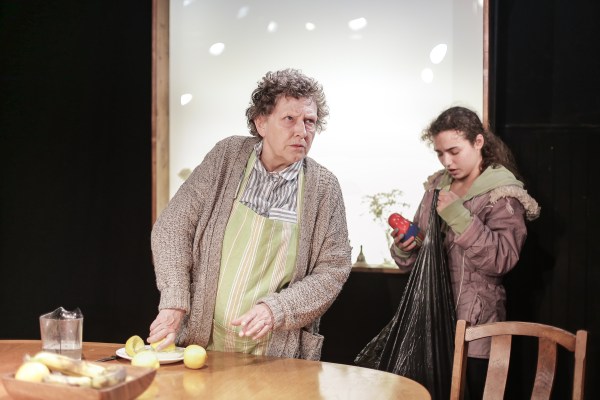
Russian Dolls at King's Head Theatre, Stephanie Fayerman and Mollie Lambert_1 © Andreas Grieger

Camelia’s just got out of young offenders’ but her mum never turned up to collect her, so she’s back to looking after herself. Hilda is a blind elderly woman fending of her goddaughter’s attempts to move her to Basingstoke. When Camelia robs Hilda after tricking into believing she’s covering for her carer, the two end up influencing each other much more than ever expected. Kate Lock’s Russian Dolls tells the fraught story of an unlikely dependency that is doomed to end badly for both women. Lock’s characters are fantastic, and their scenes together are tense and charged with moments of genuine tenderness. In between the scenes are narrative monologues that, whilst providing necessary information, are awkwardly addressed to the ether and disrupt the story’s momentum.

Stephanie Fayerman as Hilda and Mollie Lambert as Camelia are a volatile pair. The energy between them is either stormy or potentially so; the tension makes them wonderfully watchable. Their few scenes of relaxed openness towards the other are fleeting, but hugely rewarding and loaded with tough love. Both performances are excellent, and the dependency on the other is great to watch.

There is no sentimentality towards young people, the care system or aging in Lock’s script. The lack of happy ending is a touch disappointing, but it’s accurate. The stories of young people from broken homes actually managing to turn their lives around are rare considering the 69,540 young people in care as of March last year. Every now and again an “inspiring” case hits the news, but for the majority of these children, their lives are part of an endless cycle of poverty, abuse, drugs and jail time. Well done to Lock for not going the easy route with her narrative.

Structurally, the script is quite simple and there are large, frustrating chronological jumps that skips huge sections of both characters’ emotional journeys. This could easily be a full length, two-act play and would work very well as such. Provided the current ending is kept, a 2 hour or so build up would make it all the more devastating.

Russian Dolls, winner of the Adrian Pagan Award and shortlisted for the Bruntwood Prize, is a bolshy play full of life in all of its glorious imperfections. It’s an honest look at the care system and its flaws, but the actors’ characterization and electric relationship is the highlight of this new play.

Russian Dolls runs through 23 April.

The Play’s the Thing UK is committed to covering fringe and progressive theatre in London and beyond. It is run entirely voluntarily and needs regular support to ensure its survival. For more information and to help The Play’s the Thing UK provide coverage of the theatre that needs reviews the most, visit its patreon.
To Kill a Machine, King’s Head Theatre

To Kill a Machine: Scriptography Productions

How well can you condense Alan Turing’s life and work into one hour? Considering his technologically groundbreaking career, WWII code breaking and conviction for crimes of gross indecency, that’s a lot of source material for precious little time. Catrin Fflur Huws chooses to focus on the man behind the achievements at various pivotal points in his life for To Kill a Machine. From boarding school days to chemical castration shortly before his death, Huws shows the relationships rather than the events that shaped his life. Scenes of naturalism are interspersed with a surreal, presentational game show indicating the factors outside of Turing’s control that dictate his unfortunate fate at the hands of discrimination. Though stylistically dynamic, they are less compelling than the latter. Together, they make a good whole but with so much missing from Turing’s life, the highlights contained in To Kill a Machine shortchange the story of such an important man.

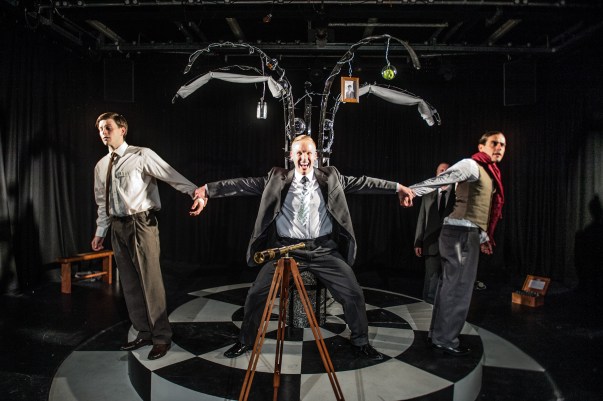
In the centre of a round platform, a wiry, mechanical tree by designer Cordielia Ashwell sprouts important mementos from Turing’s life: a photograph of Christopher, his first love at school, pages of indecipherable code, and the apple that he may or may not have used to kill himself. Its trunk is also a convenient place to store props and costume, but the visual aspect is the most dominant, and strikingly so. The symbol of life manifested in an everlasting, sculptural form against the items that were his downfall is powerful image.

The tree also dictates circular movements from the cast of four, most prominent in the game show scenes and Turing’s sex with his younger lover, Arnold Murray, who eventually betrays him – the moments where his life spirals irrevocably out of control. Alan’s eventual tethering to the tree via medical equipment during his “treatment” is a horrible,  effective reminder of history’s handing of people discovered to be gay and sapping their life force with discriminatory legislation.

Gwydion Rhys as Alan Turing is the anchor in the cast, with a nuanced and sensitive performance that leaves Benedict Cumberbatch’s generic interpretation in the dust. He is complimented well by intimate scenes with François Pandolfo as his school friend Christopher, and older brother John giving him advice in the run up the trial. This latter scene is by far the best in the play.

Though the script is good, it’s short length is unsatisfying and otherwise dwarfed by the performances and design. The structure works as does the lens with which it views Turing’s life, but surely there is more than an hour’s worth of material on the man behind the life-changing mathematician and inventor.

To Kill A Machine runs through 23 April.

The Play’s the Thing UK is committed to covering fringe and progressive theatre in London and beyond. It is run entirely voluntarily and needs regular support to ensure its survival. For more information and to help The Play’s the Thing UK provide coverage of the theatre that needs reviews the most, visit its patreon.
A Nation’s Theatre: Wail and The Beanfield, Battersea Arts Centre

For two months, theatre makers from across the country are coming to London to celebrate the state of British theatre. One of the A Nation’s Theatre venues is Battersea Arts Centre, currently hosting the double bill of Little Bulb’s Wail and Breach Theatre’s The Beanfield. Wail is an exuberant cabaret about whales and human expression; The Beanfield uses multimedia to examine the impact of police violence on peaceful people and the need to fit in. Though different from each other in content and tone, both Little Bulb and Breach play with performance conventions to create innovative new structures that are at the forefront of theatre performance.

WAIL_Little Bulb Theatre

There’s a lot of science in Wail, and a lot of musical instruments. Actor-musicians Clare Beresford and Dominic Conway, performing as themselves, also have boundless enthusiasm and impressive music repertoires. With material ranging from folk to metal, they share their enthusiasm for whales through songs alternating with monologues of scientific facts. Their charisma and cheer keeps these sections engaging, particularly with the addition of audience interaction. Though the overall energy is light and positive, Beresford’s melancholy for never actually seeing a whale in the flesh provides a bit of contrast to the Male Whale Choir, a hilarious whole-audience exploration of whale songs that males use when on the pull in the coastal waters of Madagascar.

There isn’t as much material on the promised exploration of why humans wail, but a song about why they sing songs is a tender, poignant homage to feeling fragile. This fun, frivolous show is light on the gravitas that a bit more time on this topic could bring, but Wail is still a wonderful, joyful piece as is. The symphonic final number is a fantastic climax wrapping up an excellent contribution to A Nation’s Theatre.

The Beanfield_014_please credit Richard Davenport

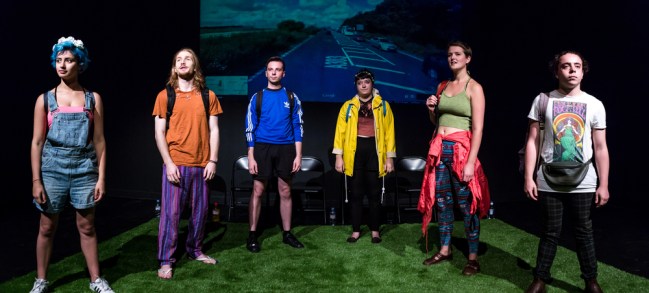
The Beanfield by Warwick University’s Breach Theatre wowed audiences at Edinburgh last summer, and understandably so. Drawing on the historic clash between new age travelers heading to Stonehenge and police fresh from the miners’ strikes, they add the framing device of a uni reenactment group researching the event in order to recreate it, and a counter narrative of a group of students going to Solstice. It’s a sophisticated script with plenty of absurdity to lighten the bleak depiction of police violence against unarmed civilians, but still serves as a potent reminder that this happens today in the UK and abroad. Part documentary, interview footage with witnesses on both sides is broadcast liberally; even though the inclusion of police is sympathetic, The Beanfield firmly supports the travelers. Rightly so – pregnant women and children were among the 600 or so attacked with truncheons and projectiles by 1000-odd police.

There is no explicit link between the Beanfield story and that of the contemporary, skeptical students at Solstice, but the inclusion of the latter provides some necessary humour. It’s not a needed subplot though, and detracts from the power behind the political statement of the Beanfield standoff. The script is a great collage of experiences past and present, the sweet naivety of students juxtaposing the atrocities that happened at thirty years previously. The Beanfield, a bit less polished than Wail, is still an excellent piece of theatre with some important thoughts on police brutality.

With multimedia at its forefront, The Beanfield captures the rapid-fire sensory bombardment of present day youth and the desire to instigate change as well as fit in with our peers. Wail, mostly analogue and much less angry, implies the importance of conservation and sympathy for all creatures, human and not. Both shows excellently address concerns of people in this country and experiment with performance, fitting contributions to A Nation’s Theatre.

Wail runs until 23 April, The Beanfield until 21 April then touring.

The Play’s the Thing UK is committed to covering fringe and progressive theatre in London and beyond. It is run entirely voluntarily and needs regular support to ensure its survival. For more information and to help The Play’s the Thing UK provide coverage of the theatre that needs reviews the most, visit its patreon.

X, Royal Court

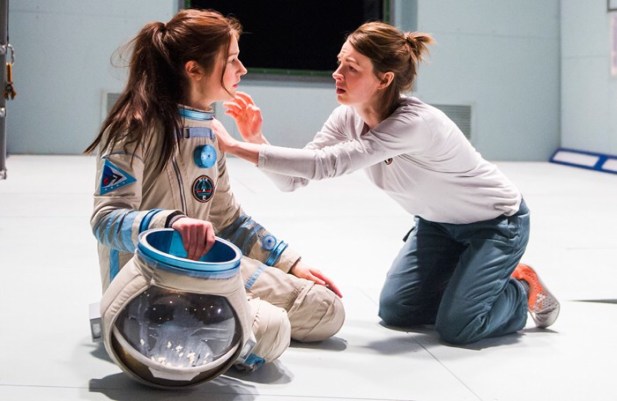
Alistair McDowall’s Pomona was one of the best things I saw last year, after it transferred to the National. Like many others I eagerly awaited his latest work, X, at the Royal Court. Set on a research station on Pluto some time in the future after all the trees and birds have died on earth, The team of four (or is it five?) have been forgotten. Or maybe there’s been an apocalypse on Earth. Or they’ve been deliberately left. We never find out. When the clock they live their life by breaks, everything else around and within them collapses. The longer they’re out there, the less real things become. 

Like in Pomona, McDowall explores time, the nature of reality, and the impact these factors have on relationships and individual characters’ mental stability. Whilst lacking the immediately visceral impact of Pomona, X is a more austere, mature play in content, but is structured in a way that is open to individual interpretation – what is objective reality what is inside the characters’ heads? The ideas are much more interesting than this particular execution, though. The characters are a bit boring and underdeveloped, victims to their surroundings and their own minds. Without the excellent tech and design brought in by director Vicky Featherstone, X would struggle to hold some people’s attention. With two acts radically different in style and questioning the other’s veracity, individual audience members will prefer one over the other and draw their own conclusions about what the “real” story is. Though a highly commendable thing for fostering dialogue, it can also confuse and alienate the more casual theatregoer, leaving broader themes and ideas ignored. Together though, the two halves make a splendid, provocative whole if the ideas are able to be seen past any immediate frustrations with plot or characterisation.

There seem to be theoretical physics and pop culture references at work that I’m missing due to having no interest in physics or science fiction, but the question of how much strain the human brain can endure under extreme circumstances has relevance beyond McDowall’s remote world. These characters could be anywhere: a brothel in the middle of London, a refugee camp, or a war prison. With months turning into years, infrastructures breaking down and no means of communicating with the outside world or anywhere to go, the disempowerment and inner collapse is palpable. Their inability to act feels like a sci-fi Beckett and Chekhov as McDowall rips, folds and turns linear time.

Though the characters are understandably powerless, it’s their perpetual victimhood that makes them hard to stomach. Gilda’s anxious crying quickly becomes tedious, as does Clark’s standoffishness. Ray and Cole are more complex, but seen less often. More of Mattie’s humour would help alleviate the near-constant intensity. There are some lovely moments of tenderness in the second half; Jessica Raine (Gilda) and James Harkness (Clark) scene of intimacy is particularly lovely, as is Raine’s transformation towards both young and older Mattie. 

Merle Hensel’s design simply sets up the prospect of skewed perception that develops into full-on chaos the longer the characters wait. It’s a fantastic development full of surprises, tightly mirroring McDowall’s unraveling of time, sanity and language. I don’t know if it was a deliberate choice by lighting designer Lee Curran or a happy accident of light reflections, but the spot of blue in the sole window looking out on nothing served as a constant reminder of the blue planet they left behind.

Alistair McDowall’s gifts for surprising the audience and questioning our perception of reality is running full tilt in X, but it takes awhile to build up speed. Though the first half provides necessary context, there’s a slowness to the character’s waiting for rescue that is a bit dull. But once the clock breaks and the lack of time ushers in a new existence, we see bigger forces are at work behind our tiny lives. 

X runs at The Royal Court until 7 May.

The Play’s the Thing UK is committed to covering fringe and progressive theatre in London and beyond. It is run entirely voluntarily and needs regular support to ensure its survival. For more information and to help The Play’s the Thing UK provide coverage of the theatre that needs reviews the most, visit its patreon.
Hamlet our brother, Brockley Jack Studio Theatre

It’s purely anecdotal, but it feels like one-person shows have become vastly more popular over the past few years. It makes sense: they’re cheaper to produce, easy to tour, give theatre makers autonomy, often experimental in form and a great way to hone performance skills. They’ve quickly become much more sophisticated, are moving away from their performance art roots and can be about anything. It’s a form that’s extremely hard to execute well, and most solo shows I’ve seen have been ok. Some have been brilliant, some have been terrible. I hoped that Hamlet our brother, considering it’s a Shakespeare-based one-person show, would be the former but the unclearly conveyed concept pushes it away from that end of the quality scale.

This isn’t an awful production by any means, but making a one-person show using Hamlet was never going to be easy. It’s Shakespeare’s longest play and arguably, his character most open to interpretation. Julia Stubbs Hughes seeks to tell the story from Horatio’s perspective but limits herself to only using Shakespeare’s text. There’s plenty to work with at 4,042 lines (and she adds a bit of the Bad Quarto as well), but Hamlet our brother bears more resemblance to a “Best Of” Hamlet than a particular perspective on the story’s events. Clarity isn’t improved by the use of a lot of content that Horatio isn’t present for and it would be easy to mistake the performer (Jeffrey Mundell) for the title role. Whilst the idea of deconstructing Shakespeare into other performance structures is a fascinating one that should be explored, in this case Stubbs Hughes stuck too close to the original source material, interfering with her concept of Horatio recalling the play’s unfolding. If Hamlet our brother is set in a world outside the original, new dialogue to add even the most basic exposition would have huge benefit.

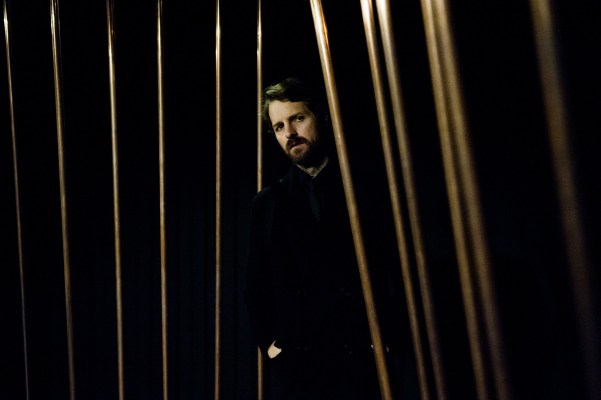
Though the concept and script don’t work, they are the only weak points in this production. Mundell’s intense, physical performance is fantastic, as are the design components. Karl Swinyard’s set, two rows of copper pipes forming a cell-like corner, is simple but creates striking shadows with Katie Nicolls’ lighting. Their surprising fluidity and balletic potential is underused by director Timothy Stubbs Hughes. Philip Matejtschuk’s composition and sound design are also neglected by Stubbs Hughes; it’s presence adds atmosphere and precision to the story that could have more variety to the moods with the addition of a full score.

Hamlet our brother needs clarity in the execution of the concept and a concise point of view: what makes Horatio’s perspective unique? What happened next that makes him doomed to relive this tragic tale over and over? Though these questions remain unanswered by the script, Mundell’s interpretation of the tortured Dane and the visual and aural landscape built by the designers helps detract from the confusion.

The Play’s the Thing UK is committed to covering fringe and progressive theatre in London and beyond. It is run entirely voluntarily and needs regular support to ensure its survival. For more information and to help The Play’s the Thing UK provide coverage of the theatre that needs reviews the most, visit its patreon.
Danny and the Deep Blue Sea, Theatre N16

John Patrick Shanley isn’t particularly well-known this side of the pond, but back in the States, this Irish-American playwright from a rough part of the Bronx is regularly produced. Probably most well-known for his Pulitzer Prize-winning play Doubt: A Parable, he is still writing plays and films. Currently exceeding 23 in number, he’s as prolific as Shakespeare and much more so than many playwrights of his generation. Though his early works lack the trappings of modern technology, the focus on relationship and family dynamics transcend any dated aspects of the setting. Danny and the Deep Blue Sea is Shanley’s second play, a two-handler set in a dingy Bronx bar where Danny and Roberta, two strangers running out of steam to continue in their own skin, find solace in a night of intimacy. Theatrum Veritatus resurrect this Shanley play from the ’80s with a solid production grounded in good performances and direction that seeks to tell this story of two lonely, angry people looking for someone to help them escape their dismal realities. 

Gareth O’Connor and Megan Lloyd-Jones are Danny and Roberta. Both are coldly aggressive, defensive against the world that has dragged them through the muck. Both have their secrets and recognise a kindred spirit across an empty bar. O’Connor nails Danny’s aggression but convincingly softens in his intimate moments with Roberta. Lloyd-Jones does the same with a character that is arguably more horrific and manipulative, but her capacity for vulnerability within such a character is admirable. The two have great chemistry and ability to capture nuance within broader characterisation choices.

Director Courtney Larkin takes advantage of the small bar in TheatreN16 and doubles up the technician as an unspeaking barman. It’s a clever device; luckily she found a willing board operator. The staging didn’t always cater to audience sight lines, though. With the bar perpendicular to one side of the audience, she followed that line rather than a diagonal that would make it easier to see both characters when they are sitting at the same table. The bedroom scenes avoided this, but with the bed as a mattress on the floor and no audience rake, this also challenged audience members beyond the first row. Otherwise there are no issues with Larkin’s work – she allows the text to breathe and grow at its own pace. 

Shanley’s script is understandably dated and has some implausible transitions, especially considering New Yorkers aren’t prone to striking up conversations with random strangers. These are soon forgotten in favour of the performances and actors’ sensitivity to the other’s character. It’s a touching story about the human condition and need to connect with others, no matter how damaged we might be, and the character-driven plot in a well-suited venue make this a good production of a little-known modern American classic.

The Play’s the Thing UK is committed to covering fringe and progressive theatre in London and beyond. It is run entirely voluntarily and needs regular support to ensure its survival. For more information and to help The Play’s the Thing UK provide coverage of the theatre that needs reviews the most, visit its patreon.