
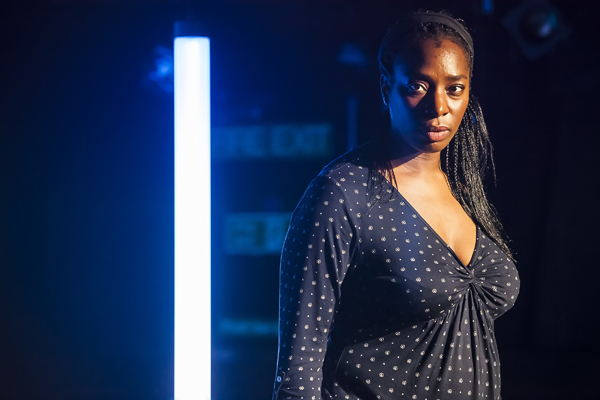
 We never meet Joanne. We do however, meet four women who encounter her at different points over a crucial 24-hour period of her life, and one that remembers her as a child. We learn that she cuts a tall, striking figure, makes immediate impact on those she meets and she doesn’t seem to fit in anywhere the world. Joanne is homeless and has just been released from prison. Production company Clean Break, founded by 2 female prisoners in 1979 and still producing, recognizes the importance of sharing stories from vulnerable women prone to falling through society’s cracks. Joanne, written by five female playwrights, has some wonderful writing and is skillfully performed in an intimate space but the brevity of the monologues and talking around Joanne distances rather than fully engages.
Tanya Moodie first plays a key worker, then easily slips into a police officer, an NHS receptionist, a hostel cleaner and a teacher. All were moved by Joanne’s plight and wanted to help her, innately sensing her need for support. These women related to something within Joanne, humanizing her and the thousands of other female prisoners like her. Moodie captures the genuine care these women feel, as well as their conflict – police officer Grace isn’t supposed to get attached to her cases, but alludes to her own struggle with finding a place in the world for her and her daughter. I am particularly touched by Kathleen, on the front line of an NHS hospital for 28 years. She makes some pointed critiques of government legislation’s effects on her workplace and its effects on those most needing care. These stories are much more engrossing than Joanne’s because they’re in front of us, as Joanne herself is a shadowy puzzle that we slowly and satisfyingly piece together.
Through written by five different writers, the monologues seamlessly connect but remain stylistically distinct. Told in the past tense through the sharing of memories, they are fine examples of storytelling that Moodie makes active and varied rather than nostalgic. She owns the distinct characterization of these women, skillfully masking Róisín McBrinn’s direction. Colour changing light-up columns and panels add visual variation, but don’t contribute towards meaning or location. Their presence is unimposing, but unnecessary. The otherwise minimal, black set draws all attention onto Moodie, as it should in this production. Audience focus is on Joanne’s attempted helpers and their capacity to empathise; they are more solid and demanding of immediate attention than the silhouetted subject of their stories who leaves nothing but a memory.
The Play’s The Thing UK is an independent theatre criticism website maintained voluntarily. Whilst donations are never expected, they are hugely appreciated and will enable more time to be spent reviewing theatre productions of all sizes. Click here to make a donation with PayPal.
 Most Shakespeare I see is performed with the actors’ genders matching that of the characters they play. Sometimes I see token cross-gender or gender-blind casting within an own-gender cast, sometimes all-male productions and less often, all-female productions (
 Punks Paul, Jan and Louis are working class lads living in south London. School didn’t do much for them and unemployment is high, so they hang around and smoke, nick cars and try to pull girls. They’re bored, angry and frustrated at the lack of opportunities available to poor kids like them. They want to improve their quality of life and feel like they belong in society, but society’s too busy fighting terrorism and racism to pay them any attention so they do their best to get by, or not. It sounds like the present, right? Nope. Barrie Keeffe’s Barbarians premiered in 1977. As London battles the National Front, striking unions and IRA bombs to a soundtrack of The Clash and The Sex Pistols, audiences can’t help but draw parallels between life then and now. It’s unsurprising this Tooting Arts Club/Soho Theatre production will soon be followed by the Young Vic’s, a completely different production of the same play, what with its contemporary social relevance and three fantastic roles for young actors to get stuck into. Though close to three hours long and composed of three self-contained plays at different points in the boys’ lives, the excellent performances, atmospheric venue and socio-political comment make the time well spent.
 Whilst visiting a Caribbean island about 100 years ago, Brutus Jones, an African American train driver, some how ends up emperor of the island’s native tribe. His reign is brutal, so Jones knows it will eventually end. Eugene O’Neill’s 1920 The Emperor Jones begins with Jones’ initially relaxed attempt at escape from the uprising citizens, and inevitable guilty descent into the madness of a Shakespearian villain. The script is entirely spoken by Jones, barring the first and last scenes, with his madness peppered with ghosts that won’t let him rest in the darkness of the island’s woods.
 New writing based on classical literature, with the audience being served Italian food as part of the performance, sounds like a cracking way to spend an evening. The Gastronomical Comedy tells Dante’s story as he tries to be an actor in London but ends up working in his wife’s uncle’s restaurant, The Inferno, to pay the bills. It’s a timeless story of artistic struggle meant to parallel Dante Alighieri’s journey through hell, though the connection between the two stories was tenuous at best as the modern day Dante didn’t encounter particularly difficult opposition to his dreams. Despite good performances, it’s a concept that is good in principle but feels very much like a work-in-progress in need of quite a lot of script development before being a completed piece of theatre.
 May, 1961. The American south. Segregation has been ruled unconstitutional, but southern states ignore the legislation and the federal government does nothing to enforce it. Activists of all ages and races, sponsored by civil rights organizations, challenge this non-enforcement on public transport and customer services by sending groups of riders, black and white, on interstate bus journeys from Washington DC to New Orleans.
 The Play's The Thing UK