Party Trap, Shoreditch Town Hall

https://www.thestage.co.uk/wp-content/uploads/2016/09/Party-Trap-Alex-Brenner-no-use-without-credit-Show-and-Tell-Party-Trap-by-Ross-SutherlandShoreditch-Town-Hall-_DSC5659.jpg

Politicians and members of the press are hardly the best of bedfellows. Unrestrained and violent, Ross Sutherland’s Party Trap explodes this relationship in a dystopian TV interview between journalist Sir David Bradley and MP Amanda Barkham after a landmark decision classifying political criticism as hate speech. Sutherland sets himself the challenge of telling his story through a script that’s an extended palindrome – an impressive feat, were it executed with more of a focus on storytelling rather than showing off a clever concept.

The palindromic writing isn’t particularly pronounced; instead it creates a haunting sense of deja vu once the script passes the halfway point. The shift in power and control from David to Amanda, and the action’s dark turn prevents it from turning stale, but the script structure is still more of a hindrance than a help. The language takes precedence over story clarity, so the plot soon muddies. The slightly futuristic premise becomes less and less tenable, to the point that the entire reality of the piece is called into question. There is little solid ground on which to build a sturdy plot line; language isn’t enough even though this experiment is certainly an interesting one.

The performances are one of the biggest disappointments. Cold and detached, they are couched in venomous sarcasm and violence. Simon Hepworth as Sir David Bradley has some nice moments of vulnerability and depth, but these are too little and too late. Otherwise, he and Zara Plessard are ruthless, calculating and distant. Video performances of other characters are relied on to fill in for news broadcasts and line managers with disturbing agendas; these characters are as self-absorbed as the two on stage.

The design elements are unobtrusive and tie the production together well, with Sutherland’s projections and video being particularly slick.There is no question that Party Trap is well-planned and thought out, but the concept is so prominent that it prevents a story from shining through. It’s a worthy experiment, but one that doesn’t work.

Party Trap runs through 1 October.

The Play’s the Thing UK is committed to covering fringe and progressive theatre in London and beyond. It is run entirely voluntarily and needs regular support to ensure its survival. For more information and to help The Play’s the Thing UK provide coverage of the theatre that needs reviews the most, visit its patreon.

The Inevitable Heartbreak of Gavin Plimsole, Edinburgh Festival Fringe

https://theplaysthethinguk.com/wp-content/uploads/2016/08/05b71-gavin2bplimsole2b252812529.jpg

Gavin Plimsole is a good enough guy. A bit geeky and nervous but well-meaning, maybe even a bit endearing if you like that sort of thing. After he receives a life-altering diagnosis from the cardiologist and realises his days are numbered, the audience (who have all strapped into heart monitors before the show begins), get to decide his fate. Part choose-your-own adventure, part poignant tale of grief morning people and times long lost, The Inevitable Heartbreak of Gavin Plimsole is a messy but touching reminder to make the most of every moment.

An ever-present projection of the audience members heartbeats overlays three energetic performers and a changing landscape of cardboard boxes. Gavin’s the sort that stores his life in tattered boxes labelled with masking tape, and these boxes now contain relics from his life. They aren’t particularly interesting, but a garden shed with a wonderful contraption that releases a large marble down a slide and into a box every 500 collective heartbeats, is ramshackle but dynamic. It cleverly represents our perpetual approach towards death with a drawn out clattering and eventual silence – a dying person’s last breaths.

Gavin monologues most of his thoughts; there are some interruptions by spunky, supporting actors that help break up the speeches but more of these would be welcome. A wiry (literally, as in made of wires) puppet makes one appearance and is similarly underused – a remarkable creature! The structure is understandable chaos that mirrors the the first couple of days after devastating news, though clearer transitions and a distinct style will help make sense of this emotional journey.

The use of the heart monitors and audience interaction unites the audience and performers, creating intimacy and empathy. It’s a sad story that manages to foster hope instead of gloom, and within the clutter there’s a lot of heart.

The Inevitable Heartbreak of Gavin Plimsole runs through 29th August.

The Play’s the Thing UK is committed to covering fringe and progressive theatre in London and beyond. It is run entirely voluntarily and needs regular support to ensure its survival. For more information and to help The Play’s the Thing UK provide coverage of the theatre that needs reviews the most, visit its patreon.

Invisible Treasure, Ovalhouse Theatre

https://files.list.co.uk/images/i/invisible-treasure-lst184367.jpg

Invisible Treasure has no script and no actors. It’s not a play, but a playspace. For this hour long part-video game, part-puzzle, the audience/participants must work together to interpret the cryptic tasks that pop up on a small screen in the sterile room where they are deposited by theatre staff. The sensors, cameras and microphones that monitor the group at all times determine whether or not you progress to the next level or not, and the chance of failure is very real indeed. A giant white rabbit sinisterly lurks in the corner, its unblinking eyes the Big Brother that is unseen but all seeing. As the levels get harder, group dynamics become more pronounced. Emotions build and there’s potential for rebellion, made more exciting by each group’s unique composition. fanSHEN’s installation/event/environment’s use of interactive technology gives audiences a high degree of agency, but is still a powerful reminder that we are never truly free.

Hellicar & Lewis’ technical design is hugely impressive, or at least it is to a tech Luddite like myself. Others may find it less so but the unification and application are still incredibly inventive. The levels’ tasks require both problem solving and play that the group, on the whole, enjoyed even though some went on a bit too long. Those that aren’t keen on audience interaction or are introverted may find it challenging to engage, but as everyone is in the same position, it also might not feel so threatening. With clear leaders and followers quickly emerging, it’s possible to not contribute ideas but not joining in doesn’t feel like an option. It’s fascinating to watch others, and easy to let go and remember the childlike joy of playing without knowing where the game will lead.

When describing the experience with a friend afterwards, he boldly stated that it doesn’t sound like theatre. To be honest, I still haven’t decided if it is. But it is incredibly theatrical. With practitioners constantly trying to push the limits of immersive and interactive theatre, Invisible Treasure is certainly at the forefront and will create a personal experience and reaction for each person that attends. It’s tempting to go again and see what differs.

On completion of the levels, bonus rounds and free play sections the group is released into an analogue liminal space to process their thoughts and feedback on their experience. This relaxed environment provides an opportunity to decompress and discuss, but could, for some, lessen the impact of the experience by discovering how it works. Though this project is still in the early stages of its development, its certainly furthering the merging of theatre and gaming to empower audiences, and a wonderfully fun experience.


The Play’s The Thing UK is an independent theatre criticism website maintained voluntarily. Whilst donations are never expected, they are hugely appreciated and will enable more time to be spent reviewing theatre productions of all sizes. Click here to make a donation with PayPal.

The Four Fridas, Woolwich Barracks

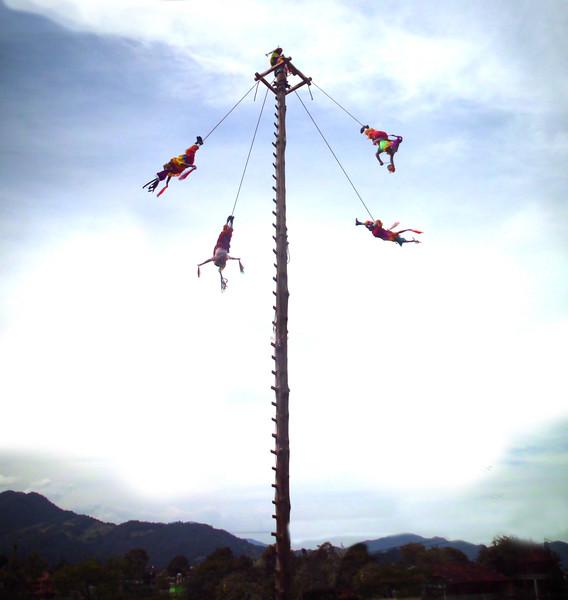
Voladoras_1396b-LWhen she was little, Frida Kahlo yearned to be able to fly. Her parents’ gift of a dress with wings proved disappointing though her dreams of flight remained, particularly following a crippling bus accident that left her with chronic pain and unable to have children. Bedridden for months during her recovery, she channeled her despair and rage into painting. These paintings, along with the ones she made over the rest of her short life, are the inspiration for Bradley Hemmings’ stunning outdoor multimedia event at Greenwich & Docklands International Festival this year. Using pyrotechnics, dance, projections, aerialists, music and the Mexican fertility ritual of the Voladores, The Four Fridas is a visually arresting spectacle but the show that is meant to be a tribute to Kahlo does not provide any particularly unique insight into her life and work.

Divided into for sections that reflect the elements earth, air, water and fire, The Four Fridas chronicles Kahlo’s life. Whilst there were clear acts to the script that took place in different areas of the site, the association with the elements was loose at best. The most sculptural set piece, a bus and tram crash built from metal and crates, was only used briefly towards the beginning. The script itself was fantastical and poetic, but densely written and delivered at a quick, even pace. The language was second rate to the visuals, though what with how impressive they were it would be nigh on impossible to surpass them with any other production element. It was easy to ignore the language in favour of visual performance surrounding the audience allowed to freely wander the performance site.

There were two highlights of the 45-minute long production. The first was an extended projection and aerialist hybrid against a giant screen held up by a crane. The projections were animations based on Kahlo’s work, with the performers against the screen adding texture and further detail. The most exquisite sequence was a flying butterfly, with a performer as the body of the insect. Each aerialist was controlled by a less obvious human counterbalance who scrambled up and down the vertical rigging on the side of the screen. This added an element of puppetry to the performance mediums used. These sections reflected freedom Kahlo felt when painting and her anguish of being trapped in a body that had previously been healthy and unscarred, but made no specific comments on her life.

The second most notable feature was the ancient ritual of the Voladores. Using nothing but rope to ensure their safety, four people climbed a wooden pole without harness, only to fall backwards suspended by their feet. The top section of the pole gently spirals, lowering them to the ground. Whilst this is a Mexican fertility ritual, the vague connections to Kahlo are her inability to bear children and that it also hails from Mexico. Surely it is an affront to an infertile woman to end a performance about her life with hope for children? Nevertheless, it is a remarkable cultural phenomenon to witness.

The free access to an event with such high technical requirements is highly commendable, though the tech is at the mercy of the outdoors. On the last night, part of a scaffolding tower collapsed and had to be removed (fortunately no one was hurt). On a previous night, winds meant that the screen was unable to be used. Whilst this adds to the immediacy of live performance, it also means the performance is shortened. Whilst it was free to stand in the site and watch, bleacher seats came at a price. Those that paid may have felt short changed by the abbreviated length.

Hemmings had set the bar high for this kind of accessible public performance though his work on the Paralympic Games Opening Ceremony and stylistically, work like this should be produced often, up and down the country. It is a shame that the spectacle did not particularly support the woman it is meant to honour. Even with basic knowledge of Kahlo and her work; the opportunity was there to communicate a deeper understanding but that was never reached. Though this kind of theatre is still new and infrequently produced, it should aim to develop more nuance and meaning. I look forward to more artists creating large-scale public performances incorporating a rich combination of performance practice and technology. This is the sort of art that has the potential to capture public affection and encourage them to more fully marry art with day-to-day life.


The Play’s The Thing UK is an independent theatre criticism website maintained voluntarily. Whilst donations are never expected, they are hugely appreciated and will enable more time to be spent reviewing theatre productions of all sizes. Click here to make a donation with PalPal.