Nuclear War, Royal Court

https://cdn.thestage.co.uk/wp-content/uploads/2017/04/21171628/Nuclear-WarDSC5303Andrew-Sheridan-Beatrice-Scirocchi-Maureen-Beattie-Gerrome-Miller-and-Sharon-Duncan-Brewster-c-Chloe-Lamford-700x455.jpg

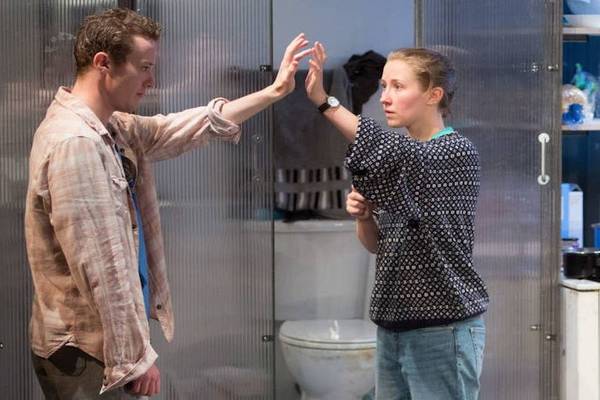
In his introduction to the Nuclear War text, Simon Stephens explains that as a playwright, he does not want directors and performers to revere him. Rather, he wants them to see his scripts as a starting point for their own creativity. The third line of the stage directions is, ‘a series of suggestions for a piece of theatre’; from these suggestions, choreographer-director Imogen Knight shapes a haunting landscape of physicalised despair.

Continue reading

The Kid Stays in the Picture, Royal Court

https://cdn.thestage.co.uk/wp-content/uploads/2017/03/22163612/Kid-Stays-In-The-Picture-Royal-Court-4291.jpg

By guest critic Willa O’Brian

The American dream is a tantalising thing. Even the grubbiest kid from New York, the son of a nobody dentist, can become a film star and producer. This is Robert Evans’ story, the man responsible for pictures like ‘The Godfather’. Complicité’s Simon McBurney adapted the show from Evans’ autobiography, which paints a picture from a better time: when movies were pictures and hard boiled men tacked “see?” on the ends of sentences wreathed in cigarette smoke. It is visually sumptuous and the cast of eight are a constantly churning ensemble that whip the story into a froth and delivery a sensory overload of American tropes and history and multi-media tricks. Given the subject matter, the desire to incorporate all of these elements makes sense.

Continue reading

a profoundly affectionate, passionate devotion to someone (-noun), Royal Court

https://i0.wp.com/www.theartsdesk.com/sites/default/files/images/stories/THEATRE/aleks_sierz/profound2.jpg

There are loads of jokes and stereotypes about life within a heterosexual relationship – women talk too much, men don’t understand the difficulties of pregnancy, LTRs feel like a burden, and so forth. Of course each relationship has its unique aspects, but there are common elements that often make generalisations about love ring true. Writer/director debbie tucker green discards many of the trappings of character specificity to expose universal truths about love and relationships in a powerful, moving script with elemental staging that taps into common experience.

Continue reading

Wish List, Royal Court

rsz_wist-list-image-1000x574

Nineteen-year-old Tamsin wants to be a normal teenager. She wants to go to college, flirt with cute boys and go down the pub. She doesn’t want to be stuck in a cycle of poverty that dictates she’s either doing manual labour at a “fulfilment centre”, or caring for her younger brother with OCD so severe he can’t leave the house. Everyday is a struggle to keep herself together since her mum died and British society has turned against them. To the wider world, she and her brother are tiny, invisible cogs in a brutal machine out to destroy the most vulnerable.

Continue reading

Father Comes Home From the Wars (Parts 1, 2 & 3), Royal Court

https://i0.wp.com/www.officiallondontheatre.co.uk/servlet/file/store5/item374788/version1/fileservice770/374788_770_preview.jpg

American, Pulitzer Prize-winning playwright Suzan-Lori Parks doesn’t shy away from epic projects. Six years ago, she wrote a play a day to create 365 Days/365 Plays, then went on to write the nine-part Father Comes Home From the Wars. Parts one, two and three centre around Hero, a strapping young slave on a remote Texan farm. Spanning the Civil War, this epic story with influence from Greek myths and contemporary socio-political issues in Parks’ distinctive, poetic language takes its time to develop and has some discordant stylistic choices, but its narrative and historical interpretation is both compelling and important.

Each of the three parts has moments of profound brilliance and devastation, but Parks is in no rush to tell her story. The dialogue-driven script takes its time, meandering around a complex landscape of slavery, loyalty and race within this particular slave family. Though set in war time, there is little action – broader issues drive the conversation more so than current events. This is more of a kitchen sink drama than a wartime adventure story.

Part one solely takes place on the farm as Hero debates whether or not join his master in battle. The rest of the slaves take bets and try to persuade him one way or the other, but in the back of Hero’s mind is a promise from the Boss-Master – but is he likely to keep his end of the deal? Hero’s loyalty is split between his owner and his wife Penny, but the lure of the cast-off but smart uniform proves too much. Though little happens, the domesticity of part one has some of the tension that precedes a huge decision. Seeing a tall, strapping black man in the prime of his life wearing Confederate greys is most unsettling; this paired with the ingrained, accepted attitude that he is the property of his owner is a potent reminder that there has been insufficient progress in America’s attempts at racial equality.

Part two, though set at a particular moment in the midst of the war, has the calm of an eye of a storm and is by far the best of the three parts. Hero and Boss-Master have captured a Yankee prisoner whilst separated from their regiment during a battle. Hero’s loyalty is tested again, this time by his prisoner upon discovery of a secret that’s hidden in plain sight and only skin deep. Racial identity, individuality and freedom intertwine in an intoxicating allure of potential for Hero, who is still doggedly loyal to his owner. The powerful ending devastates in its frank depiction of ingrained attitudes of racial inferiority and liberal frustration with this mentality.

Part three is the more mature sibling to part one. The characters are older, wiser and more world weary in the face of Southern defeat. The pre-war certainty has given way to a chance at the great unknown of freedom, and for the first time they can choose where they live – anywhere in the great, wide world, or on the farm they have known forever. Penny and Hero’s devotion is destabilised in this irrevocably changed world that is now free, but cold and dangerous – and still is for black Americans today. The morality of freedom isn’t black or white here, but the ominous, thought-provoking grey of Hero’s, (now called Ulysses) uniform.

Neil Patel’s unforgiving desert of a set doesn’t have bells and whistles, but it’s sparsity highlights the richness of Park’s language and characterisation. Steve Toussaint is the remarkable Hero, painted with delicate light and shade. The rest of the cast are excellent in their own right, though lack the development of the initially appropriately-named lead.

Parks’ script is almost completely bedded in realism (that’s occasionally heightened), though a talking pet and some contemporary costumes slightly skew reality. Both are used sparingly and without any evident justification across the three parts so their inclusion feels jarring and unnecessary. The onstage musician, though very much a separate commentator, doesn’t clash the way these choices do.

For a play set during a war and a pivotal moment of America’s history, it is oddly detached from violence and conflict. Instead, Parks’ text goes after deeper themes within this transition from slavery to freedom. Though a greater sense of danger and looming dread would add needed further tension in parts one and two, the nuance that flows through the story is undeniably exquisite.

Father Comes Home From the Wars (Parts 1, 2 & 3) run through 22 October.

The Play’s the Thing UK is committed to covering fringe and progressive theatre in London and beyond. It is run entirely voluntarily and needs regular support to ensure its survival. For more information and to help The Play’s the Thing UK provide coverage of the theatre that needs reviews the most, visit its patreon.

Unreachable, Royal Court

Anthony Neilson didn’t come into Unreachable rehearsals with a script, but an idea – a director obsessed with finding the perfect light. From this starting point, the cast sculpted a modern satire of the film industry and the people that exist in that world. Over a six-week devising and rehearsal period, six actors worked with Neilson to create the play, a rarity in anything other than small-scale and student theatre. The end result is wickedly funny with on-point performances and, whilst the story isn’t anything remarkable, its execution makes for delicious relief from the chaos of modern Britain.

Maxim (Matt Smith) is Palme d’Or winning writer and director of Child of Ashes, currently filming in an unnamed location. He pushes the self-absorbed, whimsical artist stereotype to the limit with full-on strops, totally inappropriate comments and decisions that blow his producer’s budget. He is camp, temperamental and a fantastic physical comedian. His lead actor Natasha (Tamara Lawrence) is an unfeeling, blunt force of a sociopath who clashes with lead actor Ivan “The Brute” (a sidesplitting Jonjo O’Neill in ridiculous hair extensions). On his production team are the pragmatic producer Amanda Drew, frustrated DOP Richard Pyros, and deaf financial backer Genevieve Barr. Their grounded personalities create plenty of friction (literally, in some cases) by clashing with the flamboyant artists as the shoot goes over budget and over time. Some of the arguments are petty, others deserving, but all just as hilarious. Nielson mocks artists’ egos, but it’s not nasty – anyone working in the arts will have met at least a couple of these personalities in real life.

The comedy lies in the exaggerated characters and brilliant one-liners devised by Nielson and the cast. Even though the scenarios are fairly mundane and the story not particularly interesting in itself, it doesn’t matter one bit. There are some moments of poignancy and genuine intimacy, but Unreachable is really about the laughs. Even without familiarity with working in the arts, even the hardest, most cynical of hearts will find the outstanding performances hilarious. The scenes are often short and episodic, and half an hour could easily be trimmed, though the current two hours doesn’t feel overly long.

Chloe Lamford’s set is the reflectors, flight cases and lights of a film set until the final sequence, when she and lighting designer Chahine Yavroyan can pull out all stops in an impressive display of visual mastery. The only issue with this moment is the fox. Instead of a puppet or forgoing the image all together, an animal that should be in the wild or a sanctuary is paraded about on a lead. It’s a totally unnecessary and cruel device.

In these post-Brexit, unelected Torycore prime minister days where cracking a smile takes immense effort, Unreachable is welcome relief. Even though the play itself is nothing special, experiencing devised theatre in anything more than a tiny fringe venue that doesn’t go more than a couple of minutes without triggering a laugh is a welcome escape from real life.

Unreachable runs through 6 August.

The Play’s the Thing UK is committed to covering fringe and progressive theatre in London and beyond. It is run entirely voluntarily and needs regular support to ensure its survival. For more information and to help The Play’s the Thing UK provide coverage of the theatre that needs reviews the most, visit its patreon.

Human Animals, Royal Court

https://i0.wp.com/www.officiallondontheatre.co.uk/servlet/file/store5/item365300/version1/fileservice770/365300_770_preview.jpg

I adore animals, certainly more than I like humans, and I think I missed my calling to be a zookeeper or conservationist. I can’t bear any depiction of animals being harmed on stage or film; even mentions of animal abuse is hugely upsetting. So, I found Stef Smith’s Human Animals a pretty horrible ordeal. Smith’s frantic, apocalyptic story captures society’s instinctive, “Must. Destroy. Everything.” response to the natural world threatening contemporary human sovereignty. As the government wreaks havoc on the natural world in the name of security, half a dozen civilians have a range of reactions to the animal population’s invasion of their homes. This visceral, destabilising drama blasts the audience with 75 minutes of shocking, reactive action as the infection spreads across species, but with the fast pace and constant suspense, it’s difficult to relate to any of the characters. Canny design avoids much mess and graphic depictions of the described carnage, but the narrated horror is all too easy enough to imagine from most modern nations, and his highly disturbing on several levels.

Lisa (Lisa McGrills) and Jamie (Ashley Zhangazha) are a young couple supposedly very much in love, though lacking chemistry. Lisa doesn’t like animals much, so isn’t fazed when the government starts killing off the wild ones who are trying to invade people’s homes. She’s had enough of birds smashing into her windows and either dying or injuring themselves. Jamie can’t handle the ruthless killing; his collapse is well written and convincingly performed. Lisa’s boss Si (Sargon Yelda) is one of “them”, a vile, slimy little man profiting from the disaster. Young activist Alex (Natalie Dew) has just returned from travelling abroad, but mum Nancy (Stella Gonet) still tries to treat her as a child. There’s a lot of gorgeous intimacy and tension between them, often diffused by their genial family friend John (Ian Gelder), who clashes with Si regularly in the local boozer. Otherwise, there is little contact between these conflicting personalities, but the reactions from each character to the growing destruction are heartfelt and saddening.

Smith’s best writing is her conflict scenes between the characters. The rest certainly isn’t bad at all, but the storyline requires either depicting the violent extermination of animals or copious narration. Her choice is understandable and, though well incorporated into natural dialogue, there’s a lot of describing. The design team (Camilla Clarke, Lizzie Powell and Mark Melville) work with director Hamish Pirie to break up the text effectively, with sound, lighting, projection and jets of paint constantly interrupting and surprising/startling the audience. Being constantly kept on edge for over an hour is exhausting, with the story causing additional trauma. As horrible as it is, the whole effect is intricately constructed and totes a powerful message.

Also of note is the set design. The cast and audience are inside a zoo-style animal enclosure, disempowering the characters and trivialising their problems because the outside world is dominant and ever watching. Though the set does not literally indicate the characters’ world and gives no hints of the government-ordered extermination and arson that they describe, its tranquillity is calmly sinister.

The production elements and dialogue are excellent, through the relentlessness of Human Animals can alienate – but that’s the point. It’s terrible, clever commentary on contemporary environmentalism, fear of social disorder and individuals’ reactions to what is effectively a civil war and its strong effect will be long remembered by this animal lover.

Human Animals runs through 18 June.

The Play’s the Thing UK is committed to covering fringe and progressive theatre in London and beyond. It is run entirely voluntarily and needs regular support to ensure its survival. For more information and to help The Play’s the Thing UK provide coverage of the theatre that needs reviews the most, visit its patreon.