What I Learned From Johnny Bevan, Soho Theatre; The Caucasian Chalk Circle, Jack Studio Theatre

Is revolution in the air? Or, are we all so broken and defeated by rising costs and a falling quality of life that all we can do is complain bitterly? Perhaps a bit of both? In any case, this is not the first time that I wonder if theatre is responding to the liberal sense of disaffection recently. Shortly before Christmas I questioned Dominic Cavendish’s assertion that theatre isn’t political enough, and my sentiment still stands, particularly after the coincidence of seeing two highly charged political pieces two nights in a row. Fringe theatre, like grassroots politics, is a place of community, a catalyst for change, and the foundations of revolt, as seen in Lazarus Theatre Company’s The Caucasian Chalk Circle and Luke Wright’s What I Learned From Johnny Bevan.

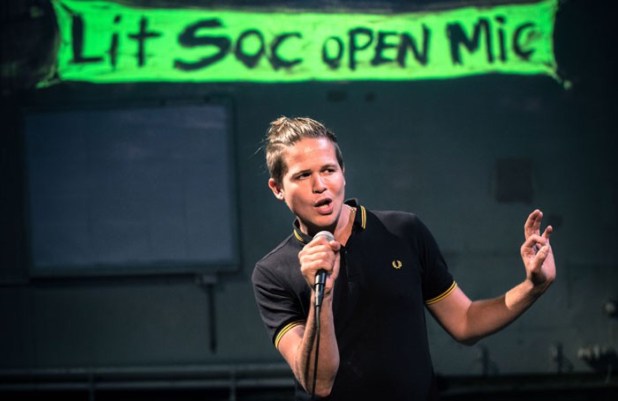
1997. The eve of the general election. Nick, who’s studying English Literature at a nameless uni stays up all night with his best mate, poet Johnny Bevan, to watch Tony Blair win. It’s the dawn of a new era and change is coming for the working class long oppressed by Thatcherite rule.  Fast forward fifteen years and Nick’s a journalist in London, but Johnny’s student aspirations didn’t come to fruition, and neither have Tony Blair’s. The story of these two lads’ friendship, written and performed by Luke Wright in a blaze of fiery spoken word, is an hour long tale of youthful vigour soured by the realities of adult life. Wright’s delivery and writing is fervent, topical and no moment is out of place in the trendy and on-point What I Learned From Johnny Bevan.

South of the river, an older revolution is taking place. In Soviet Russia, a group of peasants stages a play about a servant girl in Georgia raising the governor’s newborn baby that was abandoned during the family’s escape from a war zone. After a perilous journey, sacrifice for the sake of the infant, and a regime change, everything is put right again by a citizen judge. Lazarus Theatre Company, with its trademarks of a large cast and striking visuals, draws parallels between Brecht’s The Caucasian Chalk Circle and the despair of modern life – but “change is hope”. Energetic and in the round, the characters rally the audience to their side like they do in Wright’s monologue.

There’s optimism in both productions as well as despair, and an underlying current of discontent with the state of the UK’s current socio-political trajectory. Both display humanity’s capability for selflessness and selfishness, and the feeling that nothing has changed from Soviet ruled Eastern Europe, to Labour’s late-90’s victory, to present unviable economic conditions and Tory tyranny. We are undeniably flawed with a fickleness vulnerable to power and money, but as a society we are also deeply unhappy and feel that we lack the power to affect change. This sentiment now seems to be emerging in fringe theatre.

Though completely different in form and structure, both What I Learned From Johnny Bevan and The Caucasian Chalk Circle have plenty to say about the contemporary world from similar angles. What I Learned From Johnny Bevan is the better of the two productions, and  the more progressive. A solo performance delivered in spoken word accompanied by charcoal and watercolour landscape projections, most of the imagery in Wright’s language is precise and evocative. Brecht’s well-known play is linguistically stilted and stuffy in contrast, but it’s characters are just as colourful.

Performance poet Luke Wright is a singular tour de force and What I Learned From Johnny Bevan is politically charged and practically flawless. Lazarus Theatre’s performances vary, but of the ten-strong ensemble, no one was particularly strong or weak. Their choreography is well-rehearsed but director Ricky Dukes normally powerful movement sequences  lack impact in the round. The set components take up a lot of space and are used well occasionally, but otherwise clutter the stage with bright, industrial chaos. Neil McKeown’s sound design hints at atmosphere and mood, but is much too quiet to add the impact it could. It’s certainly not a bad production, but neither is it one of Lazarus’ stronger ones.

If theatre is a mirror held up to the world, then evidence is increasing that change is imminent. But what form will it take? Will the people rally as in The Caucasian Chalk Circle or will we either sell out or run away from it all like Nick or Johnny? Only time will tell.

The Play’s the Thing UK is committed to covering fringe and progressive theatre in London and beyond. It is run entirely voluntarily and needs regular support to ensure its survival. For more information and to help The Play’s the Thing UK provide coverage of the theatre that needs reviews the most, visit its patreon.

The Xmas Carol, Old Red Lion Theatre

rsz_2cc9d33d00000578-3250546-i_ve_never_doubted_that_mr_cameron_like_most_of_his_generation_w-m-2_1443338742165Dominic Cavendish thinks this year’s theatre lacks relevance to current affairs. He’s probably been working under a commercial and subsidized theatre-shaped rock (as mainstream critics are prone to), citing Anders Lustgarten’s Lampedusa as, “number one in a field of one” where, “nothing stood out as ‘the’ play for today.” Matt Trueman defends theatre’s ability to respond at the speed Cavendish would like, and also cites several examples Cavendish neglected: “The Fear of Breathing by Zoe Lafferty and Lucien Bourjeily’s 66 Minutes in Damascus, part of the 2012 LIFT festival, spring to mind, though Cordelia Lynn’s Lela & Co was set in an unnamed country gripped by a similar civil war.” Also springing to mind and not set in Syria but Liberia, Danai Gurira’s Eclipsed starkly presents the victims of another civil war.

The nightmare in Syria driving tens of thousands of people to flee their homeland in search of safety demands global action and aid, of course. But there were numerous other hotbed issues addressed in British theatre over the past year, even the last couple of weeks. Theatre Ad Infinitum’s Light looked at government surveillance, As Is reminded us that AIDS diagnoses are on the rise, Goodstock describes the uncertain life as a young woman with a high risk of breast cancer. Down & Out in Paris and London rallies support for the working poor, The State vs. John Hayes gives us the last night of a schizophrenic woman on death row, and Skyline is a relentless attack on the London housing crisis. There are many others as well, and that’s just in the past year of one critic’s theatregoing.

Within the past week, The Old Red Lion opened Arthur Miller’s first play, No Villain, a love letter to communism and the strikers of 1936 New York City. Accomplished theatre critic and author T L Wiswell also offered her latest work for two nights only, a satirical update of Dickens’ classic Christmas novel to the current 10 Downing Street, The Xmas Carol. That’s just at one venue, not specifically known for political theatre. The Xmas Carol has a dig at pop culture/The X-Factor to frame the consequences of David Cameron’s legislation on everyday, working people after his annual Christmas party, similar to Miller’s use of the strikes to focus on the life of one family out of millions. Both plays need further development (though it’s obviously too late for Miller), but both brashly and fearlessly confront the politics of their day.

In The Xmas Carol, Simon Cowell (Chris Royds) introduces his latest programme that’s sure to be a ratings hit; it’s an interesting meta-theatrical device that works towards justifying Cameron’s (Warren Brooking) travels through his past, present and future. Jason Meininger’s lighting and Keri Danielle Chesser’s sound effectively evoke transitions in time and space. Some more exposition to set up the television show that Cowell is steering would have clarified Cameron’s complicity and aim to improve his ratings, but the device itself is a creative deviation from having Cameron fall asleep and dream the whole thing.

There are some great impressions in the cast, particularly from Luke Theobald as Ghost of Christmas Past Margaret Thatcher. Brooking could have been a louder, bolder Cameron but he captures an element of the man in his gestures and general lack of humanity. Will Bridges is an amusing, though not particularly accurate Jeremy Corbyn but as this is a satire, his punditry can be excused. Jenny Wills as Cameron’s PA Bob Cratchett brings some grounded naturalism to this piece. She’s a lovely character, warm and family focused, with some good dialogue, but her performance style jars with the heightened delivery from the rest of the cast. It works to ground Cameron’s devastating policies in reality, but she could use some backup from other characters. As the play’s currently just under on hour, more down-at-heel, working people could easily be brought in to further emphasise the battle between the ridiculous politicians and celebrities, and the everyday man.

Having gone to a reading of The Xmas Carol about a month ago, the concept has developed quite a bit since then, but the structure could still use additional tightening and detail. More dialogue and exposition will help, particularly in the beginning and end. There are some genuinely funny moments and well-crafted scenes, but a brief resolution. The Tory criticism is relentless and mocking but also pointed and moving. Wiswell is certainly in the process of striking a good balance within the piece, but it needs just a bit more shaping.

Both The Xmas Carol and No Villain are highly political, but in very different ways; the same can be said of many of the aforementioned productions. Sure, they’re not about Syrian civil war and refugees, but they focus on diverse, divisive issues relevant to contemporary life. Perhaps Cavendish needs to visit the fringe more: it’s where angry voices can express their views unfettered, without the burden of corporate sponsors and other such bureaucratic obstacles. These shows don’t have the high production values or years of development and funding that commercial theatre does, but political theatre on the fringe is some of the most raw, honest, relevant theatre I have seen this year.


The Play’s the Thing UK is committed to covering fringe and progressive theatre in London and beyond. It is run entirely voluntarily and needs regular support to ensure its survival. For more information and to help The Play’s the Thing UK provide coverage of the theatre that needs reviews the most, visit its patreon.

Walking the Tightrope, Edinburgh Festival Fringe

Over the course of last year, several high profile political art events were cancelled due to protests and political action. The Tricycle Theatre pulled the UK Jewish Film Festival that was part-funded by the Israeli government (then changed its decision after it was too late), Barbican art installation “Exhibit B” that depicted black people (actual people, not mannequins) in cages closed the day after it opened, and Underbelly cancelled Israeli hip-hop musical The City at the Fringe last year after its first preview. More recently, the National Youth Theatre stopped a new play, Homegrown, about Islamic extremists from opening for reasons that are still unclear. These events polarized audiences, artists and others, re-sparking the censorship debate: should art be censored? If so, under what circumstances? Should racist/offensive/morally questionable art and/or art funded by racist/offensive/morally questionable sources be censored? Producers and venues also asked themselves: how far do the protests have to go before we have to give in?

Eight, 5-minutes plays by established playwrights in response to these event cancellations, followed by a panel discussion with rotating guests, create Walking the Tightrope: The Tension Between Art and Politics. Today’s panel was Jonathan Mills (Former Director, Edinburgh International Festival), Fergus Linehan (Director, Edinburgh International Festival) and Tim Fountain (writer). A cast of four excellently performs the mini-plays; the scripts are powerful and constructively contribute to the debate, and the discussion itself can become a piece of one-off theatre once the audience is handed the microphones.

For uncomfortable shock value, Neil Labute’s two-hander Exhibit A gives us Syrus Lowe as an artist and Melissa Woodbridge as a drugged art student. As Lowe’s character performs his latest piece on a bound, moaning Woodbridge, he challenges the audience to intervene, or object that what he does is not art. Whilst what he does is awful to witness, it is equally disturbing that the audience does not respond to his challenges.

Tim Fountain’s Beyond the Fringe is a hilarious and thought-provoking family piece. The mum is a writer trying to stop the Israeli performance at Underbelly, her son is a fringe performer who is going to see the show. I find myself relating to, and laughing at, both of their perspectives, illustrating the multi-faceted complexity the issue poses.

What Are We Going To Do About Harry? is Mark Revenhill’s contribution that personalises the dilemma between maintaining funding streams from the white, middle-class and meeting diversity targets by disenfranchising these backers. This is another piece with no easy solution to the problem it poses.

Other highlights are Timberlake Wertenbaker’s satire of the BBC, Shampoo, and Re:Exhibit by Gbolahan Obisesan that stages an imaginary casting for the banned “Exhibit B.” The final play, Tickets Are Now on Sale by Caryl Churchill was an anti-climax, but still a witty look at funding sources. Another letdown was that in such a politically charged event, only two of the eight performed plays were by women.

The post-show discussion provided additional commentary and historical context to the cancellations. Jonathan Mills, former Edinburgh International Festival director, and current director Fergus Linehan explain that protests against the arts have been happening in Britain for a long time. Tim Fountain elucidates that Underbelly eventually came to the decision to cancel the Israeli show because the protests had grown to such an extent that protesters were affecting other performances and audiences in the venue.

Fountain and Mills go on to discuss the challenges faced by police and venue security, then address whether all art is inherently political: “If all art is political, it becomes agit-prop.” Art is political, but is also has other functions, such an engagement and humour. Linehan touches on funding and calls for cases to be looked at individually. Fountain discusses venues’ loyalties to their artists in the face of adversity, and then the audience has the chance to ask the panel questions.

Q1: Is there ever a place for boycott in the arts?

Q2: How can a space for discussion within the festival be created?

And, then “Q3”.

Now, what happens isn’t even a question, but a tirade that personalised last year’s protests at Underbelly. An older lady who protested The City explains that the Palestinians supported the production boycott and even though their protest was disruptive, the protesters were also treated horribly. The panel attempt to respond and placate: both sides behaved badly, we need to create a space where both artists and protesters can be heard, etc. Fountain simply states, “You won.” The woman was having none of it, tensions rise on both sides, and she walks out.

Whilst this becomes an improvised, topical performance in itself with passions and viewpoints laid bare in preparation for battle, the woman’s preface to her comment sticks with me:

She explains that she isn’t an artist, and is completely removed from the “mystical process” of making art. She is just an ordinary person.

It saddens me that the creative process is still considered some sort of abstraction by people who are somehow not considered normal citizens who do a job, trying to make a living. This singular comment proves that artists are not engaging enough with “ordinary people”. This isn’t about getting bums on seats. It’s about not engaging the wider population in the process of how art is made.

Perhaps if this lady, and the wider population of non-artists, did not feel so alienated from the creative process and artists themselves, both sides of this fight would have a greater understanding of the other. Imagine what society would be like if the general public and British government actually comprehended what was involved in making art and saw it as work rather than a “mystical process”.

Take a moment, picture that world, then decide what you’re going to do about it.


The Play’s The Thing UK is an independent theatre criticism website maintained voluntarily. Whilst donations are never expected, they are hugely appreciated and will enable more time to be spent reviewing theatre productions of all sizes. Click here to make a donation with PalPal.