Hannah and Hanna, Edinburgh Festival Fringe

CultureClash’s debut production, Hannah and Hanna by John Retellack, is a perfect fit for company co-founders and actors Cassandra Hercules and Serin Ibrahim. It’s as if Retellack wrote it for them. Written and set in 2001, Hannah and Hanna takes place in Margate as the British government temporarily re-homes thousands of Kosovan refugees in down-at-heel seaside towns, causing predictable social backlash. Hannah is black British, Hanna is from Kosovo. Both are 16, love pop music and navigating life as teenagers. This production is ably directed by Greenwich Theatre artistic director James Haddrell, and well performed, but the sentimental script with a predictable story arc lets down the talent in the production.

The play is definitely still relevant to current immigration debate and highlights the absurd anti-immigration mindset through Hannah’s Afro-Caribbean heritage. She and her boyfriend Bull verbally and physically abuse Kosovan teenagers, after which Hannah returns home to her thick-accented Nan. The irony is blatant, but funny. Of course, constant violence is unsustainable in a two-hander about teenaged girls, so after a huge English v Kosovan fight, understanding is reached and friendship develops. It’s sweet. Not saccharine, there are still lovely ups and disturbing downs. Hannah goes through a radical transformation very quickly that her social circle struggles to cope with. Hanna has already encountered the horror of war before the play begins, so is the more mature one of the pair, but this is still a coming of age story for both girls.

Hercules and Ibrahim are wonderfully believable as 16-year-olds, and they endow their roles with commitment and energy. The script restricts them by being heavy with narration; the scenes between them are the best moments. They skillfully take on other characters using clear physical and vocal differences and have a lovely, watchable chemistry. Haddrell’s stylized fight choreography serves the narration and pop music theme, but they play’s message may have come across more consistently if the fighting would have looked realistic.

It’s a sensitively chosen showcase for the new company founders, but the script’s references are dated and the ending is revealed in the beginning. Smaller details are surprises, but it’s otherwise easy to see where the story will head. It still packs a potent message and is certainly worth seeing, and this is a company worth watching.


The Play’s The Thing UK is an independent theatre criticism website maintained voluntarily. Whilst donations are never expected, they are hugely appreciated and will enable more time to be spent reviewing theatre productions of all sizes. Click here to make a donation with PalPal.
Jekyll & Hyde, Platform Theatre

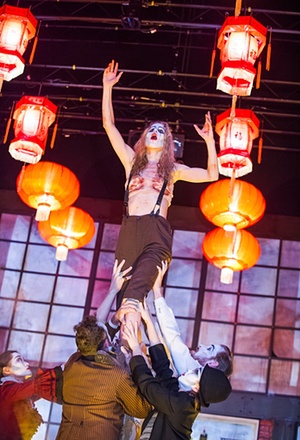
4404a479-e69a-4d92-9600-3d8eb075ff6c-1390x2040Giant red paper lanterns float over a smoky Victorian London alleyway. Six actors in western clothes and eastern whiteface also marry East and West in what initially promises to be a vibrant, transnational reimagining of R. L. Stevenson’s gothic novel Jekyll & Hyde. With the addition of a female Jekyll and a textual deconstruction that incorporates a range of performance styles, there is a lot to process in Jonathan Holloway’s script and staging. Whilst each individual choice has merit, none are fully explored due to the overwhelming array of influences Holloway employs. The sum total creates a muddy hodge-podge of ideas rather less substantial than a focus on the development of one or two of them.

The show begins away from Stevenson’s story, with an older man in Chinese dress (who is not Chinese) sharing the discovery of a wonderful but horrific tale he wants to sell to a young woman in1920s dress, presumably a publisher. To pique her interest, he begins to tell the story contained in the tome’s pages. This unnamed pair reappear regularly as the story is acted out to the audience, using narration to preempt the action and distance the audience by reminding them it is indeed a story. This is one of several Brechtian devices employed; even though it is a useful one in plays addressing social issues, it is unclear what element of the story the alienation is meant to highlight and any contemporary social relevance.

The story that plays out from the old man’s book is the more traditional Victorian story of Dr. Jekyll and Mr. Hyde, but Jekyll is a woman from Eastern Europe and the only woman doctor in the UK. It’s initially a great feminist touch, but the sex-crazed, manipulative Jekyll is hardly an empowering, feminist character. Having escaped war in her home country, she comes to London alone and uses her research to transform into a man. Though well-played by the physically expressive Olivia Winteringham, the character lacks depth and wears a costume that looks like it was put together in Camden Market rather than a costume workshop.

The set and lighting by Neil Irish are fantastic, though. Coordinated to create a horror film effect during particularly disturbing moments, they sumptuously support Holloway’s staging. Jon Nicholls’ sound design is atmospheric and sinister, well integrated with the other production elements. The costumes are somewhat inconsistent, with the men’s outfits appearing more historically accurate than the women’s. It is unsurprising that no costume designer credited.

The performances vary, with one of Chinese actors occasionally struggling to connect to the meaning in the language, creating unintended comedy. As this is a production incorporating two cultures, why shy away from using two languages? Other than a brief bit of either Cantonese or Mandarin at the start, the rest is in English. The story is well known enough to support a mix of languages, though with the melodrama, physical theatre, expressionism and naturalism already present, this would add further excess. As is, this adaptation feels predominantly English, with some East Asian design influence and a couple of Chinese performers. Though gorgeous to look at, the production never quite found the substance behind the façade.


The Play’s The Thing UK is an independent theatre criticism website maintained voluntarily. Whilst donations are never expected, they are hugely appreciated and will enable more time to be spent reviewing theatre productions of all sizes. Click here to make a donation with PalPal.

How Nigeria Became, everything theatre

“It’s 1914. The British government has merged the tribes and kingdoms to create modern Nigeria. King George V has sent Charles (Christian Roe) to visit Herbert Ogunde (Tunji Falana) to ask him and his theatre troupe to perform at the unity celebrations…

“The story the theatre troupe shares with Charles follows young girl Jenrola (Rita Balogun) on her quest to find the spear of Shango…Also looking for the spear are Aguzani (Stephanie Levi-John) and Obaze (Rebecca Omogbehin). The three women engage in a battle of wit and strength to see who can get to the spear first…

“The story of Charles, Herbert and his actors is framed by a Yoruba creation myth that starts and finishes the production…As lovely as this story was, it felt disconnected from the main plotline, even though it provided the background to the spear…

“All of the actors except Roe play multiple roles, and they do so incredibly skillfully. Falana…employs great physical skill to differentiate these characters and shows the inherent misogyny of 1914 Nigeria through comedy rather than nastiness…

“The set is simple but colourful and effective. The stage is a painting of a river delta and coast, forming the natural curve of the stage. There are mats and cushions on the front of the stage for young children, which gives them more of an opportunity to engage with the interactive elements of the production…

“This production is highly polished and engages the young members of the audience as well as the older ones. It was a great experience…seeing numerous young people engage with the action unfolding before them.”

Read the entire everything theatre review here.

Chef, Soho Theatre

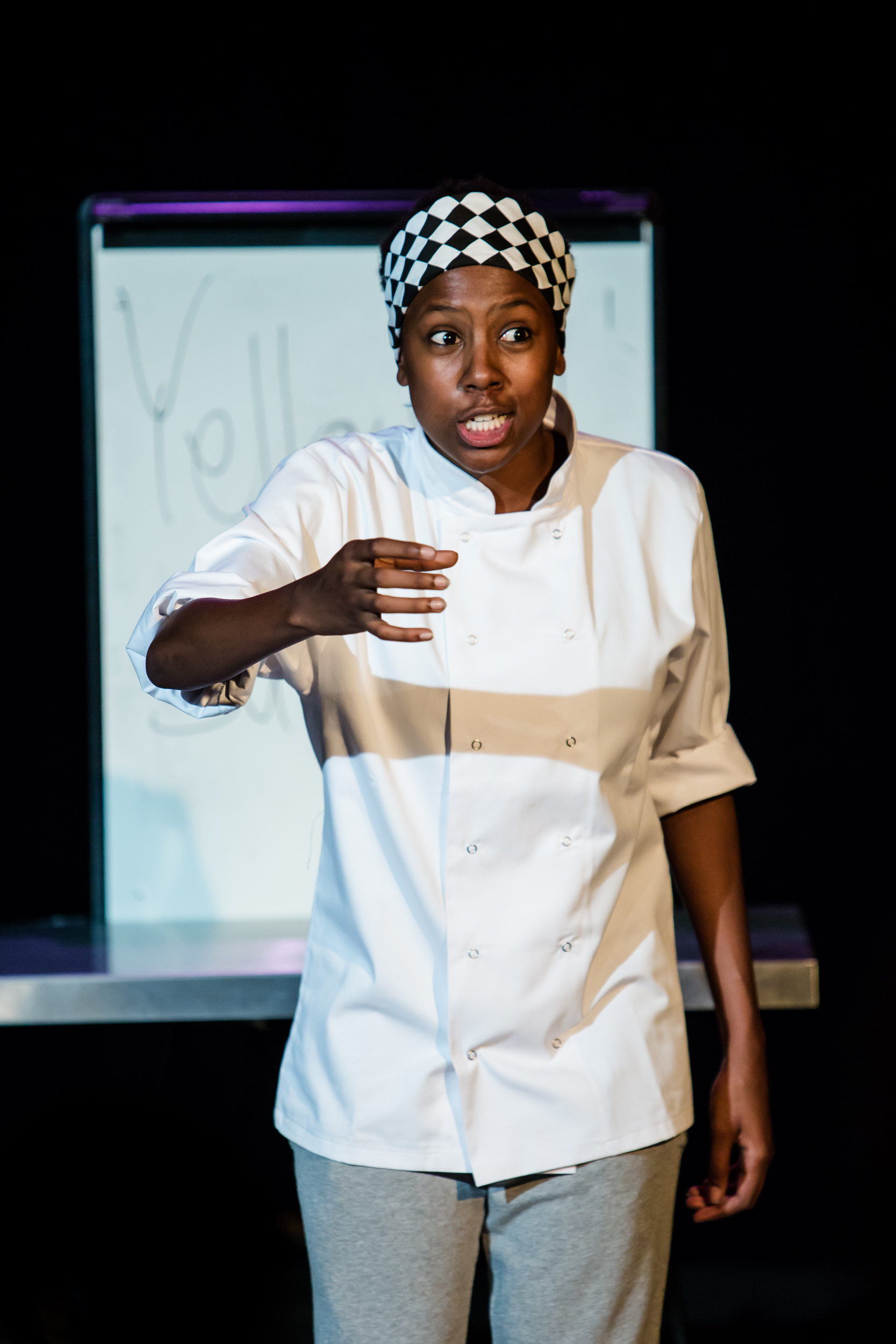
Chef, Ed Fringe 2014, courtesy Richard Davenport 035“Incredible innit, Food.”

Sabrina Mahfouz’s Chef is a one-woman play in the kitchen of a women’s prison. It’s no Orange is the New Black, though. Jade Anouka’s nameless chef shares her passion for food, recipes and stories of broken families and prison life. Anouka’s captivating, nuanced performance and Mahfouz’s poetic, imagery-filled verse holds the audience’s attention for nearly an hour without faltering.

Anouka’s performance is the primary pillar that supports this production’s success. With an innate musicality and unwavering energy, she balances the character’s true love for her work with the traumatic tales of an abusive father, a shady boyfriend and an incident that happened in her prison kitchen yesterday. Her interpretation both honours and personalises Mahfouz’s character, bringing an infectious optimism to a character that has endured so much hardship. Though this play probably works best in intimate theatres like Soho’s upstairs space, it is a great shame to deny larger numbers of people from seeing her performance.

Mahfouz’s writing is the next pillar that makes this story into a great play. Her use of poetry flips back and forth with street slang and swears, a continual reminder that not all inmates have limited vocabulary or intelligence but still keeps her believable. She gives us a truly human character with all flaws and perfections laid bare. She creates devastating empathy for this unnamed young woman doing so well at rising from the ashes of her childhood by becoming a fine dining head chef, only to be locked away for a crime she swears she didn’t commit. (Though all convicts swear their innocence, don’t they?)

Mahfouz and Anouka have worked together previously, on Chef and another play. These two clearly make a fantastic team, but both are excellent, established artists in their own right. Mahfouz is certainly a playwright to watch out for, and Anouka is a performer not to be missed.

Despite the stellar performance and writing, the scene transitions occasionally felt abrupt. Line delivery and technical transitions could have slowed down slightly, though that may have caused energy levels to drop. Another uncertainty is who the audience is in relation to chef. She is in her kitchen alone. They are not questioning her about her suspected involvement in yesterday’s incident, nor do they seem to be fellow inmates. Anouka addresses directly, so they don’t seem to be in her imagination, either. Her story keeps audience focus nonetheless.

As brilliant as Orange is the New Black is, the vibrancy and depth in Mahfouz and Anouka’s chef makes the show feel shallow and stereotyped. Even though it works excellently as a stand-alone short play, this is a character that should be seen again. This is not a production to skip over, despite its diminutive size and the fact it’s a one-woman show.


The Play’s The Thing UK is an independent theatre criticism website maintained voluntarily. Whilst donations are never expected, they are hugely appreciated and will enable more time to be spent reviewing theatre productions of all sizes. Click here to make a donation with PalPal.