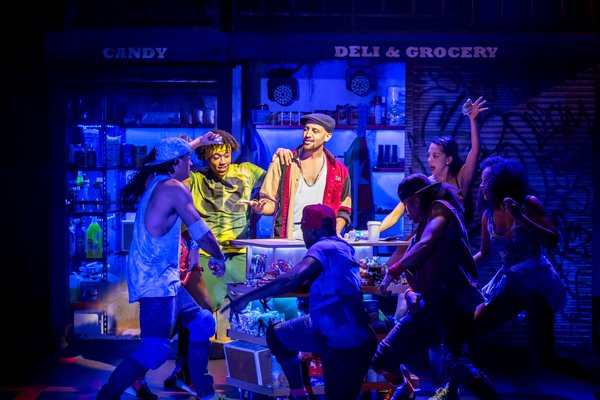
In the Heights, Kings Cross Theatre

rsz_sam_mackay_as_usnavi_and_the_cast_of_in_the_heights_photo_credit_johan_persson

Way up in Manhattan, so far north that it’s nearly the Bronx, is Washington Heights. You take the A or the 1 train to 181 Street to find this primarily Hispanic neighbourhood that’s not on any tourist radar. In the Heights shows the day-to-day struggles and celebrations of a group of residents on one block far removed from downtown prosperity with a soundtrack of salsa, hip-hop and poppy musical theatre.

The songs are the most innovative aspect of this mostly-sung musical with a stellar cast, but the book is rather sparse and the large cast of characters means it’s a cracking ensemble performance with frustratingly little development for any one character. The book and lyrics rely on stereotypes of Latino immigrants in New York City, though it both fulfills and destroys them within the diverse array of characters. The story feels rather tenuously squeezed around the songs with the dialogue serving as a plot point connector; most, of the scenes aren’t substantial enough to stand on their own. But, going back to the music, the songs make up the bulk of this musical and create a fabulous atmosphere complimented by excellent design. The Latin and hip-hop tunes are the best and most original, resulting in a fun evening and a memorable soundtrack.

This production is the same one that received numerous accolades and award nominations last year at Southwark Playhouse, and deservedly so. The Kings Cross Theatre suits this show well, with a wide traverse stage and audiences on either side, creating intimacy and suiting Drew McOnie’s circular, street party choreography. There are still design relics from The Railway Children, but Takis’ urban set and Gabriella Slade’s bright, revealing costumes pull the focus onto this completely contrasting world. With the performances practically in the laps of the front rows, it’s hard not to get up and dance. Some people do during the curtain call.

It’s not all a party, though. Nina (Lily Frazer), the first of the neighbourhood to go to university, has dropped out after her first year. Her father Kevin (David Bedella) hates her boyfriend Benny (Joe Aaron Reid) and is furious about Nina’s deceitful behaviour. Corner shop (or “bodega” in NYC lingo) owner Usnavi (Sam Mackay) and salon owner Daniela (Victoria Hamilton-Barritt) are getting priced out due to rising rents. Others came here for a better life only to find themselves cleaning houses and pigeonholed by poverty. The joy in this show comes in the characters’ ability to party and find solace in each other in the face of adversity – a powerful message for modern times.

I wanted to know more about these characters, though. This is a “slice of life” show that tries to fit in a lot of big personalities and backstories in a short amount of time, so the main characters and their tales have little space to grow. The storyline feels rushed and the ending, though a happy resolution, is a bit too “musical theatre twee” for a world that’s poor and gritty, albeit one soaked with colour and excellent music. It’s still possible to be pulled into this little stretch of Washington Heights in the height of summer and to want to dance the night away to this extraordinary blend of Latino, rap and musical theatre.


The Play’s The Thing UK is an independent theatre criticism website maintained voluntarily. Whilst donations are never expected, they are hugely appreciated and will enable more time to be spent reviewing theatre productions of all sizes. Click here to make a donation with PayPal.

The White Feather, Union Theatre

During WWI, men considered too afraid to enlist were given white feathers by those disapproving of their cowardice. Also common were boys too young to join up lying about their ages so they could experience the excitement of battle. Then there were the hundreds who were killed for desertion and cowardice in the face of the enemy. These young men suffered from PTSD, an ailment not understood or acknowledged until well after the war was over.

A cast of nine tells the story of 16-year-old Harry Briggs, who cheerfully joins up to escape humdrum village life, and his sister Georgina’s search for the truth of what really happened to her kid brother out on the front. Whilst trying to clear his name, she discovers hidden secrets of her fellow Suffolk villagers, learning more than she bargained for. Spanning several decades and touching on a wide range of issues including homosexuality, shellshock, the class system and the reality of life in the trenches, The White Feather is an intimate, provincial musical with a sturdy first act and excellent music, that reflects the close-knit and often overbearing aspect of life in a small place during wartime. The second act, shorter but covering a much longer period of time, is rather choppy and introduces an interesting subplot but too late to for much development.

Abigail Matthews flawlessly leads as the kind but tenacious Georgina Briggs, supported by wonderfully mouthy best friend, Edith (Katie Brennan). It’s not all about the girls though; David Flynn as the conflicted lord of the manor Adam Davey is the most complex character of the lot and deserves more focus than the script gives him. Edward Brown, played by Zac Hamilton, has a couple of great scenes showcasing his emotional range. This is a great cast size for a musical: enough voices to give the larger numbers a punch, but not so large that some characters are relegated to the ensemble.

A piano, violin and cello trio give the music richness but an acoustic, rural tone that beautifully suits the world of the musical. The book and music are well integrated and transitions from one to the other are mostly smooth. The act finales could stand to be a bit longer, but otherwise the music feels developed, albeit quite gentle. The book follows an evenly paced narrative arc for the first half, but several jumps feel choppy and disruptive after the interval. The programme helps with indicating the time leaps, but more could be added to the script and design to clarify them so the audience doesn’t have to regularly refer to the programme. The Adam Davey subplot could do with more than a single, brief reference in the first half in order to have greater plot integration later, but this could potentially detract from the main thread of Georgina’s quest for justice. Though the title can represent Harry’s perceived cowardice, there is little mention of the feather as a convention of the time. All of the focus points are worthy of presentation and add to the overall story, but perhaps the show is trying to do too much. Without lengthening it quite a lot, some aspects of the plot will remain under-developed.

With an engrossing first act, detailed and complimentary characters, The White Feather writers clearly Ross Clark and Andrew Keates have a gift for telling great stories. New musicals often disappear after their initial run, but this one is a mostly polished affair that deserves more development and larger houses. In the Union Theatre, it’s an emotionally charged, intimate experience not to be missed, even with its shortcomings.


The Play’s The Thing UK is an independent theatre criticism website maintained voluntarily. Whilst donations are never expected, they are hugely appreciated and will enable more time to be spent reviewing theatre productions of all sizes. Click here to make a donation with PalPal.

See What I Wanna See, Jermyn Street Theatre

Displaying The cast of See What I Wanna See at Jermyn Street Theatre. C Photography by Jamie Scott-Smith.jpg“The truth is rarely pure and never simple,” says Oscar Wilde in The Importance of Being Earnest. Indeed. We often encounter conflicts or situations where opposing viewpoints create very different stories. Michael John LaChiusa adapts three Japanese short stories by Ryūnosuke Akutagawa, including “The Grove” on which Akira Kurosawa based his western hit Rashomon, intertwining them to create a production showing that, well, we often see what we want to see and that “truth” is a flighty creature that can never be pinned down and shown objectively. See What We Wanna See, a chamber musical produced by Aria Entertainment at Jermyn Street Theatre, is a delicate, intimate performance with a strong cast. However, LaChiusa’s trilogy with loosely connected themes has little else that links them and feels like an evening of short plays rather than a cohesive, full-length musical.

As the prelude to each act, “Kesa and Morito” shows a medieval Japanese couple recently discovered having an affair. They are seeing each other for the last time. Both have plans for their final encounter and blackouts preclude discovery of their fate. “R Shomon” follows as the bulk of the first half, a thriller set in 1950’s New York. Four characters tell totally conflicting witness statements to an unseen policeman. Who is telling the truth about the death of The Husband? How is this piece connected to the opening where Kesa shares her story in a single song? The audience never finds out. The ending to this mini-musical is deliciously ambiguous with some complex musicality in the songs, but the connection to the “Kesa and Morito” prologue is tenuous at best.

The second half is the same structure. Morito shares his side of the story for the duration of a single song, then “Gloryday” is the rest of the act. This is a more compelling story than “R Shomon” and could be a longer, standalone production. A disaffected priest creates a hoax miracle that takes post-9/11 New York City by storm, making some pointed criticism of Jesus and his followers by comparing them to the vulnerable that fall for his trick. The end has a poignant twist and reiterates the show’s focus on the fluidity of truth within deceit and crime. Whilst these are good stories and maintain audience interest, there is no linking transition or any comment on the three other than presenting them together. This emphasizes the timelessness of the theme, but takes no particular point of view on it. LaChiusa’s message is consequently unclear.

The cast of five is fantastic; in a small theatre with a four-piece band are quiet enough that the actors don’t need mics so detail isn’t lost through amplification. There is no week link; they all have the chance to play at least one substantial role with the others showcasing their range. Jonathan Butterell as the priest that loses his faith in the second act’s “Gloryday” is particularly touching. Mark Goldthorp as the reserved 1950s taxi company boss in the first half’s “R Shomon” is quietly enigmatic and counters the brashness of Marc Elliott’s Thief and Cassie Compton’s resentful Wife. The priest’s Aunt Monica as given by Sarah Ingram is light relief but still possessing emotional depth.

LaChiusa’s music is reminiscent of a gentler, simpler Sondheim with influences spanning different eras and cultures. Simon Anthony Wells’ design similarly captures the different worlds in the production. Despite compelling individual stories, great performances and some lovely songs, the audience is left questioning what they are meant to take from the production and unsatisfied by the lack of a deeper connection between the three component tales. It’s still definitely worth seeing the London premiere of this unique, cosy production by Aria Entertainment, a producer vital to musical theatre for staging new and rarely staged work.


The Play’s The Thing UK is an independent theatre criticism website maintained voluntarily. Whilst donations are never expected, they are hugely appreciated and will enable more time to be spent reviewing theatre productions of all sizes. Click here to make a donation with PalPal.

Rocky Horror Show, Playhouse Theatre

Though touring regularly, The Rocky Horror Show hasn’t appeared in the West End since 1990-1991. For a limited time, this camp, B-side parody musical returns to the Playhouse Theatre before embarking on a new UK tour. Devoted fans attend in costume and call out responses during the show, carrying on long-held traditions developed after the release of the film, The Rocky Horror Picture Show. Audience behaviour is unlike anything I’ve ever seen in the West End and the regular punters don’t quite know what to make of the anarchy, but it’s a fun night out and a cultural awakening to this cult phenomenon. This is a polished revival with some inventive touches and great performances, but does the award winning musical from the 1970s withstand the test of time? Not so much.
The casting highlight for the fans is playwright Richard O’Brien as the Narrator. A small role, but an inspiring sight to behold considering the gent is in his 70s. From the applause and screams on his first entrance, fans regard O’Brien as a god among men, or an actual god. He’s charismatic, still has a wonderfully rich speaking voice and indulges the audience’s adoration. David Bedella as Frank-N-Furter is sexy with a dangerous edge and excellent comic timing, particularly in the bedroom at the beginning of Act II. Disappointingly, he corpses a couple of times at some of the more rare audience call-outs and often loses his flow. There’s no banter with the audience; instead long pauses cause frequent disruption to the pace as the actors wait for the audience to recover from the call-out humour. The performances are otherwise excellent from this highly experienced cast of thirteen, several who have been in previous Rocky Horror Show tours. The audience have the potential to become a character and do their best to make themselves known through the call-outs and bad behaviour, including talking at full volume, taking photos and shining torches, but they are largely ignored by the cast.

The design is nuanced, with elements of meta-theatre in the cinema reel edging to remind us of its root in the film world. Frank’s reveal in a striking backlit wardrobe is used enough to create impact but not overly employed. Hugh Durrant’s set richly contrasts Brad and Janet’s pre-Frank world with the castle interior. Haze is used enough to sharpen beams of light to make a laser effect with using actual lasers or an overkill on the smoke. Costumes match those in the film and are mirrored in the audience who chose to dress up.

There’s no denying that this is a slick production of a show that, to be frank, isn’t very good. Structurally, the first act has the best numbers and consistent momentum, albeit with clunky and rushed transitions into the songs. After the interval, the story and music loses its way with ballads and plot twists that don’t fit the conventions established in the first half. Some of the new sub-plots don’t even really make sense and are introduced too late to develop properly, such as the appearance of Dr. Scott in his brief scene. Most pointedly, The Rocky Horror Show is painfully misogynistic and offensive by current social standards: there’s slut-shaming, the antiquated term ‘transvestite’ (and the character labeled as such is a rather horrible villain), rape that’s justified by the victims’ enjoyment of it, objectification and sex slavery. It can be argued that it’s all in good fun and is a product of its time, but at the time it was written these were more socially acceptable behaviours that society has now rightly condemned and tries to move past. There is no element of moralizing in the story to draw attention to these actions’ unacceptability, nor are they new enough to theatrical content to make them edgy or shocking.

The fans drive the demand for The Rocky Horror Show and as such, it will never quietly fade away into retirement, despite its highly questionable themes. The skillful performances and high production values make the night enjoyable, but the story is an unpleasant relic from a time with a more limited understanding of human rights.


The Play’s The Thing UK is an independent theatre criticism website maintained voluntarily. Whilst donations are never expected, they are hugely appreciated and will enable more time to be spent reviewing theatre productions of all sizes. Click here to make a donation with PalPal.

The Quentin Dentin Show, ACT Theatre at Kingston College

IYAF 1Disclaimer: due to TfL journey planner buggery I arrived at the theatre, the ACT at Kingston College in deepest, darkest zone 6, about ten minutes into the show. Fortunately, I only missed exposition that was covered as the story continued.

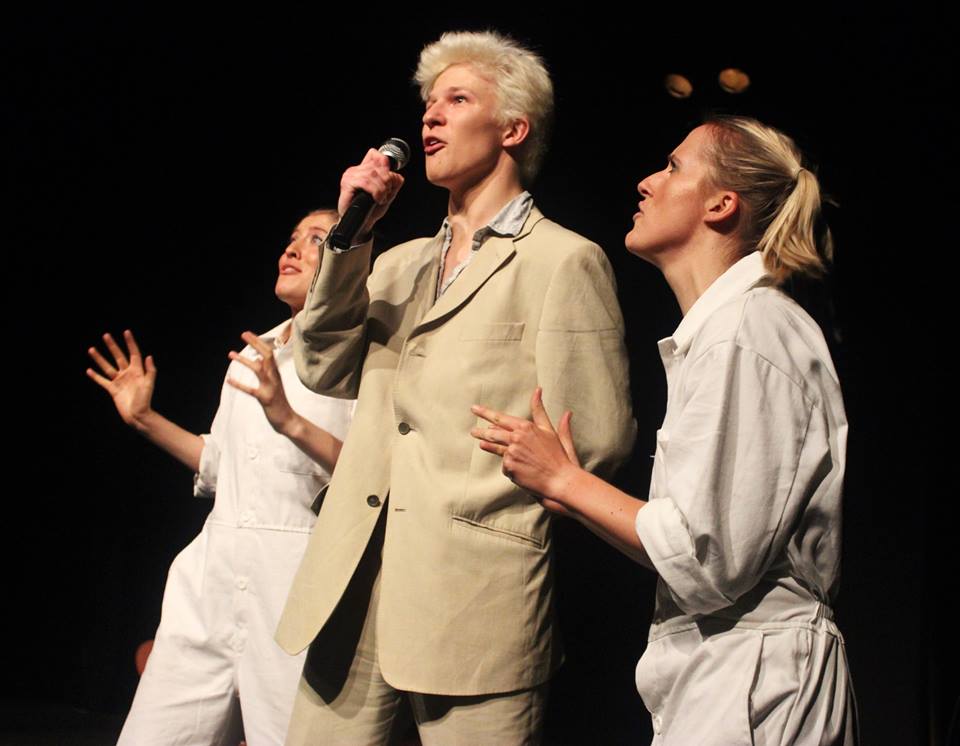
Keith (Jack Welch) and Nat (Shauna Riley) have been together for a while now. Their relationship has stagnated, as has Keith’s writing career. Nat’s had enough. They’re both chronically unhappy. The final straw as Keith’s radio breaking, but out of the static arrives weird and wonderful singing therapist Quentin Dentin (Henry Carpenter), and his two Friends (Caldy Walton and Ella Donaldson). Cloaked in white with matching hair, Quentin is a Christ-like figure there to save Nat and Keith’s relationship and to make them happy again.

Of course, this is all rather creepy and surreal. The story takes a turn to a darker side as the couple’s treatments prove ineffective. Production company Slick Rat state that one of the primary influences on the show is The Rocky Horror Picture Show; Quentin has similar qualities to Frank N. Furter, and the couple are a rather more street-wise, contemporary Brad and Janet who go along with the strange man that appeared out of their radio with little question. Musically, the songs have a 1970’s glam rock vibe and Quentin also looks a bit like David Bowie. In summary, the title role is a Frank N. Furter/Jesus/David Bowie hybrid in a new rock musical. What’s not to like?

Not much, actually. Though this is a new musical by a young company, a long development period and support from places such as Rich Mix and The National Theatre Studio have helped Slick Rat shape their idea into a quirky little show with potential.

There are still some issues that should be looked at, such as clichéd lyrics (“Swim with the fishes/all that glitters is gold”) and an abrupt ending. Not that it necessarily needs to be positive, but it’s quite vague in its current form. The transitions into the songs are similarly abrupt, but all that is needed to correct this would be more lead-in music and/or dialogue that echoes the coming lyrics. Even though I missed to beginning exposition, is ten minutes of a one-hour show too much of an introduction?

The performances are good, particularly from Donaldson, Walton and Riley (Friends and Nat). Quentin could use an injection of charisma to avoid him becoming too creepy, but this could also be addressed in the writing. Similarly, Keith could do with more external artistic angst, frustration and clear isolation from the rest of the world. The music is fun and the premise both entertaining and thought-provoking: are we allowing society to dictate that we must be happy all the time? Are we too enamoured of miracle cures? What role does religion play in this?

This one-act could nicely develop into a more complex story with the addition of more characters and songs without losing its message. It has a distinctive musical style that manages to not muddy from all its influences. It would certainly benefit from the addition of a bigger budget, good design and a whole band rather than the sole onstage guitarist. In its current state, it captures the innovation and spirit of fringe theatre and admirably contributes to new British musicals, an area sorely underdeveloped in favour of revivals and American imports. It’s worth catching at Edinburgh Fringe, particularly for those interested in new musical theatre.


The Play’s The Thing UK is an independent theatre criticism website maintained voluntarily. Whilst donations are never expected, they are hugely appreciated and will enable more time to be spent reviewing theatre productions of all sizes. Click here to make a donation with PalPal.

Gypsy, Savoy Theatre

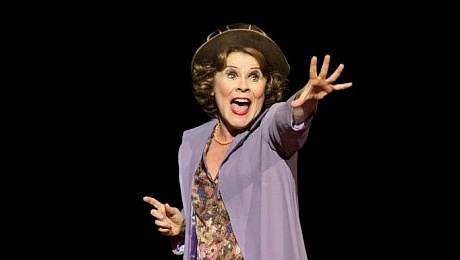
23725_fullWhen you think of musical theatre you think of singing and dancing. Sequins and jazz hands. Sparkling smiles and happiness. More recent musicals have been experimenting hugely with structure and form, but written in the 1950s, Gypsy was ahead of its time. With a focus on the main characters’ journeys rather glitz and glamour, this production creates a new standard for outstanding acting in musical theatre.

Imelda Staunton is without a doubt the star of the show. Rose’s tenacity and gradual unraveling is played with nuance, conviction and unfailing energy. Peter Davison’s Herbie contrasts Rose’s brashness with a quiet devotion, creating a lovely dynamic but that painfully mirrors every failed relationship. Though Lara Pulver’s journey from the shy Louise to the cold Gypsy Rose Lee is inevitable, it taps into the vulnerability of all characters involved. Her naïve devotion completes a charming, though dysfunctional threesome that eventually crumbles. None of these three principal actors relied on hackneyed, two-dimensional characterizations that are so easy to adopt in musical theatre.

The book certainly helps, providing a vigorous, well-constructed skeleton on which the actors lovingly add meat and flesh. The only point when the book lets down the show in the final scene. In this case, the ambiguity is unsatisfying. The show could have ended earlier, when Rose finally comes to terms with her actions, or she could have been left by Louise to face the loneliness of a life alone. Otherwise, this genre-defining book musical holds up wonderfully.

The Savoy is a splendid setting for Gypsy, capturing the grand bygone days of vaudeville and the sort of houses Rose yearns to play. The Savoy juxtaposes the meta-theatrical set of the shabby world of the regional houses Rose’s kids actually play. It’s omnipresent, just out of her reach as a shadow she can’t see properly beyond the footlights, but one that adds to the audience’s visual experience immensely. The sequins and glitter Rose eventually encounters bedeck intimidating, crude burlesque performers signifying the demise of the grand old days of vaudeville and the decent into the more sexualized, desperate world of the Great Depression.

This production is one to see for those people that are not keen on musical theatre but want the experience of brilliant acting and character development. Of course there are songs and dances, but they are not the focal point of the show. This is a musical that brushes the genre, but doesn’t overwhelm with anything other than some of the best British talent gracing the West End musical stage.


The Play’s The Thing UK is an independent theatre criticism website maintained voluntarily. Whilst donations are never expected, they are hugely appreciated and will enable more time to be spent reviewing theatre productions of all sizes. Click here to make a donation with PalPal.

The Verb, To Love and Portia Coughlan, Old Red Lion

Love, loss and obsession: Aria Entertainment’s double bill explores these themes with dramatically different outcomes. New British musical The Verb, To Love follows college lecturer Simon’s attempts to find a lasting relationship after breaking up with his boyfriend of 23 years. Mid-90’s Irish play Portia Coughlan shows the title role’s failure to function in day-to-day life whilst clinging to memories of her twin brother who drowned 15 years previously. Both productions, which can be seen singly or one after the other, depict emotion in its most raw, desperate state with committed performances and unique design elements.

The Verb, To LThe Verb, 'To Love', Old Red Lion Theatre, 29 April - 23 May 2015. Copyright Claire Bilyard -16ove by Andy Collyer is a two-hander but focuses almost exclusively on Simon (Martin Neely). He falls in love with fellow teacher, the wide-eyed, much younger Ben (Gareth Bretherton) after a breakup. Simon sings us the story of their friendship progressing to a reluctant confession of love, but there is no happily ever after. Several years later after building a successful career, Ben decides its time to move on even though doting Simon would do anything for his “baby boy”. Simon’s songs then journey through the stages of grief and forays in online dating until he finds peace with his houseplants.

Though billed as a musical there is little spoken dialogue. The contemporary musical theatre songs continuously flow into each other with few breaks and Ben doesn’t enter until he breaks up with Simon halfway through the show. Until their breakup, we hear their story exclusively from Simon’s perspective. Ben doesn’t interject often after he arrives, making this almost a one-man show. Even though it was only an hour, it’s a long time for Neely to sing almost continuously, which he does splendidly.

This is clearly a musical under development, but it has plenty of potential. Simon’s character is detailed and well developed; Neely adds plenty of nuance. The songs have enough variation to not sound too similar, but with a strong motif. It would not take much to make this a full-length show: more scenes, more Ben, and possibly some other characters – though The Last 5 Years proves a two-hander works beautifully, particularly when telling the rise and fall of a relationship. More substance will also help dilute the sentimentality, though it was never cloying. Focusing the bulk of the story on Ben and Simon’s relationship gave the show a sturdy narrative arc rather than showing a snapshot from Simon’s life. There was no dancing, lighting changes corresponded with emotional intensity and the flowery parkland set reminded the audience that there is light at the end of every tough time. I look forward to seeing The Verb, To Love develop and hope Aria Entertainment stages it again in a more fully formed state.

Marina Carr’s Portia Coughlan is mPortia Coughlan, Old Red Lion Theatre, 28 April - 23 May 2015. Copyright Claire Bilyard -42uch darker and more complete fare. Set in rural Ireland, Portia celebrates her thirtieth birthday. Fifteen years ago tomorrow, her twin brother drowned in the Belmont River that runs behind her father’s farm. She never recovered from his death, despite having a life that reads perfectly on paper: a wealthy husband, close family and three sons. Susan Stanley plays tortured Portia with a coiled spring intensity that never relents, even when drinking and flirting in the local pub. The verdant, grassy floor from The Verb, to Love remains, but a pool of water is Belmont River and a rustic kitchen set is her country home. The lighting is darker and ethereal music draws attention to the appearances of Portia’s ghostly brother, Gabriel.

Similarly broken people with hidden family secrets inhabit Portia’s world. Her parents pop in uninvited and berate her for not fulfilling her wifely duties. Her paternal grandmother abuses her and her mother relentlessly. Her best friend Stacia helps Portia with the kids, but only has one eye and needs of her own. Her patient husband Raphael (Ben Mulhern) does his best to look after their children when Portia says she wants nothing to do with them, as she’s afraid she’ll harm them. She never wanted to be a mother. She never wanted to marry Raphael. She doesn’t really want anything to do with this world at all, instead dwells on her brother’s death. She tries to distract herself with love affairs, to no avail. The day after her birthday has a predicable outcome halfway through the play, but then the action jumps back in time for more horrific familial revelations.

A cast of eleven creates Portia’s intimate, oppressive world of family, lovers and friends. Most have good intention in their hearts, but none of their efforts can save Portia from her deteriorating mental stability and Grabriel’s increasingly frequent, haunting presence. The dialogue is frank, but taps into an innate Irish poetry and spirit world of Celtic mythology. Though these characters simultaneously evoke pity and disdain, there is a grounded earthiness about them and their connections to each other. The ensemble work is excellent, particularly from those playing Portia’s family, though the other roles are certainly to be commended. Veronica Quilligan and James Holmes as older family friends, the Doorley’s, provide some comic relief and comfort amongst the abuse. Portia’s lovers Damus Halion (Alan Devally) and Fintan Goolan (Conan Sweeny) both barely conceal pent up rage and disdain for Portia. Even though she does not help herself, Portia is framed as a tragic hero, the victim of circumstances beyond her control. Carr’s writing is outstanding captures the often stark isolation of village life. Director Bronagh Lagan successfully captures the tone and mood of the play as it barrels towards its inevitable end. This is a production that would benefit from a larger venue and more space to create an even more atmospherically complex set.

Though radically different in tone, these two productions show desperate characters on the brink of collapse. Simon has a much more supportive, comfortable life and manages to pull himself back from edge after some facebook stalking and late night phone calls to Ben. Portia’s brother eventually catches up with her, but no one in her village is functional enough to save her. We could all to easily find ourselves in similar circumstances, but I hope we tend more towards Simon than Portia. The pairing of these two pieces shows great insight and intuition in producer Katy Lipson of Aria Entertainment. An accomplished young producer who focuses on British musicals, she made a wise choice to pair The Verb, To Love with Portia Coughlan.


The Play’s The Thing UK is an independent theatre criticism website maintained voluntarily. Whilst donations are never expected, they are hugely appreciated and will enable more time to be spent reviewing theatre productions of all sizes. Click here to make a donation with PalPal.


The Beautiful Game, everything theatre

“As someone who is not a huge Andrew Lloyd Webber fan and has a dislike of football, I did not have high expectations for this production. I was, delightfully, proven wrong for the most part. Creative direction, fantastically tight ensemble work, endearing characters and some beautiful ballads were some of the highlights of the show…

“Lotte Wakeham uses the intimate Union Theatre space brilliantly. Traverse staging creates both a joyful football pitch and the dangerous streets of 1970s Belfast. During the football matches, the characters watching the game stand behind the audience so we are part of the experience…A few benches are versatile set pieces; they become church pews, locker room benches and a coffin.

“Niamh Perry leads the young but skilled ensemble as the charming, feisty Mary who falls in love with 18-year-old footballer John, played by a skillful Ben Kerr…Joanna O’Hare is the other shining star... Here, the audience sees the root of the conflict: both sides have unwavering belief that Ireland is theirs…

“…The second half starts with John and Mary’s wedding, but the plot deteriorates from this point. Suddenly, the characters have aged and are going their different ways. Whilst this is a sad fact of growing up, it is the undoing of a musical that relies too heavily on the misadventures and celebrations of youth…The story abruptly ends with a short, quiet number, with little resolution…

“Overall, this show is certainly worth seeing for the novelty factor of its rarity and the excellent performances by a cast with impressive credits…”

Intention: ☆☆☆☆

Outcome: ☆☆

Star Rating: ☆☆☆

Originally posted here on everything theatre.