Titus Andronicus, Greenwich Theatre

*sAll-male Shakespeare companies justify their existence in the name of historical accuracy and providing audiences with insight into this important aspect of original Shakespearean practice. Whilst I do not negate the educational importance of such companies, the number of female theatre roles compared to male roles hardly makes this practice fair. Smooth Faced Gentlemen is an emerging all-female Shakespeare company that helps redress this imbalance and allow women the opportunity to take on great roles normally only open to male actors. Whilst they are extremely successful in creating masculine performances, capturing the energy of the text, and director Yaz Al-Shaatar has a superb instinct for striking visual theatre, the reasons behind some of their production choices in Titus Andronicus are unclear and casting tends towards younger performers.

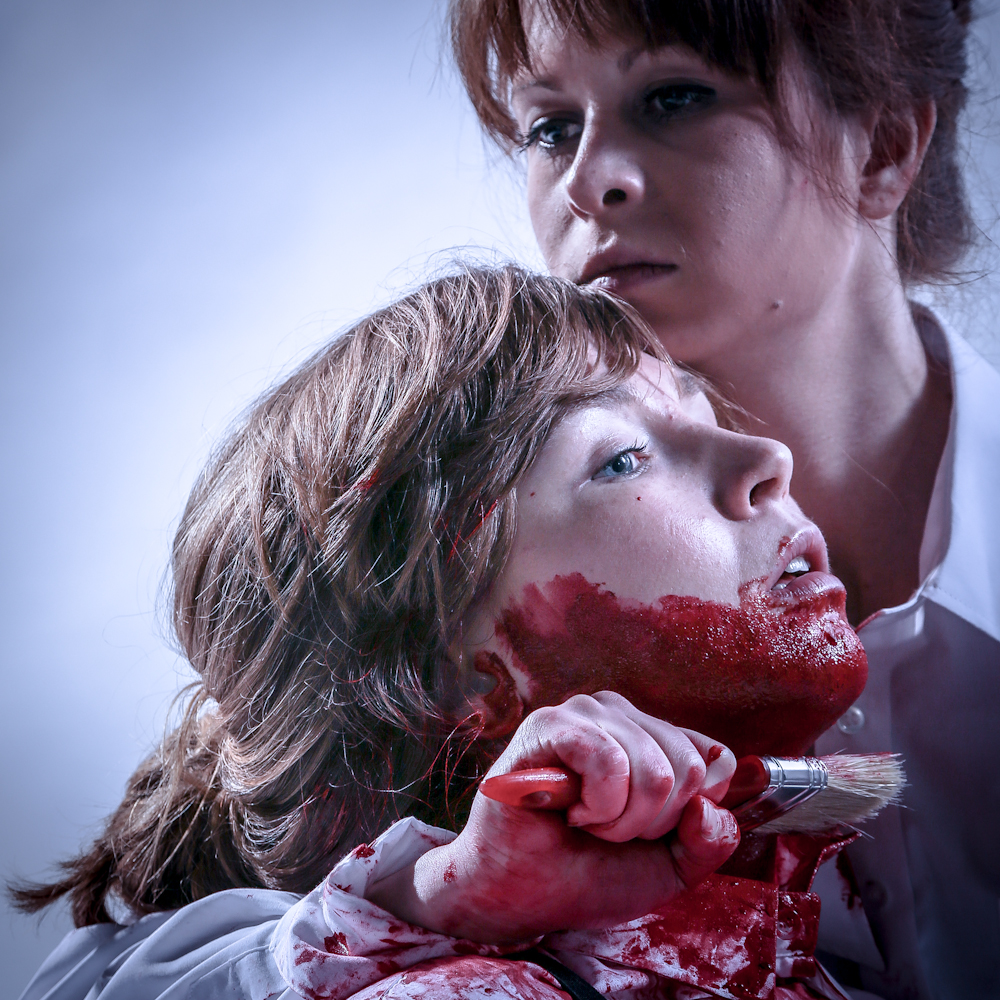
The eight-member cast wears a monochrome uniform of black skinny jeans, ankle boots, white shirts and black braces. Coats, scarves and a wheelchair identify character changes, as do physical and vocal alterations. The set is completely white, but not for long. As Shakespeare’s most gruesome play energetically unfolds and characters are mutilated and killed, the red paint in the tins on the stage edges soon covers the floor, walls and the actors. I’m rather surprised the audience managed to escape any paint splatter. Rather than swords, they have paintbrushes tucked into their waistbands that are dipped in paint before an attack. The paintbrushes were used with the same movements as swords, slicing and stabbing. With such a striking use of weaponry that normally creates rather than kills, it would have been a more unique choice to explore stylized movement rather than emulating real life. As it was, there was a level of absurdity to stabbing someone in the back or slitting a throat with a paintbrush. Perhaps this was a comment on the absurd amount of death and destruction in the play? Perhaps the murders are being compared to art, or even DIY where the old and excess is cleared to make room for new? Or perhaps I am reading too much into it and Al-Shaahtar made this choice simply because it was unique and looked great. White, black and red will always be a powerful colour scheme. The liberal use of red paint highlighted just how brutal this play is.

The performances were on the whole very good. Ashlea Kaye’s Marcus and Demetrius were a highlight of contrast between an ill, old man and scrappy, oversexed young manhood. Kaye is clearly a versatile performer with outstanding stage presence. Ariane Barnes was a formidable Titus, fully believable as the successful general that ruthlessly seeks revenge for his downfall. The ensemble work is excellent with smooth transitions at a fast pace. The ensemble aspect didn’t quite work as the actors remained on stage most of the time, but lounged casually on the periphery, half in the wings, watching the action when not performing. The goal is to enhance the ensemble aspect of the production, but the halfway approach came across as non-committal. Either be present on stage and dynamically contribute to the stage picture, or be out of sight. Otherwise, it lends itself to distractions. I would guess that the oldest cast member is in her early 30s; having a wider range of ages would make their diversity even more commendable.

With a running time of about an hour and 15 minutes, this was a good length to convey the main focal points of the story, but cutting this play can be tough. As one of Shakespeare’s earliest plays and his first attempt at writing a tragedy, it can feel quite clunky. Cutting it cannot overcome this quality and can occasionally exacerbate it. In this case, the tragic downfall of the central characters occasionally felt rushed, but not overly so. An interval wasn’t particularly necessary and felt like it occurred very late in the story. Generally in this version, the editing did a good job at preserving the story and capturing Titus’ life rapidly collapsing around him.

As previously mentioned, the energy was extremely high and well-maintained throughout. Moments of humour lightened the tragedy, particularly good was Tamora and her sons’ portrayal of Revenge, Rape and Murder. Another lovely moment is Aaron (Anita-Joy Uwajeh) meeting his newborn son for the first time and refusing to allow the child to be killed. There were numerous others. Smooth Faced Gentlemen have a clear gift for making Shakespeare accessible and telling a cracking story. They are certainly a company to follow as they grow and develop their performances.


The Play’s The Thing UK is an independent theatre criticism website maintained voluntarily. Whilst donations are never expected, they are hugely appreciated and will enable more time to be spent reviewing theatre productions of all sizes. Click here to make a donation with PalPal.
Don Q, Greenwich Theatre

Production shot 4 croppedI really struggled to come up with a suitably erudite introduction to this review of Flintlock Theatre’s Don Q. Not because it’s hard to summarize – quite the opposite. The structure works, the message and plot are clear and the performances are excellent in this suitable-for-all-ages appropriation of Cervantes’ Don Quixote. I am chalking my difficulties up to this being such an enchanting and moving play that words aren’t quite capturing that “warm and fuzzy but actually quite sad” feeling I had the entire time. Everything I tried to write came across as cold and clinical. It’s a rare occasion that I go to theatre and nearly forget to take notes because what I am seeing on stage grips me by the proverbials that as a woman, I don’t even have. Seeing Don Q evoked the joy and wonderment I had on my first experience of theatre as a small child.

It’s not a simple show, though. Four actors take on numerous levels of characterization. Like Shakespeare’s A Midsummer Night’s Dream, a group of unrelated characters bookend the play. In this case hapless librarians, frustrated by the council’s efforts to close them down, highlight the importance of storytelling by relating the tale of Norman Vaughan to us. Norman, as we soon find out, is probably their most infamous patron. Norman’s nameless nephew thinks Norman, now 81 years old, has gone mad. You see, Norman loves to read and reenact the stories he reads with his younger friend Sam and anyone else he cajoles into joining him. It is immediately and painfully clear that Norman is completely lucid; he just has a joyful passion for stories and acting them out. The younger generation are so busy being adults that they have forgotten the pleasure of playacting and the power of an absorbing tale. So not only are the audience reminded of the importance of reading and allowing ourselves to be absorbed in a good book, we are also more subtly admonished for not taking the time to listen to our elders and treat them like human beings. So what if Norman (or any other elderly person) loves what he does? As long as no one gets hurt, we are told to leave well enough alone.

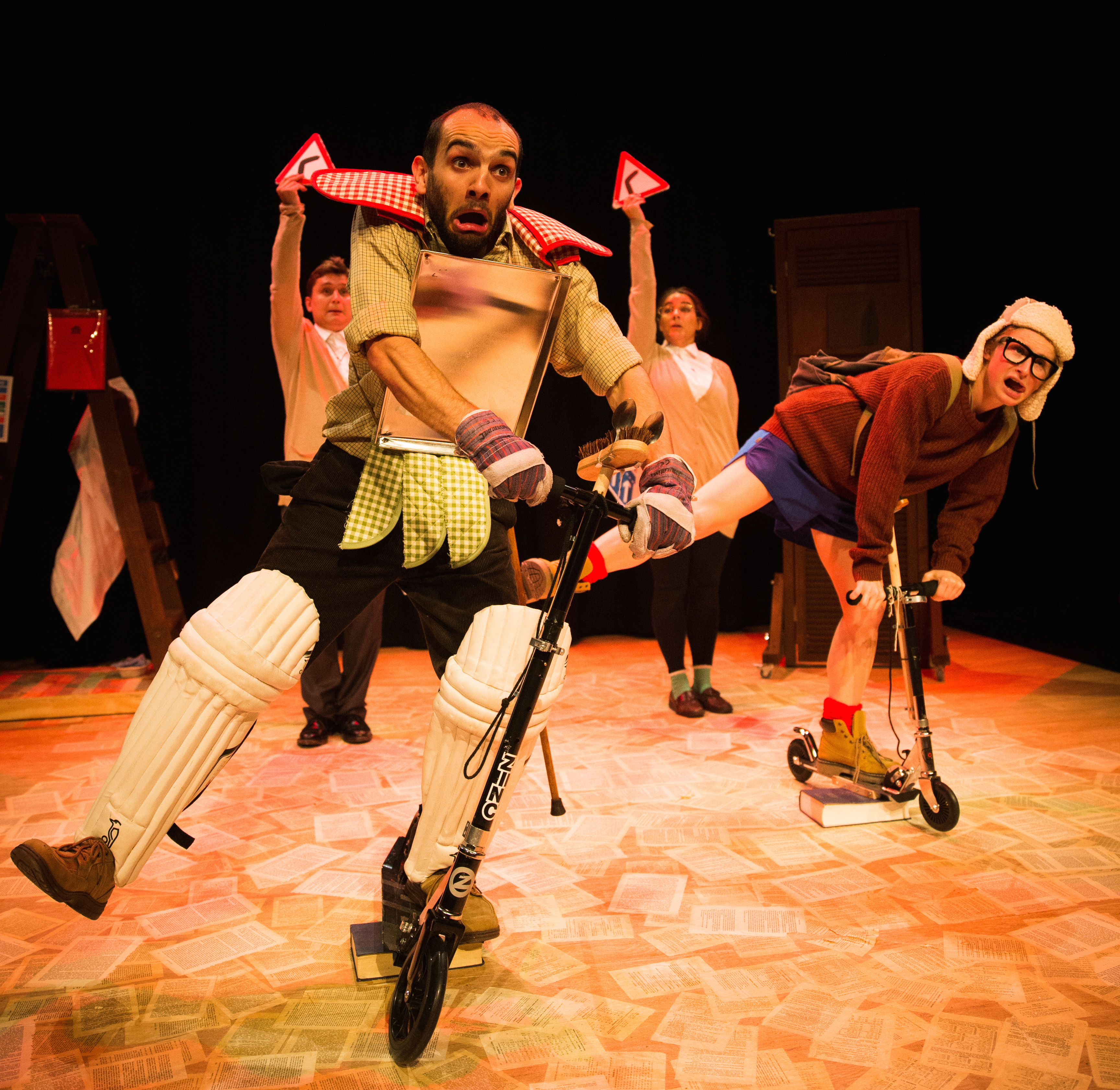
Norman’s nephew, having had enough of Norman’s mishaps and convinced he has gone mad, puts him in a nursing home to be looked after properly. He strictly forbids Norman from having access to any books. Sam, on one of his visits, smuggles in a copy of Don Quixote into the nursing home. A comedy chase results in their escape and an adventure imitating a selection of escapades from the original novel. Sam is a begrudging Sancho Panza, a pair of scooters augmented with push brooms and spoons are their trusty steeds and other people they encounter on the way play other characters (some more willingly than others). Their madcap journey is full of whimsy, spontaneity and emotional turmoil but with a potentially tearful ending for the more sentimental of audience members.

Director Robin Colyer skillfully employs physical theatre sequences to add variation and an atmosphere of a touring troupe of players. This is clearly a well-rehearsed, established production; not a breath was out of time. Objects and costume pieces are used liberally and often comically, in a style reminding me of the West End’s 39 Steps. The set and costumes are simple and rustic, but versatile and thought through. Nothing is excessive, nor sparse; the production design is just right.

The performances unite a fantastic script with heaps of audience interaction, and the great design to create a beautifully polished little show. Some call and response would have made more people feel included, as well as giving costume and lines to those in all parts of the auditorium rather than only those sat in the front row. Actors Jeremy Barlow, Francesca Binefa, Kate Colebrook and Samuel Davies are versatile multi-rollers with outstanding chemistry as an ensemble. Whilst I considered that having an older man play the role of Norman would have brought more to the story, the role is incredibly physically demanding and would be difficult to play at a more advanced age.

Don Q is only at Greenwich Theatre for a brief time, but then continues its national tour. This Oxford-based company is worth seeing no matter what your age, where you are or what you do. They use physical theatre, Brecht, storytelling and meta theatre but in an unobtrusive, charming way to create this lovely, warm, gem of a play.

Intention: ☆☆☆☆☆

Outcome: ☆☆☆☆

Star Rating: ☆☆☆☆ 1/2


The Play’s The Thing UK is an independent theatre criticism website maintained voluntarily. Whilst donations are never expected, they are hugely appreciated and will enable more time to be spent reviewing theatre productions of all sizes. Click here to make a donation with PalPal.

Kate, Greenwich Theatre, for remotegoat

They say all girls love a man in uniform. The young women in 1940 Reykjavik are no different. They certainly enjoy the company of the young British lads occupying the city to protect them from the Germans. The rest of the city exploits the financial benefits of a 25,000-strong population increase with money to spend and no fear of imminent attack. The war is particularly prosperous for husband and wife Julia and David, their daughter Selma and niece Kate. David runs a kiosk selling cigarettes to the boys, Julia mends their uniforms, Kate helps with the kiosk and Selma…well, she has sex with soldiers for money.

This production uses Brechtian staging, a capella singing, and two languages to share the wartime ups and downs of ingénue Kate (Rianna Dearden) after her move to the big city. She begins bright eyed and bushy tailed, full of countryside innocence. After becoming embroiled in her cynical cousin Selma’s (Olivia Hirst) secretive exploits, experiencing love, loss and sexual assault, Kate quietly, but sadly, matures. The girlish enthusiasm and wonder is gone. Selma does not have such an extreme emotional journey, but must face the consequences of her actions and discover they affect her family as well as her. Life starts out swimmingly, full of good intentions, but eventually collapses under the pressures of wartime.

Dearden’s and Hirst’s performances strikingly contrast each other, exploring the complexities of a close familial relationship similar to that of siblings. Mother Julia (Anna Nicholson), envious of the girls’ youth, encourages them to take up with the soldiers. Father David (Chris Woodley) tries to keep the family together and make a good living from his business endeavors. Fifth performer Alex Dowding plays several soldier characters, including Kate’s boyfriend, Rob. Despite the serious subject matter, Dowding skillfully uses comedy multirolling akin to that in the West End’s “39 Steps.” Woodley also multiroles as neighbour Benni, who is in love with Selma and ruthlessly tries to claim her.

Using bare-bones set and lighting emphasizes the performances and the characters’ relationships. Props are used sparingly, but effectively. Bits of paper are snow, a wooden crate is the kiosk and a sofa, and a leaf blower comically captures the constant wind in wintertime Reykjavik. The actors never leave the stage; they hand each other costume pieces, props and operate the leaf blower whenever a door opens or the characters are outside.

The play’s energy is excited, anticipatory and high-paced. This could be slowed down more in moments of high emotion in order to have a stronger effect, but it is a minor issue. The performance runs for an hour but certainly has scope for development into a full-length piece of theatre.The performances are excellent and energetic, but the parental characters would have benefited being played by older actors.

Lost Watch certainly is certainly a company to follow. “Kate” is an excellent example of new writing in fringe theatre using confident performances, a clever use of space and imaginative storytelling of unique subject matter.

Intention: ☆☆☆☆

Outcome: ☆☆☆

Star Rating: ☆☆☆1/2

Reposted from remotegoat.com: http://www.remotegoat.com/uk/review_view.php?uid=11793