
“The truth is rarely pure and never simple,” says Oscar Wilde in The Importance of Being Earnest. Indeed. We often encounter conflicts or situations where opposing viewpoints create very different stories. Michael John LaChiusa adapts three Japanese short stories by Ryūnosuke Akutagawa, including “The Grove” on which Akira Kurosawa based his western hit Rashomon, intertwining them to create a production showing that, well, we often see what we want to see and that “truth” is a flighty creature that can never be pinned down and shown objectively. See What We Wanna See, a chamber musical produced by Aria Entertainment at Jermyn Street Theatre, is a delicate, intimate performance with a strong cast. However, LaChiusa’s trilogy with loosely connected themes has little else that links them and feels like an evening of short plays rather than a cohesive, full-length musical.
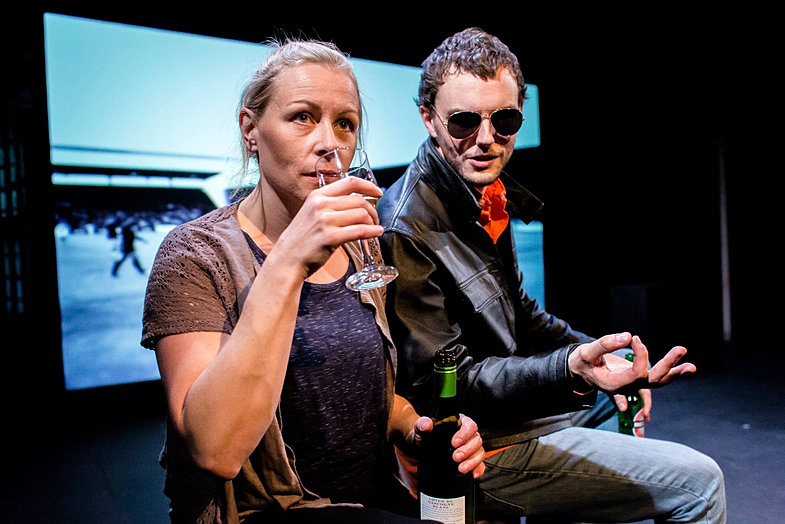
As the prelude to each act, “Kesa and Morito” shows a medieval Japanese couple recently discovered having an affair. They are seeing each other for the last time. Both have plans for their final encounter and blackouts preclude discovery of their fate. “R Shomon” follows as the bulk of the first half, a thriller set in 1950’s New York. Four characters tell totally conflicting witness statements to an unseen policeman. Who is telling the truth about the death of The Husband? How is this piece connected to the opening where Kesa shares her story in a single song? The audience never finds out. The ending to this mini-musical is deliciously ambiguous with some complex musicality in the songs, but the connection to the “Kesa and Morito” prologue is tenuous at best.
The second half is the same structure. Morito shares his side of the story for the duration of a single song, then “Gloryday” is the rest of the act. This is a more compelling story than “R Shomon” and could be a longer, standalone production. A disaffected priest creates a hoax miracle that takes post-9/11 New York City by storm, making some pointed criticism of Jesus and his followers by comparing them to the vulnerable that fall for his trick. The end has a poignant twist and reiterates the show’s focus on the fluidity of truth within deceit and crime. Whilst these are good stories and maintain audience interest, there is no linking transition or any comment on the three other than presenting them together. This emphasizes the timelessness of the theme, but takes no particular point of view on it. LaChiusa’s message is consequently unclear.
The cast of five is fantastic; in a small theatre with a four-piece band are quiet enough that the actors don’t need mics so detail isn’t lost through amplification. There is no week link; they all have the chance to play at least one substantial role with the others showcasing their range. Jonathan Butterell as the priest that loses his faith in the second act’s “Gloryday” is particularly touching. Mark Goldthorp as the reserved 1950s taxi company boss in the first half’s “R Shomon” is quietly enigmatic and counters the brashness of Marc Elliott’s Thief and Cassie Compton’s resentful Wife. The priest’s Aunt Monica as given by Sarah Ingram is light relief but still possessing emotional depth.
LaChiusa’s music is reminiscent of a gentler, simpler Sondheim with influences spanning different eras and cultures. Simon Anthony Wells’ design similarly captures the different worlds in the production. Despite compelling individual stories, great performances and some lovely songs, the audience is left questioning what they are meant to take from the production and unsatisfied by the lack of a deeper connection between the three component tales. It’s still definitely worth seeing the London premiere of this unique, cosy production by Aria Entertainment, a producer vital to musical theatre for staging new and rarely staged work.
The Play’s The Thing UK is an independent theatre criticism website maintained voluntarily. Whilst donations are never expected, they are hugely appreciated and will enable more time to be spent reviewing theatre productions of all sizes. Click here to make a donation with PalPal.
 The pool preserving the remains of The Rose Playhouse is the sea surrounding a nameless, remote island. Fascinating, dangerous, wild or wonderful, all of the island dwellers have lengthy, close relationships with the sea, for better or worse. These intertwining, turbulent histories meet and join each other at the Old Man and his Boy, a story of a new, young love and a past love, long lost. Heady Conduct’s Reckless unfolds a timeless tale of love, truth and community dictated by the sea using narration, site-specific influences and direct address interspersed with conventional performance. The story is both sweet and saddening, but the play’s structure is disjointed and thin, occasionally unclear in time and place, causing the story to lose support and clarity. Fortunately, the scenes between characters are endowed with honesty and intimacy, and the unique performance venue is fantastically utilized by director/actor Rebecca Rogers.
 That which goes up must eventually fall. Christopher Marlowe’s Tamburlaine the Great tells of the title role’s rise from common thug to emperor of Persia and Africa. A precursor to, and probable influence of, Shakespeare’s ruthless Richard III, the man is needlessly brutal: he orders rivals’ remains displayed on city walls, women and children killed, manipulates others to join his cause and then betrays them. Fate eventually catches up with Tamburlaine after he sets fire to books, including the Qu’ran, and proclaims himself more powerful than God.
 Carol (Holly Joyce) moved to a village in Carcassonne to rebuild her life after a devastating divorce and her son had grown up. She is convinced that in a past life, she was a medieval troubadour called Guy in the time of the Cathars. Raymond (Danny Solomon) is an actor working in the second-rate tourist attraction that Carol stalks, and longs for a life in the more exciting London. With a poetic, reflective script by Nick Wood and direction by Natasha Wood, Consolation has riveting moments between these two damaged, conflicting characters as they travel on parallel journeys of self-discovery, but at two and a half hours with a lengthy, slow-burning beginning, the production could use a trim. The slow development and several sub-plots lend a real-life complexity to the story, though the last to be introduced has insufficient expositional time considering its importance to the play’s conclusion. Despite the script’s need for additional development, this is a moving character piece unsentimentally following two individuals as they come to terms with the insubstantiality of their dreams.
 Confession: I don’t like Friends. I find the acting two-dimensional, the jokes not funny and it bears no reflection on real life in New York City, where I spent four happy years at drama school. So I was reluctant to see MOTOR’s Ross & Rachel, because I thought it’s about the couple from Friends.
 Eight, 5-minutes plays by established playwrights in response to these event cancellations, followed by a panel discussion with rotating guests, create Walking the Tightrope: The Tension Between Art and Politics. Today’s panel was Jonathan Mills (Former Director, Edinburgh International Festival), Fergus Linehan (Director, Edinburgh International Festival) and Tim Fountain (writer). A cast of four excellently performs the mini-plays; the scripts are powerful and constructively contribute to the debate, and the discussion itself can become a piece of one-off theatre once the audience is handed the microphones.
 Hailing from LA, Waitless is a semi-autobiographical play about newlyweds Shelly and Trent, from the American south but living in New York. Trent works in finance and Shelly in TV production, but when Trent’s job transfers him to London, Shelly gives up her career to go with him. Told through heightened, contemporary farce with moments of sincerity, Waitless shows that the cultural gap between the UK and US is bigger than you think.
 Current Location is an adaptation of the Japanese play by Toshiki Okada, set in a coastal village, presumably in England, with a minimalist script and design. It feels quite Scandinavian (which suits the simile I will use shortly). Four women anxiously rehearse for a performance, then another arrives who disrupts the natural chemistry of the group. She is soaked from a sudden downpour from the blue, “bad luck cloud” that recently appeared over the village. Its appearance effects the entire population: animals are behaving strangely and people are no longer talking to each other. Rumours abound of a coming disaster; the women we see are split – some believe them, others don’t. As the play progresses, climate change intensifies as does character conflict. Some believe nature will soon cause the village to disappear, others refuse that it’s a possibility.
 The Play's The Thing UK