Jekyll & Hyde, Platform Theatre

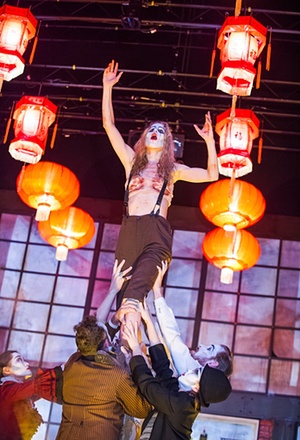
4404a479-e69a-4d92-9600-3d8eb075ff6c-1390x2040Giant red paper lanterns float over a smoky Victorian London alleyway. Six actors in western clothes and eastern whiteface also marry East and West in what initially promises to be a vibrant, transnational reimagining of R. L. Stevenson’s gothic novel Jekyll & Hyde. With the addition of a female Jekyll and a textual deconstruction that incorporates a range of performance styles, there is a lot to process in Jonathan Holloway’s script and staging. Whilst each individual choice has merit, none are fully explored due to the overwhelming array of influences Holloway employs. The sum total creates a muddy hodge-podge of ideas rather less substantial than a focus on the development of one or two of them.

The show begins away from Stevenson’s story, with an older man in Chinese dress (who is not Chinese) sharing the discovery of a wonderful but horrific tale he wants to sell to a young woman in1920s dress, presumably a publisher. To pique her interest, he begins to tell the story contained in the tome’s pages. This unnamed pair reappear regularly as the story is acted out to the audience, using narration to preempt the action and distance the audience by reminding them it is indeed a story. This is one of several Brechtian devices employed; even though it is a useful one in plays addressing social issues, it is unclear what element of the story the alienation is meant to highlight and any contemporary social relevance.

The story that plays out from the old man’s book is the more traditional Victorian story of Dr. Jekyll and Mr. Hyde, but Jekyll is a woman from Eastern Europe and the only woman doctor in the UK. It’s initially a great feminist touch, but the sex-crazed, manipulative Jekyll is hardly an empowering, feminist character. Having escaped war in her home country, she comes to London alone and uses her research to transform into a man. Though well-played by the physically expressive Olivia Winteringham, the character lacks depth and wears a costume that looks like it was put together in Camden Market rather than a costume workshop.

The set and lighting by Neil Irish are fantastic, though. Coordinated to create a horror film effect during particularly disturbing moments, they sumptuously support Holloway’s staging. Jon Nicholls’ sound design is atmospheric and sinister, well integrated with the other production elements. The costumes are somewhat inconsistent, with the men’s outfits appearing more historically accurate than the women’s. It is unsurprising that no costume designer credited.

The performances vary, with one of Chinese actors occasionally struggling to connect to the meaning in the language, creating unintended comedy. As this is a production incorporating two cultures, why shy away from using two languages? Other than a brief bit of either Cantonese or Mandarin at the start, the rest is in English. The story is well known enough to support a mix of languages, though with the melodrama, physical theatre, expressionism and naturalism already present, this would add further excess. As is, this adaptation feels predominantly English, with some East Asian design influence and a couple of Chinese performers. Though gorgeous to look at, the production never quite found the substance behind the façade.


The Play’s The Thing UK is an independent theatre criticism website maintained voluntarily. Whilst donations are never expected, they are hugely appreciated and will enable more time to be spent reviewing theatre productions of all sizes. Click here to make a donation with PalPal.
Do We Do the Right Thing?, everything theatre

“…Having read the programme whilst waiting to enter the theatre, I looked out for the actors’ earpieces.

“This performance relies on a form of verbatim theatre called, “recorded delivery.” The programme explains this is when, “recordings of the actual interview are played to the actors in earpieces on stage during the performance. Rather than learning lines, the actors respond to the material during the performance and retell their interviewees’ stories word-by-word and breath-by-breath.”…

“The structure of the play consists of fragments of interviews with people affected by war, past and present. It also hears from some people who live in Wootton Bassett…The problem here was that the individual stories had scope for an excellent narrative on their own, but the numerous excerpts did not allow for any of the characters to have a substantial journey…

“The main issue with this play is that it tries to say too much and in doing so, says very little. Author Neil Walker writes this is, “a play which raises the broader issues about acts of remembrance, the public’s relationship with the military and war, father-son relationships and individual identity. The play poses important questions about the ripple effect of loss through military conflict and what happens post-2014…” A one-act play needs only to examine one of these themes…”

Read the entire review on everything theatre here.

How Nigeria Became, everything theatre

“It’s 1914. The British government has merged the tribes and kingdoms to create modern Nigeria. King George V has sent Charles (Christian Roe) to visit Herbert Ogunde (Tunji Falana) to ask him and his theatre troupe to perform at the unity celebrations…

“The story the theatre troupe shares with Charles follows young girl Jenrola (Rita Balogun) on her quest to find the spear of Shango…Also looking for the spear are Aguzani (Stephanie Levi-John) and Obaze (Rebecca Omogbehin). The three women engage in a battle of wit and strength to see who can get to the spear first…

“The story of Charles, Herbert and his actors is framed by a Yoruba creation myth that starts and finishes the production…As lovely as this story was, it felt disconnected from the main plotline, even though it provided the background to the spear…

“All of the actors except Roe play multiple roles, and they do so incredibly skillfully. Falana…employs great physical skill to differentiate these characters and shows the inherent misogyny of 1914 Nigeria through comedy rather than nastiness…

“The set is simple but colourful and effective. The stage is a painting of a river delta and coast, forming the natural curve of the stage. There are mats and cushions on the front of the stage for young children, which gives them more of an opportunity to engage with the interactive elements of the production…

“This production is highly polished and engages the young members of the audience as well as the older ones. It was a great experience…seeing numerous young people engage with the action unfolding before them.”

Read the entire everything theatre review here.

Feature – Redefining “Emerging”

When I think of the word “emerging”, I picture the finite stage between pupae and butterfly: a damp, crumpled creature working it’s way out of a safe, confined shell, in a completely different form to what it was previously. Within that set time frame, the butterfly must climb upwards and into the sunlight so its wings can straighten and dry out. If it fails, it will not be able to fly and fulfill the potential of its adult form. The time in which the emerging must be accomplished is set; at the end it has either succeeded or failed and there is no going back.

“Emerging” is a commonly used theatre term used to categorise those that have finished their training and are in the process of finding their feet within the industry. It implies they haven’t found success yet, but it is a definitely achievable point in the not-so-distant future. “Emerging” indicates transition and must be completed within a determined time frame, after which “success” is reached. Many actors have a concrete idea of “success” at the onset of their careers and say they will give up if they haven’t “made it” within three years/five years/by the time they’re 30, and so forth. Of course, the reality is far different. This definition of “success” is often reconfigured as they navigate working in the arts. The problem with using the words “success” and “emerging” in such a fickle industry is that the elusive “success” “emerging” hinges on is unlikely to be achieved at all, let alone within a predetermined time. Also, an artist’s definition of success is likely to be reconfigured time and time again as they grow and change. They easily could, due to the realities of the business, be in a state of emerging forever.

In theatre, “emerging” also usually applies to those under twenty-six or more rarely, thirty. The general use of the term means an early-to-mid twenty something who completed training within the last few years. Until recently, the now-no-more IdeasTap briefs were almost exclusively available to artists in those age brackets. After enough feedback from members, they began to lift those age ceilings to allow their ageing membership to participate more widely. (Then they closed because the costs of running the organisation were no longer being met.) This is rare, though. I still widely see grants, internships, and participation programmes limiting ages. I even see jobs that are exclusively open to those under 26 and unemployed. What about the unemployed 28-year-olds? Or those even older?

I am most certainly not saying that young artists don’t need and deserve support, but that older artists do too. They may still be in the state of emergence, having never reached that elusive “success” even after many years in the industry working for free or low-paid. Or, they may have entered the profession at an older age. I have met numerous people (usually actors) that changed careers and began working in theatre and film in their 30s, 40s or even older. Last year I met Hugh Hemmings, who became an actor after he retired. There are also people in theatre who start working in one field, then moved to another. A common transition I have seen is from actor to director, or actor to producer. Other people straddle several roles within the industry. They were emerging too (and still may be), and deserve the support of any other emerging artist, even if their emergence does not fall into the general understanding of the word.

What that support looks like may be radically different from people in their early 20s. I recently wrote about the issue of childcare in the arts, which applies to artists at all stages of their careers, but particularly those that are not yet “successful.” Housing, particularly in London, is a primary issue for working artists. Why should any working adult have to live with their parents in a perpetually infantilised state in order to pursue a career? It’s now depressingly commonplace for young people to be living at home into their 30s if they work in low-paying fields. Over all of this is availability of funds, courses and programmes that are designed to support artists’ work, but as previously mentioned, these often come with an age limit.

So, let’s collectively re-examine our mindsets. Arts organisations and funding bodies must learn that “emerging” includes all ages and does not indicate how long someone has worked in the industry. It can include those who have taken career breaks, or changed their career path within the industry. In this precarious time of funding cuts, the last thing we need is to pigeonhole those that need support as “established” or “successful” when that couldn’t be further from the truth.


The Play’s The Thing UK is an independent theatre criticism website maintained voluntarily. Whilst donations are never expected, they are hugely appreciated and will enable more time to be spent reviewing theatre productions of all sizes. Click here to make a donation with PalPal.

The Four Fridas, Woolwich Barracks

Voladoras_1396b-LWhen she was little, Frida Kahlo yearned to be able to fly. Her parents’ gift of a dress with wings proved disappointing though her dreams of flight remained, particularly following a crippling bus accident that left her with chronic pain and unable to have children. Bedridden for months during her recovery, she channeled her despair and rage into painting. These paintings, along with the ones she made over the rest of her short life, are the inspiration for Bradley Hemmings’ stunning outdoor multimedia event at Greenwich & Docklands International Festival this year. Using pyrotechnics, dance, projections, aerialists, music and the Mexican fertility ritual of the Voladores, The Four Fridas is a visually arresting spectacle but the show that is meant to be a tribute to Kahlo does not provide any particularly unique insight into her life and work.

Divided into for sections that reflect the elements earth, air, water and fire, The Four Fridas chronicles Kahlo’s life. Whilst there were clear acts to the script that took place in different areas of the site, the association with the elements was loose at best. The most sculptural set piece, a bus and tram crash built from metal and crates, was only used briefly towards the beginning. The script itself was fantastical and poetic, but densely written and delivered at a quick, even pace. The language was second rate to the visuals, though what with how impressive they were it would be nigh on impossible to surpass them with any other production element. It was easy to ignore the language in favour of visual performance surrounding the audience allowed to freely wander the performance site.

There were two highlights of the 45-minute long production. The first was an extended projection and aerialist hybrid against a giant screen held up by a crane. The projections were animations based on Kahlo’s work, with the performers against the screen adding texture and further detail. The most exquisite sequence was a flying butterfly, with a performer as the body of the insect. Each aerialist was controlled by a less obvious human counterbalance who scrambled up and down the vertical rigging on the side of the screen. This added an element of puppetry to the performance mediums used. These sections reflected freedom Kahlo felt when painting and her anguish of being trapped in a body that had previously been healthy and unscarred, but made no specific comments on her life.

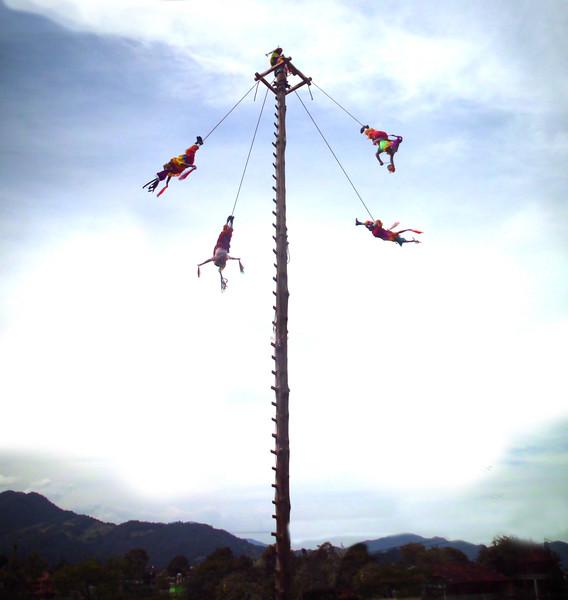
The second most notable feature was the ancient ritual of the Voladores. Using nothing but rope to ensure their safety, four people climbed a wooden pole without harness, only to fall backwards suspended by their feet. The top section of the pole gently spirals, lowering them to the ground. Whilst this is a Mexican fertility ritual, the vague connections to Kahlo are her inability to bear children and that it also hails from Mexico. Surely it is an affront to an infertile woman to end a performance about her life with hope for children? Nevertheless, it is a remarkable cultural phenomenon to witness.

The free access to an event with such high technical requirements is highly commendable, though the tech is at the mercy of the outdoors. On the last night, part of a scaffolding tower collapsed and had to be removed (fortunately no one was hurt). On a previous night, winds meant that the screen was unable to be used. Whilst this adds to the immediacy of live performance, it also means the performance is shortened. Whilst it was free to stand in the site and watch, bleacher seats came at a price. Those that paid may have felt short changed by the abbreviated length.

Hemmings had set the bar high for this kind of accessible public performance though his work on the Paralympic Games Opening Ceremony and stylistically, work like this should be produced often, up and down the country. It is a shame that the spectacle did not particularly support the woman it is meant to honour. Even with basic knowledge of Kahlo and her work; the opportunity was there to communicate a deeper understanding but that was never reached. Though this kind of theatre is still new and infrequently produced, it should aim to develop more nuance and meaning. I look forward to more artists creating large-scale public performances incorporating a rich combination of performance practice and technology. This is the sort of art that has the potential to capture public affection and encourage them to more fully marry art with day-to-day life.


The Play’s The Thing UK is an independent theatre criticism website maintained voluntarily. Whilst donations are never expected, they are hugely appreciated and will enable more time to be spent reviewing theatre productions of all sizes. Click here to make a donation with PalPal.

Domestic Labour, everything theatre

“…the performance was much more theatre than dance. It addressed a range of themes and ideas drawing on the experiences of the Iranian-British male author: feminism, domestic responsibility/burden, motherhood, revolution, sex, bicycles and headscarves…

“…The dark stage was peppered with old-fashioned hoovers and appliances each lit with a small spotlight. It was a striking visual. As the performance started, three women interacted with these props in a range of ways, from cradling them like a baby to holding them like guns. They showed both affection and aggression, much like the emotional life of a vintage housewife. This sequence showed subtle influence by contemporary dance…

“The performance was incredibly visual, though not without some technical hitches. The lighting design seemed well intentioned, but did not always suit the staging. For example, one moment had the performers’ faces in darkness whilst the rest of them was lit. In another, a light box was not big enough to light all three…These problems were countered by stunning moments, such as creating a stationary bicycle using a small heater, a hoover full of dust and a bike…

“The show was non-linear, passing back and forth through time. An Iranian man marries an English woman in the present day, but Iranian women are emancipated in 1936. Several characters experience a revolution and discuss the withdrawal method of birth control. These women, though indistinct characters, still provoked audience empathy…

Read the entire review on everything theatre here.