The Broke ‘N’ Beat Collective, Battersea Arts Centre

https://i0.wp.com/www.20storieshigh.org.uk/wp-content/uploads/2016/02/Jack-and-Lateefah-1280x853.jpg

Kids have it tough, especially if they’re poor. Decreasing social mobility, higher costs of education and living, and decreasing welfare are trapping our future generations in inescapable cycles of poverty. They are just as aspirational as young people from more privileged backgrounds and aware of the opportunities they don’t have. They are angry, frustrated and lack the opportunity to constructively express their feelings that often go completely disregarded by more comfortable members of society.

Theatre-Rites and 20 Stories High, seeing validity in their voices, worked with numerous young people in this demographic to devise a gig-theatre show that shares experiences of being a poor teenager in Britain today. The Broke ‘N’ Beat Collective is an empowering, important work that uses fantastic puppetry, mask and music to create a gloriously messy collage of young people’s concerns and issues. Structurally mirroring the rough and ready, fractured existence of urban youth culture, it rebels against theatrical and cultural preconceptions without apology for its flaws.

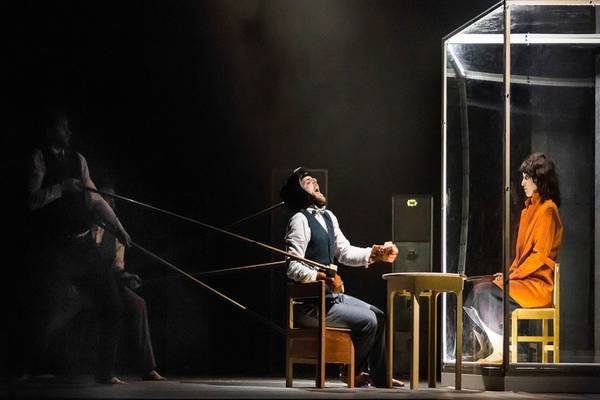
Elisha Howe’s (aka Elektric) soaring rhymes and Jack Hobbs (aka Hobbit) beatboxing energise the audience and establish a defiant, proud tone that carries through the show. They are not backing down, nor are B-boy Ryan Harson (aka LoGisTics) and puppeteer Mohsen Nouri. They literally zoom in on the tiny model tower blocks and street scenes of urban Britain, replicated in cardboard wonderfully extracted from the plain back wall, creating a landscape of alternating songs with monologues. These set pieces and puppets pass on the otherwise unknown life stories of young people they’ve met.

Omar is an insecure, confrontational grey hoodie that takes the whole show to find his voice. Jack’s a wannabe gangsta who knocks up Latifa (both with cartoonish, cardboard heads) and ditches her and the resulting child that reflects on how that’s shaped his life goals. Joanne is the Papergirl who cuts herself because her mum’s boyfriend abused her. There’s also the incredible Speaker Boy, a rotund, playful chap with a boombox for a head. Each puppet is as unique as the young person behind it, and just as inspiring. (Seriously, go look at the puppets’ photos in the gallery part way down the page; they are some of the most emotionally endowed bits of paper and foam I’ve ever encountered. All of these characters unashamedly demand attention with precise, evocative storytelling and a joyfully visualised presence. These stories are broadcast along side an ever-changing soundtrack with interjections of dance, banter and spoken word, simultaneously creating an atmosphere of celebration and seriousness. Though fun, it never loses the sense of the weight behind the work.

Despite the boldness in the work and the importance of its messages, there are some sloppy transitions that cause the piece to lose momentum. Elektric unnecessarily introduces each number by name, and there are some in-jokes between the performers that, whilst sweet, don’t carry energy with their small scale. This gives the whole piece a choppiness that makes it feel unfinished.

All four performers’ exemplary skillsets and vibrance are fantastic vehicles for the young people of this country seeking escape from the poverty that is so limiting to their ambition. Each moment connects to the next through a theme rather than a storyline, but the effect mirrors modern society: a bit messy, emotional and ambitious for a better life. The fun doesn’t override or trivialize the seriousness, and neither is it too weighty. The unpolished feel is very much ingrained in the gig-theatre style, and though it would be great to learn more about the characters presented, The Broke ‘N’ Beat Collective truly holds a mirror up to nature.

The Broke ‘N’ Beat Collective runs through 2 April.

The Play’s the Thing UK is committed to covering fringe and progressive theatre in London and beyond. It is run entirely voluntarily and needs regular support to ensure its survival. For more information and to help The Play’s the Thing UK provide coverage of the theatre that needs reviews the most, visit its patreon.

Rave Space, Camden People’s Theatre

https://www.cptheatre.co.uk/wp-content/uploads/2016/01/Will-Dickie-1-1.jpg

A few hours before the start of the New Year, I found myself alone in a dark room in Battersea Arts Centre with two DJs, Will Dickie and Jeremiah Isaacs. The encounter was intimate, revealing and brief. Twenty minute long The Resolution Studio recorded individual participants’ resolutions for 2016, created a signature dance move, and the two djs and their audience of one had a quick groove session before rejoining the venue’s party. Though I felt self conscious at being the sole centre of these two artists’ attention, it was an event that stuck with me the past few months.

When I received an invitation to Camden People’s Theatre festival Sprint 2016 closing show, Will Dickie’s latest work Rave Space, I jumped at the opportunity to experience more of his work. With The Resolution Studio captivating me with Dickie’s charisma and sensuality for such a short time, I couldn’t resist the offer of an hour-long rave and text hybrid piece in the basement of CPT. I left confused and disappointed, though. There are definitely some wonderful aspects of Rave Space­. Interaction, dance and music meld to make a gig theatre piece with some audience autonomy, but with an actual runtime closer to 90 minutes and lengthy, muddled sequences of text and contemporary dance that only tenuously fit together (if at all), this new piece is much in need of further development.

One-by-one entry, whilst it adds atmosphere and interaction, takes a long time as we each have to ID ourselves and receive a hand stamp. Once we’re in, we can peruse the tiny stations with LED signs, turntables, and random objects assembled like shrines in the corners of the room. Some people are given laser pointers. It’s mysterious, cryptic and exciting, though there isn’t much to actually do or engage with. People are chatting, performers/stewards in hi-vis pepper the space and it feels like a gig is about to start rather than a theatre piece. There are no chairs, and it’s late. The lengthy build-up creates buzz and excitement, but what follows is an anticlimax.

When the music starts, spinning from a pentagonal structure in the middle of the space, a few people get really into it, most others bob heads, some don’t join in at all. That’s ok because there’s no judgement, but watching other people have a great time can be dull. Spoken text over a mic and pre-recorded monologues eventually kick in, but there is a detachment from the music, even though the content is often about music or rave culture. There’s no through-line or any justification for pairing that particular music with those text extracts. Comparing rave culture with the experience of going to church is the most interesting proposal, but it is not investigated further. Also disconnected from any of the topics discussed in the sections of text are sequences of contemporary dance in various styles, including what looks like Butoh. Though a display of adept, emotive physicality akin to a Rodin statue coming to life, these are also detached from everything that has occurred so far.

Though the concept of creating a piece that incorporates rave culture with performance is an excellent one, Will Dickie’s execution leaves much to be desired. There is no denying his charisma and talent, but Rave Space needs to consider its aims and its audience as it grows.

Rave Space was a one-off event at Sprint 2016.

The Play’s the Thing UK is committed to covering fringe and progressive theatre in London and beyond. It is run entirely voluntarily and needs regular support to ensure its survival. For more information and to help The Play’s the Thing UK provide coverage of the theatre that needs reviews the most, visit its patreon.

The Rules of Inflation, Theatre N16

I hate balloons. Well, not balloons themselves, but the noise they make when they burst. After more than three years as a children’s entertainer that does balloon modelling, you’d think I’d be used to them, but no – if anything, it’s worse. When I walked into Theatre N16 to discover a floor covered with balloons and four actors gleefully throwing themselves around the space, I nearly left. I’m glad I didn’t though, despite numerous explosions. Rules of Inflation, a new performance art piece by Balloons Theatre, confronts socio-political issues by setting them at a children’s birthday party, complete with a deranged entertainer who demands his audience of four child characters participate in increasingly disturbing activities. Though my immediate violent revulsion towards the balloons and the job I know all too well intensified as time went on, the messages contained therein are cleverly presented. Even though they are not particularly unique to the stage, the kids’ party framework draws attention to how disturbing these global problems are.

From the start, it is clear this is not a normal children’s party. The creepy music, dark lighting and clown in a ripped, dirty costume (a disturbing Joshua Webb) create a distinctly foreboding, horror film-esque atmosphere, along with all those balloons that could burst at any moment. It’s not a unique landscape but it’s highly unsettling, and relentlessly so. As innocent childhood games become not so innocent, it’s a reminder of how seriously little ones take their play. Getting “out” actually makes them feel like they died, or that they’re gagged and bound. It also calls to mind child’s play in war torn countries, where games in a dangerous environment can result in injury, trauma or death, and the way the world’s politicians play at war without experiencing any direct consequences.

Four actors play four children with varying levels of maturity, who are prone to varying levels of exploitation. Clown targets serious and mature Blue (Nastazja Somers), and finally abandons her in a harrowing, violent end. It’s horrific to witness. Yellow (Bryony Cole) and Green (Emily Sitch) are too similar of characters, and Pink (Bj McNeill) also aligns with them. Whilst this could create an effective gang against Blue, who has a wonderfully defiant presence, this opportunity is missed and she is neither particularly isolated or supported by the kids as Clown abuses her. Instead, their youthfulness draws them to the clown, who eventually proclaims a party  winner even from their indistinctness. The piece is also a bit too long considering the straightforward format, but more abstract moments help add variation and a break from the relentless violence, abuse and manipulation. The actors’ vocal and physical energy was quite adult at times and would be more potent if the actors consistently kept to obvious depictions of children.

Rules of Inflation may not evoke such a visceral reaction in most people, but it’s aggressive displays of sexual abuse and objectification are still incredibly powerful. The piece needs a few tweaks to enhance its potency and theatricality, but not many. The balloons and kids’ party context can play on a fear of clowns as well, but this live art performance is a potent examination of power and child abuse in its own right.

The Rules of Inflation runs until 24th March.

The Play’s the Thing UK is committed to covering fringe and progressive theatre in London and beyond. It is run entirely voluntarily and needs regular support to ensure its survival. For more information and to help The Play’s the Thing UK provide coverage of the theatre that needs reviews the most, visit its patreon.

Wonderations, The Canvas Cafe

https://pbs.twimg.com/media/CcvF_vOWEAA7JKp.jpg

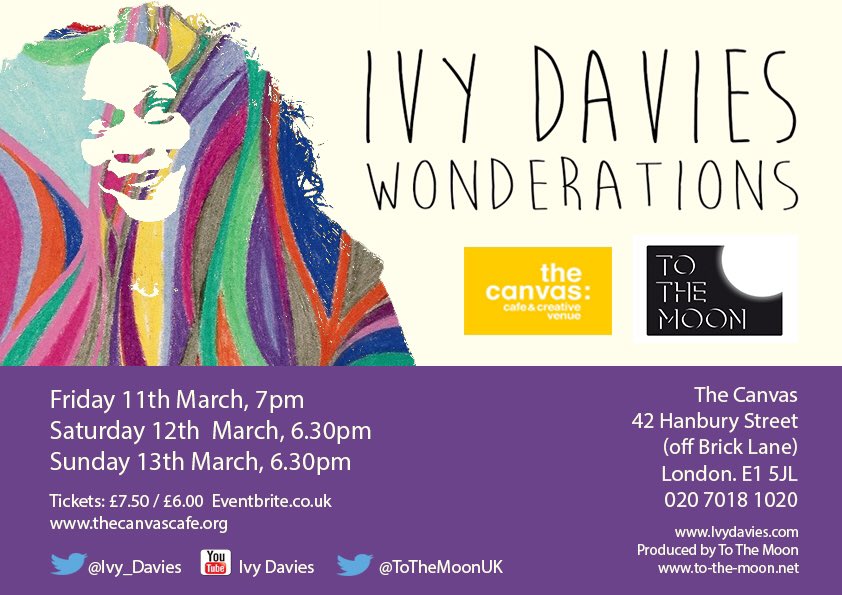
Sunday evening was a night of new discoveries. The Canvas Café, just off Brick Lane, serves homemade cakes and prosecco by the glass. It also has walls you can write on and a cosy downstairs performance space. In that space was Ivy Davies and her show Wonderations, a gentle, joyful blend of spoken word, songs from her EP and questioning whether or not Mickey Mouse is actually God. Though lacking in narrative, Davies’ performance shares issues that are particularly personal: aging and her search for identity and faith. With a touch of live art about it, Wonderations is a lovely celebration of self-acceptance akin to reading Davies’ journal.

This isn’t a visual show, but a totally aural one. It could easily be listened to through headphones or with eyes closed, though her soothing melodies and rhythms could lull you to sleep – it’s that relaxing. There are some powerful sentiments in her lyrics and poetry that deserve full attention, however. As Davies struggles to find her pre-marriage and babies self in theatrical songs and rhymes, one can’t help but to relate to her frustration with finding her true identity buried under all the nonsense life throws at us. We all find ourselves wasting hours on social media focused on constructing an image, or immersing ourselves in work and forgetting to just be present in the world for lengthy periods, but Davies exhorts us to let all of it go. She’s like a life coach, but a gentle one who uses cuddles rather than shouting.

This cabaret-esque structure feels conversational, but is precisely and satisfyingly scripted. There’s no plot to speak of, but with Davies wearing the form like her own skin, it works. Her spoken word isn’t the pounding, angry sort I’m accustomed to; it’s full of flowers, sunshine, rain and claiming her own ground. Davies has an immovable strength and presence, but one that overflows with positivity. Less connected from her celebratory songs and spoken word is what feels like an internal monologue where in looking for faith, she wonders if God is actually Mickey Mouse. He’s been seen around the world at the same time, and has plenty of purchasing power. It’s a wonderfully funny, and pointed, argument, though less clear on it’s place in the show’s structure.

Ivy Davies’ Wonderations is a hard show to pin down, but it doesn’t apologise for that. I’m pretty certain that she’s confident enough to not care what anyone thinks of her work, but the themes it contains are universally human presented in an easily digestible format. An excellent event for a quiet Sunday evening, particularly with a slice of cake and a glass of prosecco.

The Play’s the Thing UK is committed to covering fringe and progressive theatre in London and beyond. It is run entirely voluntarily and needs regular support to ensure its survival. For more information and to help The Play’s the Thing UK provide coverage of the theatre that needs reviews the most, visit its patreon.
RED Women’s Theatre Awards, Greenwich Theatre

red women logo

This year sees the launch of a new playwriting competition, RED Women’s Theatre Awards. Co- produced by Edinburgh-based academic and playwright Effie Samara, Greenwich Theatre and Female Arts, the awards are “aimed at anyone who identifies as female who has an inspirational, questioning and challenging social and political voice.” There are three regional heats in the competition; the first was at Greenwich Theatre with staged readings of four plays. Completely differing in tone and style and at various stages of development, this heat showcases the huge variety of female voices in English playwriting.

I spoke to founder Effie Samara about the awards and her reason for founding them.

What do you hope to achieve with these awards?

When I first spoke about RED to James Haddrell, Artistic Director of Greenwich Theatre, I must admit, I was dreading that it was going to achieve absolutely nothing. As a theatre artist, he engages with that female-led theatre aesthetic by producing Broken Leg, Smooth-Faced Gents and now RED. Is he a revolutionary? I think he is. Is he an exception? He is a valiant exception but we are actually witnessing the beginning of an epoch in politics and in theatre. They follow each other. My view is that the State, its governance, its justice, its policing, its education and its performativity are about to undergo a female-authored revolution. RED positions itself at the forefront of this development.

What criteria did you use when selecting plays for the heat?

The award is for political theatre. Our first concern was to ensure the writer’s engagement with the notions of justice, resistance and her ability to problematise those dramatically.

RED Theatre Awards currently cover the south of England, Wales and Scotland. What are your plans for expansion in the rest of England? Is N. Ireland a goal as well?

Northern Ireland is absolutely a goal. In the first instance, we’re including N. Ireland in the Scottish round. We can’t wait to hear some loud Irish voices! Scotland is also underrepresented on a national level.      

What can theatre makers do now to counteract the gender disparity?

The solution is very simple and I’m afraid it begins with us women. Us, being able to handle our own freedom: express it in the ownership of our person, define it in politics, and dramatise it in our consciousness and on stage. Women who robotically follow institutional missions fuel that gender disparity through their own complicity with these structures. Numbers are on our side in this argument: There are a lot of us. Over 3 billion. If we meant business, if we did this together, actioning solidarity within our cause, this injustice could be culled in no time.

What message do you want to communicate with the RED awards?

Words are loaded pistols. And we, women, can cock a gun way better than any establishment pointing one at us. Throughout the history of humankind we have been told we’re not allowed to fathom our own course, to govern our own person, our own body, its production and reproduction. RED is here to provide a platform for women.

The four plays selected for this heat are Under My Thumb by Cassiah Joski-Jethi, Spurn the Dust by Sian Rowland, Dissonance by Isabella Javor and Gone by Kate Webster. Some are more blatantly topical that others, some look at broader female issues and group dynamics. All are short plays with potential for development and by female voices that have a lot to say.

The Play’s the Thing UK is committed to covering fringe and progressive theatre in London and beyond. It is run entirely voluntarily and needs regular support to ensure its survival. For more information and to help The Play’s the Thing UK provide coverage of the theatre that needs reviews the most, visit its patreon.

The Marvellous Adventures of Mary Seacole, Rosemary Branch Theatre

I had never heard of Mary Seacole until I began working in UK schools, several years after my arrival to the UK. What a woman!  No wonder her entrepreneurial, caring Victorian spirit is on the National Curriculum and she has been the subject of several plays, including Rosemary Branch co-artistic director Cleo Sylvestre’s one-woman show, The Marvellous Adventures of Mary Seacole. With a simple narrative structure, Sylvestre’s piece focuses on characterisation and biography. It is well performed, though some adjustments to the script and tech could make this an even better solo show.

We are never told who we are, but Seacole treats us like a society or club she has come to lecture about her life.  She speaks in the past tense shortly after her return from the Crimea; we hear her life story starting with her childhood in Jamaica, helping her mother run their Hotel, Blundell Hall and learnt about her “remedies” from foraging. Continuing onto her London, Central America and finally The Crimean War, Sylvestre endows her with a confident, charismatic warmth – no wonder she was so popular with soldiers and civilians alike. Her performance peaks when recalling her mother first teachings her about plants, and later memories of battlefields heaving with wounded soldiers – her “boys.” These are lovely moments to witness, but some of the more mundane content is delivered on autopilot.

Structurally, the script is a simple, linear narrative. This would be an excellent piece to tour to primary schools, as it’s easy to follow and has plenty of captivating anecdotes. The content is interesting enough to hold an adult audience’s attention for nearly an hour, but it would be a refreshing experiment to see this piece as episodic, with more lighting and sound than is presently used to highlight pivotal moments. This is not a new show, and solo performance has evolved since its inception. Sylvestre’s imagery-laden work would suit regularly used bigger projections, detailed soundscapes stronger lighting changes. Even though this is an important story, it is not an innovative production, but it certainly has the potential to be.

Cleo Sylvestre’s performance is the highlight of The Marvellous Adventures of Mary Seacole, but this long-running solo performance needs some revisiting to give it an extra burst of life worthy of such a vibrant character.

Running at The Rosemary Branch, 9-11 April.

The Play’s the Thing UK is committed to covering fringe and progressive theatre in London and beyond. It is run entirely voluntarily and needs regular support to ensure its survival. For more information and to help The Play’s the Thing UK provide coverage of the theatre that needs reviews the most, visit its patreon.

Institute, The Place

rsz_gecko-pcte2pct80pct93-institute-e1423864432429

Say your only close friends are people you work with. Can you trust them to help you out if you’re struggling with your health? Martin’s mental health is deteriorating, so Daniel, Louis and Karl try their best to care for him despite their own inner demons and needing to be looked after as well. With a distinctive physical vocabulary and a masculine camaraderie, Gecko’s Institute is an absorbing look at a society made of lonely, needy people without the safety net that family can provide.

Rhys Jarman and Amit Lahav’s deceptively simple set of Victorian wooden filing cabinets is loaded with the possibility of discovery and serves as a convenient place for the characters to store their memories, good and bad. The moments that new items are revealed are a wonderfully surprising juxtaposition to the hulking, boxy structures. Lahav and Chris Swain’s lighting design dark and atmospheric, sharpened by the addition of otherwise unnecessary smoke. Both serve the choreography well, without drawing too much attention onto the design.

Lahav also directs this devised piece, and performs as Martin. Considering he is also the artistic director of the company, it is a true marvel, and a testament to his talent, that none of his production roles suffer. He seemlessly incorporates multiple languages and regular movement sequences that are tightly choreographed and emotive expressions of his characters. The characters puppeteering of each other is a powerfully visualised (and sometimes sinister) metaphor of helplessness at the hands of external forces and the support that peers can offer – or not offer. It’s a visually arresting comment on the support and limitations of others on our individual lives.

The strong sense of brotherhood imbedded in the choreography is a lovely thing to witness. There’s a physical comfort the performers have with each other that blends with the characterisation, making the moments where they treat each other badly all the more shocking. The single female character, Martin’s imaginary girlfriend Margaret, is inventively shown, through costume and movement, but her appearance in a plastic cube is anticlimactic. The whole piece starts to feel too long towards the end, though none of the scenes are gratuitous.

Institute is typical Gecko fare, but the character’s relationships and externalised emotions are the finest features in this physical theatre performance. It’s some of best, most reliable physical theatre work out there at the moment, and Gecko retain the ability to surprise as well as showcase their unique theatrical language.

The Play’s the Thing UK is committed to covering fringe and progressive theatre in London and beyond. It is run entirely voluntarily and needs regular support to ensure its survival. For more information and to help The Play’s the Thing UK provide coverage of the theatre that needs reviews the most, visit its patreon.

What I Learned From Johnny Bevan, Soho Theatre; The Caucasian Chalk Circle, Jack Studio Theatre

Is revolution in the air? Or, are we all so broken and defeated by rising costs and a falling quality of life that all we can do is complain bitterly? Perhaps a bit of both? In any case, this is not the first time that I wonder if theatre is responding to the liberal sense of disaffection recently. Shortly before Christmas I questioned Dominic Cavendish’s assertion that theatre isn’t political enough, and my sentiment still stands, particularly after the coincidence of seeing two highly charged political pieces two nights in a row. Fringe theatre, like grassroots politics, is a place of community, a catalyst for change, and the foundations of revolt, as seen in Lazarus Theatre Company’s The Caucasian Chalk Circle and Luke Wright’s What I Learned From Johnny Bevan.

1997. The eve of the general election. Nick, who’s studying English Literature at a nameless uni stays up all night with his best mate, poet Johnny Bevan, to watch Tony Blair win. It’s the dawn of a new era and change is coming for the working class long oppressed by Thatcherite rule.  Fast forward fifteen years and Nick’s a journalist in London, but Johnny’s student aspirations didn’t come to fruition, and neither have Tony Blair’s. The story of these two lads’ friendship, written and performed by Luke Wright in a blaze of fiery spoken word, is an hour long tale of youthful vigour soured by the realities of adult life. Wright’s delivery and writing is fervent, topical and no moment is out of place in the trendy and on-point What I Learned From Johnny Bevan.

South of the river, an older revolution is taking place. In Soviet Russia, a group of peasants stages a play about a servant girl in Georgia raising the governor’s newborn baby that was abandoned during the family’s escape from a war zone. After a perilous journey, sacrifice for the sake of the infant, and a regime change, everything is put right again by a citizen judge. Lazarus Theatre Company, with its trademarks of a large cast and striking visuals, draws parallels between Brecht’s The Caucasian Chalk Circle and the despair of modern life – but “change is hope”. Energetic and in the round, the characters rally the audience to their side like they do in Wright’s monologue.

There’s optimism in both productions as well as despair, and an underlying current of discontent with the state of the UK’s current socio-political trajectory. Both display humanity’s capability for selflessness and selfishness, and the feeling that nothing has changed from Soviet ruled Eastern Europe, to Labour’s late-90’s victory, to present unviable economic conditions and Tory tyranny. We are undeniably flawed with a fickleness vulnerable to power and money, but as a society we are also deeply unhappy and feel that we lack the power to affect change. This sentiment now seems to be emerging in fringe theatre.

Though completely different in form and structure, both What I Learned From Johnny Bevan and The Caucasian Chalk Circle have plenty to say about the contemporary world from similar angles. What I Learned From Johnny Bevan is the better of the two productions, and  the more progressive. A solo performance delivered in spoken word accompanied by charcoal and watercolour landscape projections, most of the imagery in Wright’s language is precise and evocative. Brecht’s well-known play is linguistically stilted and stuffy in contrast, but it’s characters are just as colourful.

Performance poet Luke Wright is a singular tour de force and What I Learned From Johnny Bevan is politically charged and practically flawless. Lazarus Theatre’s performances vary, but of the ten-strong ensemble, no one was particularly strong or weak. Their choreography is well-rehearsed but director Ricky Dukes normally powerful movement sequences  lack impact in the round. The set components take up a lot of space and are used well occasionally, but otherwise clutter the stage with bright, industrial chaos. Neil McKeown’s sound design hints at atmosphere and mood, but is much too quiet to add the impact it could. It’s certainly not a bad production, but neither is it one of Lazarus’ stronger ones.

If theatre is a mirror held up to the world, then evidence is increasing that change is imminent. But what form will it take? Will the people rally as in The Caucasian Chalk Circle or will we either sell out or run away from it all like Nick or Johnny? Only time will tell.

The Play’s the Thing UK is committed to covering fringe and progressive theatre in London and beyond. It is run entirely voluntarily and needs regular support to ensure its survival. For more information and to help The Play’s the Thing UK provide coverage of the theatre that needs reviews the most, visit its patreon.

Hamlet Peckham, Bussey Building

What happens when a director completely disregards age, gender and nationality in a Shakespeare production, then stages it in a former cricket bat factory with a stripped-back aesthetic and fantastic performers? Shakespeare Peckham. Founded by actor/director/producer Anthony Green, Hamlet Peckham bears more resemblance to the vibrancy and gender bending of Shakespeare’s original productions than most modern conceptual interpretations. Green incorporates several aspects of original practice, which prove that embracing the conventions of Shakespeare’s theatre with a fearless cast is a winning combination.

There are a few concepts that Green adds, such as casting three actors as Hamlet to highlight “the problem, the plan and the solution” of Hamlet’s narrative. He also empowers Polonius, making the father of Laertes and Ophelia the strongest character in the play. There’s loads of direct address and audience interaction, as there was in Elizabethan and Jacobean theatre and as there should always be. The ghost is just a man rather than ethereal or otherworldly, and when Hamlet is played by a woman, he changes all gender pronouns to “she” and “her.” These choices, proving Green’s instinct for excellent theatre and Shakespeare performance, either work well or, at the very least, don’t not work. The only one of these approaches that jars is the textual changes according to gender, but it will have little impact on a viewer who doesn’t know the play well.

The Bussey Building, here configured with the audience on three sides, also has three slender poles along the front of the stage. Though their position prohibits the curving movement that the Globe’s pillars creates, the actors use them – as supports, to hide behind and to propel them. Sight lines are occasionally blocked, but never for long. There is no backstage, so the actors hang out in the dark behind the audience. No feature of this space goes unused, though there are no specific adaptations that warrant the addition of “Peckham” to the show title. This isn’t a site-specific production, but it is certainly wonderfully site-responsive as well as being sensitive to the audience’s energy. Set designer Michael Leopold and lighting designer Adam King create a subtle, harmonising impact on the space with wooden crates, white curtains and colour. The actors’ black and white contemporary costumes looks like their own clothing, but rather than appearing cheap, it comes across as relaxed and accessible.

The cast is phenomenal. Nine of them take on all roles, with only a few not doubling, tripling or more. It’s impossible to chose a few standout performances, but the three Hamlets (Sharon Singh, Max Calandrew and Izabella Urbanowicz) seamlessly blend their interpretations whilst making each moment their own. Gil Sutherland as Polonius is the driving force behind manipulative Claudius (Pete Collis), Daniel Rusteau is a warm, grounded Horatio. Eva Savage is half a dozen characters, particularly excelling as the joyful singing gravedigger. As a whole, they are a well-oiled, energetic and charismatic bunch who have the talent for the world’s biggest stages. Working with Green, each moment is crafted with care and detail, but the effort only shows in the performers’ ease.

Both progressive and ancient, Hamlet Peckham is what contemporary Shakespeare should be – striving for equality in cast and crew, respecting core performance techniques from original Shakespearian theatre practice, and a relaxed, flexible concept that focuses on telling the story with passion and muscularity. This production creates opportunities, showcases great talent and tells Shakespeare’s story with all the energy and life of new play. Don’t miss it.

The Play’s the Thing UK is committed to covering fringe and progressive theatre in London and beyond. It is run entirely voluntarily and needs regular support to ensure its survival. For more information and to help The Play’s the Thing UK provide coverage of the theatre that needs reviews the most, visit its patreon.

Dress Rehearsal, OSO Barnes

image
A performer’s life is far from glamorous, particularly for those managing to eke out some sort of living in the business. Corporate gigs, theatre-in-education, skin work and small-scale touring is better than working in a call centre or bar, but this work is exhausting and usually demoralising. I remember similar days in my past life as an actor, particularly that panto tour to schools and social clubs in South Wales. The schools were fine; teachers kept order. But the social clubs were all loud, drunk adults, and kids hyped up on e-numbers who thought hitting the actors was the most hilarious thing ever. With two shows a day, six days a week for a month and a half, I keenly feel the anguish of opera troupe The Overtones’ pub booking in AJ Evans’ Dress Rehearsal, even though those days are long behind me. Despite kinship with the characters’ aspirations and conflicts, and fantastic singing, the clunky script, poor performances, and undeveloped characters make this a missed opportunity to showcase opera within the structure of a play.

The concept reads well on paper and it could be a great way to make opera approachable as well as demystify life as a performer: flipping between the pub floor gig, the dressing room and reserved mezzo Steph’s past, we see trouble within The Overtones cast and career goals clashing with reality, and some cracking opera numbers. There’s certainly scope for situation comedy as well as character-driven dramatic conflict. However, Evans’ script hovers in the liminal space between these styles, creating something that manages to be both unfunny and quite flat with hackneyed dialogue. Subplots and the flashbacks are neglected and left incomplete, making them feel gratuitous to the main plot thread. The first half is slow and little happens other than exposition, but after the interval, both tension and pace picks up. The final moment even has genuine emotional connection between two characters, something that is pointedly absent in the script up to this point.

The singing is excellently emotive, however. There’s enough book (albeit a poorly written one) to make Dress Rehearsal a play with music, but there’s enough music to suitably break up the simplistic dialogue. Five of the eight actors are opera singers, one is a pianist who sings and two are “just” actors. The singers are certainly good at their primary craft, but lack in their acting ability. Director Paola Cuffolo focuses more on staging than coaching truthful performances from her cast. There is some stylisation that, as a conceptual break from realism, is under used and lacks punch.

If Dress Rehearsal was a single act composed mainly of the current second half, it would be a much stronger play. As it is, it wanders aimlessly for quite some time before finding its purpose and conviction. Fortunately, the songs are welcome respite in what feels like something that well precedes a dress rehearsal.

The Play’s the Thing UK is committed to covering fringe and progressive theatre in London and beyond. It is run entirely voluntarily and needs regular support to ensure its survival. For more information and to help The Play’s the Thing UK provide coverage of the theatre that needs reviews the most, visit its patreon.