So It Goes, Greenwich Theatre

SOITGOES_CMYK_1

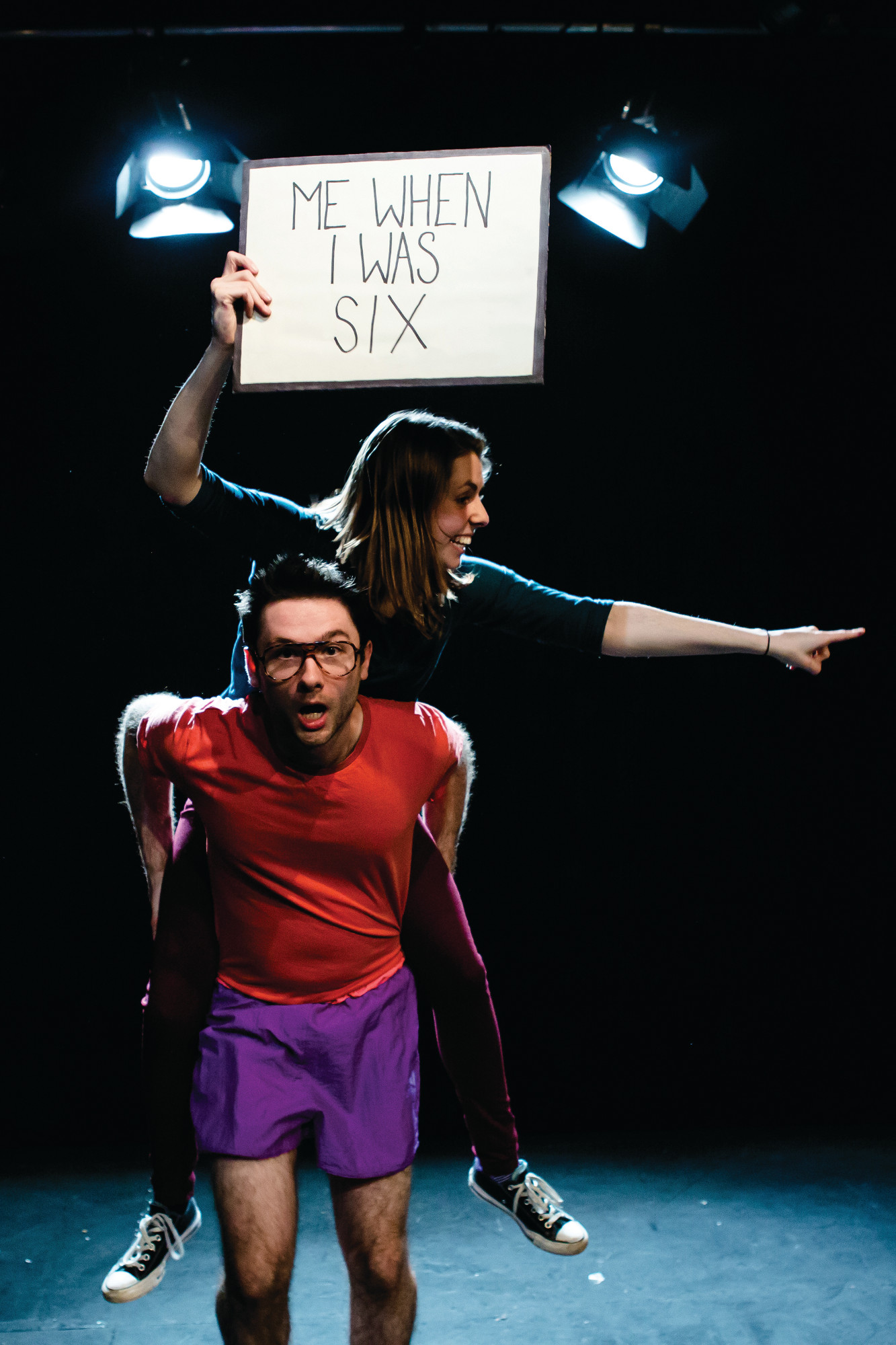
Hannah used to love running with her dad. When she was 17, her dad died and Hannah kept on running, silently and alone. She refused to speak about his death with anyone, including her family. So she decided rather than to navigate the burden of speech, she would create a silent play that tells her dad’s story and her process of dealing with his death. So It Goes is a sweet two-hander that manages to avoid over-sentimentality by focusing on the honest, deeply individual story of navigating life after the death of a parent.

Other than the last line, there is absolutely no speech in this play. All text is written on small whiteboards worn around the actors’ necks or on pre-made signs. This keeps written communication basic; it is rather like watching a comic book or graphic novel being written. This could occasionally feel slow and it was often easy to predict what was coming next on the whiteboard within a scene, but not overly so and not often. The set and props are also simple, with signage and symbolic items representing other characters and jumps in time and place. Most props are drawn outlines of objects, adding humour and a sense of youthful play to the story. The physical performance style matches- it is exaggerated but simplified, physical theatre but not ornate, embellished or for the sole purpose of showing the actors’ physical prowess. So It Goes wants to tell Hannah’s story as clearly and simply as possible, focusing on truthfulness and emotional honesty. The look of the play would certainly appeal to children, but accessing adults’ inner child makes the experience of losing a parent a journey that ends with positive reflection rather than the bitterness of loss.

The performances are equally lovely. Hannah Moss plays herself, and has “help” telling the story from David Ralfe, who plays her Dad and Mum. Ralfe in drag has an initial hit of comedy, but he taps into Mum’s outward expression of hopelessness that soon makes the audience forget that it’s a bloke in a dress. The two actors embody an exaggeration familiar to children’s theatre that is also in keeping with the cartoon aesthetic of the production, but is not crude. If they did not employ the exaggeration or humour in their physical comedy, it would make audiences want to slit their wrists. Instead, there was a lot of sniffling and nose blowing mixed in with laughter.

This is the third play I have seen about death in recent weeks. Each production used a dramatically different approach to convey the same message. Hannah spelled it out for us by writing that her dad “didn’t just die, he lived.” There’s an overabundance of factors in the world that can easily depress us and forget to look for the little moments of daily joy in our own lives, but So It Goes provides a celebratory reminder to do so through a pared down, visual-textual hybrid of physical theatre. Though the tour has now finished of their debut production, On the Run Theatre is certainly a company to watch.

Intention: ☆ ☆ ☆ ☆ ☆

Outcome: ☆ ☆ ☆

Star Rating: ☆ ☆ ☆ ☆


The Play’s The Thing UK is an independent theatre criticism website maintained voluntarily. Whilst donations are never expected, they are hugely appreciated and will enable more time to be spent reviewing theatre productions of all sizes. Click here to make a donation with PalPal.
Shooting With Light, Greenwich Theatre

1930s Paris. Jewish Europeans are moving west to escape the rise of Nazism. Two of them meet: one of them is a Hungarian photographer, the other is a German activist. Both are full of youthful confidence and fearless in pursuit of their goals. Emerging company Idle Motion uses physical theatre, light, sound to tell the story of these young lovers, their legacy and the importance of photography.

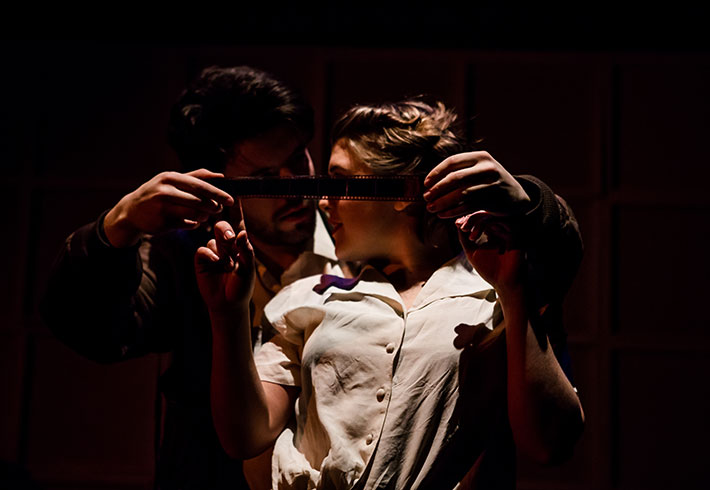
Firstly, Shooting With Light is a loveShooting-With-Light_018 story. Two young people meet, fall in love and take the world by storm before ending in tragedy. These young people are Gerda Taro and partner Robert Capa (after they changed their names), pioneering photojournalists of the Spanish Civil War. Gerda and Robert start working together; Gerda is initially his assistant who supports him in reinventing his persona in order to make the professional contacts he needs to succeed. Her talent overcomes this role however, and she eventually develops an independent reputation for honest, brave documentation. Partly fictionalized but based on Gerta’s brief life, we see Robert teach her to use a camera followed by her passionate rise to renowned photojournalist needing to show the world the reality of life on the front lines. Alternating with this storyline is the time-jumping subplot of Robert’s brother Cornell and his assistant June, seeking to amalgamate Robert’s work after his death. They are frantically searching for a mysterious red suitcase Robert once spoke of in order to complete the archive of Robert’s work.

Interspersing the scenes of historical naturalism are transitions using visual and physical theatre, similar in style to Frantic Assembly. This is an on-trend performance aesthetic, but one that is visually appealing and provides another level of insight into the characters and their struggles. The most effective of these sequences show Taro and Capa falling in love over rolls of negatives towards the beginning, and Taro’s fight to access the front lines with her camera towards the end. The set is simple in appearance as several blocks and a white screen, but they transform using projections, light and a series of doors. Like their narrative, the structure is simple but highly effective and tells an excellent story. Projections of Taro’s work add further historical context and support the world of the play – the audience sees what she sees and experiences.

The company of five twenty-somethings work wonderfully together, and so they should as they met in secondary school. Shooting With Light captures the infectious enthusiasm and ambition of youth, no doubt mirroring their own attitudes that the world is theirs to have and success is a given if they work hard enough. It will be interesting to see how their work develops as they age and experience the challenges and hardships of working in the arts. As visually appealing as their work in now, it needs more depth of human experience. June and Cornell’s quest to locate Capa’s missing work is arguably the more interesting side of the story, but neglected in favour of Taro’s and Capa’s exciting lives and career progression. The ensemble also lacks diversity of age and ethnicity, something that I hope they increase in the future. Idle Motion have an obvious gift for storytelling and integrating various performance styles at this young age, so the world really could be their oyster as they continue to grow.

Intention: ☆ ☆ ☆ ☆

Outcome: ☆ ☆ ☆

Star Rating: ☆ ☆ ☆ 1/2


The Play’s The Thing UK is an independent theatre criticism website maintained voluntarily. Whilst donations are never expected, they are hugely appreciated and will enable more time to be spent reviewing theatre productions of all sizes. Click here to make a donation with PalPal.

La Merda, everything theatre

“After reading the press release and previous star ratings for La Merda, I was very much looking forward to an edgy, raw and arty performance with a strong message that would stay with me for several days…My experience, however, was quite the opposite.

“…dim spotlights illuminated a naked woman (Silvia Gallerano) sitting on a tall platform, quietly singing something Italian into a microphone…she launched into a monologue. It began by telling us we all needed courage, then connected the idea to her father’s courage to commit suicide by throwing himself in front of a train…

“Gallerano’s character then moved onto body image: her unusually large thighs, and her teenage experience with a “beauty parlour” that had tried to reduce them. Whilst I believe body image is an issue that needs to be addressed, every teenager has insecurities about their looks, and theatre has dealt with this before, so the topic is not new, or particularly edgy…

“Gallerano’s character…didn’t develop into anything particularly interesting, or personalised. We never learned much about her other than she was an actress, her dad died when she was thirteen, and she had a slightly unconventional upbringing. I struggled to care about the woman and her issues because her issues weren’t unique. She was just like everyone else…Originally written in Italian for Italian audiences, there was a slight undercurrent of national identity, but unfortunately I missed more of this because I am not Italian…I wondered…why was she still naked?

“The piece was delivered exclusively in three long monologues…Towards the end of each section, she shouted down the microphone, which was physically uncomfortable, but I remained emotionally unmoved. Vague themes were mentioned…but my questions remained: Why was I watching this? What does the writer want us to take away? Why is she naked?”

Read the entire review here.

Margaret Thatcher Queen of Soho, for remotegoat

With a stage covered in tinsel and large neon pink script of ‘Maggie’, it is immediately clear that the audience is in for an evening of fabulously camp cabaret. The hour-long show tells us the fictitious story taking place on the eve of the Section 28 vote. Maggie has been contemplating the morality of this vote for some time, and goes for a walk to clear her head. She was not paying attention and got lost in deepest, darkest Soho where, being mistaken for a drag queen, she is invited into a club. After emerging the next morning as a new woman, she resigns and embarks on a new career in show business.

Matt Tedford, with immaculate vocals and gesture, drives the show as Margaret Thatcher. Robert Cawsey and Ed Yelland multi-role in a costume base of cut-off denim shorts and moustaches. There are some show tunes and gay standards, but the show is predominately spoken. All three performers possess a high level of physical performance and the difference between the various characters effectively uses stereotype for comedic effect. Tedford’s banter with the audience and comic timing is impeccable, creating numerous moments of raucous laughter.

The writing is tight, polished and riddled with political references and jokes. Despite the format and pretence of being a light-hearted cabaret show, it looks at Thatcher’s controversial policies, particularly the state of the country leading up to the Section 28 vote. This production ends happily for the main character, (even though the majority of audiences are the sort that despise her) and lends itself to empathising with someone that, despite her mistakes, is very much a human rather than a monster. If only this production depicted real life! Writers Jon Brittain and Matt Tedford are a great team who deliver a brilliant piece of writing that manages to be hilarious and highly political at the same time.

Whilst the show was excellent, there is little scope for development. If it were any longer, the concept would stale. As an intimate show, larger venues would also present a challenge. Despite this, it is a vital contribution to fringe theatre and caters to a wide range of audiences.

Intention: ☆☆☆☆☆

Outcome: ☆☆☆☆

Star Rating: ☆☆☆☆ 1/2

Click for original review on remotegoat.com.

Rove, Battersea Arts Centre, for everything theatre

“As the audience enters, a young man with a magnificent beard is asking the violinist on stage with him if she knows “the one about…” several times. She always says yes, and then plays a brief tune. I realized after I settled that all the requests feature a man called Rover Joe involved in numerous exploits or unlikely situations…

“The structure of the performance is relaxed and loose. The subject of the story is a man called Rover Joe, Evans’ grandfather who emigrated from Ireland to Chicago. His tale is told in four sections, in between music, and talking to the audience about the importance of stories, their families, and so on…

“Armstrong’s music is excellent, as is Evans’ storytelling; though opening his eyes whilst giving us the tales would create more of a connection with the audience…

“This is certainly a unique performance: sentimental, quaint and emotionally honest. It raises some thought-provoking points on the nature of families and the tales they harbour. This is certainly a production to see for those interested in storytelling, folk music and folk tales, and quirky performances that don’t easily fit into a genre.”

Intention: ☆☆☆☆☆

Outcome: ☆☆

Star Rating: ☆☆☆ 1/2

Read the entire review on everything theatre here.

Shipwrecked! An Entertainment, for everything theatre

“Based on the true story of Henri Louis Grien, otherwise known as Louis de Rougemont, this is a tale of Victorian high adventure and a lying man’s downfall. It is the Jack Studio Theatre’s Christmas production, and one delightfully unlike other seasonal offerings…

“As a sickly child Louis yearned to experience life outside his bedroom walls, and at the tender age of 16 he decided that it was time to find his way in the world. After arriving in London, he meets a sea captain who invites him to work on an upcoming pearling expedition in the Coral Sea. A storm leads to shipwreck and a new life in Aboriginal Australia until he decides to venture home to London thirty years later. On his return to an unrecognisable city of smoke and industry Louis’ story has turns him into a celebrity, and the audience are surprised by a revelation that something was not what it seemed…

“Written by American playwright Donald Margulies, this is the UK premiere of this wonderful play. With a solid concept by Artistic Director Kate Bannister this is a delightful holiday theatre offering. Tony Taylor convincingly portrays Louis at all ages. Rose and Durbin skilfully employ physical performance to show us characters such as the captain, Louis’ mother, his Aborigine wife and Bruno the dog (the audience’s clear favourite). Performances are excellent throughout…

“The only flaws in the production are minor…The ending critiqued the press and society’s treatment of celebrities, but glorified creativity and imagination at the same time. This left me pondering how to view the principal character, and reminded me that life is not always black and white by any stretch.”

Intention: ☆☆☆☆☆

Outcome: ☆☆☆☆

Star Rating: ☆☆☆☆ 1/2

Read the entire review on everything theatre: http://everything-theatre.co.uk/2014/12/shipwrecked-an-entertainment-brockley-jack-studio-theatre-review.html

Elephant Man, for everything theatre

“Joseph Merrick, also known as the Elephant Man or John Merrick, is a hot topic in the theatre, what with Bradley Cooper’s imminent transfer to the West End in this title role. Despite this news, the current, smaller scale production at the Jack Studio Theatre in South London is certainly worth seeing… In his original adaptation, writer and director Steve Green confronts audiences with the uncomfortable social history of ownership, entrapment and public appearance in the Victorian era.

“Actor Daniel Christostomou plays Merrick as a sensitive, articulate young man caged by his physical deformities and Victorian attitudes. Rather than prosthetics or make up, costume designer Anastasia Sarajeva has created an evocative, confrontational structure of wire, chain link and mesh for Chrisostomou. Naked underneath, we see both the actor’s and Merrick’s silhouette…

“Despite Chrisostomou’s incredible performance and the unique approach to Merrick’s experience, the script falls short. The writing is choppy, with large gaps in time and no explanation of what events were excluded. Individual scenes are well-crafted, but not pieced together to form a particularly effective whole, and I found myself needing to read up on Merrick after the fact to clarify plot holes. There are two projected sequences, but they seem arbitrary and would not have been missed if excluded.

“Regardless of the confusing and unpolished script, the characters and the performances still make this a production worth catching…”

Intention: ☆☆☆☆

Outcome: ☆☆☆

Star Rating: ☆☆☆ 1/2

Read the entire review on everything theatre: http://everything-theatre.co.uk/2015/02/elephant-man-jack-studio-theatre-review.html