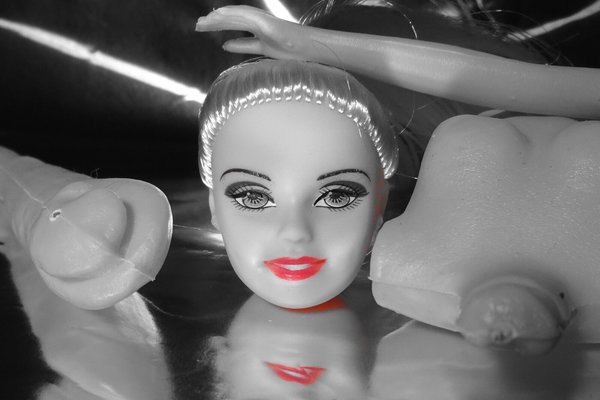
The Sandman, London Horror Festival

rsz_sandmanThe sandman doesn’t throw sand in your eyes to help you sleep, oh no. That’s just what parents want children to believe so they aren’t scared of the real sandman. The real sandman is horrible. If you’re still awake, he steals your eyes and puts them into his little bag and takes them up to his little, bald bird-children who live on the moon. Then they eat them.

T. A. Hoffmann, celebrated German gothic horror author, wrote short story “The Sandman” in 1816. Featuring automatons, folklore, love, childhood trauma and obsession, it tells the tragic downfall of Nathaniel, who couldn’t let go of his boyhood fear of the sandman, personified in his father’s malformed colleague, Coppelius. Adie Mueller and Mike Carter adapt and modernise this short story into a one-woman show of the same name that eschews linear narrative in favour of a disturbing, extremely fragmented chaos. Mueller skillfully performs the eight characters that appear in the story, but the show requires a lot of thinking and patience to decipher the truth behind the numerous perspectives.

In the programme, Mueller and Carter state, “The woman knows that this story is too much for her and she needs you, the audience. The story bursts out of her and comes at you in fragments, randomly and out of chronological sequence. You will have to play your part in piecing them together, finding the overarching narrative, and search beyond reason to make meaning from them.” This is a nice idea to draw the audience into a one-person show and make them feel needed, but for the tired and those that want to sit back and be entertained/scared, it’s hard work. It also serves as a distraction from the lack of clarity of the audience’s function and relationship to the performer, a vital element of one-person performance. Requiring us to sift through the pieces of story strewn before us has no benefit to the performance or the piece; it would be delivered identically whether the audience understands or not. Director Carter chooses to keep the house lights on so Meuller can make eye contact, but there is no direct dialogue. What does she want from us? Why are we hearing this story? It is never revealed.

Mueller’s performance draws attention away from these shortcomings, and it’s an excellent one. Her use of physical storytelling and character differentiation comes easily, and shows a high level of skill and training. Clad in white, she cuts a powerful image in the Etcetera’s small black box, adding to the chaos with her violent use of creepy props.

The story modernizes well, with a focus on sexual dysfunction, technology and its grim intersection. The characters evoke empathy, particularly Nathaniel, who we see as a scared child and an adult obsessed with his lecturer’s “daughter” Olympia. Though his behaviour is appalling, he is a victim of his past rather than a calculating psychopath. His attempts to maintain a normal relationship with human being Clara are thwarted by reoccurring psychotic episodes…or are they real? The prospect of an alternative, tormenting reality that haunts Nathaniel is deliciously spooky. The Sandman is creepily unsettling and despite the effort needed to work out what is happening, the performances and characters make up for the jagged structure.


The Play’s The Thing UK is an independent theatre criticism website maintained voluntarily. Whilst donations are never expected, they are hugely appreciated and will enable more time to be spent reviewing theatre productions of all sizes. Click here to make a donation with PayPal.

Twelfth Night: A Gender Experiment (opposite gender cast), The Rose Playhouse

Most Shakespeare I see is performed with the actors’ genders matching that of the characters they play. Sometimes I see token cross-gender or gender-blind casting within an own-gender cast, sometimes all-male productions and less often, all-female productions (I wrote about the scarcity of all-female Shakespeare companies in the UK for The Shakespeare Standard last month). What I hadn’t seen however, was a completely cross-gendered production. As part of a gender experiment, actor/director Natasha Rickman stages Twelfth Night: A Gender Experiment four ways: all-female, all-male, same gendered and cross-gendered. Rather than seeing all four, I went for the most rare of the options out of curiosity, which was satisfied by excellent performances and a 90-minute edit with plenty of fun and energy. I’m now tempted to see the remaining three as I can’t decipher quite what Rickman seeks to prove or disprove with her experiment, but the questions surrounding the nature of the experiment did not dampen the enjoyment of the evening.

A cast of seven, three men, three women and a sock puppet, play all parts. There are the same number of men and women in all four versions, supporting Equity’s goal for 50/50 gender representation in theatre. Rickman is a RADA grad, as are most of her cast so handle Shakespeare’s text easily. Julia Goulding is an outstanding, versatile Orsino, Sir Andrew and Feste, using accents to clearly differentiate her characters. Shauna Snow is, hands down, the best Malvolio I have ever seen – serpentine and androgynous, but utterly buffoonish upon discovery of Maria’s planted letter and vulnerable after her release from prison. Henry Gilbert is a lovely Olivia, feminine but not helpless. Christopher Logan’s Viola has a hard, threatening edge when fending off Olivia’s advances, rare in a female playing the role. There is a notable lack of racial diversity, though. This cast is all white and the actors that make up the rest of the company appear to be as well, or at least look like it in the small, black & white photographs in the copied programme.

Sorcha Corcoran clothes the women in costumes inspired by Smooth Faced Gentlemen’s skinny jeans, shirts and braces, showing masculinity without hiding feminine features. The men wear dresses, but don’t hide their short hair with wigs. Though they still play the gender of the characters, Rickman doesn’t strive for realism in design or performance, which works well for this play that has such a heavy focus on gender. She indicates gender with the costume rather than playing it, creating a self-referential style more in keeping with Shakespeare’s original performance practice than contemporary productions that seek total naturalism. Also, she draws on stereotypes to create the roles; there is a heavy dose of Commedia dell’arte in the characters’ movements, which would have been a large influence on Shakespeare’s comedic characters in both writing and performance. The overall feel is light, funny and camp from both the men and women, with any references to the characters’ genders heightened due to the reversed casting. Combined with a good sense for pace and timing, the 90 minutes feel more like a relaxed hour filled with laughter and music.

Rickman uses diagonals well on the small stage, but doesn’t place much action around the rest of the Rose’s site despite the tea lights scattered around the pool and back wall. Sir Andrew and Viola’s almost-fight is oddly conducted with tree branches, which feel out of place. There’s a good dose of music and a jig during Feste’s final song, ending the evening with a flourish and reinforcing the sheer joy of Shakespeare’s comedies. This is one of The Rose Playhouse’s stronger offerings, and a rare opportunity to see a cast with impressive credits perform Shakespeare in an intimate space, regardless of any gender “experiments” the production seeks to conduct.


The Play’s The Thing UK is an independent theatre criticism website maintained voluntarily. Whilst donations are never expected, they are hugely appreciated and will enable more time to be spent reviewing theatre productions of all sizes. Click here to make a donation with PayPal.

The Gastronomical Comedy, Cockpit Theatre

whatthehell_pressNew writing based on classical literature, with the audience being served Italian food as part of the performance, sounds like a cracking way to spend an evening. The Gastronomical Comedy tells Dante’s story as he tries to be an actor in London but ends up working in his wife’s uncle’s restaurant, The Inferno, to pay the bills. It’s a timeless story of artistic struggle meant to parallel Dante Alighieri’s journey through hell, though the connection between the two stories was tenuous at best as the modern day Dante didn’t encounter particularly difficult opposition to his dreams. Despite good performances, it’s a concept that is good in principle but feels very much like a work-in-progress in need of quite a lot of script development before being a completed piece of theatre.

Paolo Serra’s script co-written with Jud Charlton and Gian Sessarego is quick and choppy, too brief to allow the story to unfold at a realistic pace but neither is it episodic. Dante quickly gets a role in a profit-share show, he easily finds a day job, and his wife gives him a bit of grief but nothing major. The play runs at just over an hour, but this is too short for the time frame covered and character journeys contained in it. Dante is the active hero of the story rather than Alighieri’s passive observer and some comedy and magic opens the evening, which although fun, doesn’t contribute to Dante’s story. As for the food, there was plenty of it served by an onstage waiter-magician to select ticket holders who got several courses of food at onstage tables. Some other audience members received samples of pesto pasta from Dante’s frantic on-stage kitchen, but the rest were unlucky. Disappointing, as it smelled fantastic.

The performances are good though. Sessarego is the optimistic but poor Dante who left his wife in Italy to pursue an acting career. Two additional performers, Jud Charlton and Louise Lee, play several other characters in Dante’s life. These people are extremely heightened, which could clash with Sessarego’s naturalism but effectively draws attention to his foreignness. Charlton’s fringe theatre director who casts Dante in an adaptation of The Divine Comedy is particularly good, as is Lee as Dante’s wife Patricia who the audience mostly sees through projected skype calls.

Set was a chair and a metal trolley for the kitchen, not helping the incomplete feel of the production. There are some well-designed projections and music in Dante’s restaurant, The Inferno, which helped combat the sparseness of the script. The performances also help alleviate the lack of substance, but for The Gastronomical Comedy to really push boundaries of genre and create a food/theatre performance event, the script needs to follow through with several courses rather than try to get by with a predictable starter and a side salad.


The Play’s The Thing UK is an independent theatre criticism website maintained voluntarily. Whilst donations are never expected, they are hugely appreciated and will enable more time to be spent reviewing theatre productions of all sizes. Click here to make a donation with PalPal.

The Tempest, Bread & Roses Theatre

The Tempest cut down to an hour performed by an all-female cast in a newish fringe venue in south London? Go on, then! Gender bending Shakespeare gives women opportunities to play seminal roles and audiences the chance to see Shakespeare’s characters in a new light. Get Over It Productions have been producing all-female Shakespeare for several years, having set up in order to direct and perform in their own work. They also seek to cast a mix of seasoned pros with actors just starting out, and have a small budget. All of this is bloody brilliant in principle.

But it’s incredibly difficult to do well. Taking on multiple roles within the production team, working with a range of abilities and experiences, and not having much to spend on a good venue is hard work. What was a good concept didn’t really work in practice here. There were some cracking performances, but the mix of naturalism and Victorian melodrama showed a lack of cohesive vision within the Victorian music hall design. Director Paula Benson, who also played Prospero and is the artistic director of the company, could have done with an impartial outside eye to provide additional support and guidance. Clapham’s Bread & Roses, though a lovely space, is too small for the 11-strong cast and often led to stilted, restrained physicality and actors bumping into each other during transitions. This had a knock-on effect on line delivery, breaking up the metre and muddying line endings, and flattening energy. Shakespeare’s language is intrinsically linked to the actors’ movement and when one is blocked, it obstructs the other. There were no weapons; instead they were mimed. Unarmed combat would have been a more active choice, as the actors looked self-conscious with the lack of weapons.

The performance quality varied, but is to be expected with a company of mixed ability and experience. Benson’s melancholy, plotting Prospero was a unique and effective perspective I haven’t seen before. Sassy Clyde’s goofy, posh Ferdinand was equally unique and very funny. The contrast with the naïve Miranda (Velenzia Spearpoint) was wonderful; if she had more worldly experience she would most certainly not go for such a useless fellow. Both Clyde and Benson are convincing as blokes, with much focus on masculine gesture and movement. Joan Potter as Gonzalo and Cindy Evans as Alonso also play excellent men. Telma Rocha has the comic ability to contort her face into one resembling Commedia masks, and also has a well-developed, albeit stylized, character in Trinculo.

Despite the several issues with the production, they are ones that are easily solvable and with a few tweaks, including sharing production responsibility with a larger, trusted creative team will really ramp up Get Over It’s work. Lengthening the show, even a little bit, will make the cuts to the script less jarring and the action more fluid. Budget obviously can’t be helped much, but an adjustable space like The Bread & Roses allows for a different audience layout that would give the performers more space. I could see traverse staging working well with this production concept. Get Over It Productions ambitions are certainly commendable and the talent is clearly present. Perhaps this production was a weaker one, and I look forward to seeing future work.


The Play’s The Thing UK is an independent theatre criticism website maintained voluntarily. Whilst donations are never expected, they are hugely appreciated and will enable more time to be spent reviewing theatre productions of all sizes. Click here to make a donation with PalPal.

See What I Wanna See, Jermyn Street Theatre

Displaying The cast of See What I Wanna See at Jermyn Street Theatre. C Photography by Jamie Scott-Smith.jpg“The truth is rarely pure and never simple,” says Oscar Wilde in The Importance of Being Earnest. Indeed. We often encounter conflicts or situations where opposing viewpoints create very different stories. Michael John LaChiusa adapts three Japanese short stories by Ryūnosuke Akutagawa, including “The Grove” on which Akira Kurosawa based his western hit Rashomon, intertwining them to create a production showing that, well, we often see what we want to see and that “truth” is a flighty creature that can never be pinned down and shown objectively. See What We Wanna See, a chamber musical produced by Aria Entertainment at Jermyn Street Theatre, is a delicate, intimate performance with a strong cast. However, LaChiusa’s trilogy with loosely connected themes has little else that links them and feels like an evening of short plays rather than a cohesive, full-length musical.

As the prelude to each act, “Kesa and Morito” shows a medieval Japanese couple recently discovered having an affair. They are seeing each other for the last time. Both have plans for their final encounter and blackouts preclude discovery of their fate. “R Shomon” follows as the bulk of the first half, a thriller set in 1950’s New York. Four characters tell totally conflicting witness statements to an unseen policeman. Who is telling the truth about the death of The Husband? How is this piece connected to the opening where Kesa shares her story in a single song? The audience never finds out. The ending to this mini-musical is deliciously ambiguous with some complex musicality in the songs, but the connection to the “Kesa and Morito” prologue is tenuous at best.

The second half is the same structure. Morito shares his side of the story for the duration of a single song, then “Gloryday” is the rest of the act. This is a more compelling story than “R Shomon” and could be a longer, standalone production. A disaffected priest creates a hoax miracle that takes post-9/11 New York City by storm, making some pointed criticism of Jesus and his followers by comparing them to the vulnerable that fall for his trick. The end has a poignant twist and reiterates the show’s focus on the fluidity of truth within deceit and crime. Whilst these are good stories and maintain audience interest, there is no linking transition or any comment on the three other than presenting them together. This emphasizes the timelessness of the theme, but takes no particular point of view on it. LaChiusa’s message is consequently unclear.

The cast of five is fantastic; in a small theatre with a four-piece band are quiet enough that the actors don’t need mics so detail isn’t lost through amplification. There is no week link; they all have the chance to play at least one substantial role with the others showcasing their range. Jonathan Butterell as the priest that loses his faith in the second act’s “Gloryday” is particularly touching. Mark Goldthorp as the reserved 1950s taxi company boss in the first half’s “R Shomon” is quietly enigmatic and counters the brashness of Marc Elliott’s Thief and Cassie Compton’s resentful Wife. The priest’s Aunt Monica as given by Sarah Ingram is light relief but still possessing emotional depth.

LaChiusa’s music is reminiscent of a gentler, simpler Sondheim with influences spanning different eras and cultures. Simon Anthony Wells’ design similarly captures the different worlds in the production. Despite compelling individual stories, great performances and some lovely songs, the audience is left questioning what they are meant to take from the production and unsatisfied by the lack of a deeper connection between the three component tales. It’s still definitely worth seeing the London premiere of this unique, cosy production by Aria Entertainment, a producer vital to musical theatre for staging new and rarely staged work.


The Play’s The Thing UK is an independent theatre criticism website maintained voluntarily. Whilst donations are never expected, they are hugely appreciated and will enable more time to be spent reviewing theatre productions of all sizes. Click here to make a donation with PalPal.

Reckless, Rose Playhouse

The pool preserving the remains of The Rose Playhouse is the sea surrounding a nameless, remote island. Fascinating, dangerous, wild or wonderful, all of the island dwellers have lengthy, close relationships with the sea, for better or worse. These intertwining, turbulent histories meet and join each other at the Old Man and his Boy, a story of a new, young love and a past love, long lost. Heady Conduct’s Reckless unfolds a timeless tale of love, truth and community dictated by the sea using narration, site-specific influences and direct address interspersed with conventional performance. The story is both sweet and saddening, but the play’s structure is disjointed and thin, occasionally unclear in time and place, causing the story to lose support and clarity. Fortunately, the scenes between characters are endowed with honesty and intimacy, and the unique performance venue is fantastically utilized by director/actor Rebecca Rogers.

Rogers is the central narrator figure, the Harbour Master. She is the all-seeing and all-knowing, performing with a reserved omniscience. Rogers also plays the Old Man’s dead wife, a quiet enigmatic character often referenced but rarely seen. She’s a wonderful, etherial presence when she does eventually appear. The other living characters have more energy, particularly Alison Tennant as feisty, confident Girl that shy Boy falls in love with, and Blake Kubena as the Old Man, father of Boy. Kubena’s Old Man is a ball of pent up mourning that’s become a threatening obsessive, controlling his son’s every move. Though there is no issue with their performance, Kubena and Simon Rodda’s Boy look like they could be brothers in their late 20s or early 30s, not an elderly man and his teenaged son. The lighthouse keeper, played by Edward Bijl, is a watchful outsider trying to engage with the native islanders though never succeeds, resorting to desperate measures to fit in. Though the character provides some comic relief, he contributes little to the story and provides minimal plot progression.

The general atmosphere is good; atmosphere is vital to make a successful show in such a vast and unusual performance space. It gives productions here specificity of location and time period, otherwise the dark emptiness beyond the stage dwarfs the play. Nautical elements deck the back wall of the site, a hut perches precariously on the water’s edge, seagull puppets and some good sound design add specificity. The lighting isn’t fully utilized to create mood, nor does it do much to counter the sweeping grey ceiling and walls, but this island could be in a location that’s perpetually cloudy.

The use of ritual and tradition gives the story gravitas; the Harbour Master’s Festival of the Lost is a moving tribute to those drowned at sea. It connects the characters to each other and to the island, helping to counteract the loosely fitting scene structure. It also emphasizes the seriousness of the small twist at the end where the audience learns the details of the Wife’s death, and the gradual muddying of the truth with the passage of time. The most moving plot point is Boy giving a ring of his mother’s to Girl, inscribed with a medieval French saying, “pences pour moye du” or “think of me, God willing”. Historically, this ring was found during the Rose’s excavations and now lives in the Museum of London (The Rose sells replicas in its giftshop). This is a delightful nugget of Rose history bonding the theatre to this particular production.

Though Reckless is in the early stages of its expansion into a full production from a one-person show, it still needs more flesh on its skeletal frame. There are great characters and the love story at its core is wonderful, but its dreamlike atmosphere needs more detail to make the world of the play truly believable. It’s most certainly achievable, and this play will develop its sea legs as it continues its development.


The Play’s The Thing UK is an independent theatre criticism website maintained voluntarily. Whilst donations are never expected, they are hugely appreciated and will enable more time to be spent reviewing theatre productions of all sizes. Click here to make a donation with PalPal.

Tamburlaine the Great, Tristan Bates Theatre

That which goes up must eventually fall. Christopher Marlowe’s Tamburlaine the Great tells of the title role’s rise from common thug to emperor of Persia and Africa. A precursor to, and probable influence of, Shakespeare’s ruthless Richard III, the man is needlessly brutal: he orders rivals’ remains displayed on city walls, women and children killed, manipulates others to join his cause and then betrays them. Fate eventually catches up with Tamburlaine after he sets fire to books, including the Qu’ran, and proclaims himself more powerful than God.

Lazarus Theatre Company returns to form after a disappointing Henry V with a modern, concise presentation of Marlowe’s play depicting Tamburlaine as a violent, string vest wearing hood rat transformed into a suited and booted world ruler. Social mobility is the dominant theme, emphasized through Rachel Dingle’s costume design in this rags to riches tale. With visually arresting movement sequences, skillful use of light, and pointed similarities with Middle Eastern politics, immigration and Western meddling in the region, this is a relevant, well-crafted adaptation of the Elizabethan original.

The defining feature of this Lazarus’ adaptation is the extended movement sequences, with a powerfully striking one opening the show. A large cast use militaristic stylization and East Asian performance techniques to slowly travel across the stage, setting the tone for Tamburlaine’s merciless and unfeeling crusade. The choreography is precisely angular and even though the actors are well-rehearsed and the effect is visually stunning, there are hints of restrained self-consciousness from some of the company. Accompanied by deep, tonal sound design by Neil McKeown with the actors smartly dressed in modern suits, it reflects the contemporary Western political machine that coldly invades other countries. These sequences are used throughout, enough to be effective but not so much that they lose their power. No choreographer is credited, so they are assumed to be a product of co-directors Ricky Dukes and Gavin Marrington-Odedra.

Performances from the company of 15 are good, with delivery occasionally broken and overindulgent. These moments are rare and don’t affect the pace or energy of the cast as a whole. Particular highlights are Kate Austen as the aggressive, trackie-bottomed Techelles who is Tamburlaine’s number two. She never loses her fierceness, even when Tamburlaine’s success means she has to wear a fitted dress. Robert Gosling is the simpering, camp Mycetes, Emperor of Persia. He’s a great contrast to Prince Plockey’s earthy Tamburlaine. Alex Reynolds is the captured prisoner Zenocrates that Tamburlaine woos and makes his bride. Her transition from victim to doting wife is a disturbingly good example of Stockholm Syndrome, reinforcing Tamburlaine’s power and manipulation. Lorna Reed plays three smaller roles, with a calm strength and subtly powerful voice. She would make an excellent Hermione or Lady Anne. The bombastic Bajozeth, Emperor of the Turks, is played by Alex Maude and is a joy to watch, particularly when imprisoned and force fed by Tamburlaine.

There are few weaknesses in this Lazarus production, but those that are present are minor. Tamburlaine’s final speech has too many pauses and the use of five identical crowns can cause confusion as to which character is the most important at any given moment. There was also an unsatisfying lack of blood considering the play’s violence. However, fringe productions tend to not have a dry cleaning budget; having the Mads Mikkelsen-as-Hannibal Lector suits cleaned daily would cost a small fortune. Artistic director Dukes’ flair for updating classical theatre with contemporary relevance and visual staging is at its finest in Tamburlaine the Great and is certainly worth a watch, particularly as it’s a play rarely staged.


The Play’s The Thing UK is an independent theatre criticism website maintained voluntarily. Whilst donations are never expected, they are hugely appreciated and will enable more time to be spent reviewing theatre productions of all sizes. Click here to make a donation with PalPal.

Ross & Rachel, Edinburgh Festival Fringe

Confession: I don’t like Friends. I find the acting two-dimensional, the jokes not funny and it bears no reflection on real life in New York City, where I spent four happy years at drama school. So I was reluctant to see MOTOR’s Ross & Rachel, because I thought it’s about the couple from Friends.

PRO TIP: Ross & Rachel doesn’t have anything to do with Friends, not really.

To boil down what this solo show featuring two characters is about feels reductive, because there’s a lot in there. Playwright James Fritz fits an entire relationship and its issues spanning many years into an hour, but it doesn’t feel crowded or rushed. This piece focusing on a middle-aged couple’s ups and downs from beginning to lonely end will speak to anyone who has ever been in a relationship. For me, the theme of a partner’s premature mortality is particularly resonant.

Molly Vevers plays both characters in this relentless, rapid-fire dialogue, deservedly earning The Stage Award for Acting Excellence in week one of the fringe. She is a captivating watch and a consummate professional, endeavoring to complete the performance after a woman in the audience fainted, right in the middle of the highly emotional end. She directly engages with the audience, personalizing this “every-couple’s” story and their need to connect with others outside themselves, particularly as one of them becomes more and more ill.

The meaning of the shallow pool Vevers first tentatively steps in is made clear towards the end, but its initial incorporation feels artificial. Director Thomas Martin otherwise does an excellent job through differentiating the two characters voiced by a single performer and maintaining audience focus with pace and energy. His casting choice is an interesting one, though. Vevers’ talent is unquestionable, but the characters she plays are middle aged. Vevers looks no older than 25. I wonder how the tone of this piece would have changed if she matched the ages of the characters.

Regardless, this is a lovely piece that plays on the audience’s emotions, without becoming overly sentimental, and gently explores their relationship with the performer in an intimate venue.


The Play’s The Thing UK is an independent theatre criticism website maintained voluntarily. Whilst donations are never expected, they are hugely appreciated and will enable more time to be spent reviewing theatre productions of all sizes. Click here to make a donation with PalPal.

Down & Out In Paris and London, Edinburgh Festival Fringe

George Orwell’s first full-length book, Down and Out in Paris and London, documents the Eton graduate’s foray into a life of artistic poverty in the 1920’s. About 80 years later, Polly Toynbee spent a period of time living on the minimum wage in London to write her book, Hard Work: Life in Low-Pay Britain. Writer and director David Byrne (not that one), deconstructing and interweaving these two books, creates a hard-hitting new play that confronts contemporary notions of social progress by demonstrating that experiences of a life in poverty have not improved, and “the system” created to support some of society’s most vulnerable people is inherently flawed.

A finely tuned, energetic ensemble of six multi-role a huge range of characters across London and Paris; only Richard Delaney as narrator George Orwell plays one part. His character consistency is the linchpin that holds the Paris story together, countered by Carole Street’s impressively performed Polly Toynbee. Mike Aherne, Andrew Strafford-Baker and Stella Taylor play a diverse array of smaller characters spread across both time periods using accents and costume to distinguish them. There is potential for confusion what with the constantly alternating worlds, but these three actors support clarity and understanding. They are also clearly talented performers; the only downside is that they didn’t have larger roles to really sink their teeth into.

Structurally, Byrne’s script is sound with clear transitions and sufficient exposition. He skillfully avoids audience confusion despite the constant switching between the two different settings. Polly and George embark on similar character journeys, albeit with slightly differing initial aims, but end with the same deeper understanding of society’s invisible working poor. The play is narration-heavy, restricting meaningful character interactions to unsatisfying short scenes. It also can feel more like a lecture than a performance. The fragmentary nature successfully drives the message home, particularly as adjacent scenes in the different settings focus on identical topics, including the bureaucracies of job hunting, flat hunting, and work environments. The play is robust and important enough that it deserves to be lengthened, which would allow for more development of the characters and scenes that are already present. Further emphasis on the individual human lives affected by crushing poverty will also generate further gravitas and audience empathy.

Down & Out In Paris and London returns to London’s New Diorama this spring (where Byrne is artistic director). Hopefully its message will have a wide reach and move people to rally in support of the working poor, particularly in the face of the government’s promised brutal welfare cuts. Its message is a vital one backed by a good script and great performances that deserves more attention.


The Play’s The Thing UK is an independent theatre criticism website maintained voluntarily. Whilst donations are never expected, they are hugely appreciated and will enable more time to be spent reviewing theatre productions of all sizes. Click here to make a donation with PalPal.

Edinburgh Festival Fringe, 21 August

Two radically different solo performances make up my day: a joyful, music-based reimagining of A Midsummer Night’s Dream at Summerhall entitled Titania, and Total Theatre Award shortlisted physical/visual theatre piece, Oog at dancebase. Oog is the more polished and complete of the two, a non-verbal expressionist work depicting a broken soldier at the end of some unknown war, alone in a cellar. Titania is a sexy, celebratory, aural experience with audience participation that focuses on the fairies’ story.

Anna-Helena McLean uses live mixing, voice and cello performance in an impressive display of vocal dexterity to evoke the fairy kingdom. She often uses Shakespeare’s text, with spoken-word style delivery, and simultaneously creates atmosphere through sound. The effect is a rich, aural bath that can easily be absorbed with eyes closed. Rather than ethereal, this forest is earthy and sensual. McLean takes on a range of characters through fluid transitions and vocal differentiation, disregarding a narrative. More physical distinction between characters would have been welcome and in a piece entitled Titania, there isn’t as strong a focus on the fairy queen as expected.

At points McLean has the audience singing, snapping their fingers and joining her on stage. The scene where Titania seduces Bottom involves four audience members, one as Bottom and the others as fairy attendants; this scene is so sexually charged as she undoes Bottom’s shirt and strokes his chest that my rapidly-repeating inner monologue consists of, “OMG THEY’RE ALL GONNA START FUCKING”. As well as the sexual overtones, there is celebration and laughter. This piece could easily develop into a larger, club-style performance with additional actors, that seeks to create the forest through participation rather than the audience passively watching for much of the show.

Though using Shakespeare’s work as a launch pad for new styles of work is brilliant, to make a fully effective reimagining of the original, the artist must provide a clear, specific comment or interpretation on an aspect of the text. I’m not sure what McLean seeks to say about Shakespeare’s A Midsummer Night’s Dream; there is no evident overriding message in this piece. The grounded, sexual aspect of the fairies is a starting point, but it isn’t enough. That said, Titania is a piece I wholly enjoyed, even though it needs additional development.

Oog is an entirely different beast, using fast, twitchy movements to exhibit the trauma of war experienced by soldiers. There is no speech, but the character replays happy moments from civilian life mouthing conversation, memories of battle, and intermittently gazes up the ladder leading to his freedom that he cannot bear to climb.

Like a video sped up, performer Al Seed is relentless and tense. Oog is captivating to watch with a range of movements and styles; the expressionism lends itself to a range of interpretations. His Beckettian struggle feels like he has endured it forever, and will continue to do so for time eternal. There is little that signposts him as a soldier, though. Without the programme notes, I don’t know that I would have determined the production concept.

The design is stunning. Side lighting and smoke create strong visual angles and the electronic soundtrack enhances the tension in Seed’s body and mind. His coat is huge and sculptural, a presence in and of itself. Even though the performance is only 40 minutes, it could have been shorter and still conveyed the same intensity, particularly with the cyclical nature of the piece.

These radically different one-person shows experiment with form and style, showing the possibility of character-driven, non-narrative live performance. Both have their merits and both have their flaws, and both are worth seeing for their interpretations of timeless stories.


The Play’s The Thing UK is an independent theatre criticism website maintained voluntarily. Whilst donations are never expected, they are hugely appreciated and will enable more time to be spent reviewing theatre productions of all sizes. Click here to make a donation with PalPal.