The Color Purple in Concert, Cadogan Hall

By guest critic Alistair Wilkinson

Thunderous applause from the audience welcomes the cast as they take their starting positions. It is evident that I am in the company of committed fans and, being a show that I have been enamoured of three times on Broadway, I was eagerly awaiting what was to come.

Tyrone Huntley as Harpo is the real star of the show. His entrance brings a needed energy shift after a weak start, and totally ignites the stage. The youthful passion he conveys shows a desire to always give his best performance. In years to come, Huntley will be one of those names up there with the musical theatre greats; his charisma and charm perfectly blend with his gorgeous tone and wide vocal range. It’s a shame that he is let down a bit by his co-star who seems to not have the sass required to play Sofia. Her lack of strength is disappointing and leads to an uninteresting performance.
Continue reading

Care, Courtyard Theatre

UFKmRtsrO3wmuDLSNSiFJK-uKmbAFnUYhZURRl1jh18

by guest critic Harry McDonald

Time passes and we pass with it, but how do you measure getting older? Do you read wrinkles or responsibilities? Or did you never learn to read?

The Courtyard’s revival of Roy Mitchell’s Care, last produced in 1983 at the Royal Court Upstairs and now presented by the Angus McKay Foundation, interrogates a fraught young couple living in Birmingham in the 1970s. Childlike in their domestic play – bouncing between football, music,  comic books and sex – each lover attempts to survive the other’s presence over a long Easter weekend. And yet there is a third person present. Don’t children always make the scariest ghosts?

Continue reading

No Place for a Woman, Theatre503

By guest critic Alistair Wilkinson

The commandant is holding a party for his wife. She desires champagne, but what she gets instead is a ballet dancer from the nearby concentration camp. A breath-taking narrative of uncontrollable desire, No Place For A Woman shows how the extraordinary power of dance can be a catalyst for making life-altering decisions. Put this alongside a script that pulls right at the heartstrings and you get a seventy-five minute story that is compelling to watch. 

Continue reading

All Our Children, Jermyn Street Theatre

As much as I champion innovation in structure and style, sometimes a classic, linear two-act play surprises with its power and relevance. Stephen Unwin’s new script, though occasionally a touch overwritten, uses a historical narrative as potent criticism of current Tory policy of dehumanising budget cuts against society’s most vulnerable.

Victor is a paediatric physician and the head of an institute for disabled people under the age of 25 in 1941 Cologne. The nazis have taken over the facility’s operations and it has been decreed that every fortnight, the most vulnerable residents are to be transferred to a death camp. Victor clearly struggles with the conflict between his pledge to adhere to the Hippocratic Oath, and the potential consequences of not following the regime’s orders. Unwell and plagued by his fanatic head of administration Eric, his devoutly Catholic maid Martha and the mother of one of the patients, Victor just wants to get through the day that will end with a visit from the Bishop, who has heard rumours about the institute’s role in the reported genocide.

Continue reading

The Whisper House, The Other Palace

There’s a lighthouse on a barren stretch of America’s east coast that has seen more than it’s fair share of tragedy. It’s now the height of WWII and the building is inhabited by the surly Miss Lily, her Japanese housekeeper Mr Yasuhiro, and a couple of ghosts. A young boy arrives. Christopher is inquisitive and patriotic, the son of Lily’s brother who died in the war. With Lily less than enthusiastic about negotiating life with a child and the ghosts occasionally trying to lure him to a watery death, it’s understandable that Christopher acts up. But the story isn’t so much about the boy, even though it starts off as such. Part ghost story, part history lesson, part dealing with repressed feelings, and partly about learning to overcome prejudice, The Whisper House has the rumblings of a storm but never gets past the threat of rain.

Continue reading

It’s Not Yet Midnight, Roundhouse

https://i0.wp.com/roundhouse-assets.s3.amazonaws.com/assets/Image/11007.jpg

Compagnie XY live and work together, sharing each other’s rhythms and routines. The work they make as a collective captures this ebb and flow of human energy and emotion within a larger group rather than the individual, reflecting their chosen lifestyle. In their latest piece, an impressive twenty-two acrobats fight, flirt and fly through the after-work dusk, but It’s Not Yet Midnight… peaks too soon and winds down with the whisper of mid-week fatigue rather than the frenzied collapse following a blinding night out.

Continue reading

Posh, Pleasance Theatre

By guest critic Alistair Wilkinson

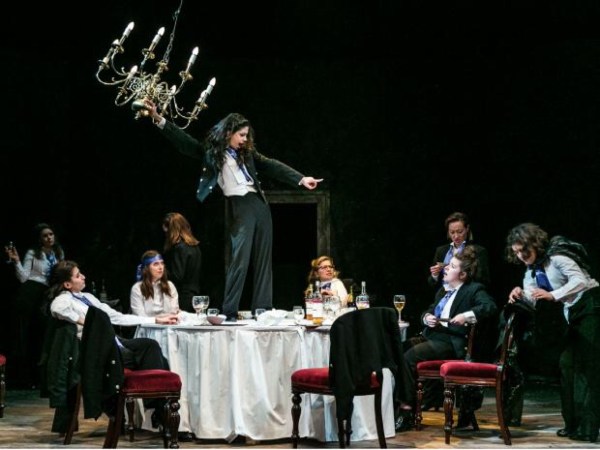
The Riot Club – a place for “getting fucked, and fucking stuff up.” This is certainly evident throughout the rollercoaster that is Posh, the critically acclaimed play by Laura Wade. Cressida Carré’s clever direction effectively demonstrates the pack mentality that is in place in this environment, investigating how far people are willing to go to keep the tribe strong – to preserve the thoroughbred.

Continue reading

The Kid Stays in the Picture, Royal Court

https://cdn.thestage.co.uk/wp-content/uploads/2017/03/22163612/Kid-Stays-In-The-Picture-Royal-Court-4291.jpg

By guest critic Willa O’Brian

The American dream is a tantalising thing. Even the grubbiest kid from New York, the son of a nobody dentist, can become a film star and producer. This is Robert Evans’ story, the man responsible for pictures like ‘The Godfather’. Complicité’s Simon McBurney adapted the show from Evans’ autobiography, which paints a picture from a better time: when movies were pictures and hard boiled men tacked “see?” on the ends of sentences wreathed in cigarette smoke. It is visually sumptuous and the cast of eight are a constantly churning ensemble that whip the story into a froth and delivery a sensory overload of American tropes and history and multi-media tricks. Given the subject matter, the desire to incorporate all of these elements makes sense.

Continue reading

Escape the Scaffold, Theatre 503

Escape the Scaffold

Grace and Marcus are a picture perfect, upper-middle class married couple, even with their opposing politics. They own their own home by their late 20s, she’s an artist and writer, and he works for the government. Nothing is as it seems on the surface, though. When radical old friend Aaron turns up much to Grace’s delight and Marcus’ resentment, the threesome’s complicated history stemming their student days is gradually relived over dinner. A series of fragmented, vague flashbacks interspersed with a confused present muddies truth, lies and allusions to a violent, dystopian world outside the tidy, suburban house – but there is a pronounced lack of overriding purpose to the messy story. 

Continue reading