Dead Funny, Vaudeville Theatre

Ellie and Richard live a comfortable, domestic life in 1990s little England. Only their marriage is in pieces because Richard can’t bear the thought of touching Ellie, who just wants to get knocked up and have a child like their friends, Nick and Lisa. Richard’s too busy with his work as an obstetric surgeon and his amdram-esque club of British comedy, the Dead Funny Society. When Benny Hill dies and he tries to arrange a party to commemorate his life and work, all doesn’t go to plan when his private life and the public party collide.

Terry Johnson’s 1994 play functions both as a cleverly interwoven tribute to old school British comedy and a domestic drama, with a good balance of comedic and serious moments. But even though the play is only a couple of decades old, it occasionally feels its age. There is also a particularly dubious casting or directorial decision that is, quite frankly, incredibly racist.

Johnson’s first act is the stronger of the two, though the start of a stereotypically bickering couple takes a bit of time to develop. Once it picks up, the moments of hilariously staged sexual dysfunction between Ellie and Richard are the funniest. Act two, starting with the party for Benny Hill, quickly loses its way in a mire of impressions of comedic sketches where little else happens. The four society members who turn up are wearing some sort of semi-fancy dress with the white Nick (Ralf Little) dresses up as an East Asian character complete with gobsmackingly offensive accent. There is no reason why this role couldn’t be played by an East Asian actor, or Johnson (who also directs) could make a different accent choice. Once the plot moves away from the play acted in-jokes and returns to the collapse of a marriage it vastly improves, crescendoing into a satisfying mix of slapstick and emotional trauma.

Of the cast of five, four are fantastic. Katherine Parkinson as Ellie particularly excels with her sarcastic, deadpan delivery. Though she alienates the other characters, the root of her bitterness is moving – she just wants a husband who loves her. Steve Pemberton’s camp Brian is utterly delightful with his good intentions and genuine care for his friends. Ralf Little is the weakest (though not bad by any means), with occasional moments of awkward delivery.

Most of this production is reasonably enjoyable, though the script is a bit baggy with the comedy references. The mix of genres keeps the story from being too light or weighty, but the performances are the best part of this production. Even with the old fashioned gags and racism, it’s a fun show.

Dead Funny runs through 4 February.

Ticket courtesy of @TheatreBlogs/theatrebloggers.co.uk & stagedoorapp.com

The Play’s the Thing UK is committed to covering fringe and progressive theatre in London and beyond. It is run entirely voluntarily and needs regular support to ensure its survival. For more information and to help The Play’s the Thing UK provide coverage of the theatre that needs reviews the most, visit its patreon.

Bits of Me Are Falling Apart, Soho Theatre

William is going through a rough time. Newly separated from his partner and the mother of his son, he’s sleeping in his office and contemplating the path that led him to this situation. As he walks to his ex’s house, he shares choices, anecdotes and memories to the ether but few of them are endearing. Actually, most of them showcase a character that is self-absorbed and entitled, and delivered with casual flatness. Adrian Edmondson’s latest work, an adaptation of the memoirs of the same title by William Leith, lacks charm, theatricality and a likeable character. Whilst the goal of addressing male mid-life crises is an admirable one, the execution is ineffective and uninteresting.

Edmondson portrays William as articulate and sensitive, but the rambling, stream-of-conscious script moves at a brisk pace with little variation in rhythm or tone. He largely glosses over the subtlety of the language, and there is little emotional expression. The moments where he does display vulnerability are lovely, but they are too infrequent to redeem the piece from the drudgery of someone who has lost their way and refuses to do anything about it. It’s a frustrating experience – the script has plenty of room for connection with the text and the audience – both are largely ignored.

Lily Arnold’s set and Amy Mae’s lighting are excellent, though. As boring as the performance is, the design is fun and colourful. Children’s toys are suspended from neon rope lights over a pristine white stage; these toys are lit when William talks about them: a playhouse is his home, the Beano is a newspaper.

There’s something fundamentally indulgent about a one-person show focused on the experience of being in the midst of an existential midlife crisis. There is no further agenda or message in the piece for the audience to take away, the character generates little empathy and Edmondson’s delivery prevents any real connection with the audience. Whilst I’m sure there is a demographic of middle aged men who will gravitate to this piece, Bits of Me Are Falling Apart is otherwise alienating and dull.

Bits of Me Are Falling Apart runs through 3 December.

The Play’s the Thing UK is committed to covering fringe and progressive theatre in London and beyond. It is run entirely voluntarily and needs regular support to ensure its survival. For more information and to help The Play’s the Thing UK provide coverage of the theatre that needs reviews the most, visit its patreon.


Follow the Faun, Above the Arts

By guest critic Tom Brocklehurst, @TomLikesTheatre

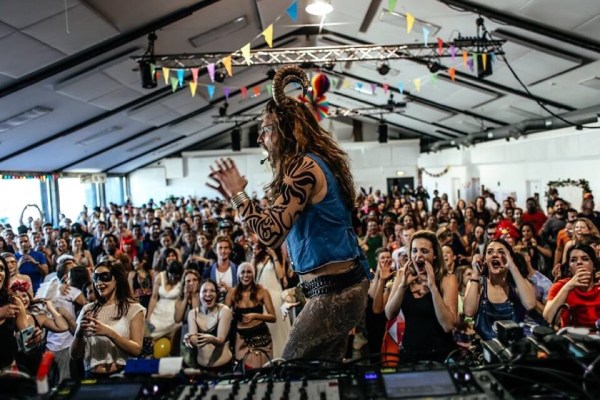
The advertising calls this a ‘shamanic rave’ – perhaps that is the best description of this hour of shambolic, low-budget hedonism. But there’s a lot to be said for Follow the Faun as a night out, especially if you like any of the following: raves, drama games, aerobics and glitter. 

The show is essentially an hour-long raverobics session, led by our wired guru/dance tutor The Faun. Under his instruction we are led through a series of wild dance routines: we gallop along hillsides, we disembowel our prey, and we have lots of enthusiastic sex. There’s not really much more to the performance, apart from the predictable stuff about feeling your energy and loving each other. But most of it is great.

Andy Black as The Faun certainly takes his role very seriously, and it’s his charisma and conviction that carries the show. We’re told repeatedly early on that ‘not joining in isn’t sexy’ and this message seems to get through, as the majority of the audience leap into the dance routines with aplomb.

There are awkward moments – the miming of sexual exploits certainly had a few people laughing awkwardly, and the masculine tone of that section is more than a little seedy. However, hedonistic rave-ups aren’t the place for prudishness, and we were soon onto the next section – the lady-fauns dance their response in a rather tame tribute to female icons Beyonce, Eva Peron and, er, Marilyn Monroe. 

Criticisms aside, I went in with more than a touch of scepticism, and came out sweaty, exhausted and grinning ear to ear. This isn’t a show for everyone – certainly not those of a prudish disposition – but it’s great for a quirky night out or if you just fancy a shamanic rave.

Follow the Faun runs through 12 November.

The Play’s the Thing UK is committed to covering fringe and progressive theatre in London and beyond. It is run entirely voluntarily and needs regular support to ensure its survival. For more information and to help The Play’s the Thing UK provide coverage of the theatre that needs reviews the most, visit its patreon.
 

King Lear, Old Vic

Glenda Jackson’s return to the stage after more than two decades serving as an MP certainly should be a momentous occasion, and in one of the great roles. At age 80, in a time where audiences and theatremakers are clamouring for more diversity, Jackson as King Lear is an obvious choice. And she is remarkable – certainly one of the most nuanced Lears I have seen in a long time, and one that challenges the conventional portrayals of masculinity, old age and madness. The problem is the rest of the production. Deborah Warner’s nearly four hour-long royal unraveling often feels it – longer scenes lack energy and pace, and a vague, austere design concept puzzles rather than enlightens. There are some outstanding performances in the cast of 23, but some character choices fall in line with the overall blandness of this staging.

Jackson indicates she plays Lear as a man through her voice and movement, and the original gender references in the text are kept. Her Lear is a consistently powerful man as well with an unwavering masculinity, though it is not a modern maleness that she takes on. She endows him with a wide emotional spectrum, from laddishness through blind anger to debilitating grief. This spectrum, one not usually shown in contemporary male characters or modern cis men’s renditions of the great classical roles, potentially provides insight into masculine expression when Shakespeare was writing. Demonstrable emotion and the ability to verbally express these feelings may or may not have been commendable, but it wasn’t considered weak or not manly. This Lear is a renaissance man – skilled at language, war and emotional expression. Within his bouts of madness, he doesn’t seem completely incoherent – there are shadows of Hamlet’s feigned insanity here – and a deliberateness to his raging. His grief is heavy, but freely flows from a wellspring somewhere deep in the guts. There is no indication that Jackson hasn’t performed in years, and her level of commitment, truth and expression is a masterclass in performance.

Though Jackson’s performance is extraordinary, the design concept is sorely lacking in substance. Mostly white, with the occasional projection of static and scene numbers on otherwise blank panels, it looks low budget and makes no statement about time or place. It doesn’t feel timeless, just empty and featureless – a kingdom hardly worth fighting over. There are initial metatheatrical hints of a film or theatre set, but these quickly disappear. Whilst the set does emphasise the contemporary dress and Lear’s bright wardrobe, it otherwise draws attention to the sweeping depth of the stage that is mostly ignored. Warner keeps the action firmly on the apron, which isn’t a problem, but the rest of the stage feels wasted. The storm scene is a notable exception with it’s oily sky brewed with black plastic sheeting underneath flickering projections. It’s delightfully lo-fi and hugely effective.

There are other good performances, particularly Rhys Ifans’ fool, who shows a similar emotional range. As well as the usual jesting, it is evident that he cares deeply for the old man; he also has quite the vicious streak. Sargon Yelda is a devoted and blustery Kent, and Harry Melling’s Edgar is wonderfully bold, pitiful and desperate as Poor Tom.

Warner’s direction is the main issue with the production. The longer scenes in the first half lose energy quickly, and the staging is often static. Picking up the pace and trimming the script would be a vast improvement and draw less attention to the boring design. Some of the cast need more urgency and variation in their delivery, which would give the show an injection of energy.

Is it worth seeing this King Lear for Jackson’s performance? Absolutely. Her interpretation of the role is positively exquisite, but when she is not on stage, things are generally much less interesting. It will hopefully find its rhythm as the run goes on, but the clumsy slowness and lack of clear concept is most frustrating.

King Lear runs through 3 December.

The Play’s the Thing UK is committed to covering fringe and progressive theatre in London and beyond. It is run entirely voluntarily and needs regular support to ensure its survival. For more information and to help The Play’s the Thing UK provide coverage of the theatre that needs reviews the most, visit its patreon.

The Acedian Pirates, Theatre503

https://newimages.bwwstatic.com/upload11/1461847/tn-500_cavanclarkeandandrewpstephen,creditsavannahphotographic..jpg

Like Homer, Virgil and Ovid, Jay Taylor takes inspiration for his writing from the Trojan War. The decade-spanning conflict over one woman is relocated to a lighthouse in a Beckettian present day, where a handful of soldiers wait for orders, years after the war began. There is a woman upstairs – THE woman. Stories are told and tensions mount as time passes and the battle approaches. This is Taylor’s first play, an impressively polished statement on the effects of war on its soldiers. As the pressure increases on this merry band, some naive and some hardened, personalities clash and desperation increases.The Acedian Pirates is a slow burn of a character study with a fantastic ensemble cast and a potent message, through the script could use some clarity in plot and pace.

Cavan Clarke plays Jacob, a young solider newly stationed at the lighthouse. He’s literary, smokes to much and desperate wants to please his superiors. Taylor gives Jacob a slowly building character arc that Clarke carries admirably and with conviction. Rowan Polonski is the volatile Troy, the commander of this unit who is rarely seen but with a powerful, dangerous presence. Sheena Patel defies convention as the frankly speaking and harsh cigarette-smoking Helen. Taylor keeps her hidden for much of the script, which although it makes her presence all the more powerful it is a shame that the woman who’s abduction started this war is given so little time to share her female experiences within this masculine landscape.

The design is fantastic, particularly Helen Coyston’s set. There is plenty of detail, from the curved, mossy walls and the shallow staircase that indicates what floor they’re on by a simple, clever pivot around the round floor. Though the set and atmosphere is further detailed through lighting and sound, the set is the star of the design. Taylor and director Bobby Brook have a good instinct for the character conflict that keeps the story moving, through the beginning is still quite slow. The imagery and anecdotes only just save it from stagnating, and things escalate incredibly quickly at the end. A more even narrative arc would give the script a smoother, slicker feel.

Jay Taylor is certainly a writer to watch for his characters and storytelling. Even though this debut play has its issues, it’s a great start.

The Acedian Pirates runs through 19 November.

The Play’s the Thing UK is committed to covering fringe and progressive theatre in London and beyond. It is run entirely voluntarily and needs regular support to ensure its survival. For more information and to help The Play’s the Thing UK provide coverage of the theatre that needs reviews the most, visit its patreon.

Knock Knock, Etcetera Theatre

knock-knock-ectetera-theatre-niv-petel-writer-and-performer-credit-chris-gardner-6

You are eighteen years old. Ready to leap from the cusp of adulthood, the world is at your fingertips and the rest of your life unfurls before you. You eagerly anticipate a heady combination of studying, partying, working, being invincible, finding your feet, falling down and picking yourself up again in those last couple of teen years.

Unless you’re Israeli. Born in a country with mandatory army service, turning eighteen means your life is put on hold for up to two years whilst you serve your country – and you might die doing so. This culture, where violence is part of everyday life and parents losing a child is a real possibility, inspires theatre maker Niv Petel’s Knock Knock. Through a solo performance from the perspective of a single mother of an only child, we see Elad grow from mewling infant to confident sergeant.

Petel’s performance is exquisitely detailed, particularly within the precision of his physicality. Though there are minimal props, his mimed actions are always immediately recognisable. Short, incongruous movement sequences break up the realistic, narration-driven scenes that make up the bulk of the story and whilst there is often an unclear connection to the text, they are a joy to watch. Though he plays a woman for most of the story, his depiction is sensitive and three-dimensional. There are moments where Petel gets a bit too close to panto, but these are rare and easily overlooked.

The linear story of a boy growing into a man is one of parenting rather than coming of age. It’s a valuable perspective, and one that is certainly unique given the story it tells. Some scenes work better than others as the person she speaks to changes – sometimes it’s Elad, sometimes an invisible friend, another time it is a video message. The transitions are always clearly marked with lighting and movement, though sound would also add another dimension to the play’s reality. The final moments are predictable and with an unrealistic timeline, but its point is devastating to consider.

Even though the stylistic disparity between the scenes and transitions creates some clunkiness, Knock Knock tells a great story from a perspective rarely considered in countries privileged enough to not have national conscription. Petel’s performance is also a privilege to watch and the piece isn’t far off being a sophisticated solo performance work.

Knock Knock runs through 6 November.

The Play’s the Thing UK is committed to covering fringe and progressive theatre in London and beyond. It is run entirely voluntarily and needs regular support to ensure its survival. For more information and to help The Play’s the Thing UK provide coverage of the theatre that needs reviews the most, visit its patreon.
Interview: Lucy Basaba Explains the Theatre & Technology Awards

Do we need another theatre awards ceremony? Independent critic Lucy Basaba, founder and editor of theatrefullstop, thinks so. Earlier this year, she launched the Theatre & Technology Awards after spotting a gap in the otherwise abundant awards landscape. I spoke to Basaba about the awards and what makes them stand out from the rest.

Why are the Theatre & Technology awards needed? 

These awards are needed more than ever as we are living in an age where using tech is second nature. This is evident in theatre where lighting, sound and projections are a staple, and the professionals behind these innovations should be celebrated. Theatre is collaborative and a lot of what helps suspend the disbelief is the tech element. I’m not sure what to call our era of theatre making, but we are definitely living in a technologically enlightened time.

What do they include that other awards don’t?

These awards acknowledge both onstage [creatives] in lighting, sound and projection as well as offstage digital professionals [such as] photographers, podcasters, bloggers and poster designers. There are twelve categories in total; all help enhance the theatrical experience. It’s rare to watch a theatre piece [that doesn’t have] any of these elements.

What is the nomination and assessment process?

Established reviewers are invited to cast their votes from 1st July 2016 until 30th June 2017 for four of the categories: Best Sound Design, Lighting Design, Projections and PR company. Shows put forward must have been during the nomination period and must have had at least five showings at an established theatre. Voting will be opened to the public from April 2017 to June 2017 for eight of the categories. Voting will close on 30th June 2017 and judging by industry professionals will take place in July for each category. They will choose five of the top nominees, with a shortlist announced in August. 

When and where will the awards ceremony be?

The ceremony will take place on Sunday 22nd October 2017; the venue is yet to be confirmed.

The Play’s the Thing UK is committed to covering fringe and progressive theatre in London and beyond. It is run entirely voluntarily and needs regular support to ensure its survival. For more information and to help The Play’s the Thing UK provide coverage of the theatre that needs reviews the most, visit its patreon.
The Wicker Hamper, Old Red Lion Theatre

Inspired by 1973 cult horror film The Wicker Man and his love for comedy, young writer Ed Hartland tries to take a humorous approach to 1970s horror films in self-referential, metatheatrical mashup The Wicker Hamper. Set on Winterisle, a remote island off the Scottish coast, Marcie arrives to start a new job as Lady Winterisle’s PA. Staying at a hotel run by Norman Bates and his mysterious mother before her job starts, Marcie hears rumours about human sacrifice on the upcoming Samhain Day. With the island’s amdram company folding because of the budget cuts, stakes are particularly high amongst the desperate, twisted islanders and their renewed pagan belief system inspires them to pull out all stops to save their precious theatre company.

Drawing on numerous classic horror films for his story, Hartland lines up the gags like beads on a necklace. The plot is choppy and often illogical as he relentlessly goes for punchline after punchline, though hardcore, horror film fans will find the references funny. His theatre jokes come into their own in the final scene, but this isn’t enough to redeem the script of its cheap laughs. There are some voiceover characters that are never fully explained, and the rapidly changing locations are not always clear, occasionally leading to further confusion.

The cast of five are clearly having a great time, and there are some good performances. Sophie Hughes as hunchback Igore and the hotel receptionist is versatile and watchable, committing to her characters rather than solely playing up to the humour. Hannah Grace May (Marcie) shows good range as a sweet new arrival, and an angry victim fighting for her life.

Hartland has some nice ideas in The Wicker Hamper and his love for genre films and comedy is abundantly clear. The passion and fun are unwavering and lovely to watch, even though the script needs a lot of polish.

The Wicker Hamper is now closed.

The Play’s the Thing UK is committed to covering fringe and progressive theatre in London and beyond. It is run entirely voluntarily and needs regular support to ensure its survival. For more information and to help The Play’s the Thing UK provide coverage of the theatre that needs reviews the most, visit its patreon.
Moby Dick! The Musical, Union Theatre

In 1992, director Andrew Wright saw Cameron Mackintosh’s production of Moby Dick! The Musical as student in Oxford. Even after its subsequent West End flop, something about the show stuck with Wright all these years later. Maybe it was one of the soaring ensemble numbers, or maybe it was the plethora of dick jokes. Either way, this innuendo-laden, musical within a musical is an aggressively loud revival with few redeeming qualities. Dug up after nearly 25 years of obscurity, this show with a barely-there book and unfunny gags ought to have stayed in the archives of theatre history.

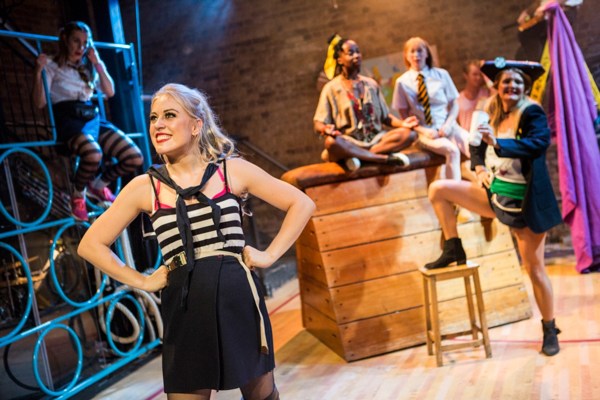
When St Godley’s Academy for Girls runs the risk of closing after a damning Ofsted inspection, the students and staff rally together to raise money and support for the school (as if that somehow changes the inspection results). Bookended by short school scenes, most of the story takes place within the performance of the musical that the geeky student playing Ishmael (Rachel Anne Rayham) wrote. 

The school play has no budget, so PE equipment gets a starring role as set and props, and their uniforms are costume with a few accessories. The line between the school girl characters and the Moby Dick characters is thin and porous, and the story hinges on the “it’s so bad it’s good” concept. The problem is that the script is just bad. There’s not much to it at all, and though there are some cracking tunes, the lyrics aren’t nuanced enough to smoothly progress the plot on their own. The gags are constant, massively inappropriate and unfunny.

Hereward Kaye and Robert Longden’s music, typical of large-scale late 80s and early 90s musicals, can be quite stirring. The first act finale is particularly good and Wright stages it well, though most of the show is approached with a scale and volume suitable for a West End house. All potential for subtlety is ignored, and even though the energy cannot be faulted, the entire production can be summed up as needlessly excessive.

There are some fantastic singers in the cast. Laura Mansell as Starbuck has one of the most powerful belts in small-scale musical theatre, and Anton Stephans (headmistress and Captain Ahab) has strength and presence even though his performance is otherwise more appropriate for pantomime. Rayham’s Ishmael is tenacious and spunky.

The beauty of fringe musical theatre is that it doesn’t have to be over the top. Wright tries to compensate for the book with energy, but that approach is too much for an intimate venue. He has some great talent in the cast, but the choice of show combined with the performance style makes for an exhausting evening.

Moby Dick! The Musical runs through 12 November. 

The Play’s the Thing UK is committed to covering fringe and progressive theatre in London and beyond. It is run entirely voluntarily and needs regular support to ensure its survival. For more information and to help The Play’s the Thing UK provide coverage of the theatre that needs reviews the most, visit its patreon.
Tomorrow I Was Always a Lion, Arcola Theatre

Schizophrenia is regarded as an incurable disease – once diagnosed, even if a person is able to lead a normal life, the medical community always considers them ill. Norwegian psychologist and PhD candidate Arnhild Lauveng defied this expectation; after a decade of living with Schizophrenia and a lengthy recovery, she was finally declared healthy. Her first of eleven books is a biography that documents life with her illness and the relentless drive that eventually made her well. Belarus Free Theatre brings this story of despair and hope off the page through outstanding storytelling and intense sensory stimuli, providing a voice for one woman trapped by mental illness in a world unwilling to accept medical miracles.

We meet Arnhild as a child who gradually loses her sense of self in a world that resembles a Picasso painting. Though her world may be colourful, it is also populated by sinister people. The first one she meets is simply called The Captain, a nasty piece of work that eventually leads to her years of hospitalisation. 

Rather than one actor playing Arnhild, the ensemble of five each take turns telling her story. Through this device, she becomes not just one person, but the one in four people who suffer from mental illness at some point in their lives. Arnhild’s story is a remarkable one of recovery, but also an everywoman representing 25% of the UK population. In and around the narration of her time in a mental health facility, shrill noises, confetti, water and striking projections uncomfortably bombard the audience with the experience of Scizophrenia.

Vladimir Shcherban’s adaptation is honest, moving and provocative. Though not as aggressively propagandist as their recent Burning Doors, Tomorrow I Was Always a Lion fosters an active understanding of life with severe mental illness and the systems in place that counteract recovery. Even though Arnhild is very much a victim, she is also a fighter with a distinctive voice who portrays her experiences with clarity and pathos. Scenes are short and episodic, often dreamlike and unreal. The format effectively conveys the lengthy time period without becoming tedious, and captures the ups and downs of the treatment and recovery process.

There is an element of criticism of the healthcare system, particularly the type of restraint used with vulnerable patients. Though BFT’s signature activism theatre is underplayed here in favour of Arnhild’s story. Her story is an excellent one, but the activism is often lost within the narrative. 

Though the staging tends towards simple, it allows the power of the story to shine through and the moments of physical discomfort to foster empathy. This is a sophisticated, sensitive piece of theatre that, whilst raising awareness, tells a wonderful story. 

Tomorrow I Was Always a Lion runs through 12 November. 

The Play’s the Thing UK is committed to covering fringe and progressive theatre in London and beyond. It is run entirely voluntarily and needs regular support to ensure its survival. For more information and to help The Play’s the Thing UK provide coverage of the theatre that needs reviews the most, visit its patreon.