Lemons Lemons Lemons Lemons Lemons, Camden People’s Theatre

rsz_8ba7e0f9-eb48-4cc6-a4fa-d91796add7eb-2060x1236

(c) Giulia Delprato

Austerity sucks. People all over the country have had their benefits cut, work opportunities reduced and wages frozen. Austerity has badly affected young people at the onset of their careers, inhibiting the making of an independent, adult life. Young couples don’t have it any easier, even if one of the pair has a great job. For Bernadette and Oliver, life’s about to get even harder. They live in a Britain where the government isn’t just limiting welfare, arts council grants and junior doctors’ salaries. The newest austerity measure is on their speech – not what they say, but how much. Every individual is limited to 140 words a day in Sam Steiner’s Lemons Lemons Lemons Lemons Lemons.

Steiner uses the word limit to frame Bernadette and Oliver’s journey as a couple and their efforts to overcome obstacles within their relationship. The audience sees them meet at a cat funeral, wake up together for the first time, make up coded abbreviations to use when the Hush Law comes into effect. They fight, they fuck, they count their words, and it’s lovely despite the dark premise. Euan Kitson (Oliver) and Beth Holmes (Bernadette) are charmingly intimate with each other, as they should be after their runs at Latitude, Edinburgh and Warwick Arts Centre. Fundamentally a love story, these two do their best to get by and stay together even though they’re chalk and cheese. Despite stylized blocking and choreography, and no physical contact for the entire play, these young actors are sweetly genuine.

The short scenes alternate between their pre- and post- speech limited relationship, with transitions well marked with movement and the use of microphones by director Ed Franklin. Steiner’s slow plot reveal keeps the audience keen, as do his conflicting characters trying to make it work one day at a time. The amount of time passing isn’t clear though, and there are logistical points that are ignored. Has the government installed internal speech limiters in everyone? If not, why don’t they ignore the law in the privacy of their homes? How does Bernadette go to work as a courtroom lawyer with a mere 140 words? How do they remember their word count? So many questions go unanswered which make the situation implausible, particularly with naturalistic performances.

Also jarring with the performance style is the abstract movement direction/choreography. With real-life dialogue and performance, the angular, distant movements provide visual variation that are pleasing to look at, but interfere with the actors’ connection to each other. In a world where words can’t be the sole means of communicating between a couple, there’s a blatant lack of contact even though they are often physically close. It makes sense to use movement to indicate scene changes, but the unfaltering style Franklin chooses is coldly repetitive. There’s a sense of showing off his cleverness or wanting to veer away from naturalism just for the sake of it. However, his sense of timing and interpretation of a script with little more than the dialogue and scene delineations is poignant and intuitive.

Considering production company Walrus are fresh out of Warwick uni and Lemons Lemons Lemons Lemons Lemons is the creative team’s first professional endeavor, this slightly dystopian two-hander is an excellent piece of theatre. With no set and a focus on the words that the government brutally restricts, this tale of young love is wonderfully performed and an easy, touching watch.


The Play’s The Thing UK is an independent theatre criticism website maintained voluntarily. Whilst donations are never expected, they are hugely appreciated and will enable more time to be spent reviewing theatre productions of all sizes. Click here to make a donation with PayPal.

The Tempest, Bloomsbury Festival

circle

By a guest reviewer who wishes to remain anonymous:

This adaptation of The Tempest by Kelly Hunter was a one-off performance as part of the Bloomsbury Festival at the Bloomsbury Studio Theatre. Hunter specifically designed this piece to enable children on the autism spectrum to participate in the show with the actors. These children’s parents/carers are invited to sit and watch.

I think this was the most unique Shakespeare productions I’ve seen. Hunter and her excellent cast of six set themselves the challenge of using The Tempest as a means of interacting and helping several young people on the autism spectrum to improve their self expression and communication with each other. Initially, I was uncertain how this would work as, personally, I’ve always found the Tempest a tricky play to follow. As the story progressed I saw that The Tempest actually lends itself perfectly to this kind of devised, interactive theatre. The play of course deals in magic; there’s also a clear physicality to many of the characters and a certain playfulness which allows the actors to introduce the young participants to the world of the play. This was not a full production of the Tempest and nor did it need to be. Considering its aims, the production was undoubtedly a huge success. All of the participants seemed to benefit hugely from playing simplified versions of various scenes from the play with these very experienced stage actors. More importantly they, along with the parents and carers watching, seemed to really enjoy themselves. When the play ended there was a lovely, warm feeling in the room. Everyone seemed enlivened by the experience, adults and children alike.

I sincerely hope that Flute Theatre will continue its success producing this kind of work in the future. It is extremely important and valuable to non-traditional theatregoers.


The Play’s The Thing UK is an independent theatre criticism website maintained voluntarily. Whilst donations are never expected, they are hugely appreciated and will enable more time to be spent reviewing theatre productions of all sizes. Click here to make a donation with PayPal.

Rise Up, Theatre Centre

Kimisha Lewis in Rise UpMay, 1961. The American south. Segregation has been ruled unconstitutional, but southern states ignore the legislation and the federal government does nothing to enforce it. Activists of all ages and races, sponsored by civil rights organizations, challenge this non-enforcement on public transport and customer services by sending groups of riders, black and white, on interstate bus journeys from Washington DC to New Orleans.
They never get to New Orleans. Over the next several months, in Alabama and Mississippi one bus after another is brutally attacked. The activists, who believe in passive protest, are terribly injured and eventually arrested. President Kennedy, embarrassed by their actions on an international level, urges them to stop but they continue to fight for equality. Rise Up by Lisa Evans uses spoken word, storytelling and multi-rolling to inspire young people to fight for equality in their everyday lives and pay homage to these brave people fighting for justice. A cast of four actor-storytellers with boundless energy plays all the characters with minimal set and props, inciting enthusiasm from both adults and young people alike.

Three metal panels on wheels are the old silver Greyhound buses. A few matching metal stools cleverly create bus seats, jail cells, shop counters and so on. Actors Emma Dennis-Edwards, Sam Kacher, Kimisha Lewis and Edward Nkom set the scenes with an array of accents and physicalities under their belts, plus a few hats and small props to help. The audience consisting mostly of children from the local girls’ school immediately warm to them, both during the production and the post-show “revolution”.

The script is narration-heavy, perhaps too much so, but these monologues feature sections of poetry delivered with a hint of spoken word, but not so much so that the performance style changes and does a disservice to production style continuity. Though more showing than telling would have been welcome, the incidents described are quite graphic and not appropriate to vividly show to school children. This isn’t a particularly visual show, so the students’ attention is a testament to the script and performers’ strength.

Theatre for young people continues to develop in leaps and bounds, creating rich stories and detailed characterization that can appeal to all ages. Rise Up is an example of this, telling a clear story that although set in another era and country, manages to relate to the lives of contemporary young people in Britain feeling the effects of inequality. The staging is simple as is the design, but this serves to focus the audience’s attention on Evans’ excellent script.


The Play’s The Thing UK is an independent theatre criticism website maintained voluntarily. Whilst donations are never expected, they are hugely appreciated and will enable more time to be spent reviewing theatre productions of all sizes. Click here to make a donation with PalPal.

Shakespeare & The Alchemy of Gender, Rose Playhouse

At 19 years old, Lisa Wolpe fell in love with Shakespeare. She’s now performed more of Shakespeare’s male roles than any woman in history after founding Los Angeles Women’s Shakespeare Company twenty years ago. She is currently touring the world with her solo show, Shakespeare & The Alchemy of Gender. Although it sounds like an academic lecture, it contains some of the best Shakespeare performances I have seen. The play pays homage to her father, telling the man’s story and how he affected her life. The man who killed himself when Wolpe was four is brought to life in a deceptively simple show that finds hope in a history of suicide, abuse and war.

Though to say the show is about her father’s life oversimplifies the content. Yes, a large portion is about him, but it also covers her life after he had gone, her relationship to specific Shakespeare characters, gender, performance, religion, Elizabethan society, family and alchemy – the transformation of a base material into something precious. These themes intertwine, with no moment unrelated or superfluous and the 55-minute show amazingly manages to not feel overloaded with messages. As she works through her life and her father’s, she relates Shakespeare’s characters to individual moments in time. As she reflects on her relationship with him now, she becomes Hamlet remembering his father’s ghost, in the best performance of the role I’ve encountered. Her father’s WWII escape and joining up with the Canadian forces as a double agent lead into Henry V. We also meet Richard III, Hermione, Shylock and others in relation to herself and her family’s history. Wolpe is not only adept as any man at embodying the male roles, she excels. She also effortlessly switches between men, women and herself, functioning in an androgynous state when addressing us out of character.

Wolpe is comfortable addressing us with an open honesty about difficult episodes in her life without coming across as confessional or masturbatory, as one-person shows run the risk of being when used to come to terms with the performer’s or writer’s issues, whatever they may be. The show is relaxed and conversational with the audience nodding, laughing, even verbally agreeing. The intimate venue helps, but she certainly has the energy to fill a huge theatre. She had a profound effect on the audience, particularly when sharing moments about her relationship with her family and dressing in boys’ clothes to defend herself against her predatory stepfather.

Her interpretation of the characters she performs seems rooted in physical and vocal distinctions, with her General American accent capturing the visceral-ness of the language that the more recently created RP/Standard English. These characters come from her gut, and she explains how she is able to relate to each one and perform them with truth. This is evidence of Shakespeare’s continuing relevance to modern life. Not only is Shakespeare: An Alchemy of Gender an excellent piece of solo theatre, it is also a lesson in performing the great Shakespearean roles of both genders and an encouragement for all to defy gender boundaries dictated by society.

Because this is a woman that must be experienced, here is an extract from her Iago. Enjoy.


The Play’s The Thing UK is an independent theatre criticism website maintained voluntarily. Whilst donations are never expected, they are hugely appreciated and will enable more time to be spent reviewing theatre productions of all sizes. Click here to make a donation with PalPal.

So It Goes, Greenwich Theatre

SOITGOES_CMYK_1

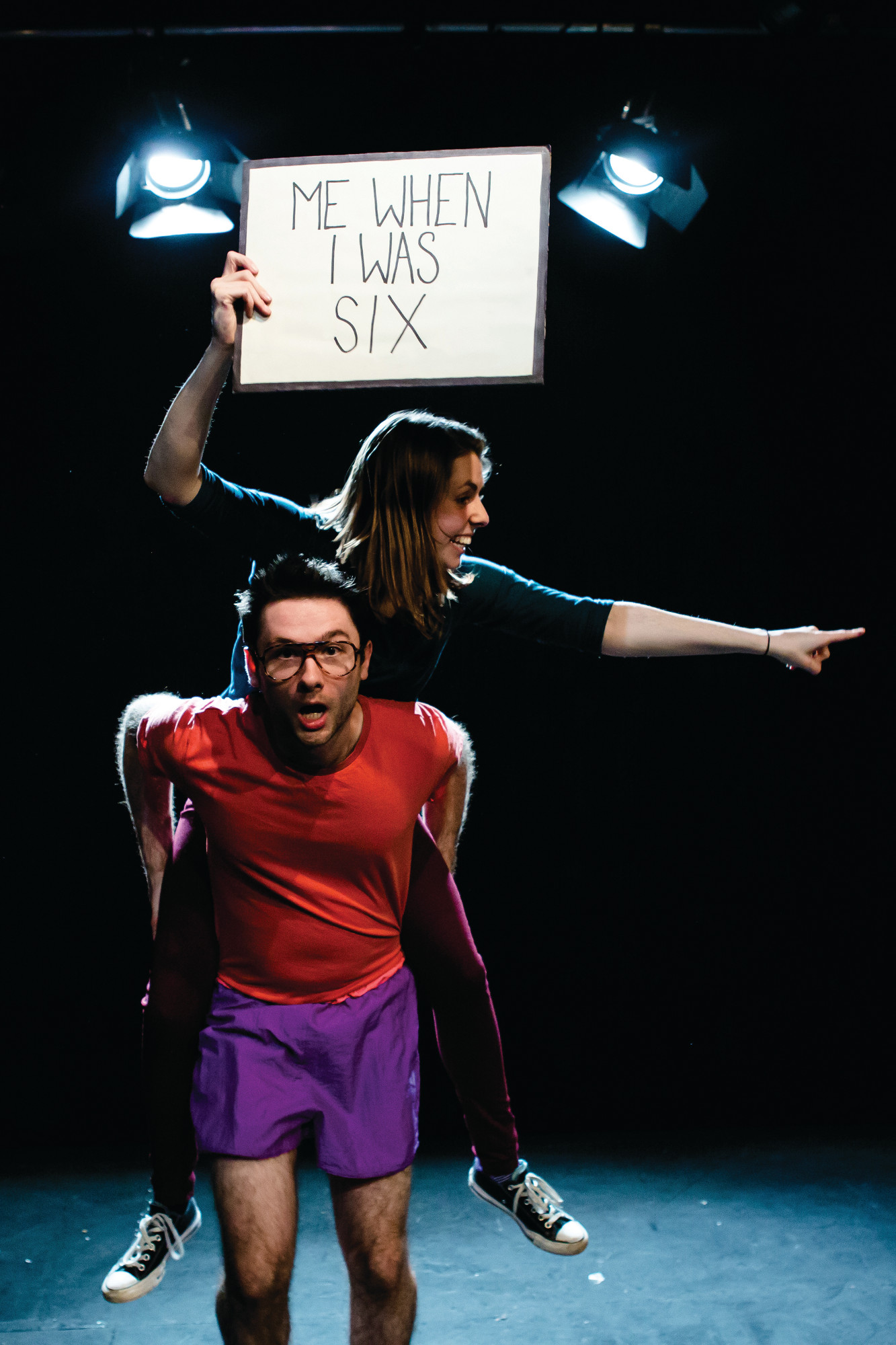
Hannah used to love running with her dad. When she was 17, her dad died and Hannah kept on running, silently and alone. She refused to speak about his death with anyone, including her family. So she decided rather than to navigate the burden of speech, she would create a silent play that tells her dad’s story and her process of dealing with his death. So It Goes is a sweet two-hander that manages to avoid over-sentimentality by focusing on the honest, deeply individual story of navigating life after the death of a parent.

Other than the last line, there is absolutely no speech in this play. All text is written on small whiteboards worn around the actors’ necks or on pre-made signs. This keeps written communication basic; it is rather like watching a comic book or graphic novel being written. This could occasionally feel slow and it was often easy to predict what was coming next on the whiteboard within a scene, but not overly so and not often. The set and props are also simple, with signage and symbolic items representing other characters and jumps in time and place. Most props are drawn outlines of objects, adding humour and a sense of youthful play to the story. The physical performance style matches- it is exaggerated but simplified, physical theatre but not ornate, embellished or for the sole purpose of showing the actors’ physical prowess. So It Goes wants to tell Hannah’s story as clearly and simply as possible, focusing on truthfulness and emotional honesty. The look of the play would certainly appeal to children, but accessing adults’ inner child makes the experience of losing a parent a journey that ends with positive reflection rather than the bitterness of loss.

The performances are equally lovely. Hannah Moss plays herself, and has “help” telling the story from David Ralfe, who plays her Dad and Mum. Ralfe in drag has an initial hit of comedy, but he taps into Mum’s outward expression of hopelessness that soon makes the audience forget that it’s a bloke in a dress. The two actors embody an exaggeration familiar to children’s theatre that is also in keeping with the cartoon aesthetic of the production, but is not crude. If they did not employ the exaggeration or humour in their physical comedy, it would make audiences want to slit their wrists. Instead, there was a lot of sniffling and nose blowing mixed in with laughter.

This is the third play I have seen about death in recent weeks. Each production used a dramatically different approach to convey the same message. Hannah spelled it out for us by writing that her dad “didn’t just die, he lived.” There’s an overabundance of factors in the world that can easily depress us and forget to look for the little moments of daily joy in our own lives, but So It Goes provides a celebratory reminder to do so through a pared down, visual-textual hybrid of physical theatre. Though the tour has now finished of their debut production, On the Run Theatre is certainly a company to watch.

Intention: ☆ ☆ ☆ ☆ ☆

Outcome: ☆ ☆ ☆

Star Rating: ☆ ☆ ☆ ☆


The Play’s The Thing UK is an independent theatre criticism website maintained voluntarily. Whilst donations are never expected, they are hugely appreciated and will enable more time to be spent reviewing theatre productions of all sizes. Click here to make a donation with PalPal.

The Picture of Dorian Gray, Greenwich Theatre

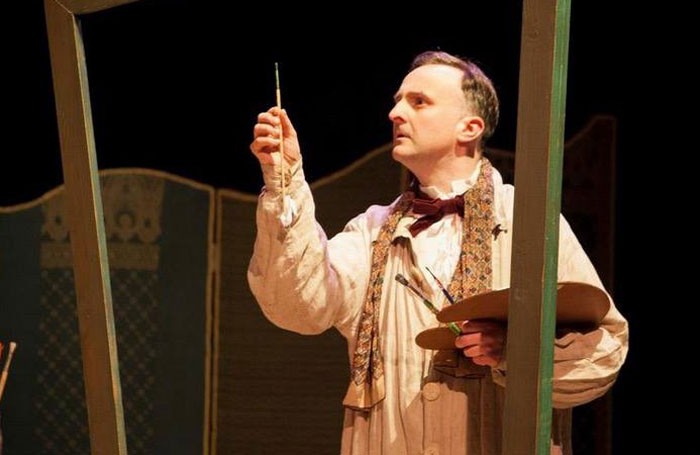
Merlin Holland is the ondorian-gray-700x455ly grandchild of Oscar Wilde. Determined to carry on Wilde’s legacy through research and writing, he adapted a new version of Wilde’s famous and infamous novel, The Picture of Dorian Gray. Touring since April as European Arts Company’s current production, it stops off at Greenwich Theatre for a few days before continuing its perky jaunt around the country.

And perky it is. With only a cast of four, this new adaptation is a largely faithful interpretation of the original story. There is a strong emphasis on artist Basil Hallward’s obsession with young Dorian, capturing the agony of Wilde’s creative and frustratingly closeted life. Played by Rupert Mason, he effectively parallels Wilde’s torment and the use of art as an outlet for homosexual expression, endowing his performance with pathos and depth. Guy Warren-Thomas is the androgynous, camp Dorian who begins as Wilde’s bright-eyed young thing making a vain, innocent wish but who slips into a life of debauchery after discovering his unintended immortality. Warren-Thomas manages to evoke some empathy in his later attempts to be good, but his corruption is a delicious downfall to witness. Gwynfor Jones and Helen Keeley complete the cast, with Lord Henry Wotton and Sybil Vane as their best roles. Warren-Thomas was the only actor to not multirole, but the others did so with great vocal and physical distinction. Cross-gendered performances provide some levity to the dark tale, as does energy and complete commitment to detailed characters.

Though the performances were excellent across the boards, there were some structural choices that did not effectively translate from page to stage. The first act was largely exposition, with Dorian only making the conscious choice to live for pleasure right before the interval. As consequence, the second half felt rushed and the effect of time passing was underplayed, though signified by grey hair in Lord Wotton and Hallward. There was also a jarringly out-of-place dream sequence that Dorian has upon receipt of a mysterious book from Wotton. Stylized and physical with coloured lights and smoke, it was unnecessary and the performers appeared uncomfortable and self-conscious.

The set provided simple but versatile atmosphere. The eponymous portrait was an empty frame that Dorian would grotesquely inhabit from time to time though often left empty and darkly lit. This is a device seen before, but an effective one as it fosters audience imagination. The costumes were sumptuous and indulgent, like Wilde himself and the characters he wrote.

This is a truly lovely production. Little is particularly inventive, but it is a classic story executed very well. The performances are certainly the highlight, as is the fact that Wilde’s grandson aided in the creation of the production. The flaws can certainly be overlooked in favour of focusing on the cast and their chemistry. It continues to tour for most of June, ending with a week at St. James Studio in London.


The Play’s The Thing UK is an independent theatre criticism website maintained voluntarily. Whilst donations are never expected, they are hugely appreciated and will enable more time to be spent reviewing theatre productions of all sizes. Click here to make a donation with PalPal.