
by Laura Kressly
Revolutions are rarely peaceful. The queer one that unfolds in Charlie Josephine’s expansive new play is no different. Yet, heaps of trans and queer joy contrast this violence. Combined, they make a well-balanced celebration and act of resistance. Set in an isolated mountain town’s saloon during the American Gold Rush, the story is immensely ambitious and imaginative in scope but would benefit from further narrative focusing and addressing a couple of the more difficult themes that arise.
Like in their remarkable play I, Joan, Josephine boldly combines past and present to reimagine the violent, cis heteropatriarchy of the American frontier as a potential gender utopia. In an unnamed town populated solely by British and Irish people, on land that would have belonged to the Apache, Arapaho, Comanche, Shoshone, or Ute nations (commonly referred to as the state of Colorado), the women wait for their husbands to come home from prospecting. The men have been gone nearly a year and have not been heard from, so morale is low. Without them, they idly pass the time and have little sense of self. When a notorious outlaw running from both the law and binary gender norms turns up, he sparks curiosity and challenges the villagers’ entire sense of self.
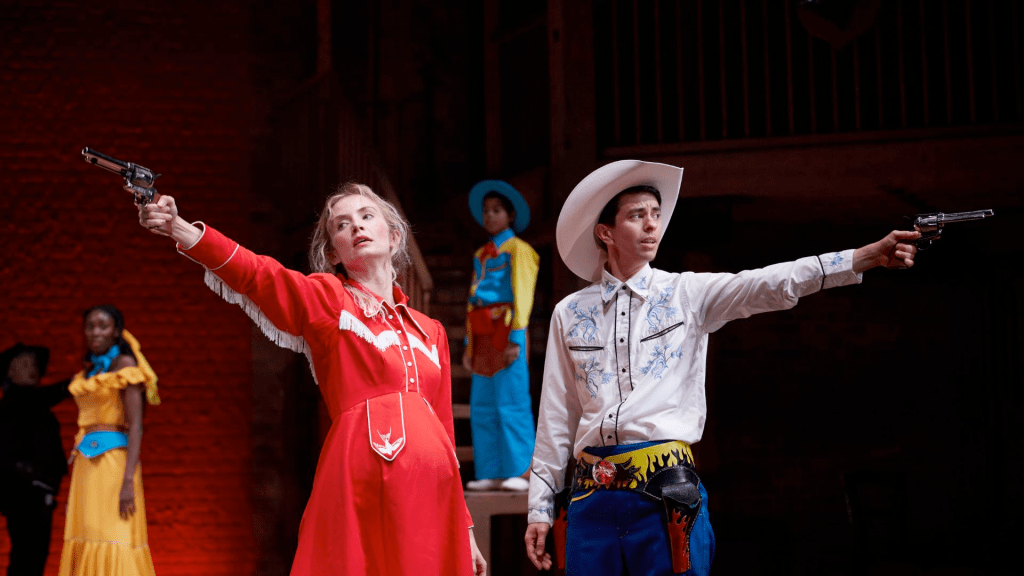
This openly FtM highwayman, Jack Cannon (played by the magnetic Vinnie Heaven), ultimately catalyses transformations within the local women and the sheriff there to protect them. There is an exuberant explosion of new gender expression and identities, queer love, colour and sex. By the end of the first half, the townsfolk are gloriously unrecognisable from the start of the play and living their authentic selves. Josephine boldly incorporates conventions from cabaret, drag and melodrama into the script, which queers not just the characters but also the dramatic form that dominates most ‘proper plays’ in Britain.
But the second half proves far more difficult. The plot immediately loses momentum and threatens to tail off altogether. There are still plenty of great lines and comedic moments like in the first half, but things don’t pick up again until the very end. The lengthy climax is tense and compelling but has an unsettling comfort with gun violence – something that still plagues, polarises and dominates American life. The lack of recognition that the characters are only there because they stole land from indigenous people also dulls the thrill of seeing trans magic and queer joy so euphorically represented.
The performances are exceptional. In the large cast, Sophie Melville’s tenacity and tenderness make her a perfect protagonist and town lynchpin. Lucy McCormick as Jayne and Emma Pallant as Sally are exceptionally good foils and brilliant physical performers. Bridgette Amofah provides a necessary grounding and rational force, and Lee Braithwaite’s gender journey gives all the feels. Despite the problematic aspects of the script, the performances and Josephine’s overall aspirations for the play mean there’s still a lot to like.
Cowbois runs through 10 February.
The Play’s the Thing UK is committed to covering fringe and progressive theatre in London and beyond. It is run entirely voluntarily and needs regular support to ensure its survival. For more information and to help The Play’s the Thing UK provide coverage of the theatre that needs reviews the most, visit its patreon.
 The Play's The Thing UK