
by Diana Miranda
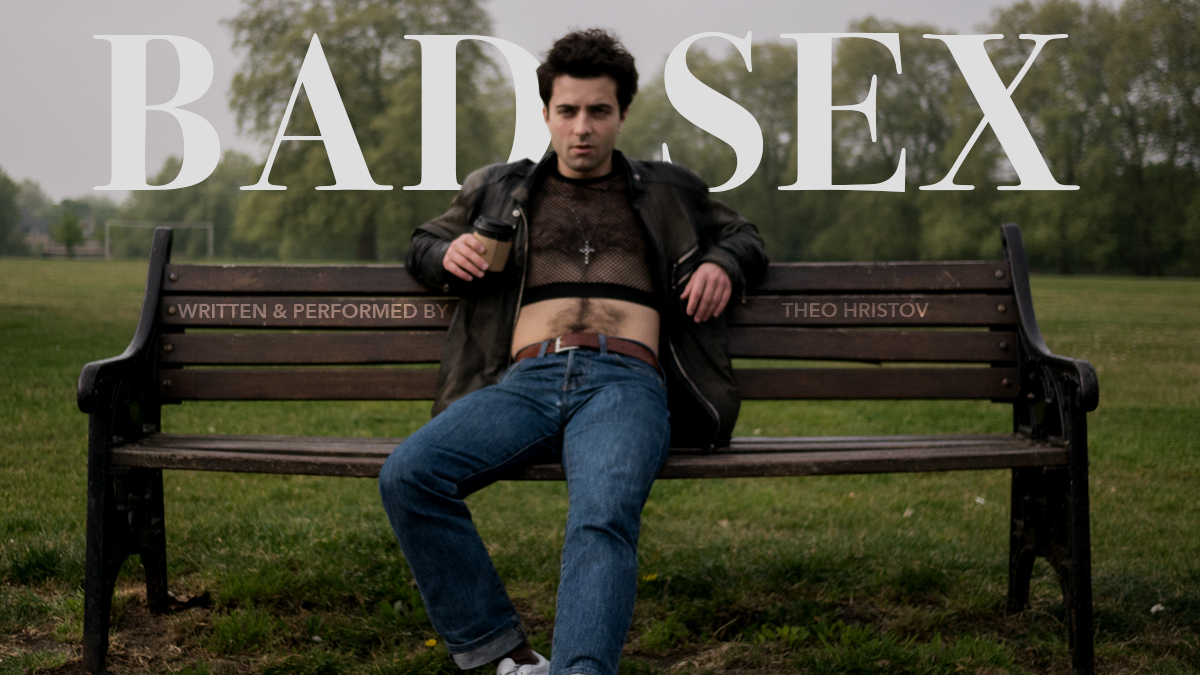
Painting a raw picture of sex and substance addiction, Bad Sex delves into the challenges of a young man spiralling in a hectic acting career while dealing with the emotional strains of showbiz and family conflict. Written and performed by Theo Hristov, this work-in-progress solo show was presented as part of A Pinch of VAULT Festival, a platform for artists to share their newest work onstage to get audiences’ sweet feedback.
‘Pinch’ is an accurate label. As with many early-stage fringe shows, this R&D’s creative team is small: playwright/performer Theo Hristov and director Neta Gracewell. I joined the team for an afternoon rehearsal before the two-night run at The Glitch’s Spacement. Hristov and Gracewell start by running the scenes in order, pausing after long sections and adding performative sauce to a highly lyrical text. The rehearsal space, The Blue Elephant, is much bigger than the pinch-sized 29 seat-venue where Hristov will perform. There’s a layout showing the stage and blocking, but they put a pin on it until the following week’s rehearsal at The Spacement, knowing that they will eventually have to adapt to that shoebox.
The development process is also pinch-sized, and the time span from the script’s dramaturgical surgery to studio and tech rehearsals is squeezed into less than one working week. Thus, the direction is straightforward and quick to make decisions during the rehearsal. The team performs multiple roles in tandem throughout the process, too: production, stage management, design, movement direction, etc. As Hristov takes the stage, Gracewell sits on the floor with a bunch of papers around her to follow the script and potentially feed Hristov his lines, a phone plugged into the speakers to improvise sound cues, a notebook to take notes, and a sharp eye looking to give directions.
That afternoon, their work mostly focuses on the performer’s delivery: voice articulation, projection, and body language. Hristov’s script traces the story with a clear, evocative narrative, which he delivers with an introspective energy that reminds me of a poetry reading. I get a glimpse of the script and how some words are arranged. Even the layout has something poetic about it. When he studies lines quickly and to himself in between running scenes, his hushed delivery captivates me. The goal is to turn that poetic energy into a dramatic drive.
The tagline I go home with is ‘Tell me a story’. Gracewell probes the character’s motivations behind the words. They aim to pump the storytelling with a rhythm to keep the ball in the air. She often gives tone and gestural examples to tell the story through performative means, sometimes emphatic, sometimes subtle. ‘It’s not literature’, Gracewell reminds Hristov. The story is being told in a theatre space, after all.
Every time Hristov performs a scene, it’s like he’s discovering himself in the words as the story unfolds. There are nuances distinctly unique each time: an inflection, a gesture, speed or volume. His voice becomes more dynamic as the afternoon moves forward, too. By the end of the day, they run everything that’s been worked on. Gracewell outlines her notes: what works well, aspects that need attention, and ideas to explore next time, such as adding specific physicality to different characters. With two people in the room, only one of them being in the spotlight, I consider how notes could be mistaken as personal criticism if not handled properly. Feedback here is clearly given to the work, though, not the people. I could take this as a good-willing work strategy (counterbalancing my thoughts about toxic working environments that unfortunately do exist in theatre). But, in fact, what I see doesn’t seem like a calculated strategy at all. It’s just a frank conversation, which fosters a just as frank, constructive environment.
I think of the pinch-size time frame again and the end-of-day notes. There are so many possibilities in a limited time. That’s fringe theatre, which I find potentially induces eye-twitching. But there are no twitching eyes in the room; Hristov is mindful of the time left (I love how there’s always someone in the room with a producer-like hat), but Gracewell ends the afternoon with a reassuring note, acknowledging the gained ground in that day’s work. There’s awareness of things to work on, but not a pinch of worry in the rehearsal’s closing words.
The Play’s the Thing UK is committed to covering fringe and progressive theatre in London and beyond. It is run entirely voluntarily and needs regular support to ensure its survival. For more information and to help The Play’s the Thing UK provide coverage of the theatre that needs reviews the most, visit its patreon.


Absolutely loved this deep dive into the behind-the-scenes world of fringe theatre! 😍 Diana Miranda’s perspective on “Rehearsing Bad Sex” truly captures the dedication and passion of the creators. It’s always refreshing to see a spotlight on the raw, poetic essence of theatre-making, especially in smaller settings. Kudos to The Play’s the Thing UK for supporting such ventures. Can’t wait for more insights like this! 👏🎭 #TheatreLove
LikeLike