
By Luisa De la Concha Montes
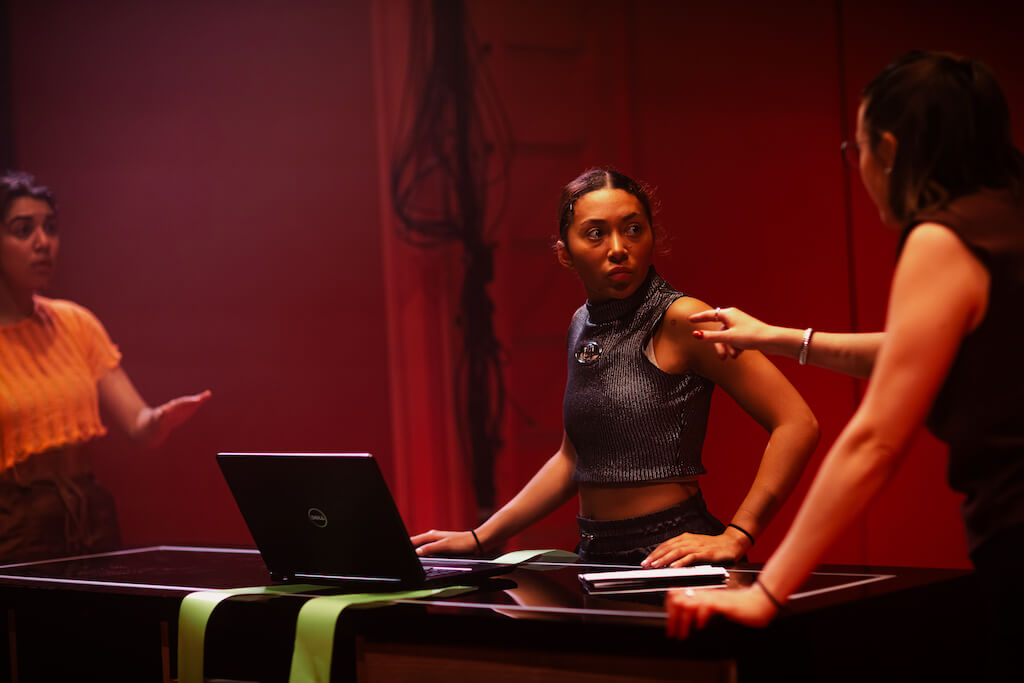
My Uncle is Not Pablo Escobar is a dynamic and exuberant play that explores and celebrates what it means to be a Latinx in London. It is a detective story peppered with telenovela-style drama.
The main story follows Catalina, a Colombian journalist who is investigating a money laundering scheme in Canary Wharf. She is ambitious and determined, willing to risk everything, including her own safety to unveil the truth. Her younger sister, Alejandra, cleans offices at night to make ends meet while trying to pass her GCSEs. Alejandra becomes an unwilling accomplice in Catalina’s scheme, and together, they rekindle their long-forgotten sisterhood, meeting other non-blood related sisters along the way, such as Honey and Lucia.
The main story is interposed with comical skits that mock stereotypes. Dance routines are overlapped with ironic game show interactions (“can you pass the British Citizen quiz?”). This unlikely combination of formats and ideas works to great effect. For instance, in one scene, the cast walk across the stage seductively, making use of body-sized fruit props to mock the objectification by the white male gaze (which exoticises Latinas as rare fruits). The scene is so ridiculous that it sent the theatre into a fit of laughter.
Even though the writers Valentina Andrade and Elizabeth Alvarado are not physically present on stage, they appear constantly. Their voices break the fourth wall, booming from above with a light effect that makes them feel like God-like figures. These interjections remind us that the story is rooted in their personal experiences, forcing us to think about the boundaries between fiction and reality, and bringing us back to the physical space – Brixton, a multicultural hub that is a living testament to the existence of the Latinx community.
The versatile stage design screams “watch me!”. A Mexican pink staircase transforms into a nightclub or an office building, smoothly holding together the transitions without interfering with the beat. Like Latinx identity itself, it transforms with the context without losing its boldness.
Each character has been carefully crafted to demonstrate the breadth and depth of the Latinx community, and to bring to the fore the systemic inequalities that forced the characters to move to England. For instance, the relationship between Catalina and Alejandra explores how migration can rupture family dynamics. Moreover, Honey’s fear of deportation and Lucia’s activist lifestyle sheds light on the existing inequalities in the community itself (“Whiteness is just a mindset of entitlement.”). All performers have a British Latinx identity, and the ethnicity of the characters can change to reflect the performer’s own identity. This creates another layer of meaning, as it quickly becomes evident that these are not actors performing fiction; they are reliving their own experiences, placing their own stories center stage.
The play’s opening scene names all the categories in the official list of ethnic groups in the UK – a list that excludes Latinx people. Activists have been campaigning to change that. Therefore, its aim is to make the Latinx community, one of the fastest-growing migrant communities in London, visible. However, it does so much more than that.
The cast’s confidence, combined with the impressive stage design feels like a deliberate analogy to being Latinx. In fact, each stylistic choice drills down the point that the Latinx community cannot be streamlined to single narrative choices. It overtly resists stereotyping because it sheds light into the collective richness and strength of our community. My Uncle is Not Pablo Escobar may be best classified as a comedic memoir.
On a personal note, I left the theatre in tears. Not because it was a sad story (it is not, it’s funny and full of joy), but because it was so emotional and empowering to finally see my experiences on stage. What is the point of theatre if it doesn’t speak back to us?
My Uncle is Not Pablo Escobar runs through 24 June.
The Play’s the Thing UK is committed to covering fringe and progressive theatre in London and beyond. It is run entirely voluntarily and needs regular support to ensure its survival. For more information and to help The Play’s the Thing UK provide coverage of the theatre that needs reviews the most, visit its patreon.
 The Play's The Thing UK