
by Laura Kressly
Samuel Coleridge-Taylor is one of this country’s great classical composers and conductors. His cantata trilogy The Song of Hiawatha is considered the best adaptation of Longfellow’s epic poem, and he had a celebrated career in the UK and abroad. Despite this, he died in 1912 at the age of 37, exhausted and in poverty. This was the end result of a lifetime spent resisting white supremacy that oppressed him for his Blackness.
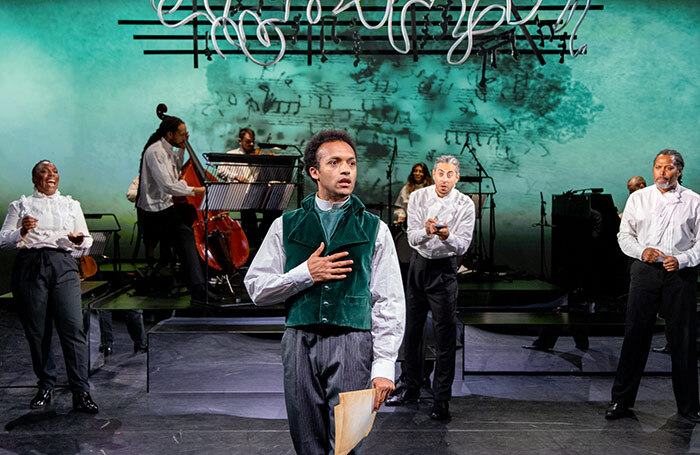
In between scenes chronologically documenting his life and achievements as well as his battles with systemic racism, we follow Song (the intensely passionate Kibong Tanji), a music student in the much more recent past. She is struggling with her final year composition, her place in the classical music industry, the pandemic, and suffocating whiteness. Her performance is a great foil to the quieter yet no less fervent Paul Adeyefa, who plays Coleridge-Taylor. Their stories intertwine and mirror each other; for example, when one of them experiences racism, so does the other. This is a canny choice by writer Amanda Wilkin that emphasises the lack of racial equality in contemporary Britain, particularly in the arts. We have not made the progress we think we have.
Wilkin and her co-creator, director and choreographer Rachel Nanyonjo, clearly foreground music in the creation of the piece – rightly so given Coleridge-Taylor’s extraordinary work. Composed by Cassie Kinoshi, and presumably Coleridge-Taylor as well, it functions like another character, supports transitions, and provides mood and atmosphere. This makes the dramaturgy a little baggy and the pacing can feel uneven though, particularly in a theatre landscape normally so reliant on the written word to shape production concepts. Some trimming would tighten it up, as there are numerous expansive themes and questions, some of which are under-explored.
Projection design (by Stan Orwin-Fraser) adds a hazy dreaminess that effectively complements Song’s ongoing research into Coleridge Taylor. The imagery evokes a fuzzy distance, but an ardour as fiery and bright as hers. These visuals aren’t quite an additional character in the same way the music is, but certainly add a richness to the highly sensory production that’s a fitting tribute to such extraordinary talent.
Recognition runs through 24 June.
The Play’s the Thing UK is committed to covering fringe and progressive theatre in London and beyond. It is run entirely voluntarily and needs regular support to ensure its survival. For more information and to help The Play’s the Thing UK provide coverage of the theatre that needs reviews the most, visit its patreon.
 The Play's The Thing UK