London Stories: Made By Migrants, Battersea Arts Centre

For time immemorial we have sat in cosy circles sharing tales of gods, monsters and everyday heroes with those we love and those we have just met. Everyone has stories in their hearts – extraordinary and familiar – and we love to share in them. Storytelling is theatre in its most elemental form, one that unites and shares rather separates and distances. In a world so fragmented and polarised, this art form is a sorely needed leveller. 

Battersea Arts Centre’s London Stories: Made By Migrants gives a voice to those that howling Brexiteers long to expel, in a format that naturally brings people together. With 24 performers who share their stories, small groups of audience members commune with them and each other in a work that, whilst quietly direct, is a potent piece of peaceful direct action with stories that awaken the heart in these dark days.

There are no more than five or six per group, including a guide. Coloured wristbands labelled with the name of a London borough determine the six stories stories heard, each a solo effort in a room or corner of the vast building. The stories are a straightforward structure, simply told, with no theatrics. The tellers come from all walks of life and all over the world, though there are more than a few theatremakers in the collection. Their stories are as varied as they are: a young artist from New York who arrived on a spousal visa days after Brexit, a Jamaican man that has struggled with homelessness, a Syrian refugee, a Kuwaiti adoptee raised in the UK and her quest to find her birth parents. Some have more impact than others, but all are immensely personal and it a privilege to hear them.

Some of the lighting is too dark, which frustratingly prevents eye contact with the storytellers even in such intimate settings. Most of the stories are told live, though there is at least one filmed story by a holocaust survivor. It’s a nice variation, though the liveness is missed. The stories are stylistically similar which isn’t an issue, though it would be interesting to explore different forms and structures across the stories offered. There are also some lengthy waiting times in between – though it is lovely to chat and connect with others in the group, it would be great to see another couple of stories instead.

This storytelling installation is much needed medicine in this post-referendum/Trump time. It reminds us of the importance of being still and listening, and the vast amounts of empathy such a simple task fosters. London Stories: Made By Migrants is necessary, vital and accessible work. Don’t miss it.

London Stories: Made By Migrants runs through 26 November.

The Play’s the Thing UK is committed to covering fringe and progressive theatre in London and beyond. It is run entirely voluntarily and needs regular support to ensure its survival. For more information and to help The Play’s the Thing UK provide coverage of the theatre that needs reviews the most, visit its patreon.

Dead Funny, Vaudeville Theatre

Ellie and Richard live a comfortable, domestic life in 1990s little England. Only their marriage is in pieces because Richard can’t bear the thought of touching Ellie, who just wants to get knocked up and have a child like their friends, Nick and Lisa. Richard’s too busy with his work as an obstetric surgeon and his amdram-esque club of British comedy, the Dead Funny Society. When Benny Hill dies and he tries to arrange a party to commemorate his life and work, all doesn’t go to plan when his private life and the public party collide.

Terry Johnson’s 1994 play functions both as a cleverly interwoven tribute to old school British comedy and a domestic drama, with a good balance of comedic and serious moments. But even though the play is only a couple of decades old, it occasionally feels its age. There is also a particularly dubious casting or directorial decision that is, quite frankly, incredibly racist.

Johnson’s first act is the stronger of the two, though the start of a stereotypically bickering couple takes a bit of time to develop. Once it picks up, the moments of hilariously staged sexual dysfunction between Ellie and Richard are the funniest. Act two, starting with the party for Benny Hill, quickly loses its way in a mire of impressions of comedic sketches where little else happens. The four society members who turn up are wearing some sort of semi-fancy dress with the white Nick (Ralf Little) dresses up as an East Asian character complete with gobsmackingly offensive accent. There is no reason why this role couldn’t be played by an East Asian actor, or Johnson (who also directs) could make a different accent choice. Once the plot moves away from the play acted in-jokes and returns to the collapse of a marriage it vastly improves, crescendoing into a satisfying mix of slapstick and emotional trauma.

Of the cast of five, four are fantastic. Katherine Parkinson as Ellie particularly excels with her sarcastic, deadpan delivery. Though she alienates the other characters, the root of her bitterness is moving – she just wants a husband who loves her. Steve Pemberton’s camp Brian is utterly delightful with his good intentions and genuine care for his friends. Ralf Little is the weakest (though not bad by any means), with occasional moments of awkward delivery.

Most of this production is reasonably enjoyable, though the script is a bit baggy with the comedy references. The mix of genres keeps the story from being too light or weighty, but the performances are the best part of this production. Even with the old fashioned gags and racism, it’s a fun show.

Dead Funny runs through 4 February.

Ticket courtesy of @TheatreBlogs/theatrebloggers.co.uk & stagedoorapp.com

The Play’s the Thing UK is committed to covering fringe and progressive theatre in London and beyond. It is run entirely voluntarily and needs regular support to ensure its survival. For more information and to help The Play’s the Thing UK provide coverage of the theatre that needs reviews the most, visit its patreon.

Bits of Me Are Falling Apart, Soho Theatre

William is going through a rough time. Newly separated from his partner and the mother of his son, he’s sleeping in his office and contemplating the path that led him to this situation. As he walks to his ex’s house, he shares choices, anecdotes and memories to the ether but few of them are endearing. Actually, most of them showcase a character that is self-absorbed and entitled, and delivered with casual flatness. Adrian Edmondson’s latest work, an adaptation of the memoirs of the same title by William Leith, lacks charm, theatricality and a likeable character. Whilst the goal of addressing male mid-life crises is an admirable one, the execution is ineffective and uninteresting.

Edmondson portrays William as articulate and sensitive, but the rambling, stream-of-conscious script moves at a brisk pace with little variation in rhythm or tone. He largely glosses over the subtlety of the language, and there is little emotional expression. The moments where he does display vulnerability are lovely, but they are too infrequent to redeem the piece from the drudgery of someone who has lost their way and refuses to do anything about it. It’s a frustrating experience – the script has plenty of room for connection with the text and the audience – both are largely ignored.

Lily Arnold’s set and Amy Mae’s lighting are excellent, though. As boring as the performance is, the design is fun and colourful. Children’s toys are suspended from neon rope lights over a pristine white stage; these toys are lit when William talks about them: a playhouse is his home, the Beano is a newspaper.

There’s something fundamentally indulgent about a one-person show focused on the experience of being in the midst of an existential midlife crisis. There is no further agenda or message in the piece for the audience to take away, the character generates little empathy and Edmondson’s delivery prevents any real connection with the audience. Whilst I’m sure there is a demographic of middle aged men who will gravitate to this piece, Bits of Me Are Falling Apart is otherwise alienating and dull.

Bits of Me Are Falling Apart runs through 3 December.

The Play’s the Thing UK is committed to covering fringe and progressive theatre in London and beyond. It is run entirely voluntarily and needs regular support to ensure its survival. For more information and to help The Play’s the Thing UK provide coverage of the theatre that needs reviews the most, visit its patreon.


Follow the Faun, Above the Arts

By guest critic Tom Brocklehurst, @TomLikesTheatre

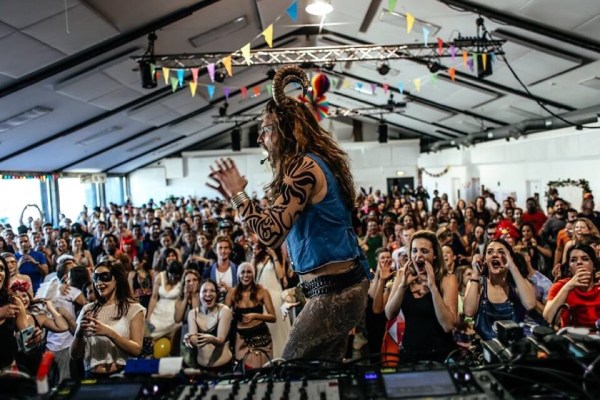
The advertising calls this a ‘shamanic rave’ – perhaps that is the best description of this hour of shambolic, low-budget hedonism. But there’s a lot to be said for Follow the Faun as a night out, especially if you like any of the following: raves, drama games, aerobics and glitter. 

The show is essentially an hour-long raverobics session, led by our wired guru/dance tutor The Faun. Under his instruction we are led through a series of wild dance routines: we gallop along hillsides, we disembowel our prey, and we have lots of enthusiastic sex. There’s not really much more to the performance, apart from the predictable stuff about feeling your energy and loving each other. But most of it is great.

Andy Black as The Faun certainly takes his role very seriously, and it’s his charisma and conviction that carries the show. We’re told repeatedly early on that ‘not joining in isn’t sexy’ and this message seems to get through, as the majority of the audience leap into the dance routines with aplomb.

There are awkward moments – the miming of sexual exploits certainly had a few people laughing awkwardly, and the masculine tone of that section is more than a little seedy. However, hedonistic rave-ups aren’t the place for prudishness, and we were soon onto the next section – the lady-fauns dance their response in a rather tame tribute to female icons Beyonce, Eva Peron and, er, Marilyn Monroe. 

Criticisms aside, I went in with more than a touch of scepticism, and came out sweaty, exhausted and grinning ear to ear. This isn’t a show for everyone – certainly not those of a prudish disposition – but it’s great for a quirky night out or if you just fancy a shamanic rave.

Follow the Faun runs through 12 November.

The Play’s the Thing UK is committed to covering fringe and progressive theatre in London and beyond. It is run entirely voluntarily and needs regular support to ensure its survival. For more information and to help The Play’s the Thing UK provide coverage of the theatre that needs reviews the most, visit its patreon.
 

The Last Five Years, St James Theatre

https://www.thestage.co.uk/wp-content/uploads/2016/11/Samantha-Barks-as-Cathy-in-THE-LAST-FIVE-YEARS-at-St-James-Theatre.jpg

The most moving performances are often largely removed from our day-to-day lives. But every so often you come across a piece of theatre that, whilst it may not be the objective best thing you’ve seen, encapsulates your life so well that you can’t not fall in love with it.

The Last Five Years is good though, even if it’s been a favourite of mine since I discovered it as a student back in 2002. The Jason Robert Brown musical, now 15 years old, is a wonderfully simple (albeit heteronormative) tale of boy and girl meeting, falling in love and falling apart. Framed by the late 90s NYC arts world (that I watched as a teenager in the suburbs and later joined as a drama school student), his story is told in chronological order and hers in reverse. There are two performers; the only time they interact directly is at their wedding, making the songs function more like reflective monologues. Though there is hardly any book, Brown’s lyrics tell the story clearly and sensitively. Dynamic staging and committed performances, like those in this anniversary production that Brown directs, are necessary to keep this quirky little musical from falling flat. It’s a powerful, disarming show when executed effectively, and this production may well be its new definitive.

Jamie is a writer and Cathy is an actor. They are 23 when they meet; neither has had any success yet but both are wide-eyed, bushy tailed, and ready to fall in love. Jamie quickly becomes a bestselling novelist whilst Cathy is left in his wake, waitressing and doing summer theatre in the depths of the Midwest. It’s within this career disparity that their relationship deteriorates, and I find Cathy painfully echoes my own life as a failed actor. The isolation and jealousy that Brown fosters in his songs is wholly believable and all too familiar.

Both characters are flawed but generally likeable and despite reservoirs of love, it’s not enough to save their marriage. Though both characters can be irritating in their own way, their good intentions and fundamental incompatibility also ring true to anyone that’s endured the heartbreak of an ended relationship or marriage. Here is yet another parallel to my past, but this time I’m more like Jamie – I married young and naive and was divorced by 30 as a result of my own mistakes.

Samantha Barks and Jonathan Bailey are Cathy and Jamie. Barks is a stronger singer, but Bailey’s full of charisma and confidently flirts with the audience – it’s a lovely touch. Both have great emotional range and their chemistry is undeniable. Their performances, layered with Brown’s storytelling, reduces many to tears. Sniffling and eye wiping is plentiful in this intimate house.

The small scale of the show is fleshed out with some delightful video design by Jeff Sugg and Derek McLane’s set. These provide the context that’s missing from the script and grounds their story in a real time and place, though its Gabriella Slade’s costumes that indicate the 1990s setting. The videos are simple and cartoon-like, a sweet and charming addition that Brown underuses.

Though more of a song cycle with hardly any spoken dialogue (if you were to listen to the soundtrack you would hear almost the entire show) and arguably rather insubstantial, this one-act show has the ability to burrow into the depths of your guts. It’s a heartfelt love letter to the countless New York City artists doing their best to get by and find meaning in each other, and to everyone that’s every fallen in and out of love. The poignant, timeless story of youthful love and loss has the sorts of songs that you play on loop whilst crying in bed with a heart broken by your own failures (I’ve done this more than I care to admit), and those you can dance to after a brilliant first date or a career win. With the excellent performances and slick design of this production, it’s not one to miss – even if you cry through it.

The Last Five Years runs through 3 December.

The Play’s the Thing UK is committed to covering fringe and progressive theatre in London and beyond. It is run entirely voluntarily and needs regular support to ensure its survival. For more information and to help The Play’s the Thing UK provide coverage of the theatre that needs reviews the most, visit its patreon.

King Lear, Old Vic

Glenda Jackson’s return to the stage after more than two decades serving as an MP certainly should be a momentous occasion, and in one of the great roles. At age 80, in a time where audiences and theatremakers are clamouring for more diversity, Jackson as King Lear is an obvious choice. And she is remarkable – certainly one of the most nuanced Lears I have seen in a long time, and one that challenges the conventional portrayals of masculinity, old age and madness. The problem is the rest of the production. Deborah Warner’s nearly four hour-long royal unraveling often feels it – longer scenes lack energy and pace, and a vague, austere design concept puzzles rather than enlightens. There are some outstanding performances in the cast of 23, but some character choices fall in line with the overall blandness of this staging.

Jackson indicates she plays Lear as a man through her voice and movement, and the original gender references in the text are kept. Her Lear is a consistently powerful man as well with an unwavering masculinity, though it is not a modern maleness that she takes on. She endows him with a wide emotional spectrum, from laddishness through blind anger to debilitating grief. This spectrum, one not usually shown in contemporary male characters or modern cis men’s renditions of the great classical roles, potentially provides insight into masculine expression when Shakespeare was writing. Demonstrable emotion and the ability to verbally express these feelings may or may not have been commendable, but it wasn’t considered weak or not manly. This Lear is a renaissance man – skilled at language, war and emotional expression. Within his bouts of madness, he doesn’t seem completely incoherent – there are shadows of Hamlet’s feigned insanity here – and a deliberateness to his raging. His grief is heavy, but freely flows from a wellspring somewhere deep in the guts. There is no indication that Jackson hasn’t performed in years, and her level of commitment, truth and expression is a masterclass in performance.

Though Jackson’s performance is extraordinary, the design concept is sorely lacking in substance. Mostly white, with the occasional projection of static and scene numbers on otherwise blank panels, it looks low budget and makes no statement about time or place. It doesn’t feel timeless, just empty and featureless – a kingdom hardly worth fighting over. There are initial metatheatrical hints of a film or theatre set, but these quickly disappear. Whilst the set does emphasise the contemporary dress and Lear’s bright wardrobe, it otherwise draws attention to the sweeping depth of the stage that is mostly ignored. Warner keeps the action firmly on the apron, which isn’t a problem, but the rest of the stage feels wasted. The storm scene is a notable exception with it’s oily sky brewed with black plastic sheeting underneath flickering projections. It’s delightfully lo-fi and hugely effective.

There are other good performances, particularly Rhys Ifans’ fool, who shows a similar emotional range. As well as the usual jesting, it is evident that he cares deeply for the old man; he also has quite the vicious streak. Sargon Yelda is a devoted and blustery Kent, and Harry Melling’s Edgar is wonderfully bold, pitiful and desperate as Poor Tom.

Warner’s direction is the main issue with the production. The longer scenes in the first half lose energy quickly, and the staging is often static. Picking up the pace and trimming the script would be a vast improvement and draw less attention to the boring design. Some of the cast need more urgency and variation in their delivery, which would give the show an injection of energy.

Is it worth seeing this King Lear for Jackson’s performance? Absolutely. Her interpretation of the role is positively exquisite, but when she is not on stage, things are generally much less interesting. It will hopefully find its rhythm as the run goes on, but the clumsy slowness and lack of clear concept is most frustrating.

King Lear runs through 3 December.

The Play’s the Thing UK is committed to covering fringe and progressive theatre in London and beyond. It is run entirely voluntarily and needs regular support to ensure its survival. For more information and to help The Play’s the Thing UK provide coverage of the theatre that needs reviews the most, visit its patreon.