
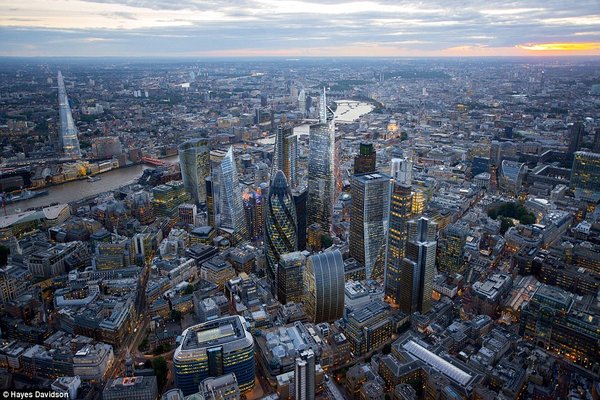
 It’s panto season, and our stages are filled with villains, heroes and dames. Playwright David Bottomley’s new work-in-progress has some passing resemblance to the characters in Britain’s traditional seasonal offerings, but his new play on the London housing crisis is darker, angering fare. Capturing its victims’ lack of power and its perpetuators’ greed, Skyline doesn’t offer a solution but still states a clear opinion on the issue. With a cast of five playing seven characters, the audience sees a microcosmic cross section of social classes who, with poetic and pointed language, are a powerful reminder of the importance of secure housing. There is still some work to be done on the script, but the staged reading in conjunction with a pre-show talk and an exhibition by Alternative Press makes a powerful point that something needs to change to prevent social cleaning through housing policy in London.
Bottomley has a clear gift with words. There’s a subtle poetry that effectively captures his characters’ feelings, laying them exposed and raw for the taking. There could be more differentiation between their rhythms and word choices, though. Drag queen Roxanne’s (Paul L. Martin) closing monologue is similar to that of unemployed single dad and grandfather from Africa, Rex (Kevin Golding). His 28-year-old daughter Tanya occasionally sounds like her Tory MP Francesca (Karen Hill). He does well to go against stereotypes, but there’s a middle ground between them and homogenisation that hasn’t been completely reached yet.
His most complex character is Francesca. Despite being a Tory who’s having an affair with villainous property developer Jasper (Cameron Robertson), the favours she grants him directly conflict with her instinct to do right by her constituents, and values the old London that Jasper desperately wants to demolish. Her dialogue is occasionally overwritten, but she otherwise feels like a real, well-rounded individual. Jasper does as well, though not to the same extent. He could perhaps do with a touch more humanity to make him less cartoonish, even though there must be people out there as horrible as he is. Rex’s inner anguish erupts in balance to the calmer Tanya, who satisfyingly shows her true feelings in Francesca’s surgery. An interesting experiment would be to explore further integration of these characters: what if Rex and Jasper meet? Tanya and Roxanne? There’s space for more scenes without the play feeling too long.
Skyline has plenty of excellent moments, like the only scene between Jasper and Roxanne (a colourful character that’s underused) that shows how truly horrible Jasper is, and Roxanne’s need for a place she can put down roots. Rex’s desperation and Tanya’s resignation come to a head in a climactic final scene, just after Francesca and Jasper do the same. Even though there’s resolution, Bottomley skilfully alludes to the wider landscape and the struggles countless Londoners face due to the housing crisis in these final scenes. Roxanne’s gorgeous monologue that serves as an epilogue underlines the entire play, but dilutes the power in Tanya and Rex’s scene. It would work well earlier, maybe in the scene between her and Jasper.
Though Skyline is still in its development stage, it is remarkably polished and well-structured. A good cast own Bottomley’s rich language and the call for change is clear but not preachy. Some gentle development will whip this story into an even more powerful piece of political theatre.
The Play’s The Thing UK is an independent theatre criticism website maintained voluntarily. Whilst donations are never expected, they are hugely appreciated and will enable more time to be spent reviewing theatre productions of all sizes. Click here to make a donation with PayPal.

 Baz Luhrmann’s 1996 film Romeo + Juliet transformed a young generation into Shakespeare fans. Dan Poole and Giles Terera were training at Mountview at the time of the film’s release. They previously weren’t keen on Shakespeare’s plays what with their difficult language and having to read them at school. But, Romeo + Juliet changed all that. These avid Shakespeare buffs joined forces to make a documentary that explores why people don’t like Shakespeare, and to make the Bard more accessible to those ruling him out as boring or irrelevant. Over four years, Terera and Poole travelled around the world and interviewed prominent actors, audience members, people on the street and passionate theatre makers about their attitudes towards Shakespeare. Funny and relaxed, Muse of Fire feels more like a goofy road trip with your mates rather than a dry, academic film as the passion and love for Shakespeare’s work always shines through.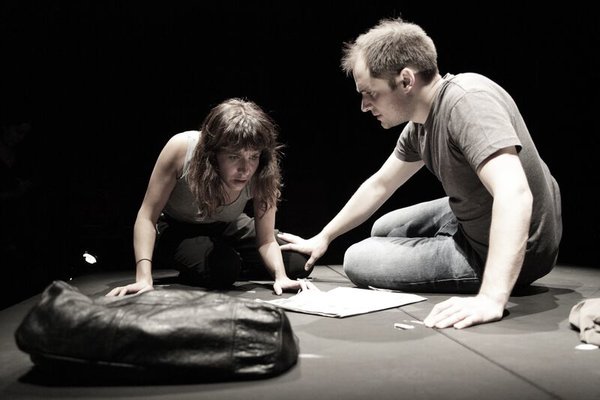
 We’ve seen “Mad Men,” or at least heard the clichés about cutthroat ad agency types. Competition for clients, drug and drink fueled late nights, ruthless bidding for commissions regardless of morals. Steve Thompson’s Spin Cycle uses all these ingredients, but the writing style doesn’t match director Stephen Oswald’s delivery. It’s either a farce that was delivered as naturalism, or a naturalistic piece (albeit with a liberal use of humour) that attempts a farcical production. All of the characters are pretty stereotypical with at least some degree of reinforcement from the script, causing the two hours of day-to-day office life to feel repetitive and lacking in depth. There are clear individual storylines, but everything that goes wrong is treated as a crisis that’s conveniently and speedily resolved. The performances are generally quite good in this strong ensemble, but the actors are unable to show much range or development due to a lack of character journey.
 There’s a mountain of inflatable sex dolls on the stage. Shiny, blank faces with gaping, toothless mouths, spherical tits and gargantuan cocks everywhere. The pile is so big that the actors have to wade through the dolls, a metaphor for the seedy Viennese streets where Shakespeare sets his Measure for Measure. Director Joe Hill-Gibbins wrenches this world into the present with a symbolism-laden, visually orgasmic production designed by Miriam Buether, and a great performance by Romola Garai as Isabella. Live video feeds, projection and pulsing beats marry a space that has ghosts of Elizabethan theatre structures, but some choices don’t sit well. Though the visuals are relevant and bold, there’s a disappointing tendency towards shouting, and a dubious (to the point of discomfort) characterization choice for infamous pimp Pompey. As the characters physically and emotionally wrestle through the heavily edited, relentless two hours of sex and religion, there is still a strong feeling that this production values style over substance.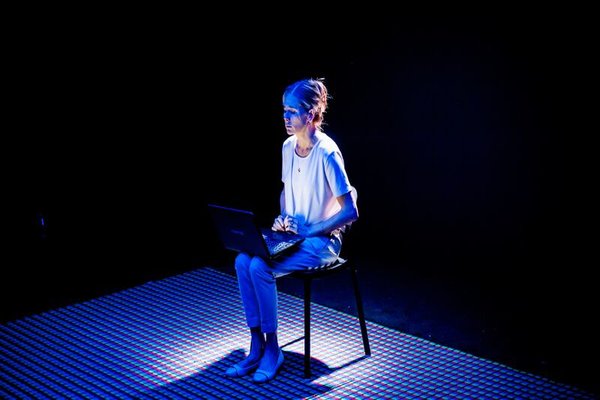
 Frankly, this is a crucial piece of theatre that all young people growing up in our cyber-obsessed culture should see. With simple design elements that draw attention to the dialogue and story, it would be easy to tour this powerful production.
 Nearly everyday we see news of refugees fleeing war torn lands in search of safety abroad. No matter how the press spins objective facts to suit their own agenda and their readers’ opinions, the perspective of these events unfailingly separates “them” from “us”. These people running for their lives are The Other that we must either keep out or allow in. It’s all very black and white, heavily doused with an air of superiority; we either look down on them as vermin that need controlling or as victims that need handling with kid gloves. We never really hear from these refugees, though. It’s all, “me, me, me” and a flamboyant display of either virtue or condemnation.
 The Play's The Thing UK