Tamburlaine the Great, Tristan Bates Theatre

That which goes up must eventually fall. Christopher Marlowe’s Tamburlaine the Great tells of the title role’s rise from common thug to emperor of Persia and Africa. A precursor to, and probable influence of, Shakespeare’s ruthless Richard III, the man is needlessly brutal: he orders rivals’ remains displayed on city walls, women and children killed, manipulates others to join his cause and then betrays them. Fate eventually catches up with Tamburlaine after he sets fire to books, including the Qu’ran, and proclaims himself more powerful than God.

Lazarus Theatre Company returns to form after a disappointing Henry V with a modern, concise presentation of Marlowe’s play depicting Tamburlaine as a violent, string vest wearing hood rat transformed into a suited and booted world ruler. Social mobility is the dominant theme, emphasized through Rachel Dingle’s costume design in this rags to riches tale. With visually arresting movement sequences, skillful use of light, and pointed similarities with Middle Eastern politics, immigration and Western meddling in the region, this is a relevant, well-crafted adaptation of the Elizabethan original.

The defining feature of this Lazarus’ adaptation is the extended movement sequences, with a powerfully striking one opening the show. A large cast use militaristic stylization and East Asian performance techniques to slowly travel across the stage, setting the tone for Tamburlaine’s merciless and unfeeling crusade. The choreography is precisely angular and even though the actors are well-rehearsed and the effect is visually stunning, there are hints of restrained self-consciousness from some of the company. Accompanied by deep, tonal sound design by Neil McKeown with the actors smartly dressed in modern suits, it reflects the contemporary Western political machine that coldly invades other countries. These sequences are used throughout, enough to be effective but not so much that they lose their power. No choreographer is credited, so they are assumed to be a product of co-directors Ricky Dukes and Gavin Marrington-Odedra.

Performances from the company of 15 are good, with delivery occasionally broken and overindulgent. These moments are rare and don’t affect the pace or energy of the cast as a whole. Particular highlights are Kate Austen as the aggressive, trackie-bottomed Techelles who is Tamburlaine’s number two. She never loses her fierceness, even when Tamburlaine’s success means she has to wear a fitted dress. Robert Gosling is the simpering, camp Mycetes, Emperor of Persia. He’s a great contrast to Prince Plockey’s earthy Tamburlaine. Alex Reynolds is the captured prisoner Zenocrates that Tamburlaine woos and makes his bride. Her transition from victim to doting wife is a disturbingly good example of Stockholm Syndrome, reinforcing Tamburlaine’s power and manipulation. Lorna Reed plays three smaller roles, with a calm strength and subtly powerful voice. She would make an excellent Hermione or Lady Anne. The bombastic Bajozeth, Emperor of the Turks, is played by Alex Maude and is a joy to watch, particularly when imprisoned and force fed by Tamburlaine.

There are few weaknesses in this Lazarus production, but those that are present are minor. Tamburlaine’s final speech has too many pauses and the use of five identical crowns can cause confusion as to which character is the most important at any given moment. There was also an unsatisfying lack of blood considering the play’s violence. However, fringe productions tend to not have a dry cleaning budget; having the Mads Mikkelsen-as-Hannibal Lector suits cleaned daily would cost a small fortune. Artistic director Dukes’ flair for updating classical theatre with contemporary relevance and visual staging is at its finest in Tamburlaine the Great and is certainly worth a watch, particularly as it’s a play rarely staged.


The Play’s The Thing UK is an independent theatre criticism website maintained voluntarily. Whilst donations are never expected, they are hugely appreciated and will enable more time to be spent reviewing theatre productions of all sizes. Click here to make a donation with PalPal.
No Take Backs, everything theatre

“What do you do when you’ve lost your dad, your girlfriend dumps you and a stranger breaks into your new flat, handcuffing you to the radiator? Engage in a battle of wits for your freedom of course!

“…Emily (Lucy Litchfield) is handcuffed to a radiator whilst the Lara Croft-esque Megan (Rachel Eireann) lords over her…The pace is almost akin to Beckett, and there are a few moments when I wonder if the action is going to progress…

“During their conversation it emerges that both of these young women carry lots of issues and baggage. The dialogue is mostly rapid fire and both characters are highly intelligent, if emotionally damaged. Power shifts again when Emily’s brother (Daniel Farley) enters the scene and recognises Megan after she beats him up. Things spiral out of control, and after the boss (Sylvie England) has cleaned up the mess the truth behind the whole hostage situation is made amusingly clear…

“The writing is tight, though playwright Michael Eckett could have easily shaved fifteen minutes from the beginning to make it even more pacy. He has a great sense of comic timing and a great understanding of sound dramatic structure, even if the twist at the end felt slightly formulaic…No Take Backs is a strong one-act offering for this years’ Camden Fringe Festival, and shows that not all good theatre relocates to Edinburgh for the summer!”

Read the entire review on everything theatre here.

Significant Other; Object of Affection, Tristan Bates Theatre

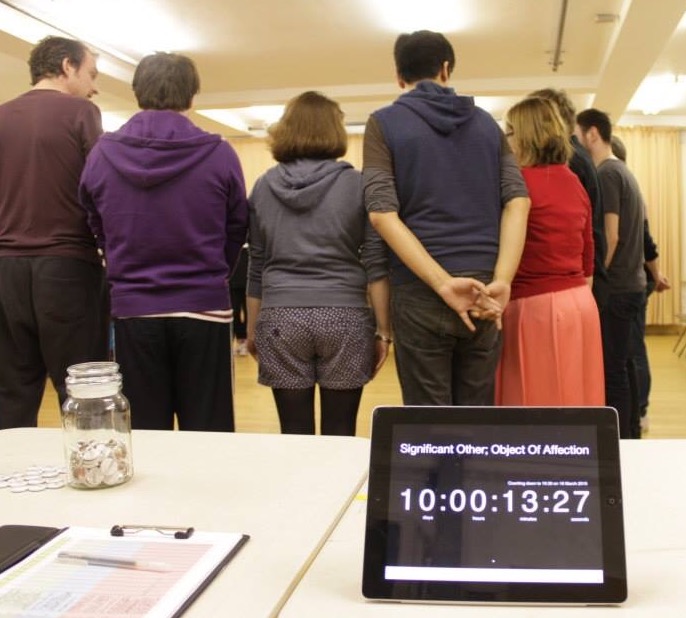
FullSizeRenderWhat do you get when you give ten playwrights, ten directors and twenty actors ten days to make some theatre? (This isn’t a Maths question.) You’ll have The Pensive Federation’s annual collection of ten, ten-minute plays, Significant Other. Inspired by modern relationships, The Pensive Federation celebrates the ups and downs of our human connections with this event. This year, each writer was given an object that had to be included in the scene and serves as the short plays’ titles. On the whole, they were funny, touching and well performed, especially considering the playwright had only five days to write the script and the director and actors had five days to rehearse them. One of the scenes was even a musical, with songs and choreography.

The relationships presented run the gamut from flatmates, sisters, straight couples, mates to co-workers. Whilst most of the plays dealt with romantic relationships, others confront familial complexities and troublesome colleagues. As it’s an issue commonly ignored in an industry that favours youth, Panties commands attention for being the sole play focusing on older characters. Here, a couple try to find the love and excitement in their relationship again now that their children are grown. All provided objects were completely random; some writers worked them into the plot more effectively than others did. My particular favourite was a life-sized cardboard cut-out of Harrison Ford, absurdly fought over by a couple who both fancied him.

As for the scripts, some are certainly stronger than others. None of them are poor and some had potential to be brilliant. Of note, Blu-Ray (by Anna Forsyth), Shirt (by Joseph Lidster and composed by Griffinn Candey), Ring (by Leah Cowan) and Life-size Cardboard Cut-out (by Breman Rajkumar) have the most potential and can certainly stand up to further development. Direction is simple but effective in all plays, with minimal set used and a focus on characters and their relationships. Of the performances, though all are consistent, Catherine Nix-Collins and Jeremy Donovan particularly shone as best friends and flatmates in Blu-Ray, with Jeremy’s character about to move in with his boyfriend and Catherine’s coming to terms with him leaving. Anthony Couzens in Cash evoked pity with his washed up underground ticket seller who fancies his much younger colleague.

Singling out one of the plays as a favourite, or “best,” is impossible. Stylistically, most are initially grounded in reality with subject matter that the audience can relate to, even if on a basic level. Rather than being complete plays, most were snapshots of a larger issue and well-rounded characters. This really is an event that appeals to everyone: gay, straight, young, old, people with children, people who work, people who have friends and people who have families. The default was comedy rather than drama, with some excellent execution of comic timing and sensibility. Performances could become quite heightened, but the emotions matched. Despite the comedic bent, there was plenty of poignancy across the board as well. Including a focus on an object draws attention to the attachment we have to material goods, particularly when we associate them with someone we love, or hate, or otherwise feel strongly about. The only play where this idea could be more fully realised is Oil Can (by Giles Fernando) but the tension created between two former schoolmates is commendable.

This is an enjoyable evening in The Actors’ Centre Tristan Bates Theatre. Plenty of comedy and writing that couldn’t be fresher help ease the predictability of the format in an evening that could do with being a couple of plays shorter. The Pensive Federation clearly have a great instinct for discovering and showcasing new talent and will should develop some these micro-plays further.

Intention: ☆☆

Outcome: ☆☆☆☆

Star Rating: ☆☆☆


The Play’s The Thing UK is an independent theatre criticism website maintained voluntarily. Whilst donations are never expected, they are hugely appreciated and will enable more time to be spent reviewing theatre productions of all sizes. Click here to make a donation with PalPal.