Ideas Tap Underbelly Award, Edinburgh Festival Fringe

Now-defunct Ideas Tap lives on at Underbelly with solo shows selected from shortlisted applicants to one of their funding briefs. The Eulogy of Toby Peach is a witty, hopeful autobiography of a young man diagnosed with Hodgkin’s Lymphoma at age 20. Brute darkly reflects back to writer/performer Izzy Tennyson’s school days at a low-performing girls’ school in a nameless English town. Much Further Out Than You Thought is the slow-burning delusion of a veteran suffering from PTSD. Wildly different in tone but with some excellent moments and good performances, these shows are good representatives of emerging solo performance at the Fringe.

The Eulogy of Toby Peach, by Toby Peach, is a eulogy in that it celebrates his life and continued survival after two bouts of cancer that could return at any time. He speaks to us quietly with numbers, statistics and anecdotes from his life with cancer in between episodes of The Cancer Club, of which half of us will eventually become members. “Cancer is you,” he explains, like, “a terrible one-man show where you play all the parts.” At The Cancer Club there are all sorts of complicated cocktails and the constant threat of remission, but Toby is lucky that his girlfriend Kristy is always by his side. The Cancer Club gets a lot of laughs, but it is equally horrifying.

The audience also discovers the NHS “wank room”, the Willy Wonka-esque magical machine that facilitates stem cell treatment, and the biological consequences of his chemotherapy. Peach is a charming, confident performer who is able to confront the awfulness of cancer with humour, hope and warmth. He switches back and forth between his everyday self and heightened versions of Toby, which maintains audience focus, a clear narrative and varied performance styles. The fear and anger that eventually emerge are truthful and fully justified without coming across as ranting or indulgent. His show is hopeful rather than wallowing, and his infectious enthusiasm leaves the audience completely on his side and reminded to appreciate those closest to them.

Brute takes an entirely different tone and has less of an emphasis on narrative, sticking to one constant character who reenacts excerpts from day-to-day life. Some of her monologues are connected, some are isolated. Poppy is in year 11, exams are looming and her friendship group is small and constantly in flux. It’s easy for adults to brush off teenage relationships, but Brute is a reminder of just how horrible kids can be to each other, particularly girls.

Izzy Tennyson is Poppy’s creator/performer, speaking to us directly about her friends, teachers and family. It is never clear what her relationship is with the audience, but they are treated like a diary or confidante. As over-dramatic as some her stories can be, Tennyson employs a stark honesty that demonstrates the complexity and viciousness of teenage friendships. She also brings up self-image; Poppy is not one of the Pretty Girls, but a troll and a virgin, like the other girls in her group. They regularly engage in bullying, isolation and bitchiness as a way of joking or communicating how they feel about each other. It’s pretty horrible to watch, but countered with a good deal of humour. Tennyson’s performance is relentlessly energetic and committed; teenaged sarcasm alternates with hurt and anger that builds to a violent climax on the last day of school. There is no performance style variation, but the power of this piece lies in the content. It’s a stark reminder of how tough it is to be a kid, even more so now with the role of technology in teenager’s lives.

So we’ve covered cancer and horrible teenage behaviour. To continue with Serious Issues, Giles Roberts’ Much Further Out Than You Thought presents a lonely veteran who has lost everything. Lance Corporal James Randall lives in a dusty flat and talks to his young son, Danny, about the experiences in Afghanistan that have left him a quivering husk of a man. The set is a simple living room, but the floor is covered in gravel and sand, the desert that James has not been able to leave behind. The first half of the play is an evenly delivered and reflective monologue about his desire to serve, enlistment and more mundane aspects of life with the British army. As it starts to feel on the lengthy side and lacking development, James abruptly relives a pivotal mission supported by powerful lighting design by Elliot Griggs. The audience sees the man he once was, a stark contrast the man he is now.

From this scene the script continues to grow, ending with a disarming revelation about Danny, and James’ plans for the future. The character develops rapidly in the second half of the play, showing Roberts’ range and emotional depth as an actor. It’s hard to empathise with James at first, but as his laddish, South London boy exterior breaks down, so does the audience. The beginning of the script could do with some editing, but the end redeems the production and sends the message home. Society is simply not doing enough to take care of our veterans.

None of these new plays take on buoyant subject matter, but all three convey important social messages. The performances are excellent and clearly demonstrate the conviction of emerging theatre artists to catalyze social change through their work. These shows could use further development and refining, but show promising developments in solo performance and carry Ideas Tap’s legacy.


The Play’s The Thing UK is an independent theatre criticism website maintained voluntarily. Whilst donations are never expected, they are hugely appreciated and will enable more time to be spent reviewing theatre productions of all sizes. Click here to make a donation with PalPal.

Greywing House, everything theatre

“One-person shows are extremely hard to create and perform effectively. It’s easy for them to be too long, too boring, too bizarre, too indulgent or too lots of other things. Greywing House uses poetic writing and language, puppetry and movement to craft a narrative that gradually exposes the otherworldly realities of coastal Greywing House and its proprietor, Miss Amelia…

“Miss Amelia is the epitome of polite restraint, akin to a 1950’s housewife…Mary Beth Morossa, the creator of the show, plays her with detail and sensitivity.

“The play mostly consists of lengthy monologues where we learn about Miss Amelia’s unfortunate family history…Most captivating are two tales told through puppetry…These are the most visual aspects of the show and excellent examples of storytelling…

“Morossa has an obvious gift for writing. She uses vivid imagery and poetry to draw in the audience. She tells the story clearly and with an effective narrative structure. There are moments of surprise and ambiguity that leave the audience questioning what is real and what is the product of madness. However, it is slow to develop…

“This is a one-person show that is not without potential but still needs development. Having debuted at the London Horror Festival last year, its creepiness works any time of year…”

Read the entire everything theatre review here.

Shakespeare & The Alchemy of Gender, Rose Playhouse

At 19 years old, Lisa Wolpe fell in love with Shakespeare. She’s now performed more of Shakespeare’s male roles than any woman in history after founding Los Angeles Women’s Shakespeare Company twenty years ago. She is currently touring the world with her solo show, Shakespeare & The Alchemy of Gender. Although it sounds like an academic lecture, it contains some of the best Shakespeare performances I have seen. The play pays homage to her father, telling the man’s story and how he affected her life. The man who killed himself when Wolpe was four is brought to life in a deceptively simple show that finds hope in a history of suicide, abuse and war.

Though to say the show is about her father’s life oversimplifies the content. Yes, a large portion is about him, but it also covers her life after he had gone, her relationship to specific Shakespeare characters, gender, performance, religion, Elizabethan society, family and alchemy – the transformation of a base material into something precious. These themes intertwine, with no moment unrelated or superfluous and the 55-minute show amazingly manages to not feel overloaded with messages. As she works through her life and her father’s, she relates Shakespeare’s characters to individual moments in time. As she reflects on her relationship with him now, she becomes Hamlet remembering his father’s ghost, in the best performance of the role I’ve encountered. Her father’s WWII escape and joining up with the Canadian forces as a double agent lead into Henry V. We also meet Richard III, Hermione, Shylock and others in relation to herself and her family’s history. Wolpe is not only adept as any man at embodying the male roles, she excels. She also effortlessly switches between men, women and herself, functioning in an androgynous state when addressing us out of character.

Wolpe is comfortable addressing us with an open honesty about difficult episodes in her life without coming across as confessional or masturbatory, as one-person shows run the risk of being when used to come to terms with the performer’s or writer’s issues, whatever they may be. The show is relaxed and conversational with the audience nodding, laughing, even verbally agreeing. The intimate venue helps, but she certainly has the energy to fill a huge theatre. She had a profound effect on the audience, particularly when sharing moments about her relationship with her family and dressing in boys’ clothes to defend herself against her predatory stepfather.

Her interpretation of the characters she performs seems rooted in physical and vocal distinctions, with her General American accent capturing the visceral-ness of the language that the more recently created RP/Standard English. These characters come from her gut, and she explains how she is able to relate to each one and perform them with truth. This is evidence of Shakespeare’s continuing relevance to modern life. Not only is Shakespeare: An Alchemy of Gender an excellent piece of solo theatre, it is also a lesson in performing the great Shakespearean roles of both genders and an encouragement for all to defy gender boundaries dictated by society.

Because this is a woman that must be experienced, here is an extract from her Iago. Enjoy.


The Play’s The Thing UK is an independent theatre criticism website maintained voluntarily. Whilst donations are never expected, they are hugely appreciated and will enable more time to be spent reviewing theatre productions of all sizes. Click here to make a donation with PalPal.

Pieces, Rosemary Branch Theatre

web.phpI’ve seen theatre that seeks to raise awareness about all sorts of issues. Racism, classism, social justice, particular moments in history, individuals, you name it. I hadn’t seen a play about organ transplants and donation until Spare Parts Theatre Company’s one-person Pieces. Founded by actor and transplant patient Steven Mortimer, Spare Parts both raises awareness about issues surrounding organ transplants and fundraises for several related charities. Pieces tells the stories of six different people affected by organ failure and the need for a transplant. Mortimer performs six separate, extended monologues demonstrating that organ failure can hit any age, class or body type, causing life to stand still until that organ is found. Mortimer effectively plays a range of characters in scripts by a few different writers that vary in quality, but maintains audience focus for the 50-minute show and succeeds in reminding audiences about the importance of organ donation.

Piece 1: a Cockney ex-taxi driver sits in the back of a black cab on his way to hospital for a double cornea transplant, chatting incessantly to the unseen driver. His fear of death is evident in his regular conversation diversions to what it must have been like processing towards your hanging at Tyburn. Some of the topic transitions are rather jerky, but Mortimer smooths them over as best as he can. The ending also terminates abruptly and quickly; some time for the character’s reflection would have also given the audience additional processing time.

Piece 2: This is the weakest of the six pieces. The monologue is framed around a man watching his twin brother Jono run a 5k in preparation for the marathon. A year ago, this was unthinkable. Periodically, we hear a group of runners go past, but Jono isn’t there. The sections where he is waiting tend to ramble, but the ending is lovely even though a bit sentimental.

Piece 3: Johnny is a character similar to the visually impaired taxi driver in piece one; Mortimer struggles to differentiate the two. To add more space between them, this piece could have come later in the production, providing stronger contrast. He’s in an AA meeting sharing his life story. This piece becomes much more dynamic by focusing on Johnny’s drinking and homelessness and less on him needing a liver transplant. His emotional reunion with his parents after fifteen years also helps broaden the story; these wide themes indicate this monologue could develop into a play with additional characters and plot. This is one of the better plays because it provides us with a much broader picture of the character’s life.

Piece 4: Radically different in style. This fragmented fever dream from a scared child under anaesthetic is excellent. Obsessed with Doctor Who, the child’s thoughts flick back and forth through time, showing his fears and hopes for a life beyond dialysis. Mortimer could have played him even younger to have a stronger effect on the audience, though the language showed that John was quite young, no more than eight or nine years old. The sound design is particularly detailed, with a tardis motif.

Piece 5: Another child, this one is older and stroppy. He is struggling with his younger sister’s need for a heart transplant. The childishness is interrupted by profoundly adult moments as he debates whether he should kill himself so she can have his heart. He also endearingly compares her upcoming transplant with gardening. This piece shows how organ failure causes those involved to grow up quickly, often too fast. This is another excellent piece; Mortimer found it easier to embody this child. Perhaps the frustration and helplessness are emotions he can access particularly well.

Piece 6: Five-year-old Liz is in a hospital bed attached to a ventilator. She’s five, has Cystic Fibrosis and is waiting for a double lung transplant. Mortimer plays her father, dreaming of a healthy child that can run and play like all the other children. He also considers the family of the child that will donate his/her lungs to Liz and how their parents must feel. Mature and complex, this is the second piece that has a character detailed enough to turn into a longer play, with additional roles acted out. This piece has a sombre and moving tone very different to the previous pieces and a good choice for an ending.

Pieces is certainly a unique production, and one that will develop further with additional variation to style and character development. The sound design by Justin Teasdale was atmospheric but not dominating and could enhance the addition of design elements including costume and set. This production relies on verbal communication; the set was a single folding chair and Mortimer’s costume never changed. Though it enhanced the storytelling aspect of the production and allowed its messages to sink in, some visual variation would also be welcome. Despite its shortcomings, this remains a unique production with important messages.


The Play’s The Thing UK is an independent theatre criticism website maintained voluntarily. Whilst donations are never expected, they are hugely appreciated and will enable more time to be spent reviewing theatre productions of all sizes. Click here to make a donation with PalPal.

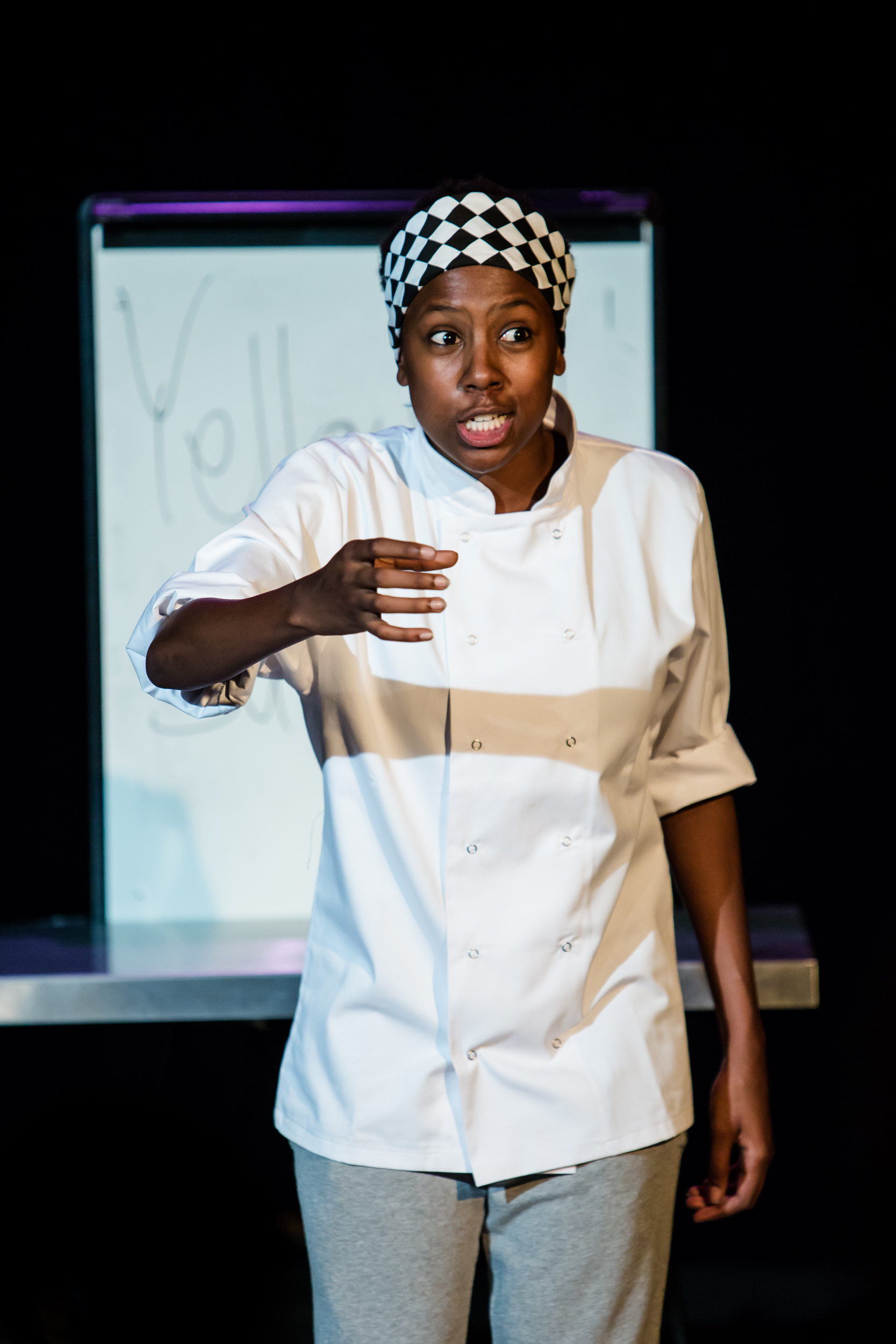
Chef, Soho Theatre

Chef, Ed Fringe 2014, courtesy Richard Davenport 035“Incredible innit, Food.”

Sabrina Mahfouz’s Chef is a one-woman play in the kitchen of a women’s prison. It’s no Orange is the New Black, though. Jade Anouka’s nameless chef shares her passion for food, recipes and stories of broken families and prison life. Anouka’s captivating, nuanced performance and Mahfouz’s poetic, imagery-filled verse holds the audience’s attention for nearly an hour without faltering.

Anouka’s performance is the primary pillar that supports this production’s success. With an innate musicality and unwavering energy, she balances the character’s true love for her work with the traumatic tales of an abusive father, a shady boyfriend and an incident that happened in her prison kitchen yesterday. Her interpretation both honours and personalises Mahfouz’s character, bringing an infectious optimism to a character that has endured so much hardship. Though this play probably works best in intimate theatres like Soho’s upstairs space, it is a great shame to deny larger numbers of people from seeing her performance.

Mahfouz’s writing is the next pillar that makes this story into a great play. Her use of poetry flips back and forth with street slang and swears, a continual reminder that not all inmates have limited vocabulary or intelligence but still keeps her believable. She gives us a truly human character with all flaws and perfections laid bare. She creates devastating empathy for this unnamed young woman doing so well at rising from the ashes of her childhood by becoming a fine dining head chef, only to be locked away for a crime she swears she didn’t commit. (Though all convicts swear their innocence, don’t they?)

Mahfouz and Anouka have worked together previously, on Chef and another play. These two clearly make a fantastic team, but both are excellent, established artists in their own right. Mahfouz is certainly a playwright to watch out for, and Anouka is a performer not to be missed.

Despite the stellar performance and writing, the scene transitions occasionally felt abrupt. Line delivery and technical transitions could have slowed down slightly, though that may have caused energy levels to drop. Another uncertainty is who the audience is in relation to chef. She is in her kitchen alone. They are not questioning her about her suspected involvement in yesterday’s incident, nor do they seem to be fellow inmates. Anouka addresses directly, so they don’t seem to be in her imagination, either. Her story keeps audience focus nonetheless.

As brilliant as Orange is the New Black is, the vibrancy and depth in Mahfouz and Anouka’s chef makes the show feel shallow and stereotyped. Even though it works excellently as a stand-alone short play, this is a character that should be seen again. This is not a production to skip over, despite its diminutive size and the fact it’s a one-woman show.


The Play’s The Thing UK is an independent theatre criticism website maintained voluntarily. Whilst donations are never expected, they are hugely appreciated and will enable more time to be spent reviewing theatre productions of all sizes. Click here to make a donation with PalPal.

La Merda, everything theatre

“After reading the press release and previous star ratings for La Merda, I was very much looking forward to an edgy, raw and arty performance with a strong message that would stay with me for several days…My experience, however, was quite the opposite.

“…dim spotlights illuminated a naked woman (Silvia Gallerano) sitting on a tall platform, quietly singing something Italian into a microphone…she launched into a monologue. It began by telling us we all needed courage, then connected the idea to her father’s courage to commit suicide by throwing himself in front of a train…

“Gallerano’s character then moved onto body image: her unusually large thighs, and her teenage experience with a “beauty parlour” that had tried to reduce them. Whilst I believe body image is an issue that needs to be addressed, every teenager has insecurities about their looks, and theatre has dealt with this before, so the topic is not new, or particularly edgy…

“Gallerano’s character…didn’t develop into anything particularly interesting, or personalised. We never learned much about her other than she was an actress, her dad died when she was thirteen, and she had a slightly unconventional upbringing. I struggled to care about the woman and her issues because her issues weren’t unique. She was just like everyone else…Originally written in Italian for Italian audiences, there was a slight undercurrent of national identity, but unfortunately I missed more of this because I am not Italian…I wondered…why was she still naked?

“The piece was delivered exclusively in three long monologues…Towards the end of each section, she shouted down the microphone, which was physically uncomfortable, but I remained emotionally unmoved. Vague themes were mentioned…but my questions remained: Why was I watching this? What does the writer want us to take away? Why is she naked?”

Read the entire review here.

Fucking Outside the Box, for everything theatre

“Frankie is a 17-year-old college student and former champion competitive ballroom dancer…She wants to fuck outside the box…

“The play is set in the present, as Frankie (Jessica Burgess) is home alone and waiting to find out if Michael is going to come and take advantage of her parents’ absence…As she waits for a text, we hear all about her last encounter with him. She’s obsessed with rape fantasy role play…

“Her confidence soon starts to deteriorate and we can see that she is really only 17 without much experience, in life or sex. As she tells us stories from her past, we learn about her mother, her ballroom dancing and the consequences of social media. Her naivety is sweet and funny, but someone who doesn’t have much patience for young people’s poor choices would probably just find her annoying…

“The VAULT Festival, in the tunnels under Waterloo Station, is an experience in and of itself. The space for Fucking Outside the Box is in a small but professionally equipped studio…The venue is achingly cool, so much so that as a 30-something, I felt like a stodgy old fart completely out of place. Fortunately, the play was very good and I had a great interest in the topics addressed…

Intention: ☆☆☆☆

Outcome: ☆☆

Star Rating: ☆☆☆

Read the entire review here on everything theatre.

Greywing House, for everything theatre

“One-person shows are extremely hard to create and perform effectively. It’s easy for them to be too long, too boring, too bizarre, too indulgent or too lots of other things. Greywing House uses poetic writing and language, puppetry and movement to craft a narrative that gradually exposes the otherworldly realities of coastal Greywing House and its proprietor, Miss Amelia. The audience are the guests staying at this B&B (which doesn’t offer breakfast because it’s too hard for Miss Amelia to keep track of the time) in the fictional coastal village of Cradlehead. There isn’t much to do in Cradlehead, but the local residents and ghostly legends make it unlike any other seaside destination…

“Miss Amelia is the epitome of polite restraint, akin to a 1950’s housewife. She seems quite innocent, but with a hint a melancholic nostalgia. She is warm and friendly, though this gradually deteriorates into desperation and madness. Mary Beth Morossa, the creator of the show, plays her with detail and sensitivity…

“This is a one-person show that is not without potential but still needs development. Having debuted at the London Horror Festival last year, its creepiness works any time of year and I could imagine it in the programme of numerous fringe festivals.”

Intention: ☆☆☆☆

Outcome: ☆☆

Star Rating: ☆☆☆

Read the entire review on everything theatre: http://everything-theatre.co.uk/2015/01/greywing-house-etcetera-theatre-review.html