The White Feather, Union Theatre

During WWI, men considered too afraid to enlist were given white feathers by those disapproving of their cowardice. Also common were boys too young to join up lying about their ages so they could experience the excitement of battle. Then there were the hundreds who were killed for desertion and cowardice in the face of the enemy. These young men suffered from PTSD, an ailment not understood or acknowledged until well after the war was over.

A cast of nine tells the story of 16-year-old Harry Briggs, who cheerfully joins up to escape humdrum village life, and his sister Georgina’s search for the truth of what really happened to her kid brother out on the front. Whilst trying to clear his name, she discovers hidden secrets of her fellow Suffolk villagers, learning more than she bargained for. Spanning several decades and touching on a wide range of issues including homosexuality, shellshock, the class system and the reality of life in the trenches, The White Feather is an intimate, provincial musical with a sturdy first act and excellent music, that reflects the close-knit and often overbearing aspect of life in a small place during wartime. The second act, shorter but covering a much longer period of time, is rather choppy and introduces an interesting subplot but too late to for much development.

Abigail Matthews flawlessly leads as the kind but tenacious Georgina Briggs, supported by wonderfully mouthy best friend, Edith (Katie Brennan). It’s not all about the girls though; David Flynn as the conflicted lord of the manor Adam Davey is the most complex character of the lot and deserves more focus than the script gives him. Edward Brown, played by Zac Hamilton, has a couple of great scenes showcasing his emotional range. This is a great cast size for a musical: enough voices to give the larger numbers a punch, but not so large that some characters are relegated to the ensemble.

A piano, violin and cello trio give the music richness but an acoustic, rural tone that beautifully suits the world of the musical. The book and music are well integrated and transitions from one to the other are mostly smooth. The act finales could stand to be a bit longer, but otherwise the music feels developed, albeit quite gentle. The book follows an evenly paced narrative arc for the first half, but several jumps feel choppy and disruptive after the interval. The programme helps with indicating the time leaps, but more could be added to the script and design to clarify them so the audience doesn’t have to regularly refer to the programme. The Adam Davey subplot could do with more than a single, brief reference in the first half in order to have greater plot integration later, but this could potentially detract from the main thread of Georgina’s quest for justice. Though the title can represent Harry’s perceived cowardice, there is little mention of the feather as a convention of the time. All of the focus points are worthy of presentation and add to the overall story, but perhaps the show is trying to do too much. Without lengthening it quite a lot, some aspects of the plot will remain under-developed.

With an engrossing first act, detailed and complimentary characters, The White Feather writers clearly Ross Clark and Andrew Keates have a gift for telling great stories. New musicals often disappear after their initial run, but this one is a mostly polished affair that deserves more development and larger houses. In the Union Theatre, it’s an emotionally charged, intimate experience not to be missed, even with its shortcomings.


The Play’s The Thing UK is an independent theatre criticism website maintained voluntarily. Whilst donations are never expected, they are hugely appreciated and will enable more time to be spent reviewing theatre productions of all sizes. Click here to make a donation with PalPal.
Shakespeare & The Alchemy of Gender, Rose Playhouse

At 19 years old, Lisa Wolpe fell in love with Shakespeare. She’s now performed more of Shakespeare’s male roles than any woman in history after founding Los Angeles Women’s Shakespeare Company twenty years ago. She is currently touring the world with her solo show, Shakespeare & The Alchemy of Gender. Although it sounds like an academic lecture, it contains some of the best Shakespeare performances I have seen. The play pays homage to her father, telling the man’s story and how he affected her life. The man who killed himself when Wolpe was four is brought to life in a deceptively simple show that finds hope in a history of suicide, abuse and war.

Though to say the show is about her father’s life oversimplifies the content. Yes, a large portion is about him, but it also covers her life after he had gone, her relationship to specific Shakespeare characters, gender, performance, religion, Elizabethan society, family and alchemy – the transformation of a base material into something precious. These themes intertwine, with no moment unrelated or superfluous and the 55-minute show amazingly manages to not feel overloaded with messages. As she works through her life and her father’s, she relates Shakespeare’s characters to individual moments in time. As she reflects on her relationship with him now, she becomes Hamlet remembering his father’s ghost, in the best performance of the role I’ve encountered. Her father’s WWII escape and joining up with the Canadian forces as a double agent lead into Henry V. We also meet Richard III, Hermione, Shylock and others in relation to herself and her family’s history. Wolpe is not only adept as any man at embodying the male roles, she excels. She also effortlessly switches between men, women and herself, functioning in an androgynous state when addressing us out of character.

Wolpe is comfortable addressing us with an open honesty about difficult episodes in her life without coming across as confessional or masturbatory, as one-person shows run the risk of being when used to come to terms with the performer’s or writer’s issues, whatever they may be. The show is relaxed and conversational with the audience nodding, laughing, even verbally agreeing. The intimate venue helps, but she certainly has the energy to fill a huge theatre. She had a profound effect on the audience, particularly when sharing moments about her relationship with her family and dressing in boys’ clothes to defend herself against her predatory stepfather.

Her interpretation of the characters she performs seems rooted in physical and vocal distinctions, with her General American accent capturing the visceral-ness of the language that the more recently created RP/Standard English. These characters come from her gut, and she explains how she is able to relate to each one and perform them with truth. This is evidence of Shakespeare’s continuing relevance to modern life. Not only is Shakespeare: An Alchemy of Gender an excellent piece of solo theatre, it is also a lesson in performing the great Shakespearean roles of both genders and an encouragement for all to defy gender boundaries dictated by society.

Because this is a woman that must be experienced, here is an extract from her Iago. Enjoy.


The Play’s The Thing UK is an independent theatre criticism website maintained voluntarily. Whilst donations are never expected, they are hugely appreciated and will enable more time to be spent reviewing theatre productions of all sizes. Click here to make a donation with PalPal.

As Is, Trafalgar Studios

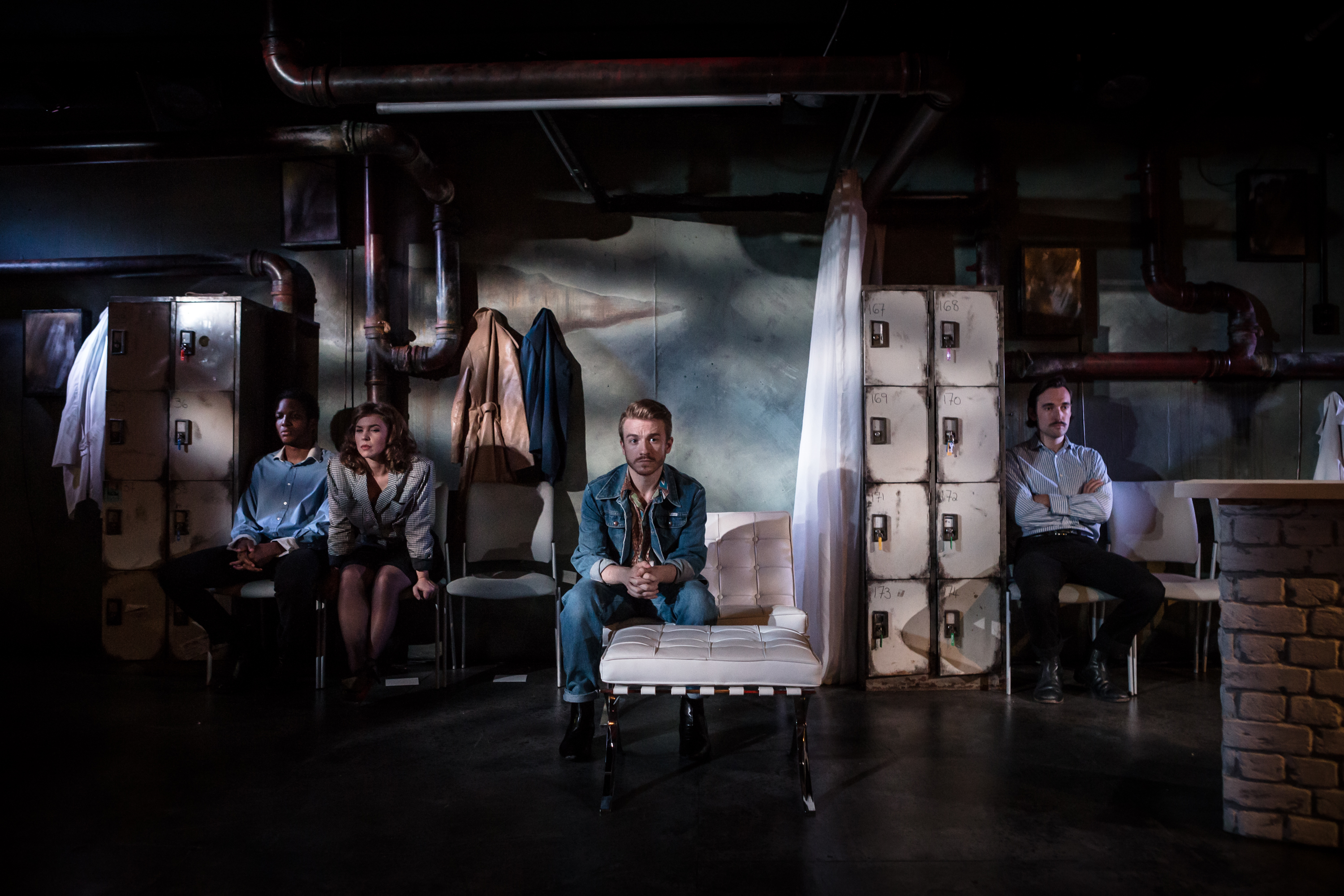
As Is, Bevan Celestine, Natalie Burt, Steven Webb & Russel Morton,Trafalgar Studios, 1 July - 1 August 2015. Courtesy Scott Rylander-022The AIDS play of my generation was Rent. I saw the original cast on Broadway when I was 15 or 16 and felt a strong bond with the characters that weren’t much older than me. By that age, my peers and I had the fear of AIDS drilled into us over several years of sex education. It was still a death sentence then, but treatment was available and quality of life was improving. We knew the history of the disease, though. We knew how it exploded into the gay community, then spread to everyone else. We knew how many people died, and how horribly. We knew that no one was safe.

In 1985, the first AIDS play, As Is was staged in New York City. The AIDS epidemic is ravaging the city, particularly the gay community. As the disease spreads and people die, fear mounts. Diagnosis is a death sentence. Oblivious in the New York City suburbs, I was 3 years old.

Now I’m 33, and this is the 30th anniversary production of As Is. AIDS is still here, and the number of AIDS cases is rising. The fear isn’t so strong any more due to advances in medicine; it’s certainly not something on my radar like it was when I was a child. People are forgetting the disease’s history and the impact it had only a few decades ago because it’s now possible to lead a full life with medication and early diagnosis. That’s why staging As Is, a production that captures the desperation and rising panic of the generation first exposed to AIDS, is crucial. Though dated, it is a vital depiction of an era of social history that must be remembered, but does so with humour, humanity and a fantastic cast.

Centered around recent exes Rich (Steven Webb) and Saul (David Poyner) who initially meet to divide up their belongings, their world suddenly alters after Rich confesses he has “it.” The story becomes a detailed and intimate journey of a man struggling to come to terms with his illness, and his ex-boyfriend’s obsessive urge to care for him. Six other actors play a variety of characters associated with Rich and Saul’s life ranging from drug dealers, to family, to medical staff. Some of the best supporting characters include Natalie Burt as best friend Lily and older hospice worker Jane Lowe. Performances are excellently committed across the board, capturing the microcosmic struggle of a disease that has affected millions since it first appeared. The only performance issue is the over-egged accents. People from the New York City area haven’t spoken with accents that stereotypical for a long time, but this is not something a non-American is likely to notice.

Written by William M. Hoffman, the dialogue races through a gamut of emotions, evoking belly laughs one moment and tears the next. Without the regular levity, the script would be entirely too depressing, and proves the necessity of laughter when coping with personal trauma. Even though the humour is ever present, so is fear. The script walks a fine line that wavers between the two, and every other emotion associated with the devastation of an AIDS diagnosis. Particularly evocative scenes include Rich nihilistically on the pull in a nightclub shortly after learning of his condition, a support group of mostly gay men with the striking presence of a pregnant woman who’s husband infected her, and Rich’s first hospital stay with Saul devotedly by his side.

The costumes are distinctly early 1980s, and the simple, versatile set of lockers, chairs and pipes captures the industrial dinginess of New York City that is still present today. The design contrasts the script, a montage of fast-paced, overlapping scenes and a frantic depiction of fear and desperation that is sweeping the city.

Trafalgar Studios 2 is an intimate venue, perfect for the immensely personal journeys depicted in the play. The actors boldly interact with the audience, atypical of naturalism. This allows the audience to feel embedded in their world and reminds us that AIDS can affect all of us. Even though it is a lovely experience to see this play in a small venue, it definitely deserves larger audiences and would be able to fill a bigger stage.

As Is perfectly balances humour and seriousness to remind audiences that AIDS is still here and has the power to irrevocably alter lives, despite medical care. It accurately evokes a fearful time that I remember in flashes of news broadcasts, interviews and health classes. Stunning, fearless performances and a great script capture a unique moment in American history, but one that has left an indelible mark on global society. We are reminded that Rich’s “it” could still happen to any of us.


The Play’s The Thing UK is an independent theatre criticism website maintained voluntarily. Whilst donations are never expected, they are hugely appreciated and will enable more time to be spent reviewing theatre productions of all sizes. Click here to make a donation with PalPal.

Perfect Lovers, Theatro Technis

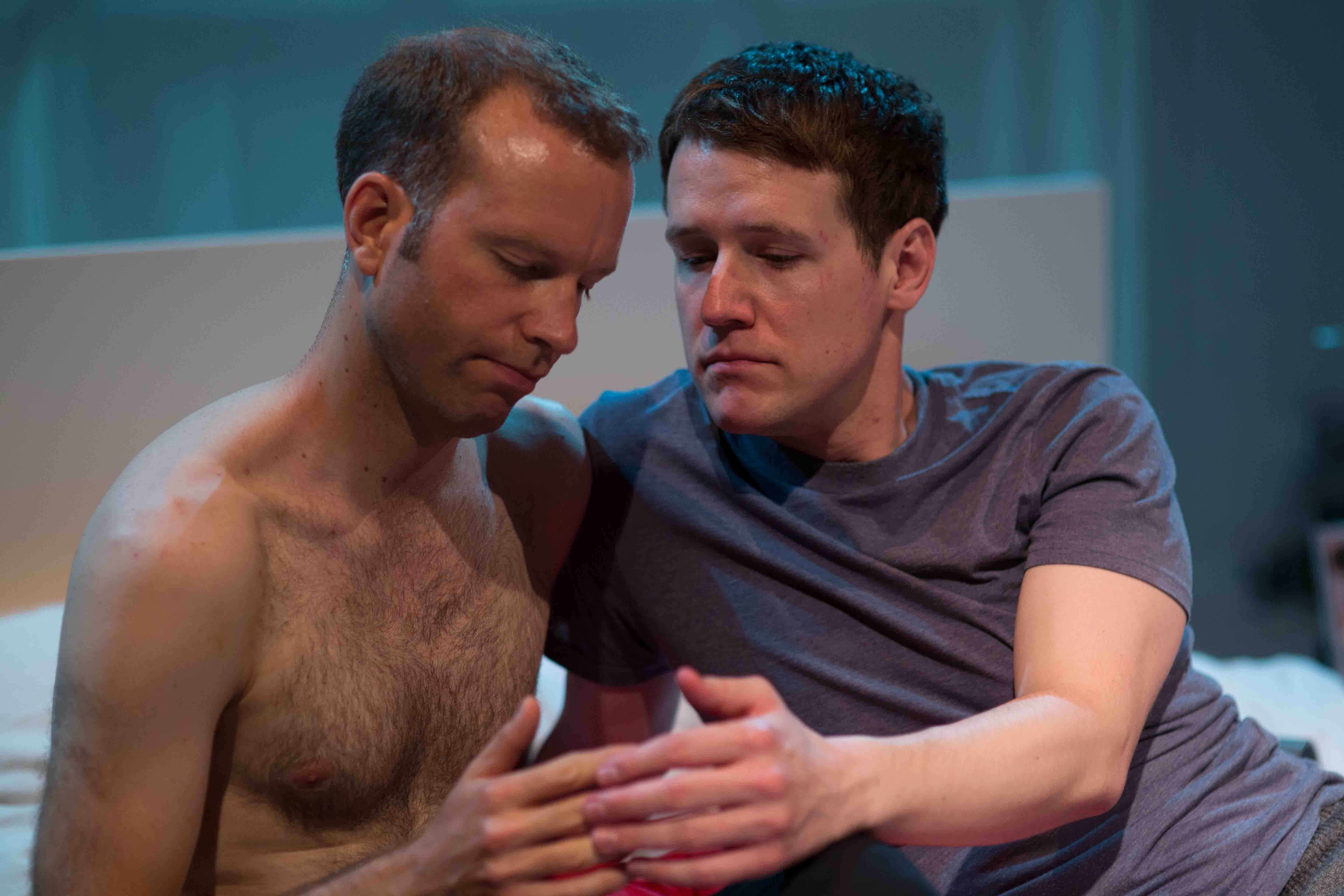
Four men, two clocks and all po_N2A6465ssible relationship dynamics meet within different moments, in one bed. Scenes bounce back and forth across time supported by symbolic projections and lighting, each one intimately presenting a different couple combination. Individuals meet and connect for a brief moment in time, then inevitably move on. La Montanya’s Perfect Lovers is a new play that explores the ups, downs and transience of gay relationships, proving they are no different than straight ones. We all seek that perfect relationship even though no such thing exists.

This is the second play by Jazz Martinez-Gamboa. It episodically documents the dysfunctional but well-intentioned connections of four characters at different points in their lives. There was some detailed writing with good instinct for both comedy and pathos. After the first couple of scenes the rhythm settled into a consistency that needed more variation, but the director and actors could solve this easily through delivery. The script is a one act, but its current structure lends itself to easy expansion. It would need more of a plot arc to add variation of pace, and the characters are robust enough to withstand closer examination of their lives.

The performances are generally good, though energy and pace dipped at points. There were too many pauses, though it isn’t clear whether this is due to the script or the direction. Actors Chris Hoskins, Oliver Hewett, Joe Leather and Craig Deucher are a tight ensemble with seemingly natural chemistry. They contrast each other without playing to any particular gay stereotypes; instead they focused on individual loneliness and their characters’ need for meaningful connection.

The design is excellent. Richard Hillier’s lighting design blends seamlessly with Alex Wells’ projections. Two adjacent, synchronised clocks racing through time are a motif influenced by artist Felix Gonzalez Torres, emphasising our own transience as well as the temporary nature of our bonds with others. Characters cling to digital photo albums of their past lovers, friends and families as they continue to search for that perfect man who will change their lives forever. The set is a never-changing bed. An adjacent nightstand becomes more and more cluttered with the characters’ detritus ranging from tea lights ,to cups of tea, to lines of cocaine. The amount of action the room sees results in a set resembling Tracy Emin’s My Bed.

Even though this production can be categorised as LGBT theatre, that is far from its end message, merely a vehicle of communication. These characters could have been straight couples; in fact, it has strong parallels with Patrick Marber’s Closer though without a linear narrative. We are all people: broken, malfunctioning people, who reach for meaning in one another. It rarely works. But that’s what makes us gloriously human, which Martinez-Gamboa presents to audiences as if he stands before us and holds up a mirror.


The Play’s The Thing UK is an independent theatre criticism website maintained voluntarily. Whilst donations are never expected, they are hugely appreciated and will enable more time to be spent reviewing theatre productions of all sizes. Click here to make a donation with PalPal.