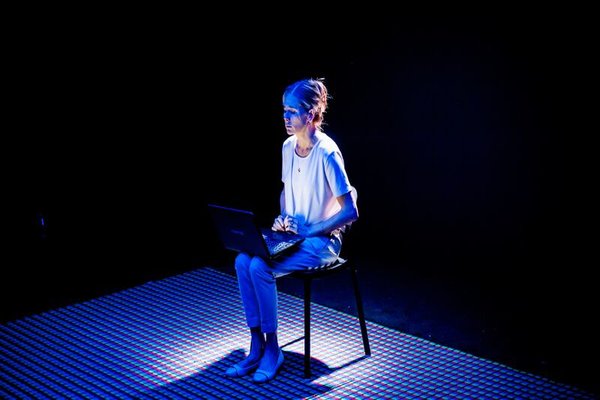
Four Minutes Twelve Seconds, Trafalgar Studios

rsz_four_minutes_twelve_seconds_-_kate_maravan_2_-_photo_ikin_yumWhat do you do if your teenaged son’s ex-girlfriend accuses him of sexual assault? What if her family refuses to go to the police and takes justice into their own hands instead? Di (Kate Maravan) and David (Jonathan McGuinness) don’t know either, and they’re living this nightmare every moment of Four Minutes Twelve Seconds. They have huge aspirations for their bright boy, hoping he makes it out of the Croydon that they themselves never managed to leave. But those dreams are teetering precariously on top of vicious rumours…or are they facts? Seventeen-year-old Jack who the audience never sees, may or may not have uploaded a film, that may or may not show him forcing himself on his girlfriend Cara (Ria Zmitrowicz) in the run-up to his A-level exams. As his parents try to discover the objective truth of the situation, some awful discoveries come to light. In short, fast scenes spanning several months, social class, parental aspiration and sexism influence the four characters’ choices in this riveting, dialogue-driven one-act.

This energetic first play by James Fritz, writer of the acclaimed Ross & Rachel at this year’s Edinburgh Fringe, doesn’t shy away from honest, infuriating material confronting ingrained attitudes that interfere with rape convictions (at the end of the play I was so angry I was shaking with the knowledge that these sorts of things probably happen all the time). A ferocious Maravan leads with an intense, focused performance and a satisfying character journey. To see a mother cope with drastically altering perceptions of her own child is heart rending, particularly as her husband’s views often clash with her own.

This is definitely an “issue” play, albeit a sophisticated one, that looks at the role of social media and the selfie culture in the lives of young people who don’t fully understand the implications of putting every detail of their life on the internet. It also looks at consent, sexist definitions of rape and how police view rape accusations. There’s also the question of how to treat crimes committed within one’s own family, vigilante justice and taking responsibility for mistakes. It’s a packed script, but manages to not overwhelm with ideas. Fritz’s dialogue is advanced for a first play, if formulaic in its gradual revealing of information. He liberally uses humour and nuanced humanity to counter the dark subject matter; these characters could easily be portrayed as stereotypes, like the sort in a bad TIE play.

On that note, this would be an excellent production to tour to secondary schools, colleges and unis, particularly since this attitude is so prevalent: https://metrouk2.files.wordpress.com/2015/10/12165535_470783216459605_1739814260_o.jpg?w=748&h=561&crop=1Frankly, this is a crucial piece of theatre that all young people growing up in our cyber-obsessed culture should see. With simple design elements that draw attention to the dialogue and story, it would be easy to tour this powerful production.

Four Minutes Twelve Seconds is hip as well as topical and provocative. Witholding Jack’s appearance draws attention to the wider impact of his actions rather than wallowing in his emotional state, a wise choice by Fritz. Excellent performances by the company and snappy dialogue keep our attention as well as enrage, but what would we do if we were in Di and David’s shoes? Though we all strive for justice for rape victims, we are but judgemental, selfish humans after all, and that is the real flaw in the system.


The Play’s The Thing UK is an independent theatre criticism website maintained voluntarily. Whilst donations are never expected, they are hugely appreciated and will enable more time to be spent reviewing theatre productions of all sizes. Click here to make a donation with PayPal.
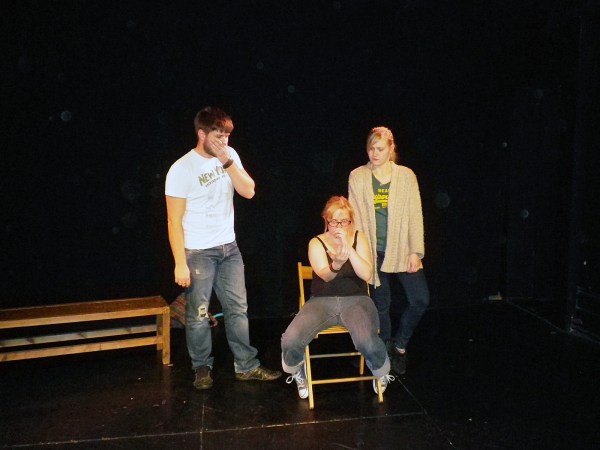
Infection, London Horror Festival

https://theplaysthethinguk.com/wp-content/uploads/2015/10/830f1-imgp2396.jpg

Sam, Dominique and Will don’t always get on with each other. It doesn’t help that they’re under a lot of stress due to a zombie-alien invasion, and can’t work out if any other people survive in their town. Dom and Will are brother and sister who don’t have much in common, and Will has no patience with Dom’s bestie Sam, a vegan, weed-smoking student. Considering all of that, they do quite well for most of Infection, a new play by the Brighton-based Bath Street Productions. With scenes alternating between the past and the present and clear transitions making this is easy to follow, but performances vary according to emotional intensity, and some of the writing is similarly overwrought. There are some witty one-liners and moving moments that, with the absence of the zombie-aliens, prevents Infection from becoming too much like a zombie film, even with strong parallels to Shawn of the Dead.

The script by Faye Woodbridge has a clear dramatic arc and climax, with a format that facilitates suspense by starting in the present, than jumping back to the beginning of the invasion two weeks previously, moving the plot forward by jumping back and forth until we’re back in present. The story itself isn’t particularly inventive, especially as we never properly see the zombie aliens or learn about how the invasion started. Other survivors communicate through graffiti on the supermarket walls, but these are never seen either. Infection is a microcosm but lacks the scope present in zombie films, despite all of the references the characters bandy around. It suits a small-scale theatre space, but doesn’t quite capture the fear of the situation what with exclusively showing such a small group of characters. There’s no sense of scale. There are some minor anomalies – though the attacks are actually seen once, the three keep getting injured without clear explanation. How do zombie aliens sprain the girls’ ankles and dislocate their shoulders? Surely they’d go for something a bit more deadly? Despite the supermarket messages, the characters comment on the town’s emptiness. Even with these issues, it wouldn’t take much development to expand the play and make the invasion’s impact more widely felt, even without adding the invaders.

Writer Woodbridge also plays Dom, giving the most consistent and believable performance from the cast of three. Direction was occasionally obvious through mechanical blocking with no clear purpose; no individual director was credited in the programme, instead directorial credit lies with the production company. A designated outside eye not part of the cast would be able to provide more unity in movement. Martin Wright’s transition sound design is excellent, providing clarity and reinforcing the gravity of their situation.

The most interesting aspect of this script is the gender dynamics that emerge during a time of crisis. Will (Michael Williams) feels obligated to protect his young sister Dom, even though they’ve grown apart as adults and don’t really know each other anymore. He treats Sam (Katie Newman) more like a bloke than he does his sister, despite her diminutive size and more girlish tendencies. Will revels in being the big, strong man even though his foolhardiness and bravado cause further problems, and Dom’s insistence of proving that she can look after herself exacerbates the danger in their situation. The girls’ comic one-liners help draw attention to the ridiculousness of Will’s old-fashioned mindset, as well as add levity to the script.

Though this certainly is not a bad production, but in order to stand out in the zombie field something dramatically different needs to be done. It’s easy to go with a popular formula for success and this is a good representation of it, but not a particularly inventive one.


The Play’s The Thing UK is an independent theatre criticism website maintained voluntarily. Whilst donations are never expected, they are hugely appreciated and will enable more time to be spent reviewing theatre productions of all sizes. Click here to make a donation with PayPal.

Twelfth Night: A Gender Experiment (opposite gender cast), The Rose Playhouse

Most Shakespeare I see is performed with the actors’ genders matching that of the characters they play. Sometimes I see token cross-gender or gender-blind casting within an own-gender cast, sometimes all-male productions and less often, all-female productions (I wrote about the scarcity of all-female Shakespeare companies in the UK for The Shakespeare Standard last month). What I hadn’t seen however, was a completely cross-gendered production. As part of a gender experiment, actor/director Natasha Rickman stages Twelfth Night: A Gender Experiment four ways: all-female, all-male, same gendered and cross-gendered. Rather than seeing all four, I went for the most rare of the options out of curiosity, which was satisfied by excellent performances and a 90-minute edit with plenty of fun and energy. I’m now tempted to see the remaining three as I can’t decipher quite what Rickman seeks to prove or disprove with her experiment, but the questions surrounding the nature of the experiment did not dampen the enjoyment of the evening.

A cast of seven, three men, three women and a sock puppet, play all parts. There are the same number of men and women in all four versions, supporting Equity’s goal for 50/50 gender representation in theatre. Rickman is a RADA grad, as are most of her cast so handle Shakespeare’s text easily. Julia Goulding is an outstanding, versatile Orsino, Sir Andrew and Feste, using accents to clearly differentiate her characters. Shauna Snow is, hands down, the best Malvolio I have ever seen – serpentine and androgynous, but utterly buffoonish upon discovery of Maria’s planted letter and vulnerable after her release from prison. Henry Gilbert is a lovely Olivia, feminine but not helpless. Christopher Logan’s Viola has a hard, threatening edge when fending off Olivia’s advances, rare in a female playing the role. There is a notable lack of racial diversity, though. This cast is all white and the actors that make up the rest of the company appear to be as well, or at least look like it in the small, black & white photographs in the copied programme.

Sorcha Corcoran clothes the women in costumes inspired by Smooth Faced Gentlemen’s skinny jeans, shirts and braces, showing masculinity without hiding feminine features. The men wear dresses, but don’t hide their short hair with wigs. Though they still play the gender of the characters, Rickman doesn’t strive for realism in design or performance, which works well for this play that has such a heavy focus on gender. She indicates gender with the costume rather than playing it, creating a self-referential style more in keeping with Shakespeare’s original performance practice than contemporary productions that seek total naturalism. Also, she draws on stereotypes to create the roles; there is a heavy dose of Commedia dell’arte in the characters’ movements, which would have been a large influence on Shakespeare’s comedic characters in both writing and performance. The overall feel is light, funny and camp from both the men and women, with any references to the characters’ genders heightened due to the reversed casting. Combined with a good sense for pace and timing, the 90 minutes feel more like a relaxed hour filled with laughter and music.

Rickman uses diagonals well on the small stage, but doesn’t place much action around the rest of the Rose’s site despite the tea lights scattered around the pool and back wall. Sir Andrew and Viola’s almost-fight is oddly conducted with tree branches, which feel out of place. There’s a good dose of music and a jig during Feste’s final song, ending the evening with a flourish and reinforcing the sheer joy of Shakespeare’s comedies. This is one of The Rose Playhouse’s stronger offerings, and a rare opportunity to see a cast with impressive credits perform Shakespeare in an intimate space, regardless of any gender “experiments” the production seeks to conduct.


The Play’s The Thing UK is an independent theatre criticism website maintained voluntarily. Whilst donations are never expected, they are hugely appreciated and will enable more time to be spent reviewing theatre productions of all sizes. Click here to make a donation with PayPal.

Shakespeare & The Alchemy of Gender, Rose Playhouse

At 19 years old, Lisa Wolpe fell in love with Shakespeare. She’s now performed more of Shakespeare’s male roles than any woman in history after founding Los Angeles Women’s Shakespeare Company twenty years ago. She is currently touring the world with her solo show, Shakespeare & The Alchemy of Gender. Although it sounds like an academic lecture, it contains some of the best Shakespeare performances I have seen. The play pays homage to her father, telling the man’s story and how he affected her life. The man who killed himself when Wolpe was four is brought to life in a deceptively simple show that finds hope in a history of suicide, abuse and war.

Though to say the show is about her father’s life oversimplifies the content. Yes, a large portion is about him, but it also covers her life after he had gone, her relationship to specific Shakespeare characters, gender, performance, religion, Elizabethan society, family and alchemy – the transformation of a base material into something precious. These themes intertwine, with no moment unrelated or superfluous and the 55-minute show amazingly manages to not feel overloaded with messages. As she works through her life and her father’s, she relates Shakespeare’s characters to individual moments in time. As she reflects on her relationship with him now, she becomes Hamlet remembering his father’s ghost, in the best performance of the role I’ve encountered. Her father’s WWII escape and joining up with the Canadian forces as a double agent lead into Henry V. We also meet Richard III, Hermione, Shylock and others in relation to herself and her family’s history. Wolpe is not only adept as any man at embodying the male roles, she excels. She also effortlessly switches between men, women and herself, functioning in an androgynous state when addressing us out of character.

Wolpe is comfortable addressing us with an open honesty about difficult episodes in her life without coming across as confessional or masturbatory, as one-person shows run the risk of being when used to come to terms with the performer’s or writer’s issues, whatever they may be. The show is relaxed and conversational with the audience nodding, laughing, even verbally agreeing. The intimate venue helps, but she certainly has the energy to fill a huge theatre. She had a profound effect on the audience, particularly when sharing moments about her relationship with her family and dressing in boys’ clothes to defend herself against her predatory stepfather.

Her interpretation of the characters she performs seems rooted in physical and vocal distinctions, with her General American accent capturing the visceral-ness of the language that the more recently created RP/Standard English. These characters come from her gut, and she explains how she is able to relate to each one and perform them with truth. This is evidence of Shakespeare’s continuing relevance to modern life. Not only is Shakespeare: An Alchemy of Gender an excellent piece of solo theatre, it is also a lesson in performing the great Shakespearean roles of both genders and an encouragement for all to defy gender boundaries dictated by society.

Because this is a woman that must be experienced, here is an extract from her Iago. Enjoy.


The Play’s The Thing UK is an independent theatre criticism website maintained voluntarily. Whilst donations are never expected, they are hugely appreciated and will enable more time to be spent reviewing theatre productions of all sizes. Click here to make a donation with PalPal.