The Picture of Dorian Gray, Greenwich Theatre

Merlin Holland is the ondorian-gray-700x455ly grandchild of Oscar Wilde. Determined to carry on Wilde’s legacy through research and writing, he adapted a new version of Wilde’s famous and infamous novel, The Picture of Dorian Gray. Touring since April as European Arts Company’s current production, it stops off at Greenwich Theatre for a few days before continuing its perky jaunt around the country.

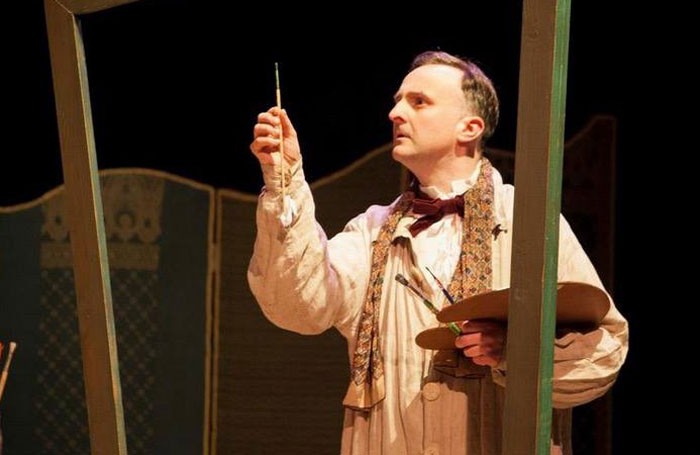
And perky it is. With only a cast of four, this new adaptation is a largely faithful interpretation of the original story. There is a strong emphasis on artist Basil Hallward’s obsession with young Dorian, capturing the agony of Wilde’s creative and frustratingly closeted life. Played by Rupert Mason, he effectively parallels Wilde’s torment and the use of art as an outlet for homosexual expression, endowing his performance with pathos and depth. Guy Warren-Thomas is the androgynous, camp Dorian who begins as Wilde’s bright-eyed young thing making a vain, innocent wish but who slips into a life of debauchery after discovering his unintended immortality. Warren-Thomas manages to evoke some empathy in his later attempts to be good, but his corruption is a delicious downfall to witness. Gwynfor Jones and Helen Keeley complete the cast, with Lord Henry Wotton and Sybil Vane as their best roles. Warren-Thomas was the only actor to not multirole, but the others did so with great vocal and physical distinction. Cross-gendered performances provide some levity to the dark tale, as does energy and complete commitment to detailed characters.

Though the performances were excellent across the boards, there were some structural choices that did not effectively translate from page to stage. The first act was largely exposition, with Dorian only making the conscious choice to live for pleasure right before the interval. As consequence, the second half felt rushed and the effect of time passing was underplayed, though signified by grey hair in Lord Wotton and Hallward. There was also a jarringly out-of-place dream sequence that Dorian has upon receipt of a mysterious book from Wotton. Stylized and physical with coloured lights and smoke, it was unnecessary and the performers appeared uncomfortable and self-conscious.

The set provided simple but versatile atmosphere. The eponymous portrait was an empty frame that Dorian would grotesquely inhabit from time to time though often left empty and darkly lit. This is a device seen before, but an effective one as it fosters audience imagination. The costumes were sumptuous and indulgent, like Wilde himself and the characters he wrote.

This is a truly lovely production. Little is particularly inventive, but it is a classic story executed very well. The performances are certainly the highlight, as is the fact that Wilde’s grandson aided in the creation of the production. The flaws can certainly be overlooked in favour of focusing on the cast and their chemistry. It continues to tour for most of June, ending with a week at St. James Studio in London.


The Play’s The Thing UK is an independent theatre criticism website maintained voluntarily. Whilst donations are never expected, they are hugely appreciated and will enable more time to be spent reviewing theatre productions of all sizes. Click here to make a donation with PalPal.

Carmen Disruption, Almeida Theatre

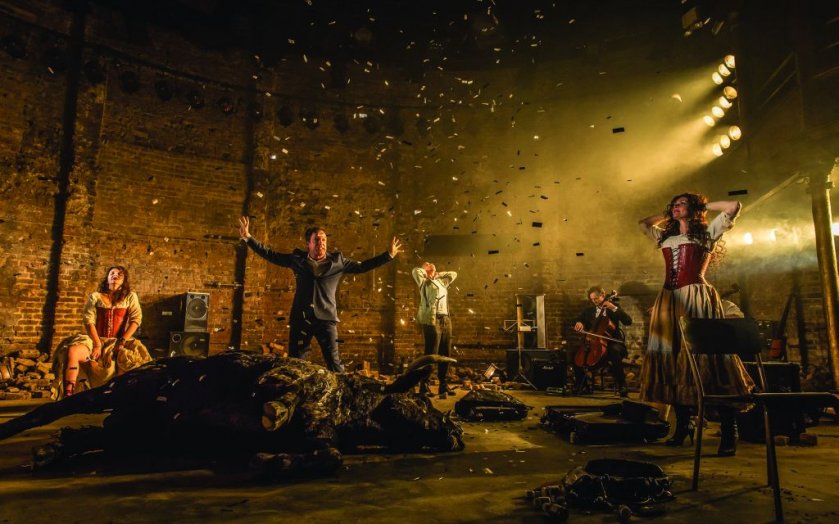
Bricks from disintegrating walls cover the stage.

A hulking, black bull breathes it last.

An aging opera singer arrives in a nameless European city.

A narcissistic rent boy readies for a “date.”

An awkward student is newly single.

A taxi driver prepares to meet the son she walked out on years ago.

A stockbroker travels to an appointment to “take care of” some poor transactions.

The one-woman chorus reaches out to each of them.

Two cellists watch and accompany from the edge.
carmen-disruption-1024x640Smash a mirror on the floor. Go on, do it. Now look at what remains. There are large chunks, long slivers and other bits that are so small they’re practically dust. Each one is uniquely sized and shaped. There is space in between them. Each one those sharp-edged, broken reflective pieces, no matter how large or small, is a person. Alone. Reflecting the world around them. With potential to fit into the pieces around us but. Just. Not. Doing it.

Simon Stephens slingshots Bizet’s Carmen into a wall at a billion mph, creating an explosion of bricks, sparkly confetti, agony, death, black blood, desperation and loneliness. His magnum opus to date, Carmen Disruption is a mess, but one that gloriously mirrors modern life with painful accuracy. Amongst the rubble are characters who are also these broken bits of mirror, pointing at us, mirroring us and paralleling Bizet’s original cast. We are them. They are us. They/we are also the creation of the deteriorating mind of the Singer (Sharon Small), who endlessly travels the world performing the same role over and over, no longer seeing truth in real life but only when she is Her. Carmen. Everyone she sees reflects an archetype from the opera, and not just the characters. Us, too. We are the Stephens’ characters, they are us, two mirrors facing each other. Reflecting infinity.

The five characters all lead radically different lives, intersecting only by chance because of opera and a motorbike accident. They never speak to each other, only to us. Even when they meet their narration is to the audience, about the others. They have no direct contact with anyone other than the observational Chorus (Viktoria Vizin). Fractured monologues weave in and out of each other, building their world that could be any major city, anywhere in the world. Fireflies blinking in the night sky. Their contact with the world filters through mobile phones, a comment on our dependence on our gadgets and urge to document rather than experience. If we take on the role of recorder, we don’t have to engage. Did technology cause the detachment from each other? This question is posed, but never answered, but not a major plot element anyway. By being posed, it makes a statement, calling on us to examine ourselves and our society in which we exist as lonely fragments of a shattered mirror.

Confrontational and omnipresent throughout the stories arising from our characters’ episodic speeches is the dark, hulking carcass of a bull. Its eventual movement surprises, showing a dying struggle rather than death. The actors pick their way around it as the audience did when they entered from the foyer, surprised and disorientated. A creeping pool of black blood eventually consumes. It is a striking visual, the elephant in the room, highlighting the destruction towards which we all hurtle.

The cellists are also fragments, as is their music. An LED surtitle screen adds an operatic element with sporadic, sarcastic content. None of the characters are particularly likeable, instead they evoke pity or disdain. The only thing that brings them together is a terrible accident they witness, but even then they only manage to bounce off of each other and continue spinning into the darkness. Alone. All roles are impeccably performed and the actors engage with each other in the space even without direct interaction.

It doesn’t matter if you know the story of Carmen or not before seeing this production. I don’t know it well at all and may have taken unintended meaning from Stephens’ script, but its ability to communicate Important Messages without having Bizet’s frame of reference attests to Stephens’ skill and the script’s excellence. Every individual will find different aspects of the production incredible and abhorrent, depending on their own frame of reference. John Light’s stockbroker, Escamillo, disgusts me. I am horrified by rent boy Carmen’s (Jack Farthing) details of his rape. I feel sorry for the naïve student (Katie West) who sexts her 63-year-old married lecturer boyfriend and believes their relationship has any love. Or meaning.

I could watch these characters forever. Not having an interval was certainly the right choice for this play. The compact snippets from their lives allude to distinct pasts and futures. Even though the world they inhabit is nameless and featureless, they were flawed, beautiful, unique humans. Smash another mirror. Go on, do it. Each individual fragment is totally unique, unlike those from our previous mirror. Future broken mirrors will be unique as well. Despite the presence of archetypes, the microscopic details of their stories are unrepeatable. On what trajectory would they all continue? I need to know. If Simon Stephens were to make a Synechdoche, New York version of Carmen Disruption, I would happily live in it. Forever.

Though director Michael Longhurst’s creative choices challenge perceptions of contemporary British drama, he could have emphasized the interaction and audience engagement even further. Even though the Almeida is known for its cutting edge work, this is a piece that could have been more fully explored in a large studio setting, without the constraints of a balcony and distinct actor/audience boundaries. I wanted to dance with these characters. I wanted them to move around me. I wanted them to look me directly in the eyes as they relayed their journeying tales and not have any regard for personal space. Carmen Disruption is aggressive, bold and visceral, the sort that is supported by more audience immersion rather than less. At the very least, the audience could have been lit so the actors could see their/our eyes, allowing a connection I craved and they characters clearly yearned for.

Despite this, the effect created was a Brechtian one of alienation and motivation to action. It’s no coincidence that Stephens’ work is popular in Germany. As I picked my way along Friday night’s Upper Street towards the tube station, the stories of those passing by and enjoying their warm, social evenings exploded around me like fireworks. I felt the need to connect. Never has the loneliness of modern life been so starkly emphasized on stage, and afterwards carried through the dark night.


The Play’s The Thing UK is an independent theatre criticism website maintained voluntarily. Whilst donations are never expected, they are hugely appreciated and will enable more time to be spent reviewing theatre productions of all sizes. Click here to make a donation with PalPal.

Romeo & Juliet, everything theatre

“Lauderdale House is the Elizabethan-era home of a former Lord Mayor of London… Behind the house, Shooting Stars Theatre Company perform their modern take on Shakespeare’s Romeo & Juliet

“Romeo (Joe Sargent) is a sensitive, intellectual hipster who hangs out with Roisin Keogh’s tomboyish Benvolio and Graham Dron’s oversexed, brash Mercutio. They drink, smoke, probably do drugs and generally make a nuisance of themselves…Sargent’s relationship with Emily Loomes’ Juliet is flawless, turning my insides to mush by the interval…

“Rory Fairbairn (Peter/Balthasar) gives us some excellent multi-rolling and physical comedy. Maxwell Tyler has a forbidding presence as the Prince and a sleazy, Cockney Paris. Ruth E. Mortimer, playing Capulet as a cold, corporate businesswoman, is all the more disturbing whilst arranging her daughter’s marriage…The whole cast is fantastic…

“The fight choreography (using flick knives and unarmed combat)…occasionally felt a bit mechanical…

“The second half struggled to find momentum initially…As it got dark, the dimming light reflected the darkening of the action even though it made it harder to see…

This is a truly excellent production with clear, creative directorial vision in a gorgeous setting. Hie thee to Highgate and catch it before it goes.”

Read the entire review on everything theatre here.

Rhesus, everything theatre

“Trinity Buoy Wharf was new to me as a venue, but certainly worth the trip. It is far from a conventional performance space…There is no obvious stage or audience space…Excellent lighting design by Pablo Fernandez-Baz gives this stark, damp basement with challenging sight lines a polished, professional feel. The set by Zahra Mansouri is minimal, but suits the space well and the audience sit amongst it, included in the world of the play…

“…There is absolutely no actor-audience boundary initially, but this changes when the play properly starts. From then on, there is no contact from the performers…

“The text is spoken well and all of the actors seem comfortable with heightened language. The cast is predominately female…Whether or not it was intentional, due to the cast being very young (late teens to early twenties, I’d guess) it carried a disturbing reminder that many who fought in our past wars were young and child soldiers are a very real tragedy in many places around the world today…

“The most notable features in this production are the regular movement sequences between the scenes. Some are abstract, some capture the brutality of battle and killing. All of them are impeccably choreographed and directed by Ailin Conant of Theatre-Temoin

“The performances in this ensemble piece were good, but as is often the case with very young performers, few stood out. No one was particularly weak but neither was anyone outstanding…

“The venue is certainly worth experiencing in this well-designed production of a rarely performed play. Though a showcase, it is certainly not a difficult one to sit through.”

Read the entire review on everything theatre here.

Macbeth, Rose Playhouse

FullSizeRender-3 copyWith inventive staging, text deconstruction and some great performances, East London’s Malachites continue their takeover of South London following last month’s excellent King Lear with Macbeth at The Rose Playhouse. Director Benjamin Blyth approaches this unique venue head on, staging scenes in all parts of the concrete expanse that stretches beyond the pool of water protecting the remains of the Elizabethan Rose. Some moments were effective due to the grandiose scale, some did not work due to sight line issues and distance from the audience. Textual edits were similarly brave, rearranging sections to emphasize Lady Macbeth’s and the witches’ control over the fate of the play. Those dogmatic about the text would probably not appreciate such actions, but they are very much in the spirit of Shakespeare: celebrate language and the improvisational nature of theatre, do not slavishly bind yourself to the text. Overall, this is a confident, experimental production to be commended for its efforts and irreverent approach to the text. Some of the choices made did not work, but Blyth is still to be commended for his effort and conviction.

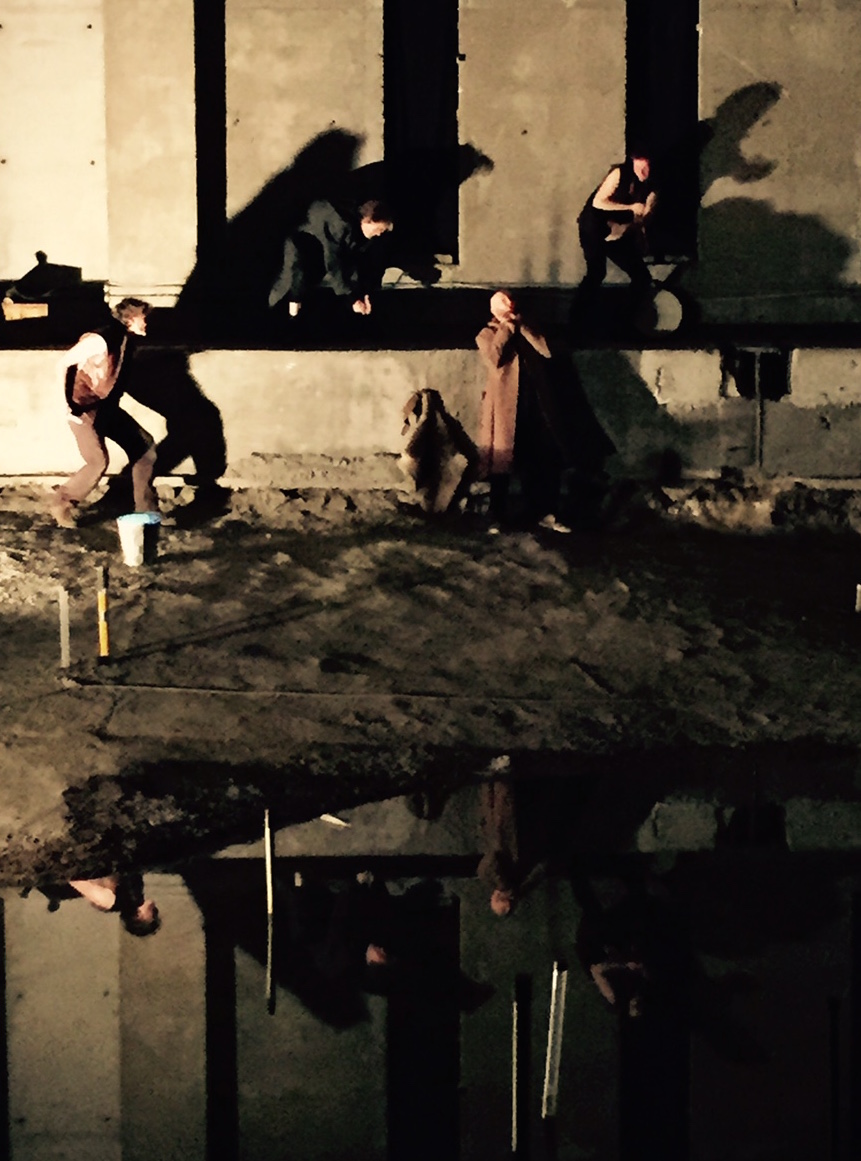
To open, Lady Macbeth reads the letter conveying Macbeth’s news from battle by candlelight. The action she reads about plays out at the back of the theatre, by the edge of the pool preserving the Rose’s foundations, like a memory or mental picture. Cinematic-style transitions break up her speech, hold a modern audience’s attention, but effectively tell the story. Choosing to begin with Lady Macbeth’s speeches and interspersing the opening scenes with them empower the character, emphasizing the control she has over her husband. This is blatant reconfiguring of the text, but it has a strong message, suits the storyline and creates a completely different tone from more typical productions. Orla Jackson gives a calmly fierce Lady Macbeth, who later on deteriorates from grief and remorse.

Following the initial rearranging of the text, the play carried on with some cuts, until the end, which was also untraditional but showed the cyclical nature of evil and the omnipresence of the witches. In this production, the witches were tall, spidery and male, almost entirely kept at the back of the site. This pulled focus from the action on stage at times and made it impossible to see detail such as facial expression, but they were well lit and cast intimidating shadows on the industrial back wall. They would have been a more powerful presence if brought onto the stage more than the once that they were.

The performances in this production were largely good, though not as consistent as last month’s King Lear. Benjamin Blyth is the highlight in the title role, playing Macbeth with outstanding nuance and emotion I have never seen in the part before. Beginning weak, he becomes more reckless but still dominated by a rich inner life of guilt, pain and fear. I daresay this is the best portrayal of Macbeth I have ever seen. Playing a role with such conviction as he did whilst directing the production indicates immense talent on Blyth’s part. Also notable is the versatile Robert Madeley as Banquo and the Porter (though his Banquo was the better performance) and David Vaughan Knight as a militaristic Macduff. Though he struggled to connect with grief upon hearing of the murder of his family, his stern, grounded performance provided lovely contrast to emotional Macbeth.

Blyth showed determination to use all available playing space at The Rose, placing a large proportion of the action on the far side of the archeological site. Whilst he does the space a service by not ignoring it, there are some obstructive railings and the distance caused visual detail to be lost. More of the action, particularly key moments in the plot, could have been moved to the stage closer to the audience. Clever lighting ensured everyone was lit well, but the presence of actors at the back of the site can distract for foreground action.

The Malachites are certainly a brave company, unafraid to adapt Shakespeare’s text to modern audiences and storytelling techniques. Blyth is a rising star worth watching. This company would benefit from more financial resources in order to add polish to their productions, but they are quickly becoming a key player in staging productions in unusual spaces.

Intention: ☆☆☆☆

Outcome: ☆☆

Star Rating: ☆☆☆


The Play’s The Thing UK is an independent theatre criticism website maintained voluntarily. Whilst donations are never expected, they are hugely appreciated and will enable more time to be spent reviewing theatre productions of all sizes. Click here to make a donation with PalPal.

Beautiful Damned, for remotegoat.com

Anthony Patch, a debonair young man, begins building a house of cards on a table in a shabby bar. On the verge of collapsing, Anthony gives up on the cards almost immediately. He takes no risks, stopping before he has really begun, or grew bored. Both possibilities reflect the tumultuous years spent with his wife, Gloria. Anthony and Gloria’s relationship mirrors their Gatsbian world of excess: they are self –absorbed, often indifferent towards each other, either passionately in love or in hate. The play chronicles the highs, lows and love affairs of their 10-year relationship with energy, commitment, versatile performances in a dingy, speakeasy atmosphere.

Nadia Cavelle and James Hyde skillfully portray the journey of the couple’s relationship as they meet for a drink to relive their past. Even with pianist and barman Fitz (Guy Hughes) to support the plot, the production is essentially a two-hander. Their first date is tea at The Plaza; Anthony clearly loves Gloria at this point, but she only loves herself. As their relationship develops, so does Gloria’s empathy but we see that Anthony is equally self-absorbed and lazy. They want to drink and dance, but cannot be bothered to put the work in to pay for their indulgences. Other friends and acquaintances from their past join them, played by Hyde and Cavelle using costume pieces to signify the character change. Altering their voices and movement style, the actors show the character transitions clearly and demonstrate their characters’ absurd behaviour extends to their social circle. They fight and make up constantly. Everything is high drama in Anthony and Gloria’s world as the action flips back and forth between past and present.

Whilst the actors make the transitions well, the lights are slow to keep up. Obvious changes in the lighting state support these episodic time leaps, but are ill timed and not actually needed. The stage space is used effectively by director Ben Weaver-Hincks, but the audience has little breathing space. £3.50 mint juleps help ease the discomfort and the theatre will want to maximize audience capacity, but the seats could have used a bit more space around them. Direct address is used occasionally to include the audience, but could have been employed more. Having not read Fitzgerald’s novel, I cannot comment on the adaptation quality. The piano accompaniment certainly aids in creating atmosphere, but the highlight of this show is the performances.

The story must come to an end, however. Anthony reveals a certain indiscretion whilst stationed down south during the war. They are older, jaded and really quite damaged. There is a strong element of faded glamour, obviously reflected in the set design and decoration. The world they knew and relished so fully has collapsed and been rebuilt unrecognizably to them, a house of cards pushed to its limits again and again. Do they genuinely love each other? Perhaps. Like two playing cards able to stand because they lean on each other, these two childlike individuals cannot navigate reality on their own.

Intention: ☆☆☆☆

Outcome: ☆☆☆

Star Rating: ☆☆☆ 1/2

Originally posted on remotegoat: http://www.remotegoat.com/uk/review_view.php?uid=11680