Dea, Secombe Theatre

It can absolutely be said Edward Bond was a revolutionary of 1960s British theatre with his seminal play, Saved, that was a pivotal role in abolishing censorship. It can also not be doubted that he endured unspeakable horror as a child in WWII London. Still yet, it can be said that Bond’s work, that used to shock and appal, is now trite and bland despite his latest play’s copious obscene acts that are tenuously based on Medea. This production, bizarrely premiering at a theatre in Sutton, manages to be extremely violent and epic, whilst simultaneously terribly boring and pedestrian. Dea is also directed by Bond and, clocking in at over three hours with two intervals, is a self-indulgent, laughable affair desperately in need of an outside eye and feels more like three days. Though commendably anti-war and with some solid performances, Dea’s downfall is Bond’s dated aesthetic, self-importance, and lengthy, rambling scenes that are full of sound and fury, but say very little.

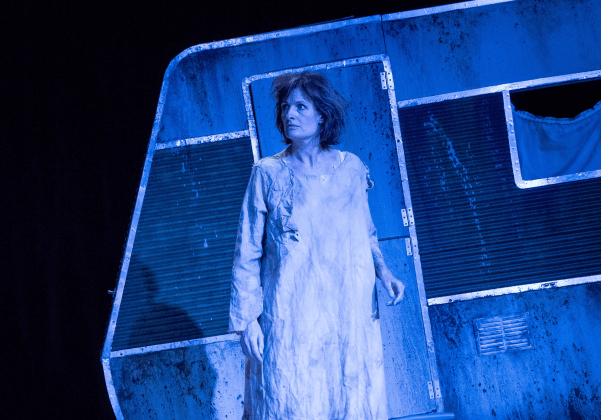
Five minutes into the first act, Dea (Helen Bang) commits a senseless act of infanticide that leads to her banishment, dooming her to wander the earth for the rest of the play. Though presumably aimed at her self-absorbed, army officer husband, her actions are entirely unjustified. Bringing destruction wherever she goes, Dea lacks the abilities to empathise or emotionally connect with others. Her husband (Edward Avison-Scott) is of similar ilk, though at least he manages to react to his children’s murder and send Dea away. Otherwise, this first scene is made rather uninteresting by flat, stilted dialogue. Neither character listens to the other, and the babies’ (cheap looking dolls) murder is badly staged. The rest of the act is about 16 years later and crowbars in incest, fellatio, rape and murder. Again, these are without justification, and again, the script lacks life. Bond seems to use his dialogue to frame the violence rather than communicating anything of any depth.

The subsequent acts are in the Middle East at a British army camp with less of a focus on Dea and more on the horrors of war. Bond chucks in necrophilia, more rape, a suicide bombing and cocks-out masturbation to pad Dea’s nonsensical quest to find a lost family member. With what’s on the news and the Internet these days, none of it shocks. Bond’s naivety in thinking it does is rather sweet. 

Bond’s ideas about the state of modern theatre are less sweet though. In fact, they’re blatantly offensive. He yearns for the good old days when people went to the theatre to be enlightened and educated, and theatre had something to say about the world. The programme notes laughably state, “I write of the rape of a corpse with a beer bottle to bring back some dignity to our theatre.” If Bond thinks our theatre lacks dignity and important messages, then he is out of touch with contemporary theatre, especially small scale and fringe work. This detachment from the real world is evident in Dea, what with the length and gratuitous violence that has absolutely no point.

Helen Bang does some great work at sustaining Dea’s fierce coldness, and her gradually loosening grip on reality is meticulously crafted. Despite awkward dialogue and some moments of unnatural delivery, she has a powerful presence and dominates the stage. Avison-Scott pales in comparison, though Joylon Price as her son Oliver isn’t far off measuring up to her. Oliver is the best written and most interesting character in the play, though is disposed of entirely too soon. The soldiers in the second act are mostly generic, though David Clayton as the PTSD-suffering Cliff in the final act does his best to make the character more well-rounded. Bond misses an opportunity to give the soldiers on the front line of modern desert warfare the depth that could move the audience to rage about their treatment and behaviour. 

Basically, Dea is a sad mess that thinks it’s radical and edgy but in trying so hard to shock, it comes across as absurd and pathetically out of touch. Bond thinks theatre lacks dignity? He needs to open his eyes to the vapid, grovelling dreck that he created.

Dea runs through 11 June.

The Play’s the Thing UK is committed to covering fringe and progressive theatre in London and beyond. It is run entirely voluntarily and needs regular support to ensure its survival. For more information and to help The Play’s the Thing UK provide coverage of the theatre that needs reviews the most, visit its patreon.

A Subject of Scandal and Concern, Finborough Theatre

George Jacob Holyoake, a pioneer in the British secularism movement, was the last man ever to be tried and sentenced for blasphemy in the UK. After an engagement in Cheltenham in 1842, the travelling lecturer and teacher found himself the subject of a damning newspaper article that caught authorities’ attention. John Osborne fictionalised the fiery young man’s story in a 1960 television drama, now largely forgotten in the wake of his popular plays. Production company Proud Haddock has resurrected the script, an hour-long tirade against religion and the establishment, in an excellently performed and staged production. A Subject of Scandal and Concern lacks finesse, though. It choppily covers a lengthy time period and all of the characters, save for Holyoake, are underwritten and underused. The story is engaging despite Osborne’s plot structure, and Jamie Muscato is a magnetic Holyoake that redeems this historical relic.

After a brief narrative monologue that is largely unnecessary, a moving scene between Holyoake and his wife indicates this is going to be a domestic poverty-drama. The story goes a completely different direction however, instead focusing solely on Holyoake’s subsequent speech, arrest, trial and imprisonment. With moving courtroom scenes and a tenacious spirit, the character is well-written and detailed. The rest of the characters frustratingly lack his depth and stage time, each only appearing a few times, if that. Multi-rolling gives the actors plenty to do, but this would be a far more interesting play if Holyoake had more substantial characters to engage with. There isn’t much in terms of a journey for any of the roles, instead Osborne uses the narrative to make a strong statement against organised religion and its death grip on Western society. This is agit-prop rather than effective storytelling, and a less able cast would make this a boring play indeed.

Jamie Muscato does a fantastic job with Holyoake, particularly in the courtroom scenes, and the rest of the cast are a smooth ensemble of devout resistance against him. Muscato’s flawless embodiment of his character’s tenacity and struggle is a masterclass in detailed characterisation. It’s a shame there isn’t enough opportunity for the other actors to showcase their ability in the same way, though there work is still very good. Their commitment to their characters is the saving grace of this production.

Philip Lindley’s set is a simple collection of slatted boxes of varying sizes and shapes that cleverly evoke a kitchen, a courtroom, a prison, and the club where Holyoake speaks. Their rearrangement is simply choreographed by director Jimmy Walters and choreographer Ste Clough, but there is missed potential for more poetic stylisation evoking Holyoake’s fight against the society that is threatened by his godlessness.

Though the generally unknown A Subject of Scandal and Concern disappointingly reinforced why it isn’t more frequently produced, Walters’ staging and the cast’s performances prevent this production from being flat and dull. It’s quite the opposite, and worth seeing for the excellent, intense performances in an intimate venue.

A Subject of Scandal and Concern runs through 11 June.

The Play’s the Thing UK is committed to covering fringe and progressive theatre in London and beyond. It is run entirely voluntarily and needs regular support to ensure its survival. For more information and to help The Play’s the Thing UK provide coverage of the theatre that needs reviews the most, visit its patreon.


Better Together, Brockley Jack Studio

Margaret and her husband Adam own a shipyard in Fife they built up to be the best in the area, after inheriting it from Margaret’s father. They lead a comfortable life in their small town and have two grown daughters. Though on the surface their life is idyllic, deep cracks are concealed under the family’s glossy veneer. Political conflict, local gossip and an unstable economy threaten the foundations of family life in Better Together, the winner of the Brockley Jack’s annual new writing competition and festival. This modern, Scottish kitchen sink drama, like an updated Death of a Salesman, has sibling rivalry, the collapse of an entrepreneurial father who’s stuck in the past and a thematically complex story that mirrors the real family life in modern Britain. Excellent performances and a script instinctively following a course of intimate conflict make this play a true winner.

It’s youngest daughter Arlene’s (Eleanor Morton) eighteenth, and she has just received her university offers. Determined to leave Scotland after the country failed to leave the UK, she breaks it to her parents that she’s off to Sweden. Mum (Kate Russell-Smith) is supportive, but dad Adam (Rikki Chamberlain) is most definitely not ok with the prospect of her leaving Scotland. Older sister Shona (Rosalind McAndrew) has enough of her own problems to deal with, what with being a single mum and having a new man every week. Her troubles eventually spread to the rest of the family, the local industry-driven economy collapses, and Adam’s determination to do business how he’s always done it creates a perfect storm of collapse. Personality differences become more pronounced and conflict naturally unfolds as their lives unravel. A climactic, irreparable end is fantastically dramatic but still plausible after the extremes the characters have undergone. No one comes out of it well. In this regard, the plot is much more like real life than its twentieth century predecessors – it’s messy, unresolved and the family has suffered permanent consequences. The linear structure is textbook, but the actual storyline manages several surprises. Structurally, the dramatic arc is watertight, though some of the plot elements are predictable, such as Arlene’s summer employment situation.

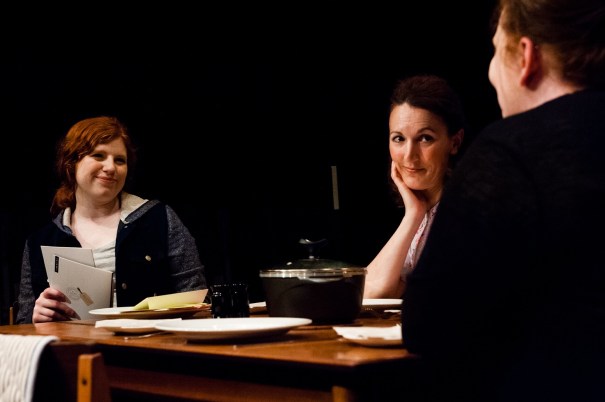
The four actors make a fantastically believable family unit and close ensemble, with no one coming across as a weak link or a dominant force. Morton and McAndrew even look alike, adding to the overall believability. Kate Bannister’s direction is commendably invisible save for a few overly-choreographed transitions, and her work is well supported by Moi Tran’s domestic set centreing around the dining table. 

There’s a heavy dose of Scottish working class life in the play, but the themes are abundant and universal, with something for everyone. Progression versus tradition, independence against safety, and old fashioned industry fighting corporate sterility are as present as political difference and familial struggles. It’s a rich tapestry of struggle that manages to avoid being overly dense.

Better Together is some of the best naturalism on the fringe at the moment. Though it follows a formula, it’s an effective and satisfying one. The play’s relevance and layers add depth and further resemblance to real life. Though inevitably tragic, the story’s events are exquisite in their unraveling. It’s a sparky, punchy story that leaves a long lasting glow.

Better Together runs through 28 May.

The Play’s the Thing UK is committed to covering fringe and progressive theatre in London and beyond. It is run entirely voluntarily and needs regular support to ensure its survival. For more information and to help The Play’s the Thing UK provide coverage of the theatre that needs reviews the most, visit its patreon.
27, Battersea Arts Centre

Brian Jones. Jimi Hendrix. Amy Winehouse. Janis Joplin. Jim Morrison. Kurt Cobain. Peter McMaster? No, he didn’t join the “27 Club” but he celebrates the risks and excesses of the age that took so many legends. With co-performer Nick Anderson, they relay personal milestones from birth through the near future amongst displays of risk taking, celebration and sensual interaction with the audience and each other. This encroaching on personal space and copious amounts of dust creates a boundary-less, intimate world with surprising additions of pain and violence – an excellent depiction of the living life on the edge.

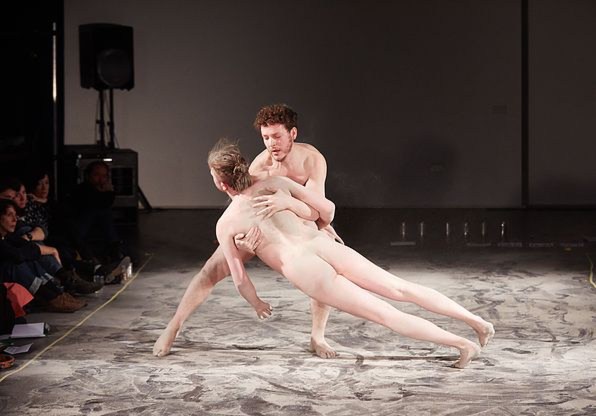
McMaster and Anderson’s start wearing skeleton morph suits and masks creates an otherworldly, animalistic effect. A joyful distribution of copious amounts of grey dust cleverly evokes death, subsequent cremation and the Judeo-Christian idea of “from dust you came and to dust you will return”.  This fine, grey powder lingers, soon kicked up into the air and covering both the performers (who are shortly out of their morph suits) and the audience. This isn’t a clean show, but neither are most people’s mid-20s. As glorious and invincible that age might be, death is inevitable and occasionally, not very far away. It’s a powerful metaphor.

The two performers have nothing on under their morph suits. The totally exposed bodies are vulnerable in their nudity, but simultaneously powerful as the two grapple and slam into each other. Sweaty bits of flesh slap into each other – this isn’t staged fighting, this is two blokes properly going for it. Trust falls become more and more risky even though repetitive and highly choreographed; the potential for harm is thrilling and visceral.

Two long scrolls document the 27 years of the performers’ lives and are read from intermittently. The lists of years and key events start out banal, but as they age, they become wonderfully anecdotal. The teen years are particularly amusing and expressed with a quiet nostalgia. The bodies on stage, what with all the flesh already exposed, seem to grow the more the audience learns about them.

The violence brings an accompanying suspense, but the vulnerability so blatantly on show is the defining feature of 27. The dust that’s kicked up into the air creates a harsh environment, but is a communal experience shared by actors and audience. Like the realities of feeling young and invincible, 27 is a wonderful, messy celebration of the age where we are not bound by societal expectations.

27 ran through 12 May.

The Play’s the Thing UK is committed to covering fringe and progressive theatre in London and beyond. It is run entirely voluntarily and needs regular support to ensure its survival. For more information and to help The Play’s the Thing UK provide coverage of the theatre that needs reviews the most, visit its patreon.
The Destroyed Room, Battersea Arts Centre

Question: do you think people are happier now or in the past?

It’s a big one with no right or wrong answer, but three actors debate it on stage for over an hour in The Destroyed Room with a deliberate diversion to terrorism and the refugee crisis. The extended, semi-improvised conversation is filmed by two live-feed cameras broadcasting to a large screen above the middle class, sanitised lounge and kitchenette that makes up the set. The audience, more like that of a televised political debate, can choose to watch the close up footage or the live wide angle. After the subject matter turns to violence, voyeurism and relationships between the onstage personas break down due to clashing viewpoints, the inescapable reality of the refugee crisis floods the stage in this subtly provocative, highly metaphorical piece of experimental performance that makes the audience reflect on how it perceives these events.

Driven by the idea that we view the world through the lens of the culture we live in, the conversation quickly heads into to the violence bedded into modern life. There’s a pretty clear, scripted signpost to steer the topic in this direction, which although necessary to ensure the conversation hits the points the production wants to make, is disappointing after the promise of improvisation.

Another question: have you ever watched one of those videos by terrorists of them killing someone?

There’s an awful, revealing confession from Barnaby Power that the three discuss for some time; it’s this subject that really starts to press the audience’s emotional buttons. Personalities are revealed, and gloves come off. It’s interesting to consider how much of what we see are characters and how much are the actors’ own selves. Power’s inner conservative conflicts with his liberal exterior, Pauline Goldsmith is flamboyant and brash, Elicia Day is the middle ground between the two and has a secret sensitive to the others’ sweeping generalisations.

An anti-theatricality to this production makes the form both experimental as live performance and occasionally a bit dull. The conversation certainly has a dramatic arc that reads like a script, but even with the live feed projection, there’s little visual variation until the end. The content has merit, but the mind can wonder until the conflict starts to emerge and things fall apart, both literally and metaphorically.

The Destroyed Room is a hard one to pin down, delightfully evading categorisation by being both small and worldly at the same time. Though the amount of time spent in sit down debate feels to long, it accomplishes its goal of reflecting on how we view world events through the lens of Western privilege.

The Destroyed Room runs through 14 May.

The Play’s the Thing UK is committed to covering fringe and progressive theatre in London and beyond. It is run entirely voluntarily and needs regular support to ensure its survival. For more information and to help The Play’s the Thing UK provide coverage of the theatre that needs reviews the most, visit its patreon.

Stowaway, Shoreditch Town Hall

A body falls from the sky, landing in a B&Q car park near Heathrow. Frozen, it explodes on impact. The event makes the news, and is quickly forgotten by everyone other than those directly involved. Andy was getting out of his car when the body landed in front of him. Lisa, a writer, was on that plane. Debbie is Andy’s wife, who has minimal patience for Andy’s trauma. And then there’s Adi, the poetic, aspirational man who fell. The threads of these people’s stories weave through news broadcasts about India’s new space programme that will place the struggling country amongst the world’s elite. Stowaway places Adi’s life in a global context whilst simultaneously giving detail and vibrancy to one of thousands of people who died in their attempts to make a better life. Moving and powerful, the script says a lot in its one act but tries to say too much in the time it has. 
 
A scaffold plane, like a cross section of a whale’s rib cage, holds the plane’s passengers (legitimate and otherwise). This skeleton is also a coastal Indian village, Andy and Debbie’s middle class house, a cafe and B&Q’s car park. Hannah Barker and Lewis Hetherington’s writing and transitions quickly clear up any ambiguity, as does their clever use of angular metal chairs to create a range of sculptural forms acting as furniture and buildings and, well, chairs. The strong metallic lines have the shimmering permanence of skyscrapers the character’s lack – a canny metaphor that fits well with the script’s style and intent.
 
Barker and Hetherington thoroughly examine various sides of the refugee debate through their characters. Adi (Devesh Kishore) wants to see the world and send money home to his family. Andy (Steven Rae) and Debbie (Balvinder Sopal) have a comfortable Western life together, more concerned with their daughter’s progress at school and DIY than the rest of the world. Lisa (Hannah Donaldson) is a successful author who has all the good, liberal intentions of giving voice to the oppressed, but as a privileged white woman, she is limited in experience and access to the research and stories she seeks. The four are excellent microcosmic representations of a good portion of the world that’s more or less likeable, though the extremely conservative, ant-immigration sort are noticeably absent. Their exclusion makes the story more palatable, though a voice from this side could potentially serve to rally greater support to the inclusive left. With or without, the characters and their responses to Adi’s death are powerful political messages.
 
There are a few brief movement sequences that, though lovely in their Frantic Assembly-like fluidity, are so infrequent that they don’t contribute much other than breaking up the emotionally intense writing that is the best feature of this show. More would be welcome. Moments of detailed description devastate; only the hardest of hearts could resist Adi’s charm and poetry that grows from a daydreaming child to a motivated young man. Disconnected telly interview fragments on India’s upcoming Mars mission and the country’s aspirations to be taken seriously cleverly mirror Adi’s hopes for himself and his family, and also obviously question why a nation is launching a rocket when so many of it’s people are destitute – though this doesn’t just apply to India. 
 
Blatantly political, Stowaway uses its well-developed characters to loudly declare support for economic migrants. It’s an emotionally draining but important production, though it could use lengthening in order to make the storyline less dense and convoluted. The performances are good vehicles for the characters’ messages and the scripts’ positive emotional manipulation has potential to be a powerful catalyst for change if the play could be compulsory viewing for the Western populace.
 
Stowaway runs through 30 April.
 
The Play’s the Thing UK is committed to covering fringe and progressive theatre in London and beyond. It is run entirely voluntarily and needs regular support to ensure its survival. For more information and to help The Play’s the Thing UK provide coverage of the theatre that needs reviews the most, visit its patreon.
Hamlet, Who’s There?, Park Theatre

Some people are so precious about Shakespeare. There’s historical merit in periodic restrained, original practice productions, and modern productions with superficial concepts add a degree of variation, but neither approach progresses contemporary Shakespeare performance practice. The first folio texts, those regarded closest to Shakespeare’s intentions, still may be quite distant from what may have come from the actors in the moment. Scholars can only speculate on performance style, staging and most other production elements due to a dearth of primary sources. Considering all of that, theatre makers should mess about with Shakespeare more. 

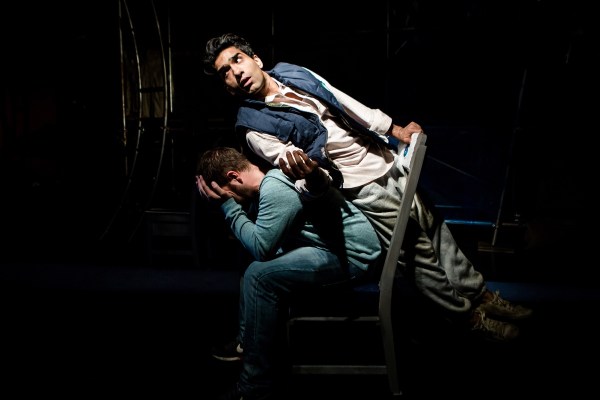
Kelly Hunter does that with her Hamlet, Who’s There? by reconfiguring the original timescale and characters to place her adaptation firmly in the present. As two frivolous, tacky families with more money than sense drunkenly celebrate a wedding, a disregarded son suffers a psychotic episode that triggers their collective downfall. Six actors focus the tragedy on the familial element, making this more of a kitchen sink drama than a grandiose spectacle. This is a Hamlet that’s easy to relate to but still be horrified by. The intimacy is well performed and powerful, and Hunter’s script, whilst dramatically different from the original, still contains its visceral, conflicted essence.

Mark Quartley is Hamlet, an angsty, tormented young man disgusted by his elders. He excellently embodies the grief that tips him into Schizophrenia, making him believe he is his dead father. This device carries him forward on a mad quest for revenge. Quartley’s Hamlet is a victim, not just of his surroundings but also his own mind. Kelley Hunter is his drunk mother Gertrude, sloppy and self-absorbed. She’s a great contrast to Quartley, and also to her manipulative new husband Claudius (Tom Mannion), who keeps her well-lubricated throughout the story. The second family is a hapless Polonius (Steven Beard) and two children. Laertes (Finlay Cormack) has been wonderfully reimagined as Hamlet’s best friend, using lines from Rosencrantz and Guildenstern. Their brief encounters are intimate and warming, alleviating Hamlet’s otherwise relentless agony. The language comes easily to the cast, managing to not jar with the modern story. 

Though the performances are excellent, the highlight of this production is Hunter’s script. Pared down, it’s more Eastenders than Stratford, and the use of identifiable mental health issues and familial conflict help move it away from Shakespeare’s fantastical ghosts and dated duels. Ophelia’s madness is logically clarified through wonderfully disturbing staging, with Hunter also directing. The gravedigger scene is still present, but somehow fits in with the concept. Though the end is rushed and heavily changed from the original, it cuts a striking image. 

Hamlet, Who’s There? As a title also suits Hamlet’s mental health struggles as he searches for himself and the father that takes over his mind. Hunter’s set is sparse, but symbolic items and copious amount of blood are visually dynamic. The venue’s lighting balcony and ladder up to it are also cleverly employed.

Flute Theatre and Kelly Hunter’s script bring Hamlet firmly into the present with Hamlet, Who’s There?. It’s firm proof that Shakespeare can be made even more relevant through radical reinterpretations and confident textual adaptations. There’s no need to slavishly follow Shakespeare’s original scripts all the time, but still respect the integrity of the language and story. This is a fantastic production at the forefront of contemporary Shakespeare practice.

Hamlet, Who’s There? Is touring the UK and Europe through the summer.

The Play’s the Thing UK is committed to covering fringe and progressive theatre in London and beyond. It is run entirely voluntarily and needs regular support to ensure its survival. For more information and to help The Play’s the Thing UK provide coverage of the theatre that needs reviews the most, visit its patreon.

Sket, Park Theatre

What sort of trouble would you have got into as a teenager if you were equipped with today’s technology? It’s a frightening thought. What with the teenage brain’s late-developing understanding of consequences and a world outside their own immediate gratification, it’s no wonder sexting is a thing. Insecure teenagers wanting to impress their crushes, an over-inflated sense of self and peer pressure brews a potentially deadly, life ruining combination in the presence of a smart phone. Maya Sondhi’s Sket is a snapshot of the perils of urban, working class teenaged life and the consequences of poverty, boredom and hormones constantly plugged into the Internet. A cast of seven depict a pretty spot-on representation of young people’s emotional lives, but Sondhi’s play seems to take a dim view of troubled teens and the adults that work with them. Painting her young people as a bunch of sex-crazed, badly behaved tearaways and their teacher as useless and boundary crossing is not only hugely generalised but a potentially harmful stereotype.

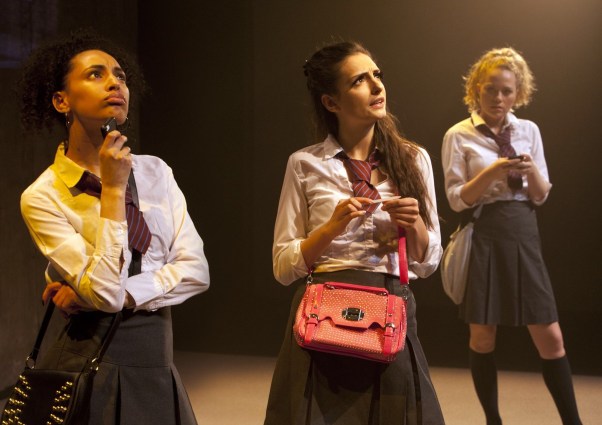
JC (Tom Ratcliffe) has a cousin who runs a porn site, and JC helps him out by manipulating his female school mates into sending him explicit photos and videos. Emily (Laura Gardiner), Daisy (Olivia Elsden) and Tamika (Tessie Orange-Turner) are friends who are just as bad as each other, but quick to judge and pair up against the odd one out of the three. JC’s backed up by the charmingly insecure Adam (Dave Parry) and Leo (Romario Simpson), who know what JC is doing is wrong, but aren’t confident enough to stand up for themselves. The six young actors are believable London estate kids most of the time, and have some nice moments of conflict and comraderie. There are a few accent slips into middle class Home Counties, but these are rare. It’s typical teenaged tribal warfare, but when the girls discover their photos and videos are online, they aren’t strong enough to maintain a tough facade. Their teacher Miss (Anna O’Grady) tries to get information out of them, but manages to be completely inappropriate most of the time and makes no mention of referring the girls to a higher power what with the information she does glean from them – a huge misrepresentation of teachers and support workers, who proactively combat the consequences of sexting.

A horrific end reinforces how brutal children can be towards each other, but it is needlessly bleak. A lack of resolution indicates that these kids will never escape the boys vs. girls revenge cycle and grow up into functional adults. Considering most kids are decent human beings trying to get through life regardless of their backgrounds, Sket paints them at their worst. A few moments of kinship and tears aren’t enough amongst the horror. Whilst sexting and revenge porn is certainly a problem, Sondhi doesn’t show any of the work that is done to fight it by schools, police and social services. The distrustful relationship between teenagers and their teachers is also hugely inaccurate. Individual scenes are well-written and the characters are otherwise believable, but the overall message the script communicates is frankly wrong.

That said, it’s a good production otherwise. Director Prav MJ keeps her staging simple in order to focus on the characters and their conflicts. Simple projections indicate location, and school uniforms reinforce the characters’ youth. There’s no set, but it isn’t particularly needed in a small venue. The script could certainly do with a wider range of material in order to diffuse the negativity and to add is some degree of resolution, but it wouldn’t take much to turn around the play’s attitude and make a really great story.

Sket runs until 14 May.

The Play’s the Thing UK is committed to covering fringe and progressive theatre in London and beyond. It is run entirely voluntarily and needs regular support to ensure its survival. For more information and to help The Play’s the Thing UK provide coverage of the theatre that needs reviews the most, visit its patreon.
Blue on Blue, Tristan Bates Theatre

There’s been a lot of attention on the lack of diversity in theatre lately. White, middle class, able-bodied males dominate theatre and the industry is finally beginning to see that it’s a problem. More diverse work is now creeping into the spotlight, as it should, but it’s usually labelled as “BAME theatre”, “working class theatre”, disabled theatre” or whatever the appropriate qualifier happens to be. That’s all fine in the short term, but if theatre wants to make true progress in diversity, it needs to move away from these labels and have a diverse cast in plays of all genres, time periods and topics. Theatre needs to aspire to be just “theatre” that is blindly inclusive of race, gender, dis/ability.

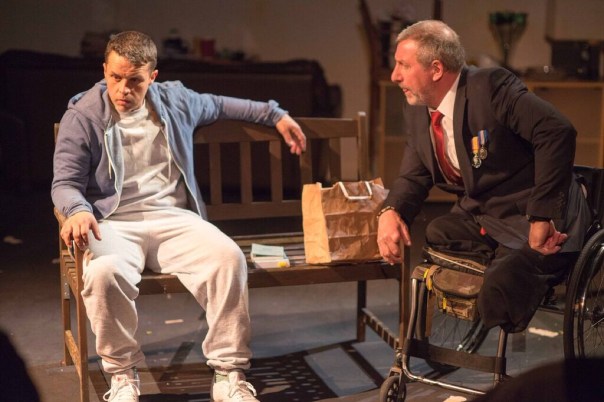
Chips Hardy’s Blue on Blue does just that. The play is fundamentally about mental health in a domestic drama setting, but happens to have a character who’s a double amputee and wheelchair user. It’s not about Moss’ disability, but his relationship with his nephew Carver, who is struggling to build a normal life as a self harmer with OCD. This little, well-made play with great performances is the sort of theatre that truly works towards championing diversity.

Daniel Gentely as Carver is a tormented 30-something trying to put his life back together after falling on hard times. He’s got a job at a garden centre and some carer responsibilities for his uncle whom he lives with, Ronnie Moss (Darren Swift), and things are on the up. But he can’t cope when the world flits beyond his control, even though he desperately tries to engage in “normal” activities, like going out with his mates or fucking Moss’ carer Marta (Ida Bonnast) in Moss’ wheelchair in the middle of the night. His defensive banter and tough guy exterior with Moss eventually give way to a rewardingly vulnerable core. This transition is lovely and shows both Gentely’s range as a performer and validates male emotional need. Swift’s similarly hardened outside, which categorises people into one of the “five kinds of cunts in the world” and wants to be left alone by his overbearing nephew, abruptly gives way to genuine care and warmth. Bonnast also has the opportunity to show some great emotional contrast as the Hungarian care worker studying accountancy who genuinely wants the best for everyone, and the three display a wonderfully consistent chemistry in the hardest and easiest of moments. 

Hardy’s script follows a conventional, linear structure which works well for following his characters’ journeys. It’s a character-driven story that, though just over an hour, has three scenes that are essentially miniature acts. Though the narrative arc is fairly smooth, it’s steep and could adapt well to lengthening. It harks back to Miller, Williams, and the like but doesn’t feel old-fashioned in the least. It’s a current play, with modern issues, families and their messed up baggage. The two scene changes are needlessly long, but other than this, faults are few.

Blue on Blue, though conventional in style still feels progressive with its inclusivity. Hardy’s intuitive dialogue and similar ability from the cast make this a strong play deserving of a solid future.

Blue on Blue runs through 14 May.

The Play’s the Thing UK is committed to covering fringe and progressive theatre in London and beyond. It is run entirely voluntarily and needs regular support to ensure its survival. For more information and to help The Play’s the Thing UK provide coverage of the theatre that needs reviews the most, visit its patreon.
Your Ever Loving, TheatreN16

In 1975, Paul Hill was convicted for bombing two English pubs, along with three other people. Coerced into confessing by the police, the twenty-one year old from Belfast later retracted his confession but was found guilty and imprisoned with the others as IRA supporters. It wasn’t until 1989, long after his attempt to appeal had been denied, that investigators discovered police officers linked to the original case had altered evidence. The “Guildford Four” were released immediately, after 14 years inside. 

Your Ever Loving chronicles Hill’s conviction, imprisonment and eventual release through the letters he wrote to his family over the years. One actor plays Hill, another plays numerous figures Hill encounters along the way. Martin McNamara’s frantic script cuts across years and locations, often leaving the audience in its dust and struggling to keep up. The cast of two display huge emotional investment in the characters, but the script’s pace, though stylistically distinct, is wanting in depth and focus.

Stevan McCusker is Paul Hill, who cuts a gentle young father and doting son as well as a prison-hardened thug who takes nothing from no one. McCusker’s quiet strength and fierce determination are charming immensely watchable. James Elmes is the often violent rest of the world, from fellow prisoners, to judges, to police and guards. Elmes provokes McCusker in dozens of short-lived fights, a clever manifestation of Hill’s lengthy battle to clear his name.

McNamara tries to fit a decade and then some into one act, but in doing so, he glosses over episodes that deserve more attention. Hill’s release is anti-climactic and rushed; the initial montage of moments (too short to be called scenes) is so fast that it confuses. Highlights of the fifteen years merge into one after awhile, creating a continuously evolving pilot point rather than separate ones. The structure constantly destabilises, along with the often maniacal caricatures painted by Elmes, but prevents any deeper exploration of Hill’s day-to-day life inside and after he’s realised. 

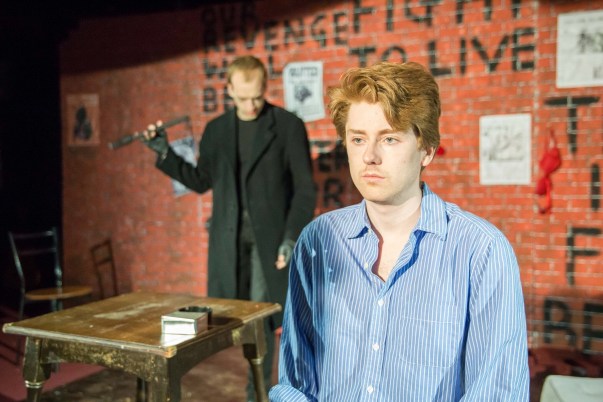
Despite the script’s shortcomings, directors Jamie Alexander Eastlake and Sarah Chapleo do a commendable job at keeping energy high and recreating the sensory barrage of life at the hands of abusive wardens. A simple red brick wall set with political graffiti and notices is an ever-present reminder of the social and political upheaval during the height of IRA activity, and the inflexibility with which suspects were treated by the UK government – a wise design choice on the part of the two directors.

Your Ever Loving isn’t a great script, but it manages to hit some important historical socio-political points. Eastlake and Chapleo do their best, along with the two performers, but McNamara’s play is an ultimately unsatisfying gloss over a vital period of recent history and the government’s treatment of people wrongly accused in times of trouble.

Your Ever Loving runs through 5 May.

The Play’s the Thing UK is committed to covering fringe and progressive theatre in London and beyond. It is run entirely voluntarily and needs regular support to ensure its survival. For more information and to help The Play’s the Thing UK provide coverage of the theatre that needs reviews the most, visit its patreon.