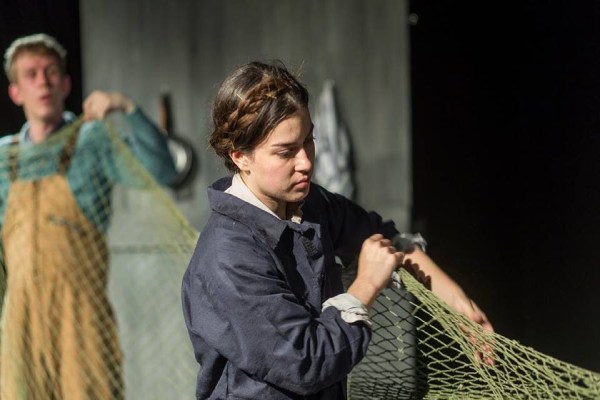
Confessional, Southwark Playhouse

How does it feel to have never had something beautiful in your life?

In this reimagining of the Tennessee Williams’ one-act that later becomes the more fully-formed Small Craft Warnings, the flotsam and jetsam of a remote Californian coastal town are relocated to the Thames estuary. The ‘immersive’ staging spreads the actors amongst sections of the audience in Monk’s Bar, making the characters’ volatility all the more threatening to those in the midst of their fighting and fucking. But not a lot happens in this extended character study at a forgotten edge of the world. Tense, emotive performances and pretty language help hide the existential-ish script, but Williams’ lonely poetry leaves a lingering emptiness. 

Lizzie Stanton as the attention seeking, volatile Leona leads the cast of disparate and desperate characters. Stanton has a ferocious, watchable energy that dictates a sensitive and varied pace. It’s a shame Williams doesn’t grant her a role with more depth than poetic monologuing on her transient existence searching for the world’s elusive beauty. She is ably foiled by her lazy, townie live-in lover (Gavin Brocker) and weepy, nymphomaniac Violet (Simone Somers-Yeates). 

Though the characters translate rather well despite the decades and distance that separate them from the original, the vocabulary sits uncomfortably in their mouths. There are numerous giveaways that the text is American, and a dated one at that. It’s great that the concept grants this contemporary Essex seaside town the words to honestly and thoroughly express themselves, but the choice is unrealistic and initially confusing to the ear.

Director Jack Silver essentially stages in the round, with the audience tightly packed in. This disappointingly limits the actors’ use of space to designated paths – a shame what with their vivacity and heightened emotion. Justin Williams’ set is every inch the working men’s club or grotty housing estate pub to the point I instinctively check I’m not going to sit in any suspicious crumbs or liquids.

Williams’ characters are, without question, wonderful creations. But this one-act doesn’t live up to his masterpieces that balance characterisation with story. Watching someone drift through their life without purpose is only interesting for so long; watching half a dozen people carry on as such for over an hour pushes the limits of human sympathy.

Confessional runs through 29 October.

The Play’s the Thing UK is committed to covering fringe and progressive theatre in London and beyond. It is run entirely voluntarily and needs regular support to ensure its survival. For more information and to help The Play’s the Thing UK provide coverage of the theatre that needs reviews the most, visit its patreon.

The Right Ballerina, Hen & Chickens Theatre

Theatre is well and truly a product of the left, with mainstream and commercial work often comfortably centrist at the most. It’s rare to come across right wing work, particularly something as extreme as Billy Cowan’s The Right Ballerina. His depiction of the ruination of a naive prima ballerina (discovered to be a member of a far right political party by an international human rights charity) brutally demonises the so-called ‘PC Brigade’ and champions the individual’s right to quietly choose their affiliations and get on with their life as long as they aren’t causing anyone direct harm. 

Watching the play is a deeply uncomfortable experience, particularly when the charity’s spokesman behaves so despicably towards a young woman who just wants to dance and start a family. Though there is a copious amount of this discomfort that comes from an emotional response clashing with one’s belief systems, The Right Ballerina voices a perspective rarely seen on stage and has the potential for fostering reflection on the easy dismissal of right wing points of view and the feelings of the people that hold them.

Cowan’s script is well-formed and detailed, giving plenty of time for dancer Penny’s fall from a great height to feel believable and tragic. There’s an element of stereotyping in camp company director Trevor and suited, multinational representative Mr X. But Penny and the company’s artistic director Jack are intricate, humanly flawed and alive. Dialogue-heavy and a touch too long, it could do with a bit of trimming but too much would force the narrative. The only letdown is the highly unlikely ending, but the rest of the script is generally sound.

Filip Krenus as Mr X, representative of an organisation protesting the ballet company’s performances due to Penny’s party membership, is of panto villain proportions and easy to hate in the face of his cold, relentless bullying. Gregory A Smith’s Trevor is more than a bit of a young Nathan Lane, though he deserves more stage time and development. Adam Grayson and Genevieve Berkeley-Steele as Jack and Penny have excellent emotional range and chemistry. Berkeley-Steele’s fighting strength in the face of her victimisation generates plenty of empathy, even though she’s anti-immigration/racist. 

Boaz Torfstein’s design is Jack’s office, crafted with lots of little details down to the pointe shoes on a bookcase and stunning costume displays from past productions. Matthew Gould’s direction is suitably subtle and works well in the slightly irregularly-shaped venue, though his fight choreography is clumsy.

In spite of a few issues with the script and production, the perspective unapologetically presented here certainly deserves stage time even though it flies in the face of left wing sentiment that fuels our theatre. Though The Right Ballerina is angering and provocative, its story is certainly a thought-provoking one.

The Right Ballerina runs through 22 October.

The Play’s the Thing UK is committed to covering fringe and progressive theatre in London and beyond. It is run entirely voluntarily and needs regular support to ensure its survival. For more information and to help The Play’s the Thing UK provide coverage of the theatre that needs reviews the most, visit its patreon.

Can You Hear Me Running?, Pleasance Theatre

Louise is a successful actor and singer with numerous, impressive credits to her name, a gorgeous family, and a plenty of auditions. But when a cold turns out to be a sign of something worse, Louise is sent into an existential spin. Now looking back on this life changing encounter, Can You Hear Me Running? follows her journey through illness, diagnosis and recovery. This solo performance uses an episodic approach to document Louise’s journey, with a secondary thread of self-discovery by running. Gorgeous projections and a live piano score add layers to this intimate performance piece, but the two intertwining narratives are too loosely connected to have a truly moving impact.

It’s devastating when your body rebels against you to the point that you can no longer do what you love or trained to do. When Louise has to stop singing and is warned that she may never sing professionally again, performer and co-creator Louise Breckon-Richards captures this emotional abyss with perfect agony. As co-creator it is presumed this is an autobiographical work, but that in no way diminishes the uncontainable passion and energy clambering over a mountainous landscape of white boxes.

Designer Adrian Gee and projection designer Eve Auster work in tandem to treat the senses with rich visual accompaniment. We see Louise’s childhood in rural Wales, the streets and parks she runs in and her vocal folds in all their alien glory across the entire width and depth of the stagehands . As Louise embodies the various medical practitioners she meets along the way, we see their credentials spelt out in clinical precision, a good contrast to a world so beautiful it compels Louise to sing.

Though it’s clear that Louise eventually finds solace in running, it is never explained how she got to that point. A throwaway line that she hadn’t run since she was at school makes her sudden choice to do so disconnected from any motivation to escape her health issues. Whilst she can’t sing or speak, why run? Why not knit, or write, or garden or cook? The disconnect is so pronounced that her running journey is almost a totally separate play from the story of her health, making both storylines a bit patchy.

Despite this, Breckon-Richards and Jo Harper’s script has the bones of a lovely story full of hardship and hope. With further development and unifying the plot threads, it will be a very powerful piece indeed.

Can You Hear Me Running? runs through 23 October.

The Play’s the Thing UK is committed to covering fringe and progressive theatre in London and beyond. It is run entirely voluntarily and needs regular support to ensure its survival. For more information and to help The Play’s the Thing UK provide coverage of the theatre that needs reviews the most, visit its patreon.

The We Plays, Hope Theatre

A man goes on a solo holiday after a difficult breakup. A woman fights through day-to-day life to find a job. These two little, globally insignificant stories are monumentally spotlighted in Andrew Maddock’s The We Plays with potent effect. The working class heroes of his monologues, Me and Pru, each have a narrative constructed of some rather exquisite contemporary verse. Poetic and emotionally bare, both stories plumb the depths of grief and despair but inspire tenacity and hope.

John Seaward is a vibrant, fragile Me in “Cyprus Sunsets”. The story of a young man returning to the island that shaped his adult life is delicate, moving and raw. It was there that he came of age and later met the woman who recently broke his heart. In his hotel room, Me battles stereotypical British holidaymakers, terrible dance music and the demons that still fester in the inner corners of his heart. As he relives his relationship and the moment that tore them apart, he deteriorates rather than improves but finds an unlikely saviour. 

Me is a wonderfully rich and detailed character, and Seaward totally embraces his vulnerability. This makes Maddock’s storytelling all the more riveting and combats the usual drawbacks of a monologue solo performance. There are enough motifs and refrains to provide a structure, but not so many that the text is stifled. The wide vocabulary and character’s emotional life make this first piece the stronger of the two, but the second still resonates.

“Irn Pru” takes us to Glasgow, where ball busting goddess Pru is single, unemployed and desperate. The fearless heroine is also a verse speaker, and the rhythm is equally at home amidst her passion and rage. This everywoman fights gentrification, wanky potential employers and daily prejudice against her upbringing and education. The stakes get higher the longer she is unemployed and as acquires someone dependent on her, but under the boiling rage there is a young woman who is desperate to do the right thing.

Jennifer O’Neill is the ferocious Pru heading to a job interview in a Viking helmet. She’s rough but with a heart of gold, and O’Neill shapes a larger-than-life character that spills her soul onto the rowdy Upper Street stretching out below the theatre. She rallies support to the down-trodden and celebrates the mentality that never gives up.

There is little that needs improving in The We Plays, if anything at all. These everyday people that Maddock’s makes so real and compelling in his multi-layered writing evoking poets of yore could each easily fill a play of their own, but set together in this format emphasises the leading roles we have the potential to play in our own lives, no matter how small and insignificant we may feel.

The We Plays runs through 15 October.

The Play’s the Thing UK is committed to covering fringe and progressive theatre in London and beyond. It is run entirely voluntarily and needs regular support to ensure its survival. For more information and to help The Play’s the Thing UK provide coverage of the theatre that needs reviews the most, visit its patreon.

Girls, Soho Theatre

Haleema, Ruhab and Tisana have been friends for their whole lives. Like other girls, they enjoy chatting about celebrities, boys, and their future plans whilst doing each others’ hair. Even after they are kidnapped by an unnamed African terrorist group that attacked their village, they try to maintain a degree of normality in the face of forced prayers, attacks on their camp and the disappearance of other girls. 

Short, episodic scenes span an unknown (but substantial) amount of time in Theresa Ikoko’s first full-length play. The girls’ youthful optimism gradually deteriorates in the face of a horrific reality that forces them to grow up too quickly, but with only the three characters and action limited to that which is between them, the story becomes rather sanitised and distant. The focus on telling rather than showing their ordeal diminishes the impact and importance of the play’s message.

Western pop culture is a frequent reference point in which the girls find solace throughout. They bond over Beyoncé, Disney princesses and the royal family. The unobtainable lifestyle of wealth and materialism provides comfort and an escape from the increasing threat to their lives, and serves as a powerful juxtaposition highlighting Western privilege that subsequently evokes guilt. It’s a great literary device, and Ikoko uses it to good effect. 

The cast are excellent. Anita-Joy Uwajeh’s older Haleema is feminism incarnate, an inspiring warrior of a woman full of biting comments and ferocious activism. Yvette Boakye as Ruhab gets the best character journey of the three – her transition from capricious child to serious adult is most upsetting to witness. Tisana (Abiola Ogunbiyi) is the youngest, a sweet child that doesn’t fully comprehend the gravity of the circumstances and most susceptible to the inevitable trauma the girls face.

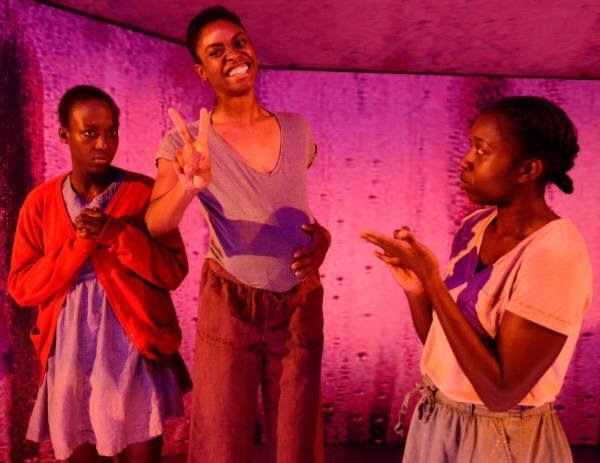
There are some unconventional design choices by Rosanna Vize – the forced perspective set creates a claustrophobic cave or shack but is undeniably pink. Though the colour of girls, its stark cleanliness is puzzling. The pile of grain in the corner is the same colour and used for various purposes. Though the symbolism of the design is clear, the execution further detaches the characters’ experiences from reality.

Ikoko’s script is certainly compelling storytelling and serves as a powerful reminder at how quickly issues become “old news” but still remain a problem. Her focus, whilst humanising these distant girls in Africa with lives cut short or forever changed, diminishes the terrorism that does this to them despite an unforgettable end to the story.

Girls runs through 29 October.

The Play’s the Thing UK is committed to covering fringe and progressive theatre in London and beyond. It is run entirely voluntarily and needs regular support to ensure its survival. For more information and to help The Play’s the Thing UK provide coverage of the theatre that needs reviews the most, visit its patreon.
Danger: Memory, Theatro Technis

In 1986, Arthur Miller was in his 70s. He still had more plays and screenplays to come, but his most well-known works were already created and he was starting to slow his output. Danger: Memory is one of these late, lesser known works, and spotlights the worries of someone in the twilight of their life. Two unrelated and stylistically different one-act plays are thematically timeless, but the truncated length doesn’t serve Miller’s usually rich stories and characters particularly well. 

Leo and Leonora spend most of I Can’t Remember Anything bickering like an old married couple. Though that’s how they come across for much of the play, their relationship is never defined – a persistent bugbear. Leonora’s husband is dead and her grown son is in Sri Lanka, but the reason these two people (who don’t like each other much) spend every evening together is never made clear. Much of their moaning revolves around old memories, forgotten details and an existential view of life which, though relatable, says little. Actors Julian Bird and Deborah Javor have great chemistry and some touching moments of tenderness, but the script is less of a narrative and more of a casual conversation that barely conceals Miller’s politics. Their characters have a decent amount of development, but the story is lacking. Enjoyable in the moment and evoking plenty of laughs, the end result is rather forgettable.

Clara has more tension and action than I Can’t Remember Anything, but the characters have less substance. The 70s cop drama with a stunned Julian Bird as Albert and relentless interrogator Detective Fine by the excellent Anthony Taylor is punchy but still powerful. Albert struggles to recall details of people close to his now dead adult daughter, but memories of her childhood are vivid. Simeon Miller’s intermittent flashbulb lighting design startles the way a sudden recollection does; this piece draws the audience in more than the first. The flashbacks with Clara (Kristy Quade) are moments of calm amongst the rapid-fire questioning, but the content lacks weight. There’s a hint of Miller’s earlier family dramas in these moments, but they don’t go as far as they could.

Good performances and lovely individual moments hold attention for two hours along with the wonderful novelty of seeing this rare text on stage, but as individual pieces the snapshots they provide are somewhat unsatisfying. Miller does grand domestic conflict so well that these single acts with limited plot development and hints of complex characters leave the audience wanting more.

Danger: Memory runs through 15 October.

The Play’s the Thing UK is committed to covering fringe and progressive theatre in London and beyond. It is run entirely voluntarily and needs regular support to ensure its survival. For more information and to help The Play’s the Thing UK provide coverage of the theatre that needs reviews the most, visit its patreon.

Imogen, Shakespeare’s Globe

All praise Emma Rice! Under Dominic Dromgoole’s artistic directorship, The Globe’s commitment to innovation in Shakespeare production first established during Mark Rylance’s reign fell by the wayside in favour of new writing; his Shakespeare generally stuck to original practices (OP) that Rylance and his team developed and championed. Shakespeare under Dromgoole was largely in this safe, now established style. There is value to be had in OP productions without a doubt, but entire seasons of it year in and out could certainly put off a seasoned regular. OP productions are so helpful in providing context for exams and a novelty to those who’d never seen this sort of work before, but for someone who has seen a lot of Shakespeare, there’s nothing inherently interesting in yet another OP production.

Rice’s appointment made the old, middle class (usually male) academics positively apoplectic what with her lack of Shakespearian credentials, intention to innovate and blatant feminism. Others were ecstatic on hearing the announcement – finally, Shakespeare that’s fit for the 21st century and something unlikely to have been seen before on the Globe’s stage. Since the season’s opening, her heavily adapted productions have received mixed notices from the mainstream press who, like the academics that bemoan the death of tradition, are mostly middle aged or older men, white and middle class (there are obviously exceptions). 

Matthew Dunster’s urban Imogen, the final show of Rice’s inaugural season, is the opposite of the restrained and well-spoken Shakespeare that these scholars and press use as a benchmark for quality. This anarchic gangland update of Cymbeline is exceptionally alive, aggressive, dirty and unapologetic. If we want young people and the general populace to take interest in Shakespeare, this is the sort of relevant work we need – not another well-spoken, corseted rendition. This production will rile those aforementioned critics and scholars, but they are wrong. It’s an absolute, undeniable fact that Dunster’s Imogen is a necessary, vital work.

Most of the ensemble employ a contemporary urban/London accent that comes with an undertone of aggression and a ballsy edge. Its energy and rhythm still works within Shakespeare’s verse, even without the open vowels and carefully pronounced consonants. The use of contemporary additional lines and ad libbing is no different than what is likely to have happened in Shakespeare’s day, and furthers the production’s accessibility. It is the accent of youth, the working class and this country’s disenfranchised. Dunster’s small choice to use this accent gives entire demographics validation on stage – their stories and lives are important and worthy of attention.

Placing young princess Imogen at the centre of the story is an empowering choice – Maddy Hill plays a strong, feisty and independent young woman. She admirably fights off her laddish step-brother Cloten’s (Joshua Lacey) revolting advances and for her husband Posthumous (Ira Mandela Siobhan) that her dad Cymbeline (Jonathan McGuinness) banished. Her constant battling against patriarchal structures that keep her second place to men rings painfully true today. Hill is supported by an outstanding ensemble that is racially, ability, and gender-diverse.

Jon Bausor’s simple but evocative set is reminiscent of a slaughterhouse or meth lab. Plastic sheeting that wraps around all but the very front of the stage shifts the antechamber forward so it’s closer to the audience, and can be drawn all the way back in the name of flexibility and openness. Flooring drives action towards the middle of the stage unnecessarily, though the front corners are still used – just not with any regularity. This is one of the production’s only faults.

Conventional and aerial fight choreography by Rachel Bown-Williams and Ruth Cooper-Brown doesn’t shy away from graphic tribal/gang violence and is of an appropriate scale for such a grand venue. Tracksuits and trainers are a functional uniform that’s easily colour coded to indicate Roman or English allegiance. This is a world where only the strong survive and the risk of betrayal is high, though there are gorgeous moments of tenderness, intimacy and brotherhood amongst the hardness. Shakespeare’s story translates remarkably well to this modern context, and the concept is imbedded thoroughly into the re-worked text, including the final jig. 

In Dunster’s Imogen, we see a Shakespeare that is hip, relevant and achingly alive. People from all walks of life can see themselves reflected in his modernised characters, not just the well-spoken middle and upper classes. Dunster’s commitment to Rice’s mission to make the Globe a place where audiences “ cheer and whoop and smell and feel the spit of actors on our faces” thorough, laudable and wholly necessary. 

Imogen runs through 16th October.

The Play’s the Thing UK is committed to covering fringe and progressive theatre in London and beyond. It is run entirely voluntarily and needs regular support to ensure its survival. For more information and to help The Play’s the Thing UK provide coverage of the theatre that needs reviews the most, visit its patreon.
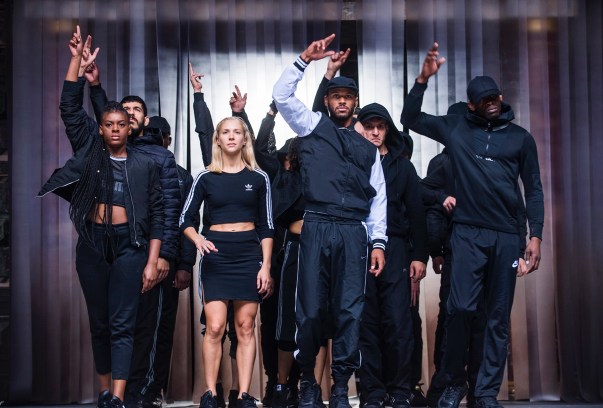
Layla’s Room, Theatre Centre

Layla is fifteen years old. She’s the cleverest girl in her year, writes poetry, and has a supportive mum. The trouble is, her best friend Monica’s got with a proper rude boy who launches a full-on campaign of abuse against Layla. As the bright, happy girl monologues her ordeal around short scenes, the focus splits – though her treatment at the hands of her peers is a horrific primary storyline, other concerns arise. Issues such as body image, friendship, gender pay gap, education, dating and alternative families all find their way into Sabrina Mahfouz’s script. Mahfouz makes Layla a rounded, complex character with potential for numerous stories rather than becoming a single-issue driven vehicle; an excellent cast and supporting characters give the play depth and an appeal to its teenage target audience.

Shanice Sewell plays Layla with vivacity and charm. She is the daughter every mum wants – a good kid with ambition and warmth. Emma White’s Monica is a great foil who, although a girly contrast to Layla’s sporty boyishness, doesn’t alienate audience members who focus more on fitness, fashion and boys than school. Alex Stedman plays several male roles in a skilled display of multi-rolling. There is some lovely chemistry developing between the three actors that is sure to grow as the run goes on.

Though Monica’s choices come with clear moralising, it isn’t too heavy handed. She’s more misguided than a bad girl, demonstrating how easy it is to be lead astray. Her boyfriend Joe is a nasty piece of work, but contrasted by Layla’s doting father and quiet boy Reece, who’s long fancied her. Mahfouz commendably paints almost all of the characters as flawed, but positive – she and Theatre Centre totally get that preaching to kids doesn’t work.

The hour-long running time is spot on for the format. More scenes and fewer speeches would make the piece more dynamic were it longer but as is, it works. Designer Ele Slade’s monochrome set hints at the young people’s London without diminishing their colourful characterisation.

Layla’s Room, though clearly pitched to a teen audience, appeals more widely through its easygoing characterisation and approaching the ideas without condescension. The story is warm and caring, setting realistic examples without over-egging the message.

Layla’s Room tours through 23 November.

The Play’s the Thing UK is committed to covering fringe and progressive theatre in London and beyond. It is run entirely voluntarily and needs regular support to ensure its survival. For more information and to help The Play’s the Thing UK provide coverage of the theatre that needs reviews the most, visit its patreon.

dreamplay, Vaults Theatre

August Strindberg’s expressionistic A Dream Play has inspired theatre makers since it’s debut in 1901. In the otherworldly Vaults, BAZ Productions reinvents the innovative work for a modern audience. A collage of loosely connected characters flit back and forth through time and space, never quite fully formed but too visceral to be wholly in the mind. This is no linear, unified world, but one that traverses several planes of existence. Live music and interaction fosters inclusivity, though some of the content is far from warm and cuddly. This dreamplay is certainly surreal and atmospheric, but overly broad themes and the lack of a strong through-line makes for a generalised moodiness that leaves little lasting impact beyond striking imagery.

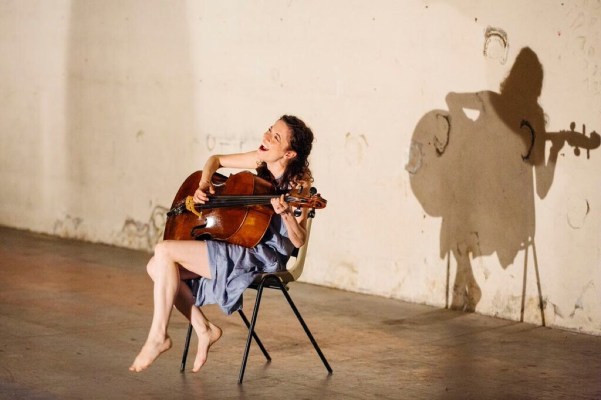
Laura Moody’s acoustic cello and operatic vocals add richness and depth to the piece, and are the most striking feature of dreamplay. Even the softest tones echo through the Vaults’ tunnels and quite possibly still linger there in the darkness. There is not enough music to form a soundtrack, but any more of her music would cause it to lose its impact.

Four actors form the rest of the ensemble cast who take on multiple roles. With impressive CVs behind each of them, their performances are suitably engrossing even though the script’s scenes deliberately evade connection to others. Jade Ogugua particularly entrances as the non-verbal dancing girl who wears her heart on her sleeve, and Jack Wilkinson’s stage door keeper elicits laughter from his attempts to wrangle defiant performers.

The script has lovely individual moments that are beautifully realised fully formed by director Sarah Bedi, but beyond satisfying visual appetites, it lacks substance. The text draws the audience in, but after we are spit back onto the surface of Lower Marsh, it mostly fades. Flickering images remain as if on deteriorating film stock, but with no coherent message – a disappointing effect after such striking execution, even if this is reminiscent of a dream.

dreamplay runs through 1 October.

The Play’s the Thing UK is committed to covering fringe and progressive theatre in London and beyond. It is run entirely voluntarily and needs regular support to ensure its survival. For more information and to help The Play’s the Thing UK provide coverage of the theatre that needs reviews the most, visit its patreon.
The Awakening, Jack Studio Theatre

Johannes, a young man with pronounced learning difficulties, is in solitary confinement for raping and murdering a young girl. The prison captain Agnes, seeing goodness in the boy, introduces him to Christianity and gains permission for him to live and work on a remote island farm. Sadly, her good intentions don’t come to fruition in this story that disintegrates as quickly as its moral compass does. A strong cast of four help ease the discomfort that abuse and structural weakness encourages, though good performances aren’t enough to redeem The Awakening.

Unn (Joana Nastari) lives alone on the farm she runs whilst her brother is at sea fishing most of the year. Keen to have help, she seeks out Agnes for help finding a suitable farmhand. Nastari is the highlight of the show as she delicately guides Unn’s transformation from cold dictator to accommodating teacher; it’s a marvellous transformation despite the character’s questionable ethics. Alex Dowding’s Johannes is charming and innocent, with the added depth of a violent edge that could emerge at any moment. 

Despite the performances, Julian Garner’s script is the problem here. The plot becomes more and more choppy as it goes on, as if Garner cut entire scenes in the last third in order to meet a running time restriction, leaving the whole thing to collapse at sea. The ending offers no resolution or explanation for Unn’s choices, and supporting character Iversen is underwritten and implausible. An interval serves to fragment the story even further and the initial work on relationships to disappear.

The minimalist set by Florence Watts is versatile and indicative of the Scandinavian setting, complimented by Jennifer Rose’s sleek lighting. Director Medelaine Moore captures the rhythm of the scenes well, though she makes some questionable staging choices in the routes through and around the space – they become comical rather than indicative of a location change.

The Awakening feels like the work of an inexperienced playwright, though the production does a fairly good job at realising the characters and ideas that are lightly sketched in the script. It has the potential to be a challenging story; instead it drifts away into nothingness.

The Awakening runs through 24 September.

The Play’s the Thing UK is committed to covering fringe and progressive theatre in London and beyond. It is run entirely voluntarily and needs regular support to ensure its survival. For more information and to help The Play’s the Thing UK provide coverage of the theatre that needs reviews the most, visit its patreon.