
by Laura Kressly
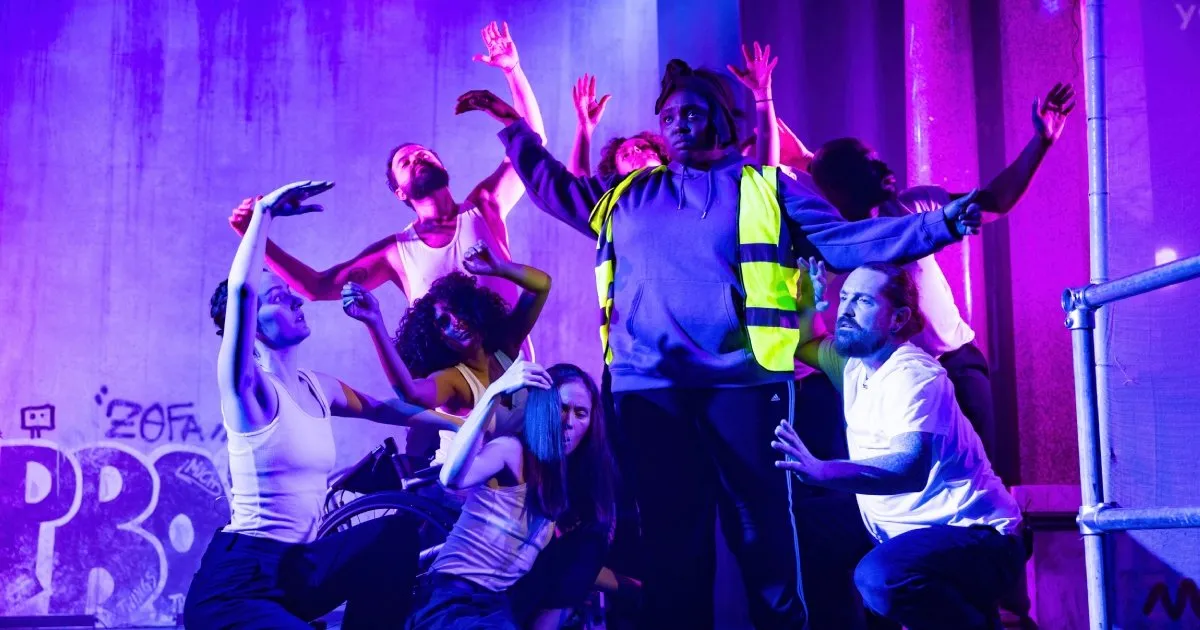
It’s getting late and raining hard, so most people have settled in for the night. Instead of a quiet one, playwright Paula B Stanic’s world premiere takes us to Croydon, where an array of night shift staff are working. We meet a huge host of Deaf and hearing people, including an emergency services dispatcher, a delivery driver, a DJ, a doctor, and a train driver who keep the borough moving whilst everyone else sleeps. As the storm floods the streets, the disparate collection of characters struggle to get their work done and battle with their own demons across short scenes and movement sequences.
Rather than a singular story with one protagonist, Stanic’s script is a collection of many smaller ones. This gives a wide-angle view of a segment of society that are largely ignored or forgotten by 9-5ers. Whilst we may think there aren’t many nighttime workers, the width and breadth of jobs portrayed effectively challenges this assumption. However, the large number of characters means that we only get to know them a little bit, and the action is slow to develop despite some of the scenarios’ high stakes. The pace can also be quite sluggish, particularly in the earlier scenes. The old-fashioned, proscenium arch hall further flattens the ensemble’s energy and swallows these quieter moments. Though the dialogue – spoken and signed – has a lot of impact on its own, the delivery and space work against it.
The play focuses on people already working in society’s margins, but it really shines in the liminal spaces around them. The scene transitions and movement sequences are slick, sophisticated and utterly absorbing. Zoo Co’s strengths as an ensemble devising company are evident in these in-between moments on the edges and creases of those already marginalised. The directors do their best to bring these close to the audience and create a sense of immersion that is missing during the main scenes. Also typical of Zoo Co’s work, the cast consists of both Deaf and hearing actors, and the show is captioned and signed throughout. This contributes another compelling layer of choreography that adds dynamism to the production.
As well as this fantastic inclusion and ensemble work, Stanic’s critique of capitalism and classism has sharp, political teeth. Though the pandemic prompted reflection on the importance of many of these jobs, the people doing them are still underpaid, overworked and endure horrendous, risky conditions for the sake of their pay packet. No one here has it easy, even those in what are widely considered ‘proper jobs’ like surgeons and and politicians. Though the execution needs some polishing and a black box space would be far better for the production style, huge heart, activism, and a lot of passion are at the forefront.
Night Shift runs through 25 November.
The Play’s the Thing UK is committed to covering fringe and progressive theatre in London and beyond. It is run entirely voluntarily and needs regular support to ensure its survival. For more information and to help The Play’s the Thing UK provide coverage of the theatre that needs reviews the most, visit its patreon.
 The Play's The Thing UK