
by an anonymous guest critic
It is a fool’s errand to try to review Trajal Harrell’s epic trilogy Porca Misera. It is a 3.5 hour-long monster of a show in three parts, which tests the limits of audience endurance and patience.
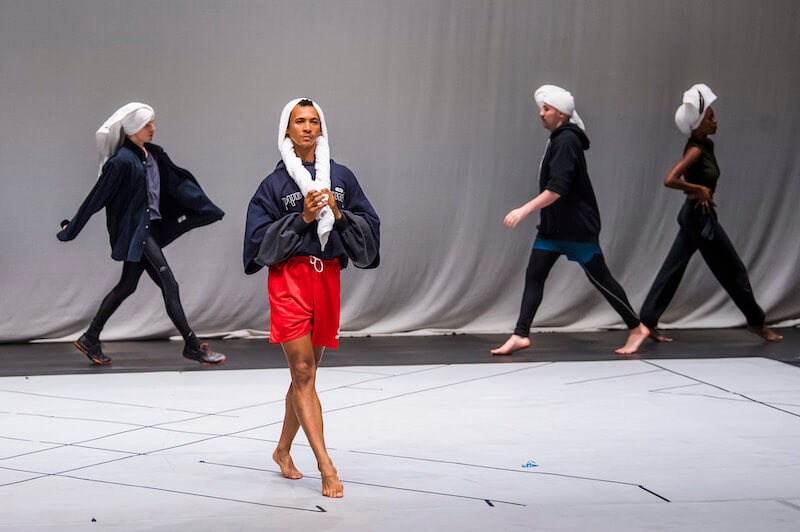
For the first, we are seated on the stage of the Barbican, up close and intimate with the 12-strong company. The piece, Deathbed, has clear themes of grief in it. People to the side of the stage lay out small items on velvet trays, as if enumerating a life. The dance ranges from a serious-faced skipping to a mournful procession later. Dancers walk in slow motion with colourful lampshades on their heads. Perhaps they represent urns.
It is strong, unflinching, deliberate performance. By using the physical language we all likely recognise from funerals, we cannot escape confronting our own feelings about death and the ceremony around it.
For parts two and three, we head back to the venue’s standard auditorium seating. Part two, O Medea, is a filmed performance made during lockdown. Over the 30-minute piece, the on-screen dancers progress from dancing prostrate on concrete at dawn, through flinching, twitchy dances of sadness – sometimes seeming to truly cry – to a more relaxed dance party as the sun goes down.
Although the piece was clearly an expression of grief and sadness, there didn’t seem to be any exploration of the wider themes of Medea, nor did the piece attempt to identify any performer as any particular character. Rather, they seemed to grieve and recover as a unit of four, maybe drawing on the shared feeling of the Greek chorus grieving for the characters in the text. This is the weakest part of the trilogy. Watching dance on screen is rarely effective, and watching 10 minutes of twitching on the floor does nothing towards the evening’s enjoyment.
Part 3, Maggie the Cat, is an exuberant celebration. The company are back, and mostly vogueing across imaginary catwalks with various garments made out of cushions and quilts, whilst Harrell and another company member rap, or sing childish songs into the mic. There was no explicit link to Cat on a Hot Tin Roof, the inspiration for the piece’s name, apart from the frequent mentions of Maggie the cat in the sing-song or garbled, gibberish lyrics.
Overall the piece is an overlong and arduous watch that does not live up to the hype surrounding it. All of the pieces lack focus, and fail to interact with each other in a meaningful way. However, Maggie the Cat is definitely the most enjoyable: the company’s enthusiasm and verve, and the silly cushion costumes mean that at the very least the evening ends on a somewhat higher note.
Porca Miseria – Triple Bill runs through 14 May.
The Play’s the Thing UK is committed to covering fringe and progressive theatre in London and beyond. It is run entirely voluntarily and needs regular support to ensure its survival. For more information and to help The Play’s the Thing UK provide coverage of the theatre that needs reviews the most, visit its patreon.
 The Play's The Thing UK