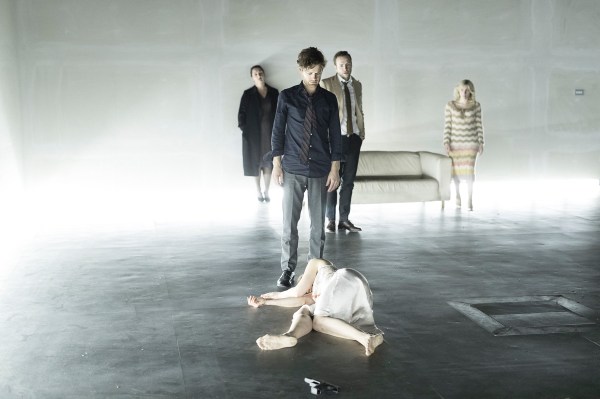
Hedda Gabler, National Theatre

Hedda Gabler should be happy in the 1890’s world that Ibsen created for her. She has everything a woman wants: a successful new husband, servants in a huge new apartment and possibly a baby on the way. But she’s not happy with her lack of autonomy, and power others have over her and her body now that she is a wife. Railing against the patriarchy, she draws feminist audiences to her side despite her paradoxically strong helplessness. She is a quiet revolutionary, a martyr, a catalyst, and despite fighting against the society in which she lives, she is a product of it. In her being out of place, she fits. 

That’s a large portion of the problem with Ivo van Hove’s Hedda Gabler. He has forced her into a wealthy and minimalist present, and made her so unpleasant that she comes across as quite the nasty piece of work. Whilst her behaviour is understandable in the face of the horrendous misogyny she encounters, empathising with her – and anyone else – is difficult and the characters’ choices are often wholly implausible in present day. Some of van Hove’s choices are so uncomfortable that even though they try to challenge Hedda’s oppression, they imply masculine complicity or at the very least, indifference.

Patrick Marber’s script has been streamlined from Ibsen’s, though there is a scattering of jarring anachronisms. His update is largely believable and the characters’ economic privilege is a dominant theme. He stays close to Ibsen’s script, but too much so for it to be completely believable in the present day. Further divergence would certainly be a more interesting premise.

Ruth Wilson’s work is stunning, though – her performance is up there with Denise Gough’s in People, Places and Things. She successfully grapples with Hedda’s emotional changeability and displays a stunning range of aggression, vulnerability and volatility. Her reactions are totally unpredictable, matched in intensity by Rafe Spall as a totally abhorrent Brack. Chukwudi Iwuji’s Lovborg is also excellent, with an earthiness and emotional life that betrays his American training. Though it doesn’t add anything or detract from the performance, it is great to see a cast from around the world, with their native accents on show – a reflection of the range acting talent in the UK outside the white, British standard.

Van Hove’s expansive minimalism further develops a world where Hedda is out of place, but the sparsely furnished living room is so huge that no one seems to belong there. Though it forces distance between the characters, everyone is isolated and on show – not just Hedda in her ridiculously, barely-there slip of a dress. The aesthetic more closely resembles a modern art gallery than an upscale urban apartment, and the choice reeks of vanity rather than function. Even the plethora of brightly coloured flowers that are slowly crushed under foot (an obvious metaphor for Hedda herself) are more reminiscent of an art installation than a newlywed couple’s home.

Making mostly-silent maid Berte (Eva Magyar) ever present on the edge of the stage is also an evocative choice. Instead of supportive sisterhood, she is silhouetted and watchful, complicit with the men. Hedda’s pistols, mounted in a glass cupboard, are also a continuous threat – even though they are her’s, anyone can access them. They are not exclusively her’s, or a secret. 

By far, the most disturbing choice during Brack’s blackmail scene is the use of what appears to be an innocuous can of Coke, but its contents and their violent employment go beyond powerful, into the territory of offensive. The shock value this abusivemoment creates is entirely excessive, particularly when alluding to a woman’s inability to carry a pregnancy to term.

Though Hedda is a character that defies pinning down, van Hove’s attempts to crucify her on the wall of his exhibit is too much. The performances are certainly worth seeing, but the context they are placed in is an uncomfortable and totally inappropriate one to witness. The play itself does a fine job at advocating for feminism without the gratuitous choices in this production.

Hedda Gabler runs through 21 March.

Press tickets courtesy of Theatre Bloggers.

The Play’s the Thing UK is committed to covering fringe and progressive theatre in London and beyond. It is run entirely voluntarily and needs regular support to ensure its survival. For more information and to help The Play’s the Thing UK provide coverage of the theatre that needs reviews the most, visit its patreon.

The Tempest, Cockpit Theatre

Shakespeare’s original performances wouldn’t have had rehearsals or a director, and the actors never received full scripts – it was too expensive and time consuming to copy them out. Instead, they learnt their lines and cues from a script that was just that – their lines and cues. This cue script technique is now a huge challenge to actors who are used to weeks of rehearsal and analysis before their first performance, but it’s a fun exercise – for performers. Audiences used to nuance and polish in their Shakespeare will miss these elements, even though the seat of the pants approach inevitably brings unintended comedy. Clocking in at three hours long with a large cast, this is a worthy experiment and one that is helped along by a director, but the approach lends itself to a snail’s pace and underdeveloped characters.

The performance is often slow and flat despite a prompter’s help, as actors tend to focus on their lines rather than characterisation and responding to others. Some are better at it than the rest, making the pace inconsistent. Those that struggle aren’t better or worse actors no more than the ability to, say, play a musical instrument or juggle does – but regularly needing support with lines inhibits connection with the story. Scenes with more characters are more of a challenge what with snappier dialogue and more cues; unfortunately these are most effective when played at speed. Speeches and two-character scenes are more successful, with greater energy and emotional range – Prospero and Miranda’s first scene together is particularly lovely.

This Salon:collective production is worth commending for their experimentation and diversity. Four roles normally played by men are now women, with language adapted to match: King of Naples Alonso (Geraldine Brennan), Prospero (Lizzie Conrad Hughes) Francisco (Odera Ndujiuba) and Gonzalo (Angela Harvey). With powerful characters now female, this world of betrayal and magic is distinctly feminine, which completely alters the relationship dynamics between characters. A female Gonzalo’s support for a female Prospero in the face of forced exile by male Antonio (Dominic Kelly) reframes the event as sisterhood in the face of masculine oppression of women in power – an example of the impact gender reversal can have in Shakespeare’s texts. 

Some of the cast are particularly excellent. Dewi Hughes’ Trinculo is flamboyant and prissy; his attempts to tolerate Stephano and Caliban are utterly joyous. Alex Vendittelli’s camp Sebastian elicits belly laughs from bitchy looks and dry delivery, even when forgetting lines. Laurie Stevens’ Miranda’s innocence and joy is lovely, but she’s not all perfect – there’s a teenaged stroppiness she takes on around her mother. 

The company as a whole handles the space particularly well, and is largely confident enough to employ direct address to the audience. The design elements do little to add detail – the music and sound design it too repetitive. The costumes are rather generic, though at least the design is consistent and appropriate to the world of the play. Lighting could have been used to create more environmental contrast.

As the Salon:collective is a training body for actors, it’s understandable that their focus is on enabling their students to grow. The trouble is that this process doesn’t always make the most compelling of performances. This version of The Tempest, no doubt a brilliant challenge for the cast, is too long and often arduous for the audience.

The Tempest runs through 15 January.

The Play’s the Thing UK is committed to covering fringe and progressive theatre in London and beyond. It is run entirely voluntarily and needs regular support to ensure its survival. For more information and to help The Play’s the Thing UK provide coverage of the theatre that needs reviews the most, visit its patreon.

Santa’s Stocking, Lost Rivers Elephant

Amongst all the dispute about whether or not new venues should be opening, Lost Rivers Brewery, known for their Bermondsey Yard Cafe and other pop-up venues, have quietly expanded from beer into performance in their brand new temporary venue. Made out of shipping containers and a stretch tent on a pre-regeneration patch of land in the Elephant & Castle, Lost Rivers Elephant is unassumingly tucked behind the shopping centre and train station. It’s no mirrored spiegeltent or purple cow, but its rough-and-ready simplicity and grit approaches the edge of minimalist cool. Their debut show, the circus/cabaret Santa’s Stocking by Zero Central (creators of The Raunch), is a hit-and-miss collection of acts with a decidedly stronger second half. The show and venue are still very much finding their feet, but there is evident promise within some powerful moments (and excellent pints).

Hosted by X-Factor contestant Seann Miley Moore and Gingzilla, the two form a fabulously queer, gender binary-defying duo exuding pride and sex appeal. Their cheesy, punny banter wears on entirely too long but redeem themselves somewhat with well-sung Christmas and pop songs.

Of the Act I performers, Candy Cane Girl (Teresa Callan) is a smily, bendy hula hooper with moves that gradually increase in skill and complexity. She is accompanied by animated kaleidoscopic projections that add more adult flavour. She is the strongest in the first half, narrowly outdoing a Cyr wheel elf who tries and fails to flirt with the audience.

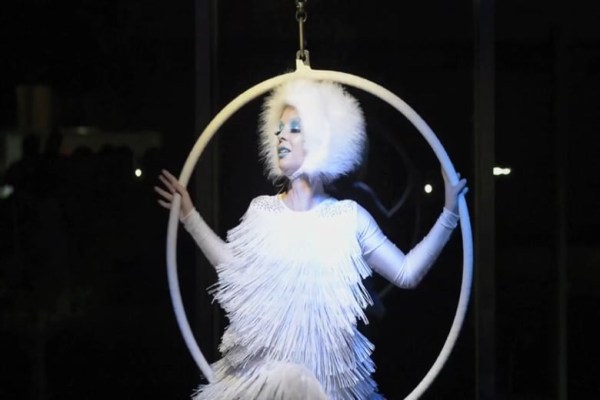
The second half mercifully has less of the hosts’ banal chat, more impressive circus and bolder sex. Hand balancer Michael Standon has an unusually impressive fluidity, Gingzilla’s Santa strip tease is akin to a opening a wonderfully unexpected gift on Christmas morning and Moore’s rendition of Hallelujah accompanied by ariel hoop artist Jo Foley is an exquisite finale in this intimate cabaret venue. 

Zero Central does well considering the space limitations in Lost Rivers Elephant, though cutting down the introduction, adding more punchy acts to the first half and taking out the interval would certainly improve the show. Shared lighting encourages guests to move around as needed, with food and drink easily accessible. With a bit of jazzing up, this intimate new venue could certainly become quite an exciting offer with a specialisation in small-scale circus and cabaret.

Santa’s Stocking runs through 22 December.

The Play’s the Thing UK is committed to covering fringe and progressive theatre in London and beyond. It is run entirely voluntarily and needs regular support to ensure its survival. For more information and to help The Play’s the Thing UK provide coverage of the theatre that needs reviews the most, visit its patreon.
Muted, The Bunker

The Bunker’s debut season in the Menier’s disused carpark-turned-theatre has been nothing short of triumphant. Isley Lynn’s Skin A Cat and Philip Ridley’s Tonight With Donny Stixx, transfers from VAULT Festival and Edinburgh respectively, are rounded out with new British rock musical, Muted. The story of a promising, young musician who stops speaking after a string of highly traumatic experiences is surprisingly complex with some great numbers – but the script gets lost within itself. There are a few too many subplots and surprises that crowd out the main storyline and dilute the power of the message of hope and recovery.

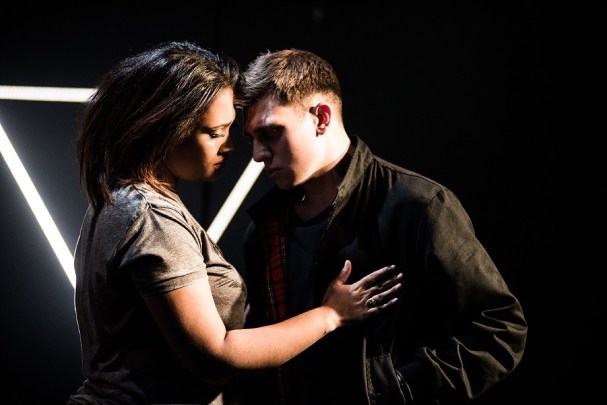
Lauren (Tori Allen-Martin) and Jake (Jos Slovick) are a young, urban couple with loaded pasts and the urge to help their friend Michael, who’s shut himself away in his uncle’s Bethnal Green house and refuses to speak after his mum’s sudden death. As Lauren tries to coax him to speak to her by recounting good memories, Michael is tormented by darker times. His younger self and mum are sporadically made flesh by Edd Campbell Bird and Helen Hobson, though the majority of the action is in the present. Emotions and personal history get the better everyone, causing inevitable conflict and heartbreak.

The trouble is that Sarah Henley’s book packs in too much, and true transformation is minimal and slow. Hurt feelings and arguments abound, but little is achieved from them. There are some genuine surprises, but amongst the tangle of plot lines, they lose their impact. Allen-Martin and Tim Protty-Jones’ music is generally strong, though there’s a handful of overly trite lyrics. Some of the tunes are too short and come to abrupt ends, but others are absolutely cracking. 

Designer Sarah Beaton’s set is simple but a wonderful juxtaposition to the sticky web that entraps the characters. A swing hovers above a boxy platform containing a large island surrounded by water. All black and angular, the construction is a subtle metaphor that enhances symbolic but occasionally clunky choreography by Isla Jackson-Ritchie. 

Though the performances take a bit of time to gather speed and the script doesn’t quite manage to come together seamlessly, the story Muted tells is full of heart and potential. The passion and commitment in the work is clear, and the characters are real flesh and blood. It’s not a big, showy American musical, but one that is distinctly and quietly British. With more development and dramaturgical support, Muted will really shine.

Muted runs through 7 January.

The Play’s the Thing UK is committed to covering fringe and progressive theatre in London and beyond. It is run entirely voluntarily and needs regular support to ensure its survival. For more information and to help The Play’s the Thing UK provide coverage of the theatre that needs reviews the most, visit its patreon.
Benighted, Old Red Lion Theatre

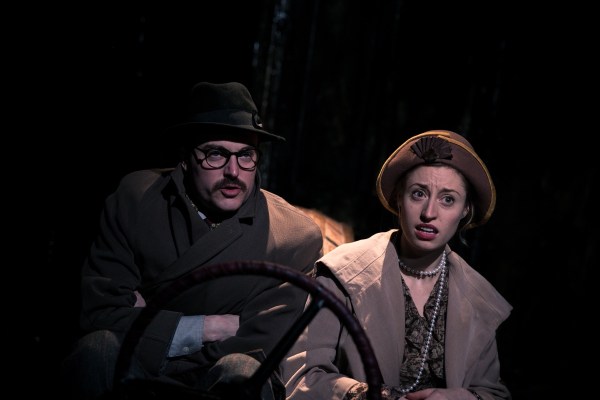
When repressed middle class couple Mr Phillip and Mrs Margaret Waverton and their friend Roger get lost in rural Wales in a horrific downpour, they head to the nearest house for shelter. With the roads flooded and cars in the 1920s not what they are today, they are well and truly stranded until the waters recede. But the creaking edifice and its ancient hosts, brother and sister Horace and Rebecca Femm, are not as welcoming as they hoped. The world premiere of this adaptation of JB Priestley’s early novel spanning a single terrifying night is a fun, jumpy thriller executed with polish and conviction.

The design is a particular highlight. Gregor Donnelly makes an immediate impression with his cubic fireplace, uneven floor and wall of floating chairs – we know we’re entering a world that is far from the way it should be. Though the set shows detail and thought, it doesn’t dominate the small stage and provides the actors with distinct levels and playing areas. David Gregor further enhances the tension and fear with his excellently layered sound design that’s akin to a cinematic score – something rarely heard in small-scale theatre but contributes so much to small budget shows.

The cast of six form a polished ensemble, with Matt Maltby as Roger and Jessica Bay as showgirl Gladys particularly standing out. They all attack their heightened characters with energy and commitment – a pleasure to watch. There is also some solid multi-rolling from Ross Forder and Michael Sadler, though director Stephen Whitson has Forder play a woman rather than casting another woman and attempting to even out the gender disparity. 

Duncan Gates’ script is well formed, creating suspense with good effect. Whitson captures its rhythms with intuition, though a singular, stylised fight scene is out of place. Some of the transitions are slightly clumsy, but these will easily speed up after a few more performances. The play’s anti-war, pro-veteran agenda is slow burning but satisfying when revealed and unfortunately, one that is still relevant despite the time period.

Other than a few minor issues, there is little that detracts from the deliciously classic film vibe of Benighted. It’s a great story that is well executed and a welcome break from saccharine holiday theatre.

Benighted runs through 7 January.

The Play’s the Thing UK is committed to covering fringe and progressive theatre in London and beyond. It is run entirely voluntarily and needs regular support to ensure its survival. For more information and to help The Play’s the Thing UK provide coverage of the theatre that needs reviews the most, visit its patreon.
Monorogue: Elf Off, Old Red Lion Theatre

https://i0.wp.com/northpoleexperience.com/wp-content/uploads/2014/09/slide-1.jpg

The Salon:Collective’s Monorogue is back again, this time with a Christmas edition. The monologue showcase is now in Santa’s workshop, where perky elf Gingersparkles is interviewing human candidates for a vacancy in the Lapland workshop. Seven lacklustre individuals who can’t otherwise find seasonal employment are created and performed by Salon:Collective actors in this spunky, lighthearted show where the audience gets to vote for the best performer/character. Distinctive characters and good performances are the trademark of this regular event, and the framework around the monologues makes for more palatable viewing.

The set is a simple construction of heaps of brightly wrapped presents, Christmas decorations and toys. It’s easy, cheap and hugely effective in the intimate blackbox theatre. Though perhaps unintended, it is also a lovely juxtaposition to some of the more down-at-heel characters.

The performances are generally good, though some of the characters tend towards stereotypical and miss opportunities for nuance. The standouts are Lucy Gallagher and Louise Devlin’s intense Scottish tomboy Mae, and Angela Harvey’s struggling mum of five Hayley. Rachel Stoneley’s confused but sweet stripper, Jade, is a great way to wrap up the candidates. Laurie Stevens is the adorable Gingersparkles, but she surprises with a ferocious climax that wraps up the evening well.

The scripts have a strong lean towards comedy, which suits the time of year, but some of them lack depth and choose to mock personality traits rather than empathise. Whilst there is nothing overtly offensive and the stereotypes created are identifiable and relatable, there is room for more variation.

Monorogue proves again that they offer an entertaining event that allows actors and playwrights to showcase their talents without taking the more common, in your face approach to self-marketing usually found in showcases. The theme sets the actor/writers a challenge and gives the audiences a needed framing device, and the performances are usually good.

Monorogue: Elf Off is now closed.

The Play’s the Thing UK is committed to covering fringe and progressive theatre in London and beyond. It is run entirely voluntarily and needs regular support to ensure its survival. For more information and to help The Play’s the Thing UK provide coverage of the theatre that needs reviews the most, visit its patreon.

The People Show 124: Fallout, Toynbee Studios

https://i0.wp.com/cdn.paper4pc.com/images/desert-landscape-pictures-wallpaper-2.jpg
Making devised work for the past 50 years, People Show are nothing less than prolific. Their multidisciplinary works are numbered as part of the title; the company’s works now number 132. To celebrate their anniversary, the company’s taken over Toynbee Studios for three days, filling the venue with performances, films and an exhibition celebrating their half a century of work.

People Show 124: Fallout, first performed in 2013, is resurrected here. The piece deconstructs speeches by public figures and adds light, sound and film; the overall effect is one of provocative absurdity – isolated soundbites lose all meaning, even in a world that’s said to be falling apart. This short piece drives its point home quickly and efficiently and stimulates the senses, but with its message emphasising meaninglessness, it soon becomes repetitive.

Everything in the room is white, even the padded floor is powdered with talc to add an additional layer of frost. Pillows attached to the walls evoke a soothing dreamscape. But soon, pulsing colours disturb the peace as the cast of four fiercely deliver snippets of text. The lights are often so bright they are uncomfortable, even though the colours are childlike and fun. The juxtaposition is clever and sharp, and the switch from austere to saturated is an effective one.

The actors’ tone ranges from gentle to antagonistic, with a decidedly post-apocalyptic bent to the text. Projections of sweeping desert landscapes back up the promises of nuclear fallout, though the dreamy atmosphere from the beginning still lingers – what is real, and what is the product of our subconscious? The disconnect from reality diminishes any potential meaning, making the outcome decidedly absurd, even though the intention seems to want to carry more weight.

This colourful world enhanced with gorgeous projections, bright lights and music is integrated  with the text, though there is a lack of development in the core idea of the piece. If real life is has no purpose and we’re better off in a dream because the world is hellbent on destroying us, that’s fine – but a performance telling us that is not an easy thing to execute and in this case, not done fully effectively.

People Show 124: Fallout is now closed.

The Play’s the Thing UK is committed to covering fringe and progressive theatre in London and beyond. It is run entirely voluntarily and needs regular support to ensure its survival. For more information and to help The Play’s the Thing UK provide coverage of the theatre that needs reviews the most, visit its patreon.

Bianco, Southbank Centre

https://i0.wp.com/caramellattekiss.com/wp-content/uploads/2014/06/6T9T8237e1.jpg

By guest critic Rebecca Nice @rebeccajsnice

NoFit State Circus takes London by storm with a big show in a big top with grand ideas and huge audiences. A must-see on the London tourist and art scene, the slightly ominous looking grey tent is nestled into a winter wonderland of overpriced bars with a ticket price to match but the raucous, everyone-welcome, ‘roll up roll up’ nature of circus emanates from the tent in boundless quantities. Programmed by the Southbank Centre in a key Christmas location, Bianco will undoubtedly reach new audiences – which brings a certain responsibility to the oeuvre. The show not only introduces circus to new and well-seasoned theatregoers, but it sits within a concentration of productions in Southbank’s multiple venues that all want to be the cream of the crop. Based on a series of short acts that each display a specific circus skill, Bianco is accessibly fast paced but disappointingly repetitive in its lack of dramaturgy.

The main attraction of Bianco is a set made of scaffold ladders and truss that are separated, wheeled about and reset between acts. Audiences can move at their will, see things close up, from behind or directly underneath. The crew happily holler ‘mind ya backs’ as they restage and point you in new directions. This makes for constantly changing viewpoints; you always have the best seat in the house as you watch from wherever you want to be. Four towers form a central square area where truss cross bars support trapeze acts and tightrope walkers accompanied by live music. The greater sense of agency makes for a work that is almost promenade and immersive in terms of the sensory landscape. This culminates in a final snow scene where glowing white (foam) snowflakes descend upon our shoulders.

The original music ranges from folk to lyrical, acapella to rock and pop, as singer-musicians Andy Moore, Annette Loose, Doug Kemp and Matt Collins swap microphone for guitars, saxophone to accordion and double bass to drums. The strong musical score sets the tone and atmosphere for each piece and holds the work together during down moments where scenery is being set.

No Fit State travels and lives together, erecting and dismantling the big top and their lives to pack them away for the next place. This traditional circus lifestyle is evident in the precision, communication and identity of the cast and this connection feeds through into performance both in terms of the mechanics of the show and the performative camaraderie between characters.

Artistic Director Tom Rack and Director Firenza Guidi work here with a cast of seventeen, each with their own act, and it is the stringing of these together like a never-ending list of circus skills that is a downfall for the work. Bianco is long and relentless with one person after another selling their wares. Any loose plot or theme to mesh these phrases together are lost and the sheer volume of content begins to hinder the success of the piece as each new act blurs into another and recalling previous ones becomes impossible.

Out of a whopping number of acts (over eighteen), from solos to full ensembles, few stand out in either creating striking visual compositions or containing themes and characters that allow the circus skills to be fully shown off. The female juggling solo may not throw the highest club or make the most complex siteswaps but the throws and catches between the legs, behind the body and into the audience make a vivacious, flirty and clumsy character fully realised and incredibly funny, firmly rooted in her choreography and clowning. The sheer volume of this company in numbers of performers and size of the performance space provides tableaus not seen before. Five ropes in line, each with an individual aerial performer who turn and ascend in unison are a feast for the eyes. The entire cast emerging from the dark, lit by flaming torches or a man spinning inside his cyr wheel flanked by four figures dangling from aerial hoops make for striking compositions. A solo female performer hangs upside down from a rope with her legs bent and toes facing the ceiling. As the loose end of the rope drapes on top of her feet in a perfect curve, she lets herself slowly down as if magically walking upside down along this arc. Gems like this unexpected delicacy in a fresh take on an old trick appear sporadically in Bianco, but are in danger of being lost with the acts being so short and so many. Hula hoops are spun and aerial hoops rotate, performers swing from swags of loose hanging rope or shimmy along a tightrope. Jugglers swing on a trapeze, two aerial silks support solo and duet. A trampoline is rolled out, there is a handstand act and a contortionist with a wine glass balancing act. Box frames spin on high with strings of beads creating sparkling halos and another trapeze act appears, this time with a dress embellished with fluorescent lights. Many acts like these are cut short before they reach their true potential.

I delight in the seaside swim scene with up to nine performers diving from the heights of the big top onto a central trampoline. Dressed in old fashioned striped bathing suits with arm bands or goggles, this scene is visually wonderful but could be stronger if the choreography and swimming motifs were tighter and crisper. Compositions of performers diving one after the other can be more tightly woven into mini sketches. What if someone wearing a shark fin dived in, or someone belly-flopped and bounced everyone out of the sea? What if someone was scared of the water and got stuck on the high hanging rubber ring? Scenes like these don’t quite reach a climax in humour and pacing of skills.

After two hours and twenty minutes of high energy, constant tricks and emotive portraits of people laughing, shouting, twisting and turning on high, both audience and cast are exhausted and elated. A sinuous male aerial act returns to close the show on a rope as his curly locks and chiaroscuro muscles form a Christ-like visage. The lyrical piece is an unapologetic show of human beauty as the Vitruvian man soars in circular flight as artificial snow falls from the darkness. It is this image that leaves an imprint in my mind, of hundreds of tiny people looking up to the dark depths of the tent top, dancing in the snow.

Bianco runs through 22 January.

Tickets arranged by Theatre Bloggers.

The Play’s the Thing UK is committed to covering fringe and progressive theatre in London and beyond. It is run entirely voluntarily and needs regular support to ensure its survival. For more information and to help The Play’s the Thing UK provide coverage of the theatre that needs reviews the most, visit its patreon.

Her Aching Heart, Hope Theatre

Pantos are great –  but it’s easy to overdose and they can feel rather samey if you see more than two or three a season. The trend for adult and alternative pantos is great for adding variety, but they tend to follow similar storylines and narrative formulas. Bryony Lavery’s victorian send-up Her Aching Heart has all the OTT melodrama and silliness of a pantomime, but this two-character, lesbian love story is decidedly not a panto. Full of innuendo and comedy, the play-within-a-play is a well executed, richly designed and utterly delightful affair.

As two contemporary, nameless women fall in love over gothic novel Her Aching Heart, the book unfolds around them in reams of velvet, riding crops and bloomers. With heaving bosoms and heightened emotions, Lady Harriet Hellstone of Hellstone Hall (Colette Eaton) encounters bewitching blond peasant Molly (Naomi Todd) whilst hunting in the wilds of Cornwall. Though their initial meeting has a violent end, it’s the birth of an all-consuming obsession spanning personal tragedies and multiple nations. 

Lavery’s early script is a bit clunky and takes some time to settle into its own rhythms, and the ending is a bit abrupt. The second half is generally stronger as the structure has been clarified by the interval. Matthew Parker’s detailed direction attacks the story with enthusiasm, visual gags and lots of hilarious gimmicks. Eaton is a posh, plummy Harriet and Todd an earthy, animal loving Molly; they are excellent character foils, strong singers and full of energy and charisma. Their snogging is a bit awkward and there’s a surprising lack of sex, but the story is a joy to behold despite its softly sanitised portrayal of pretty femme lesbianism.

Rachel Ryan’s design is fantastic. Blood red velvet curtains, riding coats and ribbons, waspies and lace-up boots transform this intimate venue into a fully formed and richly tactile world. The design and direction are in perfect partnership here, but are occasionally let down by this fairly inexperienced script.

Even though the script isn’t particularly strong, it certainly isn’t weak and Parker’s direction effectively distracts from this by focusing on the character-driven story. A sprinkling of songs (the Act I finale is particularly cracking) and meta theatre adds even more joy to this already wonderfully funny production that’s a fantastic, feminist alternative to a Christmas pantomime. 

Her Aching Heart runs through 23 December.

The Play’s the Thing UK is committed to covering fringe and progressive theatre in London and beyond. It is run entirely voluntarily and needs regular support to ensure its survival. For more information and to help The Play’s the Thing UK provide coverage of the theatre that needs reviews the most, visit its patreon.

POST, Ovalhouse

Being an immigrant is hard. Sure, it gets easier but it’s never easy. You are always an outsider, the Other, or that loaded word – FOREIGN. Even though the homesickness may fade and the debilitating attacks of nostalgia become less and less frequent, a niggling feeling of not really being part of the adopted country is ever present. In the current political climate, it’s even harder to fit in.

Xavier de Sousa is a theatre maker, producer and an immigrant from Portugal who knows this struggle too well. In a world that’s both more globalised and polarised than ever, his new work POST quietly contemplates what it means to be a migrant. The interactive, extra-live piece, though anti-theatrical, has a lot of love and a lot of heart, leaving you feeling wanted and valued regardless of where you are from and has power to foster crucial, cultural dialogue.

Much of the performance is about de Sousa and his experiences growing up in a Portuguese village, framed by the wider narrative of historical migration and colonisation. Read from a large book, these sections of the performance are informative and contextual, but less interesting to take in. Though there are extensive monologues, he breaks them up with conversations with audience members. He immediately rallies the audience to him, and exudes a genuinely caring charisma that is undeniably charming.

Food, drink, nicknames and dancing are strong threads used to unite an audience from all corners of the globe. As he talks us through his country’s customs, it provokes contemplation of our own rituals. Though there are idiosyncrasies from family to family, we all bear the cultural stamp of where we are from. It’s so easy to use these differences to alienate, but fundamentally, we all want the same things – to be with our loved ones around a table, sharing a meal and entertainment together. The reminder of these basics is powerful and comforting.

Structurally, there are clear transitions but a bit of clunkiness as de Sousa moves from one them to the next. There will be variation from one audience to the next, though unlikely big differences. This isn’t an issue, but there’s a safeness inherent to the piece in a theatre audience. Considering how societal devision is mirrored in schools due to children likely having their parents’ views, this would be a fascinating work to adapt for an audience of children, or to take into community centres, church halls and the like. 

There’s a cosiness to POST that is reassuring in these dark days of the rising alt-right/fascist movement in Europe and the US. Being an immigrant is frightening right now, and it’s easy to feel alienated and unwanted in the face of Brexit and Trump. The show also has the power to unite and provoke conversation, though typically liberal theatre and live art audiences aren’t the people de Souza needs to reach. As much as we may love the work it’s one not especially suited to us – but to those won the right with whom we don’t share our ideals. 

POST runs through 3 December.

The Play’s the Thing UK is committed to covering fringe and progressive theatre in London and beyond. It is run entirely voluntarily and needs regular support to ensure its survival. For more information and to help The Play’s the Thing UK provide coverage of the theatre that needs reviews the most, visit its patreon.